
Jin Rong Shi Bao

Search documents
京津冀三地分行发布《金融支持京津冀协同发展行动计划》
Jin Rong Shi Bao· 2025-11-27 02:22
Core Viewpoint - The "Financial Support Action Plan for Coordinated Development of Beijing-Tianjin-Hebei" was jointly released by the Export-Import Bank's branches in Beijing, Tianjin, and Hebei, aiming to allocate a credit limit of 100 billion yuan over the next five years to support key development areas in the region [1] Group 1: Key Tasks - The plan focuses on six major tasks: supporting the de-concentration of non-capital functions in Beijing, promoting innovation in foreign trade, constructing a modern industrial system, enhancing regional transportation integration, deepening green finance practices, and supporting technological innovation and achievement transformation [1] Group 2: Implementation Measures - The Export-Import Bank will establish a collaborative mechanism among the three branches, form an integrated professional service team, diversify the financial product system, and strengthen cooperation among banks, government, and enterprises to ensure the effective implementation of the plan [1]
资金面整体均衡 债券收益率震荡下行
Jin Rong Shi Bao· 2025-11-27 02:22
Core Viewpoint - The external environment remains complex and uncertain as of Q4 2025, necessitating supportive monetary policies to stabilize the financial market and bolster domestic economic recovery [1] Group 1: Monetary Policy and Market Conditions - The People's Bank of China (PBOC) continues to implement a supportive monetary policy stance, utilizing various tools to ensure liquidity arrangements across short, medium, and long terms [1][2] - In October, the PBOC announced the resumption of government bond trading, which temporarily boosted market confidence and contributed to a balanced and loose funding environment [2][3] - The average daily trading volume and balance in the interbank currency market saw a slight increase, with major repo rates declining [1][2] Group 2: Market Transactions and Liquidity - In October, the interbank market recorded a total transaction volume of 172.8 trillion yuan, representing a month-on-month decrease of 18.4% and a year-on-year decrease of 3.3% [1] - The PBOC's open market operations included a net injection of 200 billion yuan from government bond trading and a net injection of 4 trillion yuan from reverse repos [2][3] - The overall funding environment remained loose, with the PBOC's actions ensuring stability despite significant market fluctuations due to tax periods [4] Group 3: Bond Market Dynamics - In October, the bond market saw a total issuance of 3.87 trillion yuan, a month-on-month decrease of 20.6% but a year-on-year increase of 5.2% [5] - Long-term bond yields experienced fluctuations, with the yield curve flattening; specific yields for various maturities showed mixed movements, with some declining and others slightly increasing [5][6] - The resumption of government bond trading is expected to stabilize the yield curve and reduce financing costs for the real economy [3][6] Group 4: Interest Rate Swaps and Trading Activity - The interest rate swap curve shifted downward in October, with significant declines in long-end rates; daily trading volume in interest rate swaps increased [7] - The average daily transaction volume for RMB interest rate swaps reached 186 billion yuan, reflecting a month-on-month growth of 23.4% [7] - The trading of standard bond forwards and interest rate options also saw substantial increases, indicating heightened market activity [7]
科技金融:体系化推进的江西路径
Jin Rong Shi Bao· 2025-11-27 02:07
Core Viewpoint - The development of technology finance is essential for promoting the deep integration of technological innovation and industrial development, as well as achieving high-quality economic growth in Jiangxi province [3][12]. Group 1: Financing Initiatives - Jiangxi Xunkang Technology Co., Ltd. and Kruit Software Group Co., Ltd. received loans of 14 million yuan and 12 million yuan respectively, under the "Qianfei Loan" program, which aims to address the financing challenges faced by technology-oriented enterprises [1]. - The "Qianfei Loan" program has provided a total of 2.099 billion yuan in loans to 127 technology-oriented enterprises in Jiangxi within just six months [1][2]. Group 2: Policy and System Innovation - The Jiangxi financial system is focusing on technology finance as a priority, implementing innovative measures to create a financial service system that meets the high-quality development needs of local technology innovation [2][5]. - A multi-dimensional approach is being taken to innovate the technology finance system, including institutional, product, and service model innovations [6][8]. Group 3: Performance Metrics - In 2023, Jiangxi's total R&D investment exceeded 60 billion yuan, and the transaction volume of technology contracts reached 258.8 billion yuan, marking a 10.1-fold increase compared to the end of the 13th Five-Year Plan [3]. - As of September, the balance of technology loans in Jiangxi reached 1.05 trillion yuan, with a year-on-year growth of 14%, surpassing the national average growth rate of 2.2% [10]. Group 4: Collaborative Efforts - The establishment of a technology finance alliance has seen participation from 50 financial institutions, providing a range of financial products and services to technology enterprises [10]. - The "Yiqi Growth" model aims to align loan pricing and future financial services with the growth potential of technology enterprises, fostering long-term partnerships between banks and companies [8][11].


为第三支柱养老保险体系发展注入活力
Jin Rong Shi Bao· 2025-11-27 02:03
Core Viewpoint - The inclusion of electronic savings bonds in the personal pension product range is a significant enhancement, providing investors with a low-risk, moderate-return investment option, thereby enriching the personal pension account offerings and improving the attractiveness of the pension system [1][3][4]. Group 1: Policy Announcement - The Ministry of Finance and the People's Bank of China announced that starting from June 2026, qualified members of the savings bond underwriting group will offer services for purchasing electronic savings bonds to personal pension investors [1]. - This move aims to support the development of a multi-tiered pension insurance system and enhance the product supply for personal pension accounts [1][3]. Group 2: Market Impact - The addition of electronic savings bonds is expected to fill the gap for ultra-low-risk, moderate-return products, thus improving the risk-return spectrum of personal pensions [3]. - The stable nature of electronic savings bonds, backed by national credit, is anticipated to attract conservative investors and enhance the long-term stability and sustainability of the pension system [3][4]. Group 3: Operational Mechanism - The notification outlines specific operational procedures for account opening and business handling, including a dynamic adjustment mechanism for the allocation of exclusive quotas for pension institutions [5][6]. - The allocation of quotas will be adjusted quarterly based on the proportion of uninvested amounts in pension accounts and the sales performance of savings bonds, promoting efficient resource allocation and incentivizing institutions to enhance their services [6][7]. Group 4: Investor Guidance - Currently, personal pension investors can choose from five product categories: funds, wealth management, savings, insurance, and bonds, with experts advising individuals to align their investment choices with their retirement needs and risk preferences [7].
王晟:深入学习贯彻党的二十届四中全会精神 全力推动一流投资银行建设
Jin Rong Shi Bao· 2025-11-27 01:58
Core Viewpoint - The 20th Central Committee's Fourth Plenary Session has set clear requirements and strategic deployments for accelerating the construction of a financial power during the "14th Five-Year Plan" period, providing fundamental guidelines for financial work [1] Group 1: Financial Development Strategies - The "14th Five-Year" plan emphasizes the development of technology finance, green finance, inclusive finance, pension finance, and digital finance as essential strategies for enhancing the financial sector's service capabilities to the real economy [2] - China Galaxy Securities has established a closed-loop mechanism for serving national strategies, achieving significant growth in technology finance and green finance, with increases of 637% and 323% respectively in direct financing methods by the end of September this year [2] Group 2: Service Enhancements and Innovations - The company aims to enhance its service capabilities in technology finance by integrating research, funds, investment banking, and direct investment to support enterprises in IPOs and refinancing [3] - A comprehensive green finance service system will be developed, focusing on green bonds, asset securitization, and ESG investment services to support carbon market construction and achieve dual carbon goals [3] - Inclusive finance will be promoted by strengthening financial supply to small and micro enterprises and enhancing investor protection [3] Group 3: Capital Market Development - The "14th Five-Year" plan highlights the need to improve the inclusiveness and adaptability of capital market systems, guiding securities companies in their business operations [4] - China Galaxy Securities has maintained rapid growth in key financial metrics over its 25 years, ranking among the top five in the industry, with a wealth management client base exceeding 18.8 million [4] Group 4: High-Quality Development Focus - The company is committed to high-quality development, aligning its strategies with the "14th Five-Year" plan's major strategies and key tasks, ensuring the political and organizational advantages of the party are fully reflected in its development [7] - The focus will be on high-quality party building, reform and innovation, and foundational strengthening to ensure sustainable growth and risk management [8] Group 5: International Business Expansion - China Galaxy Securities plans to leverage its Southeast Asia business layout and the "Belt and Road" initiative to enhance its international business, aiming to build a cross-border financial service platform [6]
一金融行业协会更名→
Jin Rong Shi Bao· 2025-11-26 13:15
Core Viewpoint - The China Banking and Insurance Asset Management Association has been renamed to better integrate banking and insurance asset management sectors, marking a significant step in self-regulation and collaboration within the asset management industry in China [1][2]. Group 1: Association's Renaming and Objectives - The association's renaming to the China Banking and Insurance Asset Management Association aims to enhance self-regulation and promote collaboration between banking and insurance asset management institutions [1]. - The event was attended by over 200 representatives from various financial institutions, highlighting the importance of this transition for the industry [1]. Group 2: Strategic Focus and Development Goals - The association is urged to align with the strategic tasks of the 14th Five-Year Plan, focusing on national strategies and enhancing wealth management frameworks [2]. - Emphasis is placed on deepening reforms and innovations to stimulate new growth drivers within the banking and insurance asset management sectors [2]. Group 3: Governance and Operational Enhancements - The association is committed to strengthening political awareness, governance structures, and self-regulation to support industry stability and growth [2]. - The fourth council meeting approved various reports and elected new leadership, including Wang Yi as the president of the fourth council [3].
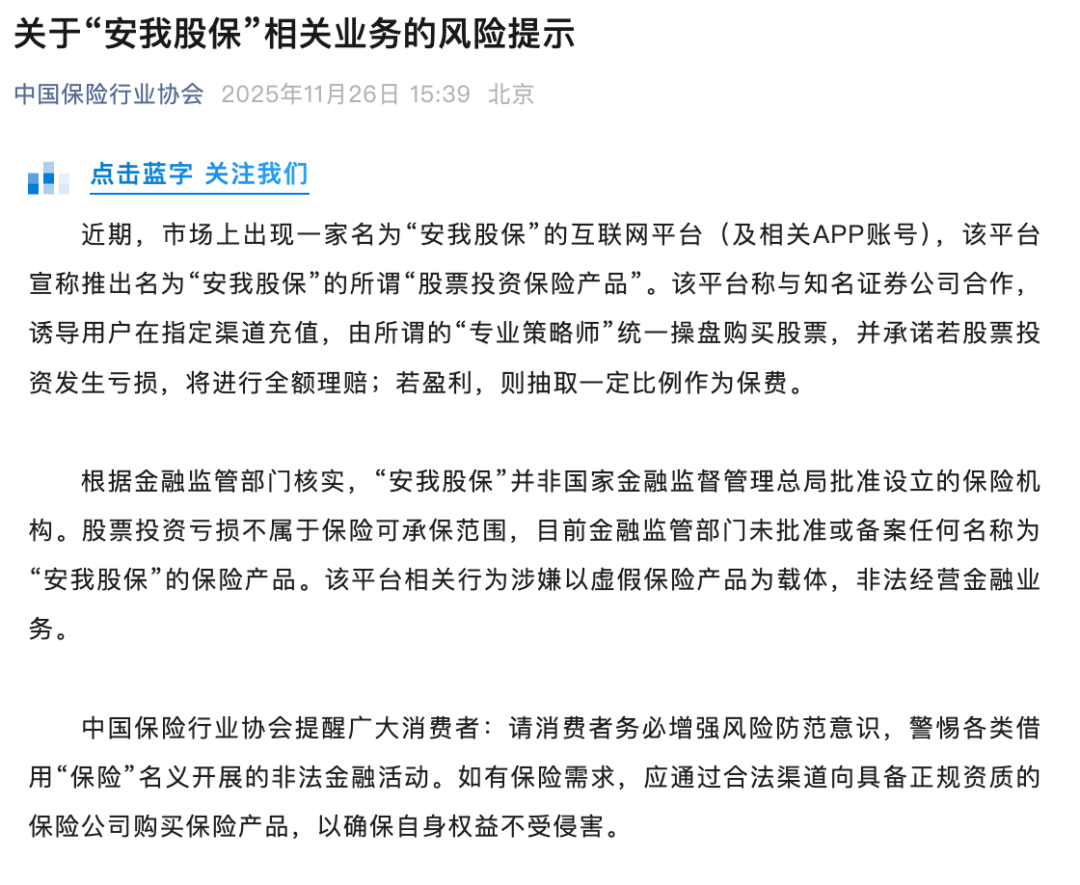
中保协,点名“安我股保”
Jin Rong Shi Bao· 2025-11-26 12:01
Core Viewpoint - The China Insurance Industry Association has issued a risk warning regarding the "Anwo Stock Insurance" platform, which claims to offer a stock investment insurance product that is not approved by regulatory authorities [3] Group 1: Product Claims - The "Anwo Stock Insurance" platform claims to collaborate with well-known securities firms and encourages users to deposit funds through specified channels [3] - The platform promises full compensation for any investment losses and takes a percentage of profits as a fee if investments are successful [3] Group 2: Regulatory Status - The platform is not recognized as an insurance institution approved by the National Financial Regulatory Authority [3] - Investment losses from stock trading are not covered under insurance, and no products named "Anwo Stock Insurance" have been approved or registered by financial regulatory authorities [3] Group 3: Legal Implications - The activities of the "Anwo Stock Insurance" platform are suspected of using fraudulent insurance products to illegally conduct financial business [3]

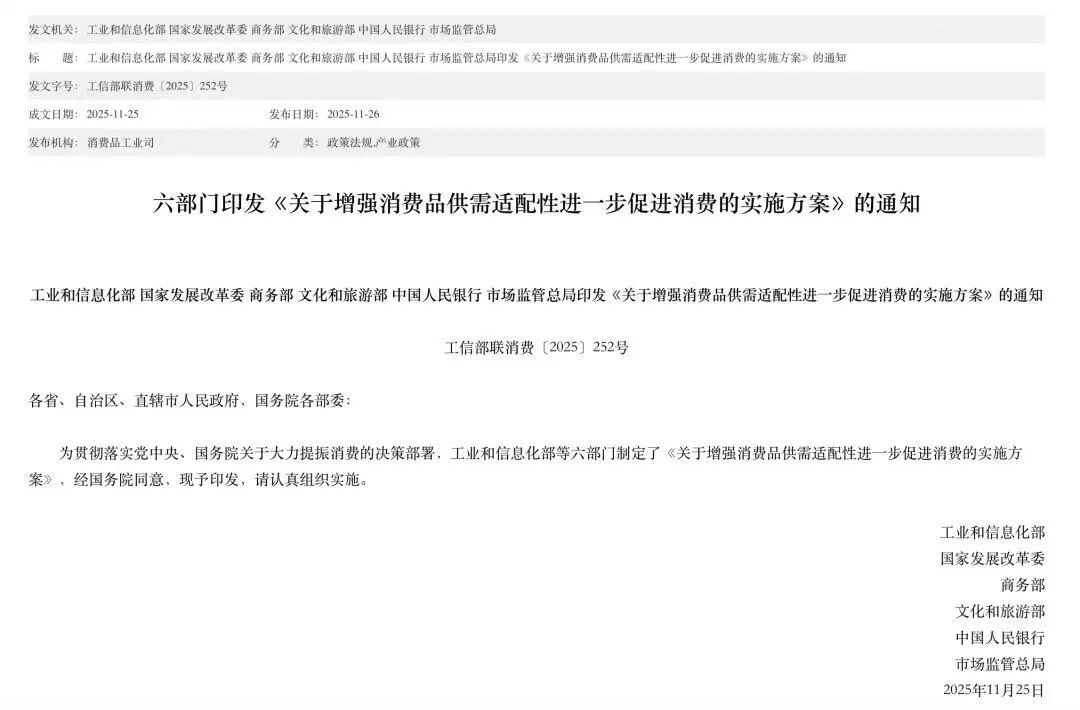
重大利好来了!国务院同意→
Jin Rong Shi Bao· 2025-11-26 11:20
Core Viewpoint - The implementation plan aims to enhance the adaptability of consumer goods supply and demand, leading to consumption upgrades that drive industrial upgrades, thereby achieving a dynamic balance between supply and demand at a higher level [1][4]. Policy Framework - The plan is jointly issued by multiple government bodies, including the Ministry of Industry and Information Technology, the National Development and Reform Commission, and others, marking it as a significant policy document following the Fourth Plenary Session of the 20th Party Congress [1][2]. Goals and Targets - By 2027, the supply structure of consumer goods is expected to be significantly optimized, forming three trillion-level consumption sectors and ten hundred-billion-level consumption hotspots [4]. - By 2030, a high-quality development pattern characterized by positive interaction between supply and consumption is anticipated, with a steady increase in the contribution of consumption to economic growth [4]. Industry Focus Areas - The plan emphasizes the development of new fields and tracks, focusing on key industries such as smart connected vehicles, smart home products, consumer electronics, modern textiles, food, and green building materials [5]. - It encourages the integration of artificial intelligence across the entire consumer goods industry, promoting the development of AI-enabled products like household service robots and smart appliances [5]. Sports and Health Products - The plan aims to enhance the supply of leisure and sports products, targeting new demands from the sports economy, outdoor economy, and ice and snow economy [6]. - It supports the innovation and development of health products, including special dietary foods and high-end medical devices, while promoting the consumption of organic and geographical indication agricultural products [6]. Diverse Consumer Interests - The plan seeks to expand the supply of interest-based consumer products, including pet-related items, anime, and trendy products, while also promoting low-altitude tourism and private flying [7]. - It encourages the development of local intellectual property and innovative design in cultural products, as well as the transformation of traditional retail spaces to include trendy stores [7]. Customization and Experience - The plan emphasizes the need for precise matching of consumer needs, particularly in the baby and children's product sector, and encourages the development of high-end fashion brands and personalized services [8]. - It promotes the creation of immersive consumer experiences through the use of digital technologies, including virtual reality and the metaverse [10]. Financial Support and Services - The plan highlights the importance of financial support for the consumer goods industry, including policies for equipment upgrades and trade-in programs, as well as enhancing the adaptability and convenience of consumer financial services [11].
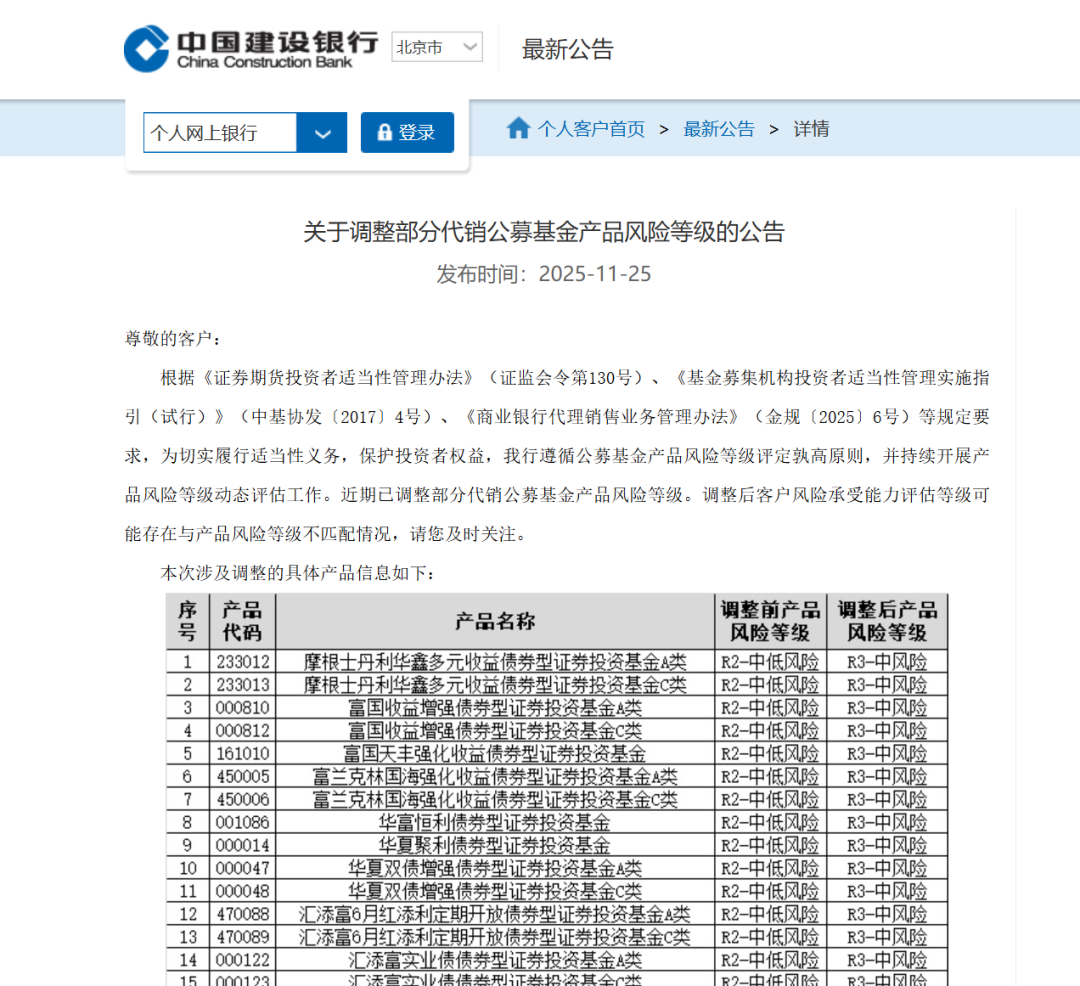
建行、邮储等多家银行宣布:上调!
Jin Rong Shi Bao· 2025-11-26 07:33
Core Viewpoint - Several major state-owned and joint-stock banks have recently announced adjustments to the risk levels of certain publicly offered fund products they distribute, indicating a trend towards increased risk assessment in the banking sector [1][5]. Group 1: Adjustments by Banks - China Construction Bank (CCB) announced on November 25 that it has adjusted the risk levels of some publicly offered fund products to fulfill its suitability obligations and protect investor rights [1][5]. - The adjustments include a total of 87 products, with 32 products' risk levels raised from "R2 - Medium-Low Risk" to "R3 - Medium Risk," and 55 products raised from "R3 - Medium Risk" to "R4 - Medium-High Risk" [3][4]. Group 2: Regulatory Compliance - The adjustments made by CCB are based on regulatory requirements, including the "Securities and Futures Investor Suitability Management Measures" and other relevant guidelines [4][6]. - Other banks, such as Postal Savings Bank, Citic Bank, and Minsheng Bank, have also made similar adjustments to their fund risk ratings, indicating a broader industry trend [5][6]. Group 3: Market Considerations - The adjustments are driven by both regulatory compliance and current market volatility, with banks needing to accurately reflect product risks due to increased fluctuations in underlying assets [7]. - The trend of raising risk ratings is seen as a proactive measure by banks to enhance investor suitability management and does not necessarily indicate a universal increase in market risk for publicly offered funds [7].



美联储12月降息预期升至80%,什么原因?
Jin Rong Shi Bao· 2025-11-26 07:00
消费者信心与零售数据是利率定价的重要指标之一,疲软的调查数据将令美联储内部决策的分歧加大。 数据公布后,美国国债收益率曲线小幅走高,回吐了此前两年期国债收益率的飙升。美元指数由99.93 反弹5个点,而现货黄金由4135美元快速上涨12美元,至4147美元/盎司。这一市场反应显示投资者降息 预期再度回升,并重新评估美联储的货币政策前景。"CME美联储观察工具"显示,美联储12月会议降 息25个基点的概率约为80%,而数日前仅为30%。 11月26日,美国商务部公布因政府关门推迟的9月零售数据。整体而言,美国9月零售销售额小幅上升, 这表明在此前数月强劲消费者支出步伐之后,一些中低收入消费者在通胀与就业难度增大的重压之下按 下了暂停键。 在未经过通胀调整的基础上,9月份零售销售额增长0.2%,低于8月份0.6%的增幅。不含汽车和汽油, 零售销售额仅增长0.1%。13个类别中有8个录得增长,主要受加油站、个护商店和其他杂项零售商的销 售拉动。机动车销售出现四个月来首次下降。电子产品、服装和体育用品方面的零售销售也出现下滑。 消费者支出在本来表现偏向稳健的第三季度末失去了一些动能,尽管整体支出受益于股市强劲的高收入 ...