Qian Zhan Wang

Search documents
2025年中国物联网芯片上游产业分析:半导体材料和设备市场均增长
Qian Zhan Wang· 2025-07-02 07:32
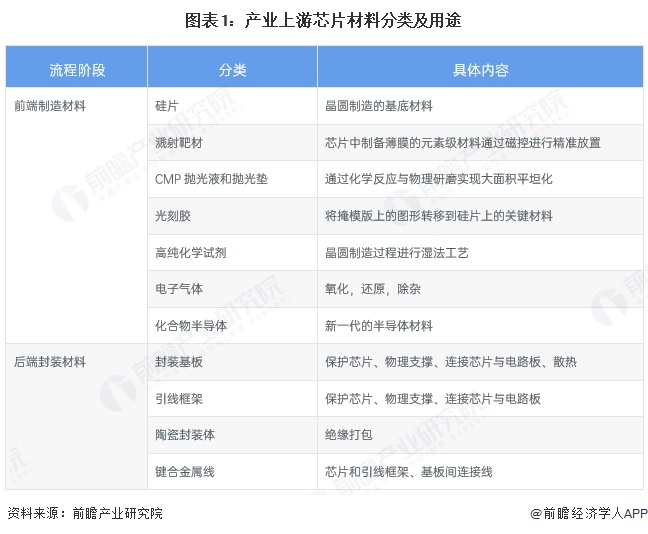
Group 1 - The core viewpoint of the article highlights the continuous growth of China's semiconductor materials market, with Taiwan being the largest consumer market globally [2] - The semiconductor materials are categorized into front-end manufacturing materials and back-end packaging materials, with specific components listed for each category [1] - The market size for semiconductor silicon wafers in China is projected to exceed $2 billion in 2024, reflecting significant growth driven by policy support and technological advancements [3] Group 2 - China's semiconductor equipment market has become the largest globally, with a market size of $366 billion in 2023, showing a 29% year-on-year increase [6] - The demand for thin film deposition equipment in China has been steadily increasing, with the market size growing from 16.8 billion yuan in 2018 to 60 billion yuan in 2023, indicating a compound annual growth rate of 28.99% [8] - The semiconductor materials market in mainland China reached $131 billion in 2023, with projections of $142 billion for 2024 [2]


【球阀】行业市场规模:2024年中国球阀行业市场规模约290亿元
Qian Zhan Wang· 2025-07-02 07:19
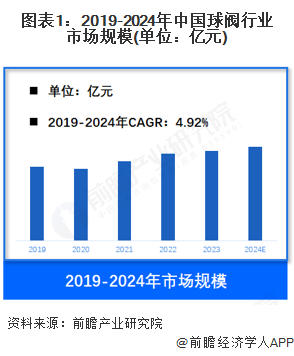
Industry Overview - The Chinese ball valve industry is projected to reach a market size of approximately 29 billion yuan in 2024, with a compound annual growth rate (CAGR) of 4.92% over the past five years [1]. - The ball valve has been developed in China for over 70 years, with significant advancements in long-distance pipeline ball valves and metal-sealed ball valves since the 21st century [1]. Market Trends - The number of bidding projects in the ball valve industry has shown an upward trend, increasing from around 3,000 projects in 2021 to over 8,000 projects expected in 2024 [4]. Competitive Landscape - Key players in the domestic ball valve manufacturing industry include Neway Valve (纽威股份), Fangzheng Valve (方正阀门), Jiangsu Shentong (江苏神通), Yongsheng Technology (永盛科技), Jintai Meilin (金泰美林), and Zhongde Technology (中德科技) [7]. - Neway Valve is noted for having the most comprehensive product offerings and the largest revenue scale, positioning it in the leading tier of the domestic ball valve market [7]. Product Offerings - Neway Valve specializes in floating ball valves, fixed ball valves, and double ball valves [8]. - Jiangsu Shentong offers hard-sealed ball valves, ceramic ball valves, high-temperature and high-pressure ball valves, and various nuclear-grade ball valves [8]. - Zhongde Technology provides a range of ball valves including floating hard-sealed, fixed soft-sealed, and LNG ultra-low temperature ball valves [8]. - Fangzheng Valve focuses on side-mounted, top-mounted, and fully welded ball valves, among others [8]. - Zhejiang Lino offers various types of ball valves including flange V-type ball valves and floating ball valves [8].


预见2025:《2025年中国医美注射材料行业全景图谱》(附市场现状、竞争格局和发展趋势等)
Qian Zhan Wang· 2025-07-02 03:44
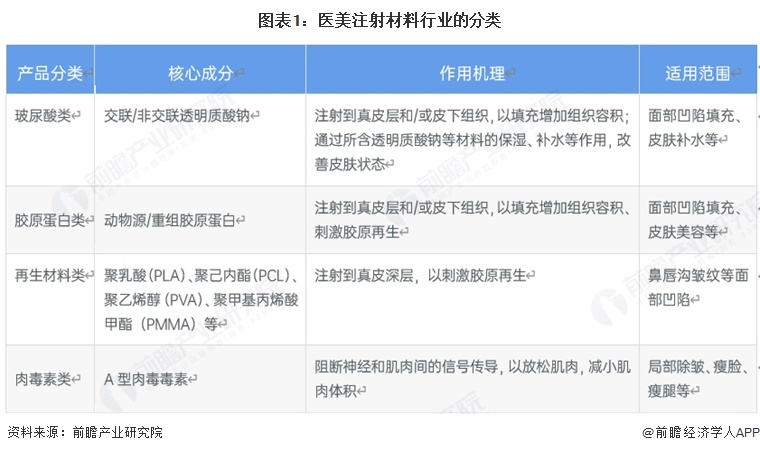
Industry Overview - The medical beauty injection products mainly include hyaluronic acid, collagen, regenerative materials, and botulinum toxin, with hyaluronic acid and collagen being classified as medical devices, while botulinum toxin is categorized as a toxic medical drug [1][2][5] Industry Chain Analysis - The upstream of the medical beauty injection materials includes raw materials and equipment manufacturing, while the midstream focuses on product research and manufacturing, and the downstream consists of sales channels such as public hospitals and private chains [2][5] Industry Development History - The Chinese medical beauty injection materials market has evolved from reliance on imports to self-innovation, with significant milestones including the approval of the first domestic hyaluronic acid filler in 2009 and the emergence of domestic leaders like Huaxi Biological, Aimeike, and Haohai Biological by 2015 [6][8] Industry Policy Background - Regulatory measures have been strengthened since 2019, with guidelines issued for the clinical trial of hyaluronic acid products and stricter management of medical beauty injection materials to enhance product quality and safety [9][11][12] Current Industry Status - The market size of China's medical beauty injection materials is projected to reach approximately 34.6 billion yuan in 2024, reflecting a year-on-year growth of 28.6% and a CAGR of 31.3% from 2021 to 2024 [14][16] Market Structure - Hyaluronic acid and botulinum toxin dominate the market, with hyaluronic acid accounting for about 36% and botulinum toxin for about 29% of the total market share [17][19] Competitive Landscape - Major competitors in the hyaluronic acid market include Huaxi Biological, Aimeike, and Haohai Biological, while the botulinum toxin market is primarily represented by Lanzhou Biological, which is currently the only domestic company with approved products [23][25] Future Industry Outlook - The medical beauty injection materials market is expected to reach 93.7 billion yuan by 2030, driven by technological advancements, compliance, and the rise of male consumers [28][30] Industry Development Trends - Key trends include the long-lasting and precise application of materials, the rise of intelligent and customized solutions, and increased regulatory scrutiny leading to higher approval thresholds for injection materials [32]


2025年中国靶材价值链分析:原材料是靶材生产成本的主要来源
Qian Zhan Wang· 2025-07-01 08:13
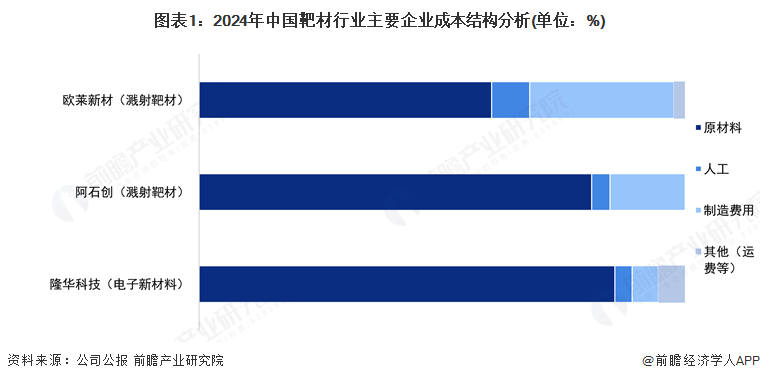
Group 1 - The core point of the article highlights the significant cost structure of the target material industry, with raw materials, particularly lead, being the largest cost component [1][2] - In 2024, the raw material cost proportion for companies like Aishi Chuang and Longhua Technology exceeds 80%, while Oulai New Materials stands at 60.17% [1] - Labor costs are relatively low, ranging from 3.5% to 8%, while manufacturing expenses fluctuate between 5% and 30% [1] Group 2 - The pricing of target materials in China is influenced by supply-side factors, manufacturing costs, value-added premiums, and consumer demand elasticity [6] - The cost structure of Aishi Chuang's target materials shows that direct materials account for around 85% from 2019 to 2024, indicating a significant impact from raw material price fluctuations [2] - Manufacturing costs have been rising, with a proportion between 9% and 16%, while direct labor costs remain below 5% [2] Group 3 - The value chain of the target material industry in China exhibits a "high middle, low ends" trend [8] - The upstream of the target material industry consists of raw material and production equipment suppliers, while the midstream includes metal, ceramic, and alloy target materials [9] - The downstream applications are primarily in emerging fields such as semiconductors, flat panel displays, and photovoltaics [9] Group 4 - The gross profit margin levels in the upstream raw materials show differentiation, with high-purity metals and ceramic materials reaching up to 85%, while the gross margin for downstream applications is projected to decline to below 15% in 2024 [11] - Midstream target material manufacturing companies can achieve gross margins between 15% and 35%, with industry leaders like Jiangfeng Electronics and Longhua Technology maintaining margins above 20% in their target material businesses [11]


猛砸1000亿,再造一个三峡!
Qian Zhan Wang· 2025-07-01 02:02
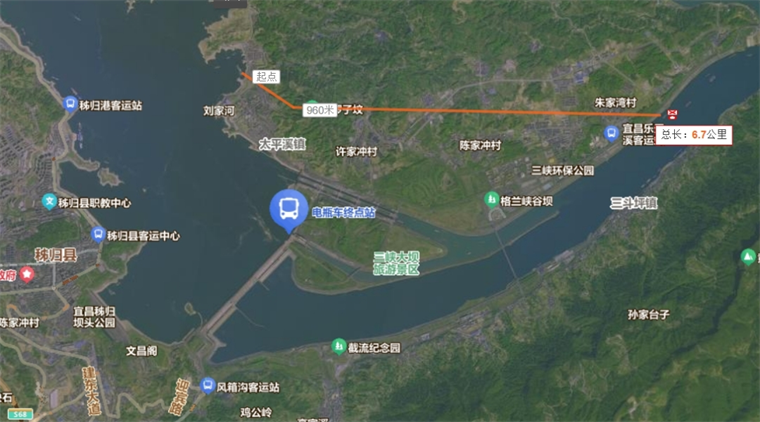
Core Viewpoint - The construction of the new Three Gorges Waterway project is a significant strategic initiative aimed at enhancing the shipping capacity and efficiency along the Yangtze River, addressing the urgent demand for increased cargo transport due to rapid economic growth in the upstream regions [3][16]. Group 1: Project Overview - The National Development and Reform Commission has approved the feasibility study for the Three Gorges Waterway New Channel project, which integrates water conservancy, shipping, and ecological functions [3]. - The project includes the construction of a new waterway and the expansion of the Gezhouba shipping capacity, with a total static investment of approximately 76.6 billion yuan and a construction period of 100 months [7]. - The new channel aims to double the throughput capacity from the existing 100 million tons to nearly 180 million tons, addressing the bottleneck caused by the current Three Gorges lock system [7][8]. Group 2: Economic Impact - The Three Gorges Waterway New Channel is expected to significantly boost the economic development of the Yangtze River Economic Belt, facilitating smoother material flow and industrial collaboration between regions [16]. - The project will particularly benefit the Chengdu-Chongqing economic circle, where over 90% of foreign trade goods rely on inland shipping, enhancing the shipping capacity of Chongqing port and reducing logistics costs [17]. - The automotive industry in Chongqing, which produced 2.54 million vehicles in 2023, will particularly benefit from improved shipping routes, allowing for faster and more cost-effective transportation of goods [18]. Group 3: Historical Context and Delays - Discussions about the need for a second lock at the Three Gorges began around 2016, but progress was delayed due to local economic interests and the development of the "bypass logistics" industry [13][14]. - The existing Three Gorges lock has been overwhelmed by cargo demand, with throughput exceeding 150 million tons annually since 2022, leading to significant delays and increased operational costs for shipping companies [9][10]. - The rapid economic growth in the upstream regions, particularly in the Chengdu-Chongqing area, has outpaced initial projections, necessitating the urgent development of the new waterway [8][12]. Group 4: Future Prospects - The new waterway is anticipated to serve as a "shot in the arm" for the Yangtze River Economic Belt, enhancing regional collaboration and economic integration [16]. - The project aligns with national strategies for infrastructure development and is expected to play a crucial role in the transformation of local industries towards greener and smarter operations [22][28]. - The Three Gorges Waterway New Channel is positioned to become a vital link in the global supply chain, particularly for the automotive sector, facilitating quicker access to international markets [21].
Model Y首次完成全程无人驾驶!小米雷军点赞:特斯拉确实了不起,引领行业趋势【附新能源汽车行业市场分析】
Qian Zhan Wang· 2025-06-30 10:29
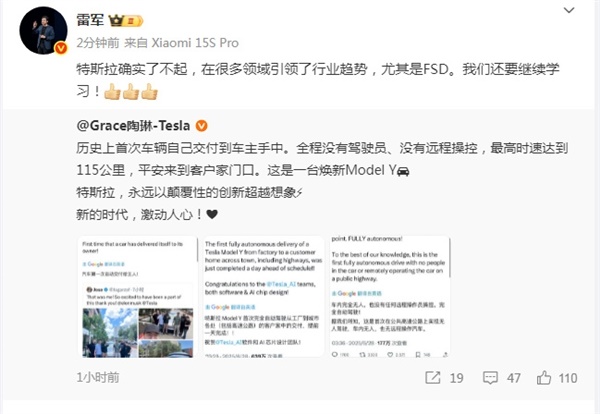
Group 1 - Lei Jun, founder of Xiaomi Auto, publicly praised Tesla's Full Self-Driving (FSD) technology, highlighting Tesla's leadership in the industry and expressing a desire to learn from it [1] - Tesla achieved a historic milestone by delivering a vehicle autonomously without a driver or remote control, reaching a top speed of 115 km/h [1] - Xiaomi Auto's second model, the Xiaomi YU7, received over 200,000 pre-orders within three minutes, showcasing strong market demand [2] Group 2 - In 2023, China's new energy vehicle production reached 9.587 million units, with projections to exceed 12.888 million units in 2024, maintaining the world's leading position for ten consecutive years [5] - Xiaomi's investment strategy has involved investing in nearly 100 companies across the automotive supply chain, focusing on areas such as autonomous driving and smart cockpit technology [7] - The Chinese new energy vehicle market has benefited from a complete industrial chain, supported by major players like CATL and BYD, which dominate global battery installation [2][10] Group 3 - The shift in China's automotive policy focus from quantity to quality has been significant, with a reported 34.7% global market share in early 2025, an increase of 2.7 percentage points from the previous year [10] - The competitive landscape is intensifying as companies like Xiaomi, BYD, and NIO strive to enhance their autonomous driving capabilities to challenge Tesla's dominance [10] - The development of the new energy vehicle industry is expected to drive growth in related sectors, including battery, motor, and electric control manufacturing, as well as charging infrastructure [10]


重磅!2025年中国及31省市包装行业政策汇总及解读(全)“推进包装绿色化,防治过度包装”
Qian Zhan Wang· 2025-06-30 06:31
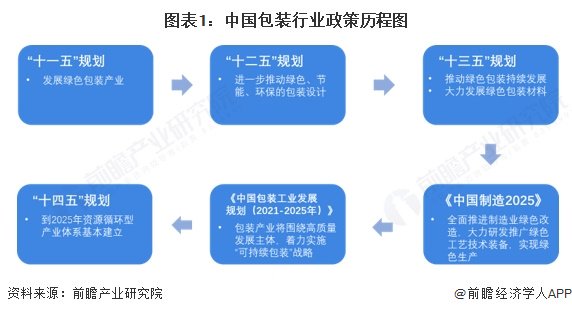
Core Insights - The Chinese packaging industry has a long development history and has formed a mature industrial chain, with a continuous push towards green and sustainable packaging from the "11th Five-Year Plan" to the "14th Five-Year Plan" [1][3] - The government has issued multiple policies to support the packaging industry, emphasizing its importance in the national economy and its role in sustainable development [3][9] Policy Development Timeline - The packaging industry has seen a progressive focus on green packaging from the "11th Five-Year Plan" to the "14th Five-Year Plan," with specific goals set for 2025 to establish a resource-circulating industrial system [1] - Key milestones include the promotion of green packaging materials and the establishment of a comprehensive green packaging standard system by the end of 2025 [9] National Policy Summary and Interpretation - The packaging industry is supported by national policies that encompass design, production, printing, raw material supply, and machinery manufacturing, reflecting its integral role in the economy [3][4] - Recent policies include the "Interim Regulations on Express Delivery" aimed at promoting green, reduced, and recyclable packaging, and the "Action Plan to Reduce Logistics Costs" focusing on green transformation [5][6] Specific Policy Highlights - The "Action Plan for Deepening the Green Transformation of Express Packaging" aims for a comprehensive green packaging standard system by the end of 2025, with specific targets for reducing excessive packaging and increasing the use of recyclable materials [9][10] - The "Notice on Further Strengthening the Governance of Excessive Packaging" emphasizes the need for innovation in packaging design and materials to reduce waste and promote sustainability [11][12] Local Government Policies - Various provinces have introduced policies focusing on green packaging and the reduction of excessive packaging, with specific measures to enhance governance and compliance [13][14] - For example, Zhejiang Province has implemented measures to strengthen the governance of excessive packaging, while Gansu Province has focused on developing packaging design capabilities [14][16] Industry Goals and Future Directions - The "14th Five-Year Plan" outlines key actions for the green transformation of express packaging, with provinces setting specific targets for the adoption of recyclable packaging and the reduction of plastic waste [18][21] - The overall direction is towards a more sustainable packaging industry, with an emphasis on reducing material usage and enhancing recycling capabilities across the supply chain [12][21]


【干货】2025年预制菜产业链全景梳理及区域热力地图
Qian Zhan Wang· 2025-06-30 03:44
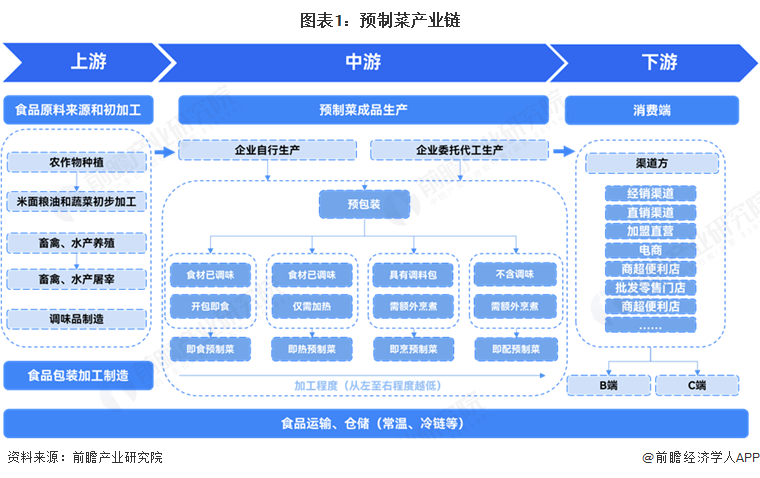
Group 1 - The core viewpoint of the article highlights the structure and distribution of the prepared food industry in China, emphasizing the production methods and key players involved in the supply chain [1][2]. - The prepared food production in China is categorized into two main types: self-produced and self-sold, and commissioned processing [1]. - Key participants in the prepared food supply chain include upstream raw material suppliers, initial processing companies, and downstream consumer outlets such as large retail chains and emerging e-commerce platforms [2][6]. Group 2 - The regional distribution of prepared food companies is primarily concentrated in Shandong, Henan, Jiangsu, and Anhui provinces, with Shandong having the highest number of companies at 2,959, accounting for 21.2% of the national total [6][8]. - The prepared food industry is notably concentrated in the East and Central China regions, benefiting from developed agriculture and advantageous transportation networks [6][8]. - As of April 2025, there are three major prepared food industrial parks in China, with two located in Shandong province, indicating a significant regional focus on this industry [11][13].


预见2025:《2025年中国口腔种植行业全景图谱》(附市场现状和发展趋势等)
Qian Zhan Wang· 2025-06-28 01:08
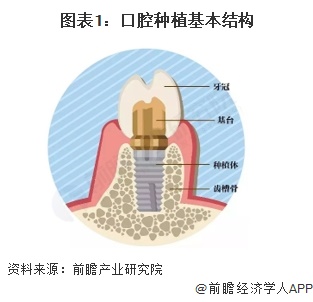
Industry Overview - Dental implant industry involves surgical placement of artificial materials into the jawbone to serve as artificial tooth roots, followed by the installation of crowns [1] - The process includes four main steps: implant placement, waiting for osseointegration, installing abutments, and placing crowns [1] Industry Chain Analysis - The upstream of the dental implant industry includes raw material suppliers, equipment manufacturers, and software developers, with titanium and zirconia being key materials [4][5] - Midstream consists of implant manufacturers and distributors, while downstream includes dental institutions providing implant services to patients [4][5] Industry Development History - The industry has evolved through three main phases: 1. Emergence phase (1980-2000) with initial education and product development [7] 2. Dominance of foreign brands (2000-2010) with a focus on public institutions [10] 3. Rise of domestic brands (2020-present) with a shift towards high-quality local products [10] Industry Policy Direction - Policies focus on reducing medical costs, standardizing management, improving service quality, promoting talent development, and supporting digital technology applications [12] - Key policies include price standardization for dental services and promoting centralized procurement to enhance transparency and reduce costs [12][14] Current Industry Status - Dental implants account for 40% of the total implant costs, with a significant portion of the market still dominated by international brands [15][16] - The number of dental implants in China is projected to exceed 10 million by 2024, driven by increased demand and lower prices due to centralized procurement [18] Market Size and Growth - The dental implant market in China is expected to surpass 60 billion yuan by 2024, with significant price reductions leading to increased accessibility [21] - The average cost of a single implant has dropped to 5,000-7,000 yuan due to policy changes, representing a 50% decrease [21] Competitive Landscape - The market is characterized by a high concentration, with leading companies like Dentium and Osstem dominating the first tier, while others like Straumann and Nobel Biocare are in the second tier [23][26] - The market concentration ratio (CR2) is 45.78%, indicating a competitive environment with a mix of domestic and international brands [26] Future Development Trends - The demand for dental implants is expected to grow due to an aging population and increased awareness of oral health [28] - The implementation of centralized procurement policies will further stimulate market demand and enhance the penetration of domestic brands [28] - Innovations in technology, such as 3D printing and robotic-assisted surgeries, will improve the precision and efficiency of dental implants [28] - By 2030, the market size is projected to reach 277 billion yuan, with an average annual growth rate of 29% [28]


英伟达市值重回全球第一!黄仁勋:未来数十亿机器人与亿辆自动驾驶车将由英伟达技术提供动力【附自动驾驶行业市场分析】
Qian Zhan Wang· 2025-06-27 04:06
(图片来源:摄图网) 6月25日,AI芯片巨头英伟达股价再创历史新高,达到154.31美元,市值跃升至3.76万亿美元,成功重 登全球市值第一的宝座。背后是英伟达在AI领域的持续深耕以及市场对其AI芯片强劲需求的双重推 动。 在英伟达年度股东大会上,首席执行官黄仁勋指出,除了人工智能(AI)这一核心驱动力,机器人技术将 是英伟达最具发展前景的市场,并预测自动驾驶汽车将成为该技术首个主要的商业应用领域。他强 调:"我们公司在各个领域都有很多增长机会,而其中人工智能和机器人技术是最大的两个,代表着数 万亿美元级别的增长机会。" 黄仁勋表示:"我们很久以前就不再把自己仅仅看作一家芯片公司了。我们正在朝着这样一个目标努 力:未来将有数十亿个机器人、数亿辆自动驾驶汽车,以及数十万个机器人工厂,它们都可以由英伟达 的技术提供动力。" 从全球机器人行业的现状来看,2023年全球机器人行业市场规模超660亿美元,五年行业复合增速为 11.27%,呈现出蓬勃发展的态势。 目前,全球机器人行业竞争激烈,涵盖工业机器人、服务机器人、特种机器人等多个领域。其中,服务 机器人市场占比最大,超过50%。 | 图表3: 全球机器人领域领先 ...