Qian Zhan Wang

Search documents
2025年全球铝型材发展现状分析:2024年全球铝型材总产量约为3918万吨
Qian Zhan Wang· 2025-06-08 05:15
Group 1 - The global aluminum profile industry has evolved from initial industrial applications to multiple high-tech and traditional fields [1] - Guinea holds the largest aluminum ore reserves globally, accounting for 25.52% of total reserves [2] - Guinea, Australia, and China each contribute over 20% to global aluminum ore production, with respective shares of 28.99%, 22.22%, and 20.67% [5] Group 2 - The total global aluminum profile production is projected to be approximately 39.18 million tons in 2024, with China accounting for 50%-55% of this total [7] - There is an increasing demand for lightweight aluminum profiles, particularly in the automotive and aerospace sectors, driven by technological innovations and the rapid development of industries such as new energy vehicles and photovoltaics [9]



【投资视角】启示2025:中国航空发动机行业投融资及兼并重组分析(附投融资汇总和兼并重组等)
Qian Zhan Wang· 2025-06-07 03:10
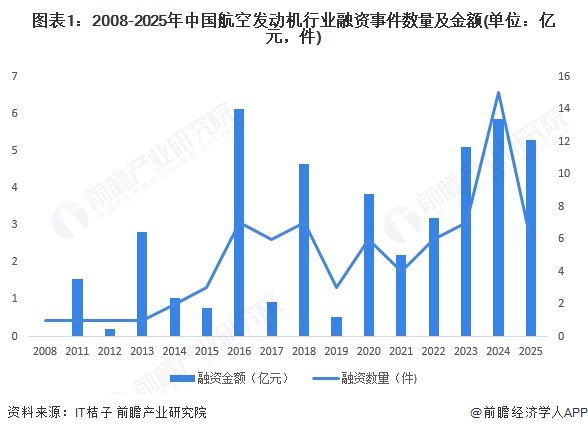
Group 1 - The core viewpoint of the article highlights the significant growth in investment and financing activities within the Chinese aviation engine industry, particularly in 2024, where financing amounts reached 586 million yuan with 15 events, indicating an increasing demand for capital support [1][3][6] - The aviation engine industry is undergoing a transformation phase, with fluctuations in single financing amounts, which generally range from several million to several billion yuan. In 2024, the single financing amount slightly decreased to 40 million yuan but rebounded to 90 million yuan in 2025, reflecting diverse financing needs across different project scales and development stages [3][6] - The financing structure of the aviation engine industry is diverse, with a significant focus on early-stage financing, particularly angel and A-round investments, which accounted for 17 and 21 events respectively. This indicates strong investor interest in startups and confidence in the industry's long-term development [6][12] Group 2 - The majority of financing activities are concentrated in technology research and production, with a notable emphasis on aviation engine components and research. From 2023 to 2025, the main financing events in the industry reflect this trend [7][10] - Mergers and acquisitions in the aviation engine industry primarily focus on horizontal integration, with over 45% of events categorized as such. This strategy aims to enhance market share and competitive advantage through collaboration among similar enterprises [12][16] - Recent investment activities by representative companies in the aviation engine sector indicate a trend towards integrating technology and capital, which can enhance operational efficiency and market competitiveness [16][18]


2025年中国AR眼镜产业供应链十大代表性企业:雷鸟创新、太若科技、灵伴科技、影目科技、歌尔股份……
Qian Zhan Wang· 2025-06-07 03:09
Core Insights - The AR glasses industry is a significant part of China's strategic emerging industries and digital economy, with strong government support for innovation and industrialization in virtual reality and related fields [2][20] - The industry is characterized by a high market concentration, with the top five companies holding a combined market share of 89.9% in 2023, indicating a strong competitive landscape [16] - The AR glasses market in China is experiencing robust growth, with shipments reaching 261,000 units in 2023, and projections for continued expansion in 2024 [2] Industry Overview - The AR glasses industry is divided into three main segments: upstream (core technology R&D and component supply), midstream (device manufacturing and integration), and downstream (application scenarios and ecosystem services) [2] - Key technologies in the upstream segment include interaction technologies such as gesture recognition and voice control, with significant advancements in optical waveguide technology enhancing comfort and display quality [2][20] - The integration of AI technology with AR glasses is providing enhanced smart capabilities, contributing to the rapid growth of the consumer market [2] Market Data - According to IDC, the shipment volume of AR glasses in China reached 261,000 units in 2023, with split AR glasses accounting for 230,000 units and all-in-one AR glasses for 31,000 units [2] - The market is projected to continue growing, with expectations for increased shipments in 2024 [2] Key Players - The top ten representative companies in the AR glasses industry include: 1. Thunderbird Innovation - Focused on consumer-grade AR ecosystems with products like the Thunderbird Air series [4] 2. Tai Ruo Technology - Known for its Nreal Light and other MR devices [4] 3. Lingban Technology - Offers lightweight AR glasses with advanced AI features [4] 4. Yingmu Technology - Specializes in AI smart glasses and wireless AR solutions [4] 5. Liangfengtai - Develops AR terminals and cloud solutions for industrial applications [4] 6. GoerTek - A leading manufacturer in the AR glasses OEM sector, holding significant market share [4] 7. Luxshare Precision - Known for its innovative AR glasses using PVG optical waveguide technology [4] 8. Xingji Meizu - Focuses on AI-enabled AR glasses with a strong market presence [4] 9. Li Weike - Targets the youth market with trendy AR products [4] 10. Huawei - Recently entered the AR glasses market with its Vision Glass product line [4] Consumer Insights - The primary use case for AR glasses among consumers is for viewing content, which accounts for 59% of usage scenarios, highlighting the importance of entertainment features in product development [18] - Companies are encouraged to focus on enhancing user experience in entertainment, gaming, and commuting to meet evolving consumer demands [18]



预见2025:《2025年中国运动服行业全景图谱》(附市场现状和发展趋势等)
Qian Zhan Wang· 2025-06-07 01:09
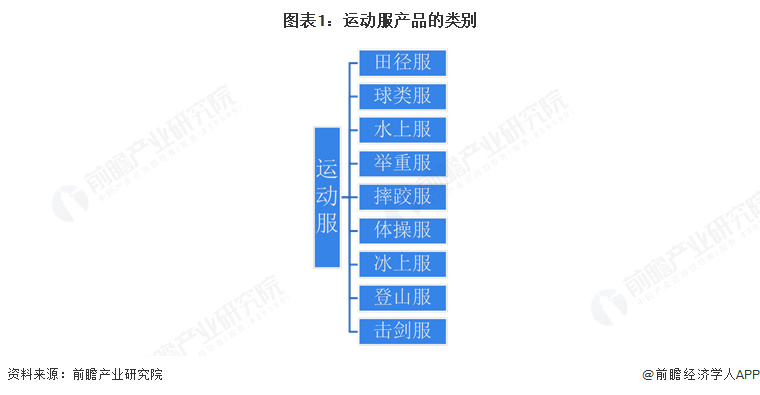
Industry Overview - The sportswear industry in China is defined as clothing specifically designed for sports competitions, including categories such as athletics, ball sports, water sports, and more [1] - The industry has seen a shift towards sports leisure clothing, which is now commonly worn in daily life [1] Industry Chain Analysis - The upstream of the sportswear industry includes textile raw material suppliers, while the midstream consists of production manufacturers, and the downstream focuses on sales through e-commerce and physical stores [2][3] - Major textile raw material companies include Jiangsu Lianfa Textile Co., Ltd. and Fujian Baihong Polyfiber Technology Co., Ltd. [5] Industry Development History - The Chinese sportswear industry has evolved from simple designs to incorporating high-tech materials and intelligent features, reflecting a shift from "Made in China" to "Created in China" [6] - Recent trends include a focus on environmental sustainability and the integration of traditional elements with modern design [6] Industry Policy Direction - Recent government policies aim to promote outdoor sports and enhance sports consumption, supporting the digital transformation of traditional textile manufacturing [10][12] Current Industry Status - The market size of China's sportswear industry has shown fluctuations, with a peak of 3199.3 billion yuan in 2019, followed by a decline in 2020 due to the pandemic, and a recovery expected to reach 4089.1 billion yuan by 2024 [13][14] - The product composition is changing, with children's sportswear market share increasing from 9.8% in 2019 to 12.2% in 2024 [14] Sales Channel Analysis - Online retail has significantly increased its share from 22.4% in 2019 to 36.6% in 2024, while traditional department stores have seen a decline [17] Competitive Landscape - The majority of sportswear manufacturing companies are concentrated in Liaoning, Guangdong, and Fujian provinces, with Fujian having the most listed companies [20] - Domestic brands like Anta and Li Ning are gradually increasing their market share, with Anta's share rising from 15.3% in 2019 to 23.0% in 2024 [21] Future Industry Trends - The sportswear market is expected to grow further due to the rising health consciousness and upgraded sports consumption, with digital technology enhancing production efficiency [25]
坚持自主研发生产!董明珠:格力任何产品没代工,贴牌压价最后一定会偷工减料【附白色家电行业市场分析】
Qian Zhan Wang· 2025-06-06 10:21
Group 1 - Gree Electric Appliances emphasizes that all its products are independently developed and manufactured without outsourcing or OEM production, ensuring high quality and consumer trust [2] - The company has received numerous awards for its technological capabilities, including 99 significant awards and over 96,626 patent applications, making it a leader in the home appliance industry [3] - Gree's R&D investment has remained high, with amounts of 6.529 billion yuan in 2021, 6.430 billion yuan in 2022, 7.006 billion yuan in 2023, and projected to reach 7.140 billion yuan in 2024 [3] Group 2 - In terms of smart home appliance patent applications, Gree's total in 2021 was approximately 1.45 times that of Haier, with 717 and 496 applications respectively [5] - The home appliance industry is experiencing price fluctuations, with online prices for major white goods declining due to weak downstream consumption, while offline prices have increased significantly [6] - Experts note that while significant advancements have been made in smart appliance technology, challenges remain in the white goods sector, particularly in sensor technology [9]

2025年中国预制菜价值链分析:原材料是预制菜生产最大的成本来源,国内预制菜行业毛利率波动下滑
Qian Zhan Wang· 2025-06-06 08:11
Core Insights - The pre-prepared food industry in China is characterized by a significant cost structure, with raw materials being the largest component, accounting for over 75% of total costs [2][4] - The industry's pricing mechanism is influenced by supply-side costs, manufacturing value addition, distribution channel premiums, and consumer demand elasticity [4] - The value chain of the pre-prepared food industry shows a trend of "midstream collapse," with varying gross profit margins across different segments [5][9] Cost Structure - Raw materials, labor, and manufacturing costs are the primary components of pre-prepared food product costs, with raw materials including poultry, eggs, grains, vegetables, and seasonings [2] - Among competitive companies, raw material costs can be as high as 94.8% for specific products, while labor costs range from 3.5% to 10% [2] Pricing Mechanism - The pricing of pre-prepared food products is determined by a combination of supply-side costs, manufacturing costs, and distribution channel premiums, along with consumer demand elasticity [4] Value Chain Analysis - The gross profit margins across the pre-prepared food industry show that upstream raw material segments have low margins (below 10%), while packaging and retail segments have higher margins (20%-30%) [5][8] - The midstream segment, represented by specialized pre-prepared food manufacturers, has gross profit margins ranging from 10% to 25% [5] Industry Trends - The overall gross profit margin for pre-prepared food companies in China has been declining, from 20.07% in 2018 to 13.79% in 2024, driven by increased competition and the growing number of industry players [9]
【行业深度】洞察2025:中国润滑油行业竞争格局(附竞争梯队、市场份额等)
Qian Zhan Wang· 2025-06-06 03:11
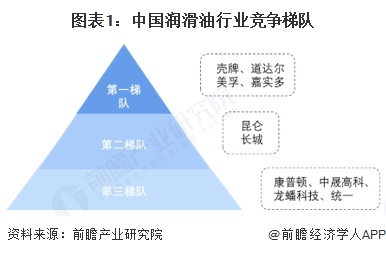
Group 1: Industry Overview - The Chinese lubricating oil industry is divided into three competitive tiers: the first tier includes international leaders like Shell and Mobil, the second tier consists of domestic giants China National Petroleum Corporation (CNPC) and China Petroleum & Chemical Corporation (Sinopec), and the third tier includes companies like Compton and Longpan Technology [1][3]. - The market is characterized by a "tripod" competition structure, with international brands holding nearly 25% market share, while CNPC and Sinopec's brands occupy close to 50% of the market [3][8]. - The industry shows a high concentration level, with a significant portion of the market dominated by a few key players [3][8]. Group 2: Brand Development - Domestic brands are enhancing their market presence through superior R&D capabilities and innovative marketing strategies, aiming to reshape consumer perceptions of traditional lubricating oil brands [4]. - The LubTop2023 awards recognized the top ten lubricating oil brands, which include Mobil, Shell, Castrol, and others, highlighting the competitive landscape and brand recognition in the industry [4][6]. Group 3: Company Performance - CNPC's Kunlun lubricating oil and Sinopec's Changcheng lubricating oil are the leading domestic brands, with CNPC's lubricating oil-related revenue reaching 3.5 trillion yuan and Sinopec's at 1.48 trillion yuan [7]. - Longpan Technology reported lubricating oil revenue of 5.32 billion yuan, while Compton's revenue was 7.55 billion yuan, indicating a diverse product range across these companies [7]. - The product offerings from CNPC and Sinopec cover a wide range of lubricating oils, including automotive, industrial, and marine lubricants, contributing to their extensive market reach [6][7]. Group 4: Competitive Dynamics - The competitive landscape is stable, with a high market concentration and strong brand loyalty among consumers, which limits the threat of new entrants [8]. - The bargaining power of downstream customers is relatively weak due to high demand for lubricating oils, while upstream suppliers face challenges from fluctuating crude oil prices [8].




【全网最全】2025年短视频行业上市公司全方位对比(附业务布局汇总、业绩对比、业务规划等)
Qian Zhan Wang· 2025-06-06 01:58
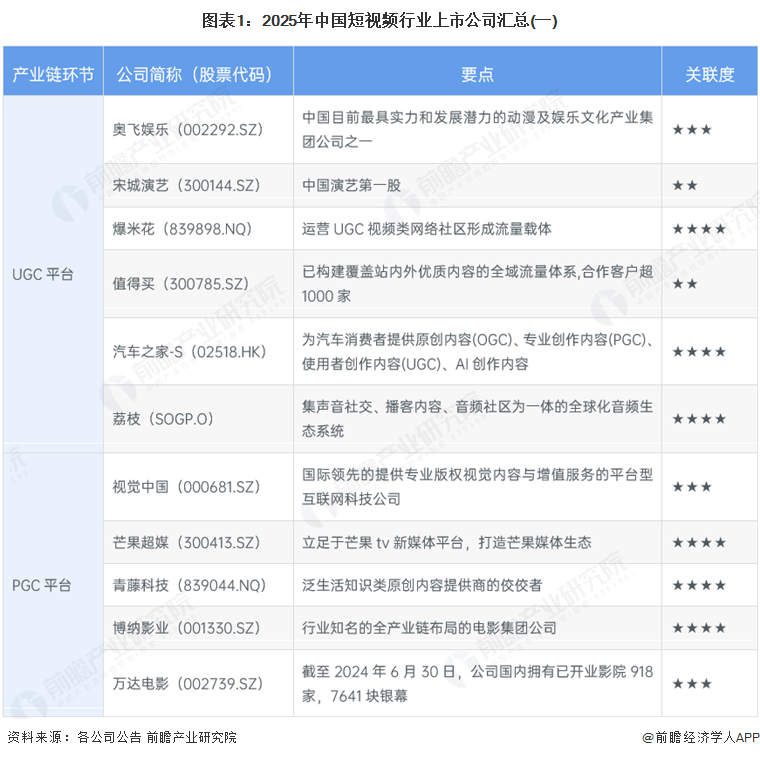
Group 1 - The core viewpoint of the article highlights the competitive landscape and performance comparison of listed companies in China's short video industry, emphasizing the growth potential and diverse business models within the sector [1][12][15] - The article identifies key players in the short video industry, including Kuaishou, Tencent, Baidu, Bilibili, and Pinduoduo, and categorizes them into different segments such as UGC platforms, PGC platforms, MCN institutions, and content distribution platforms [2][4][6] Group 2 - Kuaishou is positioned as a leading player with a broad product matrix, including various short video applications and tools, while Tencent and Baidu also maintain strong competitive positions with their respective platforms [12][13][14] - The revenue performance of major companies is discussed, with Kuaishou's online marketing service revenue reaching 72.42 billion yuan in 2024, reflecting a year-on-year growth of 20.09%, while Baidu's iQIYI reported a revenue of 29.225 billion yuan, down 8.31% year-on-year [15][16] - The article outlines the strategic business plans of leading companies, indicating a trend towards diversification and technological innovation to enhance user experience and competitive edge in the short video market [20][21]




雷军:我们就对标特斯拉和保时捷,高标准才能为大家造出一辆好车,只要敢比就是走在赢的路上【附新能源汽车行业市场分析】
Qian Zhan Wang· 2025-06-05 08:59
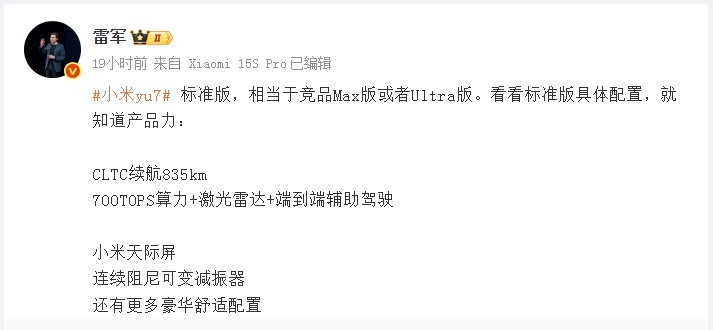
6月3日,小米集团董事长雷军微博发文称,小米YU7的标准版,相当于竞品Max版或者Ultra版,并详细 列举了标准版的具体配置。他表示,"看看标准版具体配置,就知道产品力,CLTC续航835km, 700TOPS算力+激光雷达+端到端辅助驾驶,小米天际屏。连续阻尼可变减振器,还有更多豪华舒适配 置 。" 不久后,雷军再次发文强调,小米YU7并非普通的、平庸的SUV,而是一款高性能豪华SUV,既有很好 的驾驶体验,又有豪华舒适配置,还兼顾空间和日常使用场景。 (图片来源:雷军微博) 在政策推动下,我国新能源汽车产业近年来保持快速增长态势。2022年销量爆发式增长至688.7万辆, 同比增长93.4%;2012-2023年,销量从1.28万辆跨越到949.5万辆;2024年1-11月累计产量1126.2万辆,同比 增长35.6%,消费者对新能源汽车的需求逐年攀升。 尽管汽车行业竞争激烈,但新能源汽车市场仍处于快速增长期。中国作为全球最大的新能源汽车市场, 政策支持和产业链成熟度为新入局者提供了机遇。 2024年3月28日,小米在汽车发布会上正式公布了其首款量产智能电动汽车——小米SU7,这也标志着 小米集团正式由 ...
2025年中国稀土行业市场主体分析:民营企业是行业发展最鲜活的血液
Qian Zhan Wang· 2025-06-05 06:12
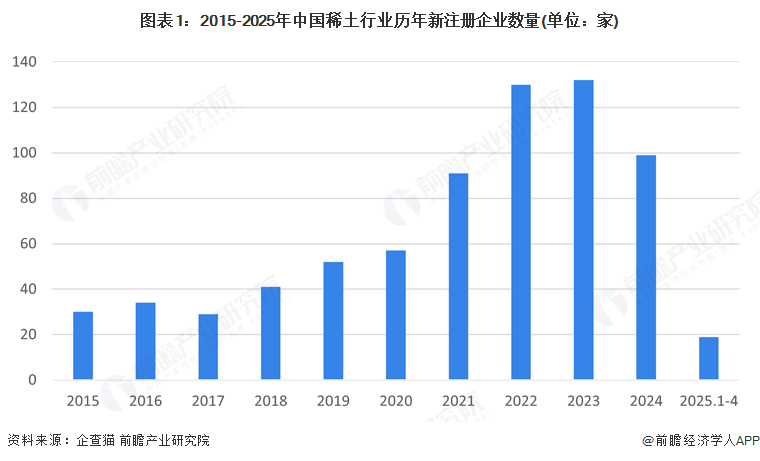
Group 1: Industry Overview - The number of newly registered companies in China's rare earth industry has shown a fluctuating growth trend from 2015 to 2023, with a significant decline in 2024, registering only 99 new companies compared to the previous year [1] - As of April 17, 2025, the number of newly added companies in the rare earth sector is 19 [2] Group 2: Company Characteristics - As of April 17, 2025, 50.33% of registered rare earth companies in China are operational, while 26.79% have been deregistered, indicating a generally stable operational status [2] - The majority of registered capital in the rare earth industry is concentrated in companies with capital under 1 million, accounting for 40% of the total, while 35% of companies have registered capital exceeding 5 million [6] Group 3: Regional Distribution - The majority of operational rare earth companies are located in Jiangxi, Zhejiang, Inner Mongolia, and Shaanxi, with Jiangxi having the highest number at 197 companies, representing 16.4% of the national total in the rare earth mining sector [9] - Zhejiang ranks second with 105 companies, where 94% are involved in rare earth metal processing [9] Group 4: Company Type Distribution - As of April 17, 2025, 90.32% of operational rare earth companies in China are privately owned, while state-owned enterprises account for 7.91%, highlighting the dominance of private enterprises in the industry [12]