Qian Zhan Wang

Search documents
2025年中国短视频助力“三农”分析:通过促进农村电商发展、带动旅游经济,推动乡村产业振兴
Qian Zhan Wang· 2025-06-10 08:22
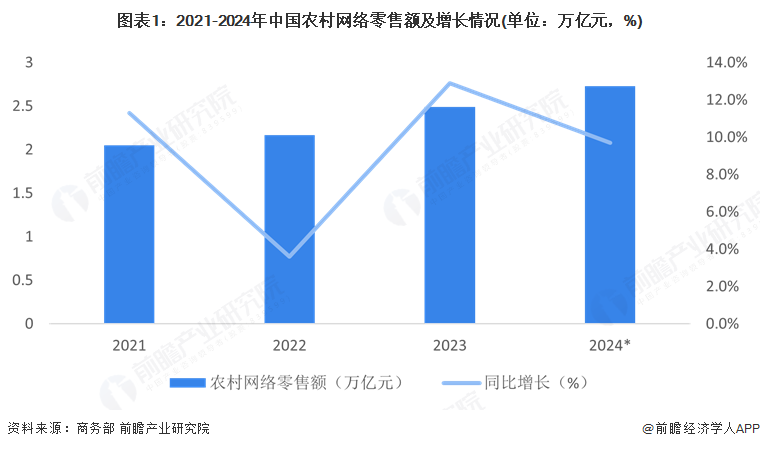
Core Insights - The core viewpoint of the article highlights the significant growth of rural e-commerce in China, driven by the increasing penetration of short video platforms, which are becoming essential tools for promoting agricultural products and enhancing rural economic development [1][4]. Group 1: Rural E-commerce Growth - In 2023, China's rural online retail sales reached 2.49 trillion yuan, marking a year-on-year increase of 12.9%. Projections suggest that this figure will rise to 2.73 trillion yuan in 2024 [1][2]. - By the end of 2024, the number of rural audio-visual users is expected to reach 30.304 million, with a usage rate of 96.6%, indicating widespread adoption of short video platforms among farmers [2]. Group 2: Role of Short Video Platforms - Short video platforms are playing a crucial role in rural e-commerce development by facilitating the sale of agricultural products through live streaming and innovative marketing strategies [4][8]. - The number of creators in the "agriculture and rural areas" category on short video platforms has increased, with a 19.8% year-on-year growth in the number of creators with over 10,000 followers, reflecting the expanding monetization opportunities for content creators [6]. Group 3: Impact on Agricultural Sales - The volume of agricultural group buying orders surged by 125% year-on-year, while the number of agricultural merchants grew by 32%, demonstrating the effectiveness of short video platforms in expanding sales channels for agricultural products [8]. - The number of e-commerce orders from "agriculture and rural areas" creators increased by 10.2%, with Gross Merchandise Volume (GMV) rising by 19.4%, further confirming the platforms' positive impact on rural e-commerce [8]. Group 4: Cultural Promotion and Tourism - Short video platforms are effectively promoting rural culture and enhancing the development of the cultural tourism industry, with a 15.7% year-on-year increase in the number of creators focused on rural lifestyle content [10]. - The monthly video release volume and playback volume for rural lifestyle content have also seen significant increases of 29.6% and 25.9% respectively, indicating a growing audience interest and consumption in rural cultural content [10].


【行业深度】洞察2025:中国预制菜行业竞争格局(附细分领域企业竞争力评价等)
Qian Zhan Wang· 2025-06-10 07:56
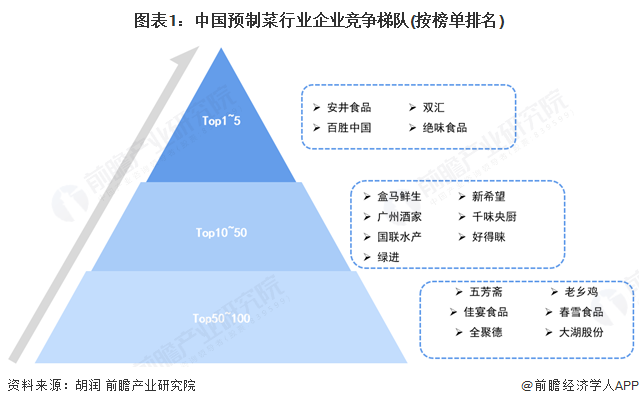
Group 1: Industry Overview - The pre-prepared food industry in China is experiencing intense competition, with major players like Anjuke Food, Yum China, Shuanghui Development, and others leading the market [1][2][16] - The industry is characterized by a low market concentration, with many companies competing across various product segments, resulting in significant performance disparities among them [16] Group 2: Competitive Landscape - Anjuke Food ranks first in the pre-prepared food sector, followed by Yum China, Shuanghui, Juewei Food, and Weizhi Xiang in the top five positions [1] - The revenue scale of Shuanghui Development and Anjuke Food exceeds 10 billion yuan, while companies like Chunxue Food and Guolian Aquatic Products also maintain a leading position in terms of revenue [2][10] - The overall revenue of the industry is expected to decline in 2024, but Anjuke Food's frozen prepared food and dishes achieved a 13.04% year-on-year growth in the first half of 2024 [2] Group 3: Profitability Analysis - The gross profit margins of pre-prepared food companies vary significantly, with Guangzhou Restaurant leading at 26.08%, while companies like Yike Food and Delisi have margins below 10% [5][10] - The profitability of the pre-prepared food sector is under pressure, with many companies facing operational challenges despite some achieving growth [2][5] Group 4: Market Segmentation - In the vegetable-based pre-prepared food segment, Shuangta Food and Qianwei Central Kitchen are the leading companies, focusing on fresh vegetable products [8] - The meat and poultry pre-prepared food market is highly competitive, with Shuanghui Development maintaining a strong market position due to its brand influence and product diversity [9] - The aquatic product segment features companies like Anjuke Food and Dahu Co., which leverage their resource advantages to develop high-end products [11] Group 5: Regional Distribution - As of April 2025, there are 13,971 companies in the pre-prepared food sector in China, with the majority located in Shandong, Henan, Jiangsu, and Anhui provinces [14] - Shandong province has the highest number of pre-prepared food companies, accounting for 21.2% of the national total, benefiting from its agricultural resources and transportation advantages [14] Group 6: Competitive Forces - The pre-prepared food industry faces moderate threats from potential entrants due to low technical barriers, while the bargaining power of suppliers and consumers is relatively weak [16] - The industry is challenged by substitutes such as home cooking and dining out, but the convenience and standardization of pre-prepared foods position them as a significant part of future diets [16]


【男装】行业市场规模:2024年中国男装行业市场规模约6500亿元 男裤市场占比约24%
Qian Zhan Wang· 2025-06-10 06:48
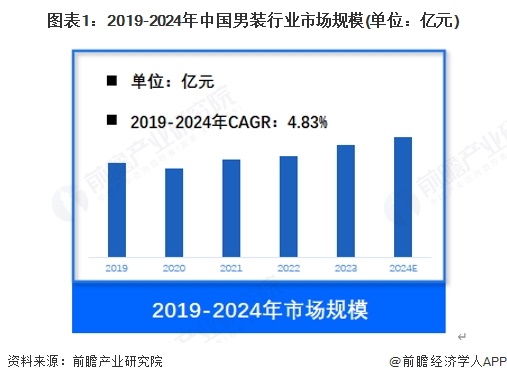
Core Insights - The Chinese men's clothing industry is projected to reach a market size of approximately 650 billion yuan in 2024, with a compound annual growth rate (CAGR) of 4.83% over the past five years [1][3]. Market Segmentation - Men's clothing can be categorized into formal wear, casual wear, sportswear, and underwear. Formal wear includes suits, shirts, and ties; casual wear encompasses casual pants, jackets, and T-shirts; sportswear consists of sports jackets, pants, and undergarments; while underwear includes base layers and thermal wear [3]. - According to Statista, the men's pants market and men's sportswear and swimwear market are the two largest segments within the Chinese men's clothing industry, accounting for 24% and 16% of the market share, respectively [3]. Industry Competition - Leading companies in the Chinese men's clothing sector include Hailan Home (海澜之家), China Lilang (中国利郎), and Baoxini (报喜鸟). The specific competitive landscape and strategies of these companies are detailed in the report by Qianzhan Industry Research Institute [5].


2025年中国靶材行业贸易分析:中国靶材出口规模已大于进口,但在高端市场上仍需提升竞争力
Qian Zhan Wang· 2025-06-09 07:17
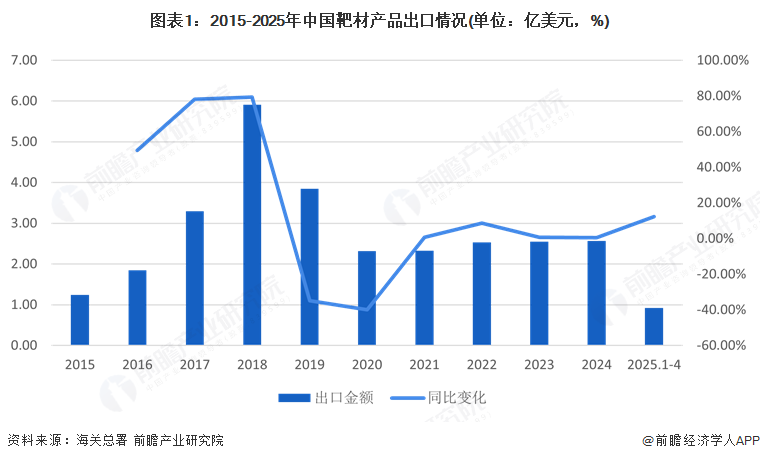
Core Insights - The export scale of China's sputtering targets has been greater than imports in 2023, indicating a positive trend in the export market [1][2] - The import demand for sputtering targets is unstable and significantly affected by market fluctuations [2][8] Export and Import Scale - From 2015 to 2025, China's sputtering target export value fluctuated, increasing from $12.4 million in 2015 to $59.1 million in 2018, with a year-on-year growth rate exceeding 40% [1] - Exports dropped to $23.1 million in 2020 but gradually recovered, reaching $25.7 million in 2024, with a year-on-year increase of 0.59% [1] - In the first four months of 2025, the export value was $9.2 million, showing a year-on-year increase of 12.29% [1] Import Trends - China's sputtering target import value was $22 million in 2015, rising to $31.8 million in 2021, but fell to $20.9 million in 2023 [2] - Imports rebounded to $24.3 million in 2024, with a year-on-year increase of 16.17% [2] - In the first four months of 2025, the import value was $7.7 million, showing a slight year-on-year decrease of 4.01% [2] Export Destinations - In the first four months of 2025, China exported sputtering targets to 37 countries and regions, with Taiwan being the largest destination, accounting for 36% of total exports at $33.2 million [4] - South Korea was the second-largest destination with exports of $13.4 million, followed by Singapore, the USA, Japan, and Vietnam [4] Import Sources - The main sources of sputtering target imports in the first four months of 2025 were South Korea, Taiwan, and the USA, with a combined import value of $41.3 million, representing nearly 90% of total imports [8] Price Comparison - The average import price of sputtering targets was $215.70 per kilogram in January 2015, while the export price was $147.92 per kilogram [11] - By April 2025, the average import price had decreased to $182.05 per kilogram, while the export price was $102.14 per kilogram [11] - This indicates that there is still room for improvement in the competitiveness of domestic products in the high-end market [11]
【全网最全】2025年中国电力行业上市公司全方位对比(附业务布局汇总、业绩对比、业务规划等)
Qian Zhan Wang· 2025-06-09 06:08
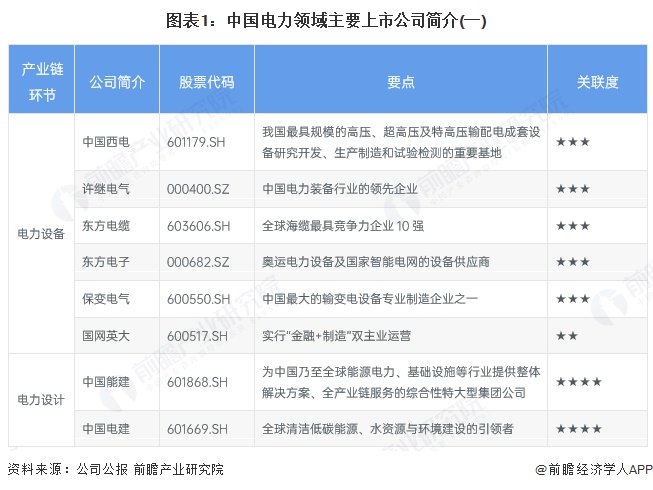
Group 1 - The core viewpoint of the article highlights the comprehensive overview of the Chinese power industry, focusing on major listed companies, their performance, and future development plans [1][9][10] - The article provides a summary of key listed companies in the power sector, including their business segments and market positions, with a focus on companies involved in power generation and equipment [1][2][3] - Major listed companies in the power sector include Huaneng International, Datang Power, Huadian International, Guodian Power, and others, with a detailed breakdown of their operations and financial performance [2][4][6] Group 2 - In terms of revenue performance for 2024, Huaneng International leads with a revenue of 2455.51 billion, followed by Guodian Power at 1791.82 billion, and Datang Power at 1234.74 billion [9][10] - The article outlines the geographical distribution of these companies, noting that Huaneng International and Guodian Power have extensive operations both domestically and internationally [9][10] - Future investment plans indicate a shift towards renewable energy, with companies like Huaneng International planning to invest over 50 billion in new energy projects by 2025 [13]





2025年中国矿用机器人行业需求分析 矿用机器人满足矿山生产需求【组图】
Qian Zhan Wang· 2025-06-09 05:10
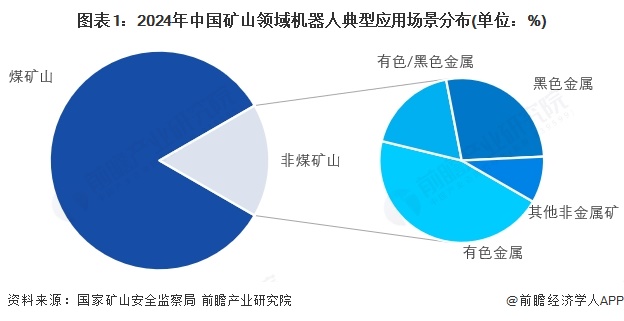
Core Insights - The article discusses the growth and application of mining robots in China, particularly in coal mining, highlighting the government's initiative to promote robot usage for safety and efficiency in the mining sector [1][10]. Coal Production and Robot Demand - In 2023, China's coal production reached 4.71 billion tons, a historical high with a year-on-year growth of 3.4% [3]. - The output from large-scale coal enterprises was 4.66 billion tons, an increase of 1.6 million tons or 2.9% compared to the previous year [3]. - For 2024, the projected coal production is 4.78 billion tons, reflecting a year-on-year increase of 1.2% [3]. - The focus of coal production is shifting towards the central and western regions of China, with expectations of continued growth in production and consumption through 2025 [3]. Mining Robot Applications - The National Mine Safety Administration and the Ministry of Industry and Information Technology have selected 66 typical application scenarios for mining robots, with 55 scenarios in coal mining and 11 in non-coal mining [1]. - Various companies are involved in the production and application of mining robots across different scenarios, including autonomous operations in tunneling, support, and transportation [5][7][9]. Metal Production and Robot Demand - The article outlines the increase in metal ore production in China, with a focus on the demand for robots in metal mining activities such as drilling and transportation [13]. - The growth in metal production is driven by emerging market demand, government policies, and increased construction activities, which are expected to boost the demand for mining robots in this sector [13]. Non-Metal Resource and Robot Demand - As of the end of 2023, China has identified 173 types of minerals, with non-metallic minerals accounting for 95 types [14]. - The article notes significant growth in the reserves of various non-metallic minerals, indicating potential future demand for mining robots in this sector [14]. - Currently, the application of robots in non-metallic mining is still in its early stages, with a lack of specialized products and clear application scenarios [15]. Conclusion - The mining robot industry in China is poised for growth, driven by increasing coal and metal production, government initiatives, and the need for enhanced safety and efficiency in mining operations [1][10][3][13].


循环寿命翻倍至483次!宁德时代锂金属电池研究成果登上国际顶级期刊《自然》【附锂电池行业市场分析】
Qian Zhan Wang· 2025-06-09 04:26
(图片来源:摄图网) 6月6日,宁德时代在公众号上发文宣布,宁德时代21C创新实验室欧阳楚英、王瀚森团队独立完成的锂金属 电池研究成果发表于国际顶级期刊《自然·纳米技术》,标志着宁德时代基础科研能力获纳米技术领域最高 水平认可。 宁德时代研究团队通过独创的动态追踪技术,成功量化电解质失效机制,首次揭示了锂金属电池失效的核心 消耗路径。研究结果显示,电解液盐在循环中的消耗量高达71%,远超学界预期。基于这一重要发现,团队 引入低分子量稀释剂优化电解液配方,实现电池的循环寿命较前代产品翻倍至483次。而且,同样的电解液 设计逻辑,还可进一步支持电池能量密度突破500Wh/kg,使电动航空规模化、超千公里续航电动汽车成为 可能。 我国锂电池行业近年来发展迅猛,已经成为全球锂电池产业的重要力量。凭借丰富的锂资源、完善的产业链 配套以及强大的技术研发能力,我国在锂电池的生产制造、技术创新和市场应用等方面均取得了显著成就。 以宁德时代、比亚迪等为代表的国内企业,在全球市场份额中占据重要地位,不仅为国内新能源汽车、消费 电子等产业提供了坚实的能源支持,还积极拓展海外市场,提升了我国锂电池产业的国际竞争力。 在市场份额方面, ...


用技术创新反馈用户!比亚迪:我们不打价格战,任何人掀起价格战我们都玩得起
Qian Zhan Wang· 2025-06-09 03:10
Group 1 - BYD's chairman Wang Chuanfu emphasized high-end and intelligent development as the core strategy for the next three years during the 2024 shareholder meeting [2] - BYD's secretary Li Qian expressed confidence in the company's ability to handle price wars, stating that the company will not engage in price competition but will focus on technology [2] - In 2022, BYD held a 31.7% market share in China's new energy vehicle market, leading the industry significantly [2] Group 2 - In May, BYD surpassed Toyota in sales in Brazil, ranking fourth with a market share of 8.67%, and has sold 18,874 pure electric vehicles this year [4] - BYD won two prestigious patent awards, including a gold medal for its integrated thermal management system at the 25th China Patent Awards [4] - The rapid growth of China's new energy vehicle industry is highlighted, with a total of 24.72 million vehicles and 439.7 thousand new registrations in the first half of 2024 [4] Group 3 - Wang Xia, president of the China International Trade Promotion Committee's Automotive Industry Committee, warned that unlimited price wars and blind technological competition could squeeze reasonable profit margins and affect product quality and service [6] - The Forward Industry Research Institute has established a "New Energy Vehicle Industry Planning Institute" to provide scientific planning services for local governments [6]

用技术创新反馈用户!比亚迪:我们不打价格战,任何人掀起价格战我们都玩得起【附新能源汽车行业市场分析】
Qian Zhan Wang· 2025-06-09 03:06
Group 1 - BYD's chairman Wang Chuanfu emphasized high-end and intelligent development as core strategies for the next three years, acknowledging challenges in the high-end process and committing to overcoming them [2] - BYD's secretary Li Qian expressed confidence in the company's ability to handle price wars, stating that the company will focus on technological innovation and efficiency improvements rather than engaging in price competition [2] - In 2022, BYD held a 31.7% market share in China's new energy vehicle market, leading the industry significantly ahead of other brands [2] Group 2 - In May, BYD's sales in Brazil surpassed Toyota, ranking fourth with a market share of 8.67%, and the company sold 18,874 pure electric vehicles in the country this year [4] - BYD won two prestigious patent awards, including the China Patent Gold Award for its integrated thermal management system and the China Design Gold Award for the exterior design of the Tengshi D9, showcasing its strong capabilities in technology research and innovation [4] - As of mid-2024, China's new energy vehicle ownership reached 24.72 million, with 4.397 million new registrations in the first half of the year, accounting for 7.18% of the total vehicle count [4] Group 3 - The president of the China International Trade Promotion Committee's Automotive Industry Committee highlighted that price wars and blind technological competition could harm profit margins and product quality, suggesting that mergers and acquisitions are necessary for industry maturity [6] - The current state of the Chinese automotive industry, characterized by stagnant market capacity, declining profits, and increasing market concentration, indicates it is entering a mature phase, making mergers and acquisitions inevitable [6] - The Forward Industry Research Institute has established a "New Energy Vehicle Industry Planning Institute" to provide comprehensive consulting services for industrial planning, investment attraction, and project operation [6]
重磅!2025年中国及31省市纺织行业政策汇总及解读(全)“纺织行业加速推进高端化”
Qian Zhan Wang· 2025-06-09 02:23
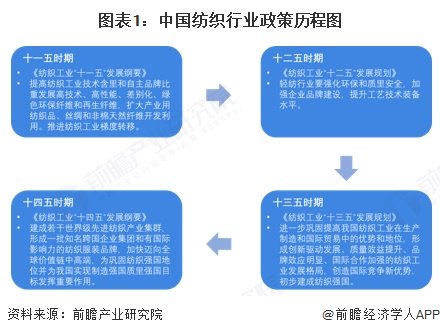
Core Viewpoint - The article discusses the evolution and current policies of China's textile industry, emphasizing the government's support for digital transformation, quality improvement, and sustainable development to enhance the industry's global competitiveness and achieve the goals of becoming a manufacturing and quality powerhouse [1][3]. Policy Evolution - During the "11th Five-Year Plan," the focus was on increasing the technological content and brand proportion in the textile industry, promoting high-tech and environmentally friendly fibers, and expanding the use of non-cotton natural fibers [1]. - The "12th Five-Year Plan" emphasized environmental protection, quality safety, and brand building within the light textile industry [1]. - The "13th Five-Year Plan" aimed to consolidate China's advantages in textile manufacturing and international trade, establishing the country as a textile powerhouse [1]. - The "14th Five-Year Plan" seeks to elevate the textile industry to a higher position in the global value chain, contributing to the goals of becoming a manufacturing and quality strong nation [1]. National Policy Summary and Interpretation - Recent national policies, such as the "Three-Year Action Plan for Digital Transformation of the Textile Industry (2022-2024)" and the "Implementation Plan for Quality Improvement and Upgrading of the Textile Industry (2023-2025)," provide a favorable macro environment and policy support for the industry's development [3][4]. - These policies aim to promote healthy and rapid development across various segments of the textile supply chain and enhance the industry's global competitiveness [3]. Key Policy Details - The "Implementation Plan" outlines goals for 2025, including: - R&D expenditure intensity of 1.3% for large-scale textile enterprises [8]. - 70% of large-scale textile enterprises achieving digital networking [8]. - Reduction in energy and water consumption per unit of industrial added value, along with continuous decreases in major pollutant emissions [8]. - Improvement in the quality and scale of recycled textile products, aiming to establish 20 globally recognized brands [8]. Key Tasks and Focus Areas - Accelerate innovation-driven development and enhance independent innovation capabilities by focusing on key technology breakthroughs and establishing industry innovation platforms [9]. - Promote high-end manufacturing in textiles and expand the application of functional chemical fibers across various sectors of the economy [9]. - Develop smart manufacturing and improve industry quality and efficiency through the adoption of digital technologies [9]. - Advance green and circular low-carbon development by promoting energy-saving and pollution-reducing technologies [9]. - Enhance the resilience of the supply system to meet and lead fashion consumption upgrades [9]. - Optimize regional industrial layouts and foster open cooperation within the textile industry [9]. Provincial Policy Summary - Various provinces have introduced policies to support the development of the textile industry, focusing on high-quality growth, digital transformation, and the promotion of environmentally friendly materials [12][14]. - For example, Guangdong aims to enhance the digital transformation of its textile industry by 2025, achieving over 60% integration of digital technologies [16].