Guo Jia Tong Ji Ju

Search documents
2024年《中国妇女发展纲要(2021—2030年)》统计监测报告 - 国家统计局
Guo Jia Tong Ji Ju· 2025-12-30 01:37
Core Insights - The implementation of the "Outline for Women's Development (2021-2030)" is progressing smoothly, with improvements in women's health, education, economic participation, social security, and legal rights protection observed in 2024 [1] Group 1: Women's Health - Women's health levels have continued to improve, with the maternal mortality rate at 14.3 per 100,000, a decrease of 5.3% from 2023 [2] - The rate of prenatal medical examinations reached 77.1%, an increase of 0.5 percentage points, while the rates for systematic management of pregnant women and prenatal screening were 94.9% and 93.5%, respectively [2] - The mother-to-child transmission rate of HIV remains low at 1.2%, down by 0.1 percentage points from 2023 [3] Group 2: Women's Education - Gender disparity in compulsory education has been largely eliminated, with both girls' and boys' net enrollment rates in primary education at 99.9% [4] - The proportion of female students in high school education reached 46.7%, an increase of 0.1 percentage points from 2023 [4] - The enrollment of female students in higher vocational education increased to 865.6 million, accounting for 47.9% of total enrollment, up by 0.6 percentage points [5] Group 3: Women's Economic Participation - The proportion of women in the total workforce remains above 40%, with 3.2 billion women employed, representing 43.4% of all workers, an increase of 0.1 percentage points from 2023 [7] - The percentage of enterprises complying with special regulations for female workers' protection reached 75.3%, an increase of 1.8 percentage points [7] Group 4: Women's Participation in Decision-Making - The proportion of government leadership teams with female members increased by 1.7%, 2.2%, and 2.1% at the provincial, municipal, and county levels, respectively [8] - The representation of women in corporate governance roles has improved, with female board members at 38.1%, up by 0.4 percentage points [8] Group 5: Women's Social Security - The number of women participating in basic medical insurance reached 49.1% of total participants, with an increase of 462.1 million women in employee medical insurance [9] - The number of women participating in basic pension insurance reached 5.3 billion, accounting for 49.3% of total participants [9] Group 6: Women's Family Construction - The proportion of marriage registration institutions providing marriage and family counseling services reached 70.8%, an increase of 5.5 percentage points from 2023 [12] Group 7: Women's Environmental Conditions - The water quality compliance rate for urban drinking water sources was 96.0%, while rural tap water coverage reached 94%, an increase of 4 percentage points from 2023 [13] Group 8: Women's Legal Rights - The number of personal safety protection orders issued for women reached 6,005, indicating improvements in the anti-domestic violence system [14] - Legal aid services for women have expanded, with 35.6 million women receiving legal assistance in 2024 [15]
2024年《中国儿童发展纲要(2021—2030年)》统计监测报告 - 国家统计局
Guo Jia Tong Ji Ju· 2025-12-30 01:37
Core Viewpoint - The implementation of the "China Children's Development Outline (2021-2030)" has made significant progress in 2024, with improvements in children's health, safety, education, welfare, family support, environment, and legal protection. Group 1: Children's Health - The health level of children continues to improve, with a decrease in neonatal, infant, and under-five mortality rates to 2.5‰, 4.0‰, and 5.6‰ respectively, down by 0.3, 0.5, and 0.6 percentage points from 2023 [3][4] - The comprehensive prevention and treatment system for birth defects has been optimized, with prenatal health check coverage reaching 93.2% and premarital medical check rates at 77.1% [3][4] - The capacity for children's medical care has increased, with management rates for children under three and under seven at 94.9% and 96.1% respectively, both showing slight increases from 2023 [4] Group 2: Children's Safety - The child injury prevention system has been strengthened, with enhanced safety education for students and multi-department cooperation in safety initiatives [5] - The safety of children's food and products has improved, with a food safety inspection pass rate for infant formula at 99.88% [5] Group 3: Children's Education - The enrollment rate for preschool education reached 92.0%, an increase of 0.9 percentage points from 2023, with 87.3% of kindergartens being inclusive [6] - The retention rate for nine-year compulsory education is 95.9%, up by 0.2 percentage points, with a net enrollment rate for primary school children at 99.9% [7] - High school enrollment rates have also improved, reaching 92.0%, with a total of 4.58 million students enrolled in high school education [8] Group 4: Children's Welfare - The welfare level for children has steadily improved, with monthly support for orphans increasing to 1987.1 yuan and for disabled children to 1515.9 yuan [9] - The quality of care services for children has been enhanced, with 443 child welfare institutions established and 4.2 million child supervisors appointed [9] Group 5: Children's Family Support - A comprehensive family education guidance service system is being established, with over 10,400 urban community parent schools set up [10] - The number of institutions providing childcare services has reached 114,000, with a total of 573.7 million childcare spots available [10] Group 6: Children's Environment - Public cultural services for children have been strengthened, with 4.4 million types of children's books published, an increase of 6.7 million from 2023 [11] - The living environment for children's growth has improved, with rural tap water coverage reaching 94% [12] Group 7: Children's Legal Protection - The judicial protection for minors has been significantly enhanced, with 2,720 juvenile courts established, an increase of 539 from 2023 [13] - Legal actions against crimes against children have intensified, with 337 child trafficking cases and 12,000 cases of child molestation reported [13]
2024年全国文化及相关产业增加值占GDP比重为4.61% - 国家统计局
Guo Jia Tong Ji Ju· 2025-12-30 01:37
Core Insights - The total value added of the cultural and related industries in 2024 is projected to be 62,094 billion yuan, accounting for 4.61% of the GDP, an increase of 0.02 percentage points from the previous year [1][2]. Industry Breakdown - In 2024, the value added of the cultural service industry is expected to be 43,256 billion yuan, representing 69.7% of the total cultural and related industries' value added, an increase of 0.5 percentage points year-on-year [1][3]. - The cultural manufacturing industry is projected to add 12,607 billion yuan, accounting for 20.3% of the total, which is a decrease of 0.2 percentage points from the previous year [1][3]. - The cultural wholesale and retail industry is expected to contribute 6,231 billion yuan, making up 10.0% of the total, down by 0.3 percentage points compared to last year [1][3]. Field Analysis - The core cultural field is anticipated to generate 44,238 billion yuan, which is 71.2% of the total value added in the cultural and related industries [1][3]. - The related cultural field is expected to add 17,856 billion yuan, accounting for 28.8% of the total [1][3].
2024年全国农业及相关产业增加值占GDP比重为15.29% - 国家统计局
Guo Jia Tong Ji Ju· 2025-12-30 01:37
Core Insights - The total value added of agriculture and related industries in 2024 is projected to be 20,617.3 billion yuan, accounting for 15.29% of the national GDP [1][2] Group 1: Value Added by Industry - The value added by the primary industry is 91,636 billion yuan, representing 44.4% of the total value added [2] - The value added by the secondary industry is 55,913 billion yuan, accounting for 27.1% [2] - The value added by the tertiary industry is 58,624 billion yuan, making up 28.4% [2] Group 2: Value Added by Agricultural Subcategories - The value added from agriculture, forestry, animal husbandry, and fishery is 96,976 billion yuan, which is 47.0% of the total [2] - The value added from the processing and manufacturing of edible agricultural products is 39,798 billion yuan, constituting 19.3% [2] - The value added from the circulation services of agricultural products is 31,761 billion yuan, representing 15.4% [2]
2024年全国数字经济核心产业增加值占GDP比重为10.5% - 国家统计局
Guo Jia Tong Ji Ju· 2025-12-30 01:37
Core Insights - The core value added of the national digital economy core industries in 2024 is projected to be 140,891 billion yuan, accounting for 10.5% of GDP [1][3]. Industry Composition - The digital technology application industry has the highest value added at 61,928 billion yuan, representing 44.0% of the digital economy core industries [1][3]. - The digital product manufacturing industry contributes 48,145 billion yuan, making up 34.2% of the total [1][3]. - The digital factor-driven industry adds 26,519 billion yuan, which is 18.8% of the total [1][3]. - The digital product service industry has a value added of 4,298 billion yuan, accounting for 3.1% [1][3]. Definitions and Methodology - The digital economy core industries refer to economic activities that provide digital technologies, products, services, infrastructure, and solutions for industrial digitalization, as well as those fully reliant on digital technologies and data factors [4]. - The value added of the digital economy core industries is defined as the new value created by all resident units in a certain period through production activities [4]. - The classification for the digital economy core industries is based on the "Statistical Classification of Digital Economy and Its Core Industries (2021)" and includes four main categories: digital product manufacturing, digital product services, digital technology applications, and digital factor-driven industries [5].
2025年11月份能源生产情况 - 国家统计局
Guo Jia Tong Ji Ju· 2025-12-29 09:36
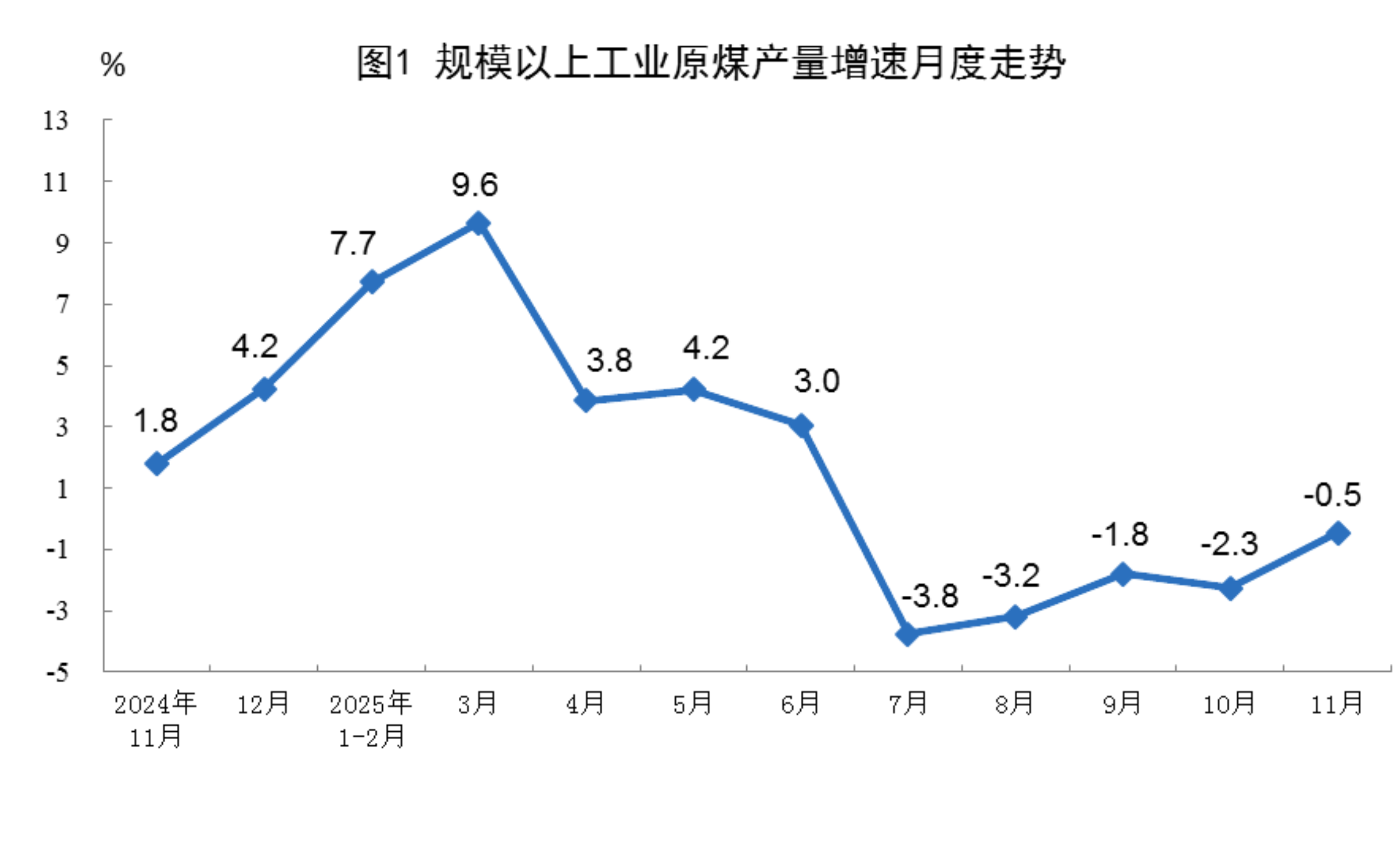
11月份,规模以上工业(以下简称规上工业)原煤生产保持稳定,原油生产增速加快,天然气生产平稳增 长,电力生产保持增长。 一、原煤、原油和天然气生产及相关情况 原煤生产保持稳定。11月份,规上工业原煤产量4.3亿吨,同比下降0.5%;日均产量1423万吨。 1—11月份,规上工业原煤产量44.0亿吨,同比增长1.4%。 原油生产增速加快。11月份,规上工业原油产量1763万吨,同比增长2.2%,增速比10月份加快0.9个百 分点;日均产量58.8万吨。 1—11月份,规上工业原油产量19825万吨,同比增长1.7%。 原油加工平稳增长。11月份,规上工业原油加工量6083万吨,同比增长3.9%;日均加工量202.8万吨。 1—11月份,规上工业原油加工量67507万吨,同比增长4.0%。 天然气生产稳定增长。11月份,规上工业天然气产量219亿立方米,同比增长5.7%;日均产量7.3亿立方 米。 1—11月份,规上工业天然气产量2389亿立方米,同比增长6.3%。 二、电力生产情况 规上工业电力生产保持增长。11月份,规上工业发电量7792亿千瓦时,同比增长2.7%;日均发电量 259.7亿千瓦时。1—11月份 ...

2025年1—11月份全国房地产市场基本情况 - 国家统计局
Guo Jia Tong Ji Ju· 2025-12-29 09:36
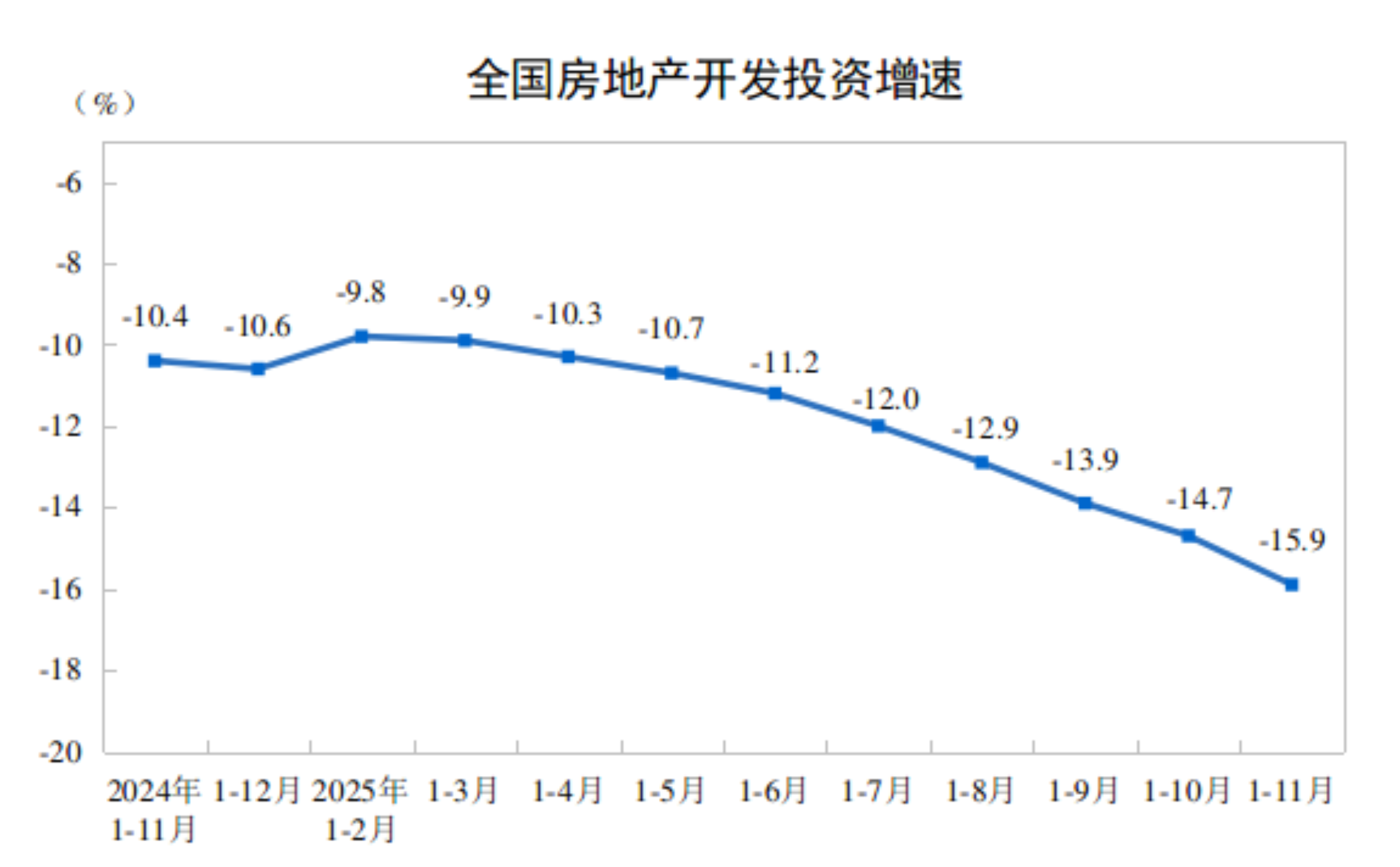
Core Insights - The real estate development investment in China from January to November reached 78,591 billion yuan, showing a year-on-year decline of 15.9% [1][12] - Residential investment accounted for 60,432 billion yuan, down 15.0% compared to the previous year [1][12] Group 1: Construction and Development - The total construction area for real estate development was 656,066 million square meters, reflecting a decrease of 9.6% year-on-year [3][12] - The new construction area was 53,457 million square meters, down 20.5%, with residential new construction area at 39,189 million square meters, a decline of 19.9% [3][12] - The completed construction area was 39,454 million square meters, down 18.0%, with residential completed area at 28,105 million square meters, a decrease of 20.1% [3][12] Group 2: Sales and Inventory - The sales area of new commercial housing was 78,702 million square meters, down 7.8% year-on-year, with residential sales area decreasing by 8.1% [4][12] - The sales revenue from new commercial housing was 75,130 billion yuan, a decline of 11.1%, with residential sales revenue down 11.2% [4][12] - As of the end of November, the inventory of unsold commercial housing was 75,306 million square meters, a reduction of 301 million square meters from the end of October [6][12] Group 3: Funding Situation - The total funds available to real estate development enterprises amounted to 85,145 billion yuan, down 11.9% year-on-year [7][12] - Domestic loans contributed 13,149 billion yuan, a decrease of 2.5%, while foreign investment was 23 billion yuan, down 24.6% [7][12] - Self-raised funds were 30,628 billion yuan, down 11.9%, and personal mortgage loans were 11,786 billion yuan, a decline of 15.1% [7][12] Group 4: Market Sentiment - The real estate development prosperity index (National Housing Prosperity Index) stood at 91.90 in November, indicating a lower level of market sentiment [8][12]
2025年1—11月份全国固定资产投资基本情况 - 国家统计局
Guo Jia Tong Ji Ju· 2025-12-29 09:36
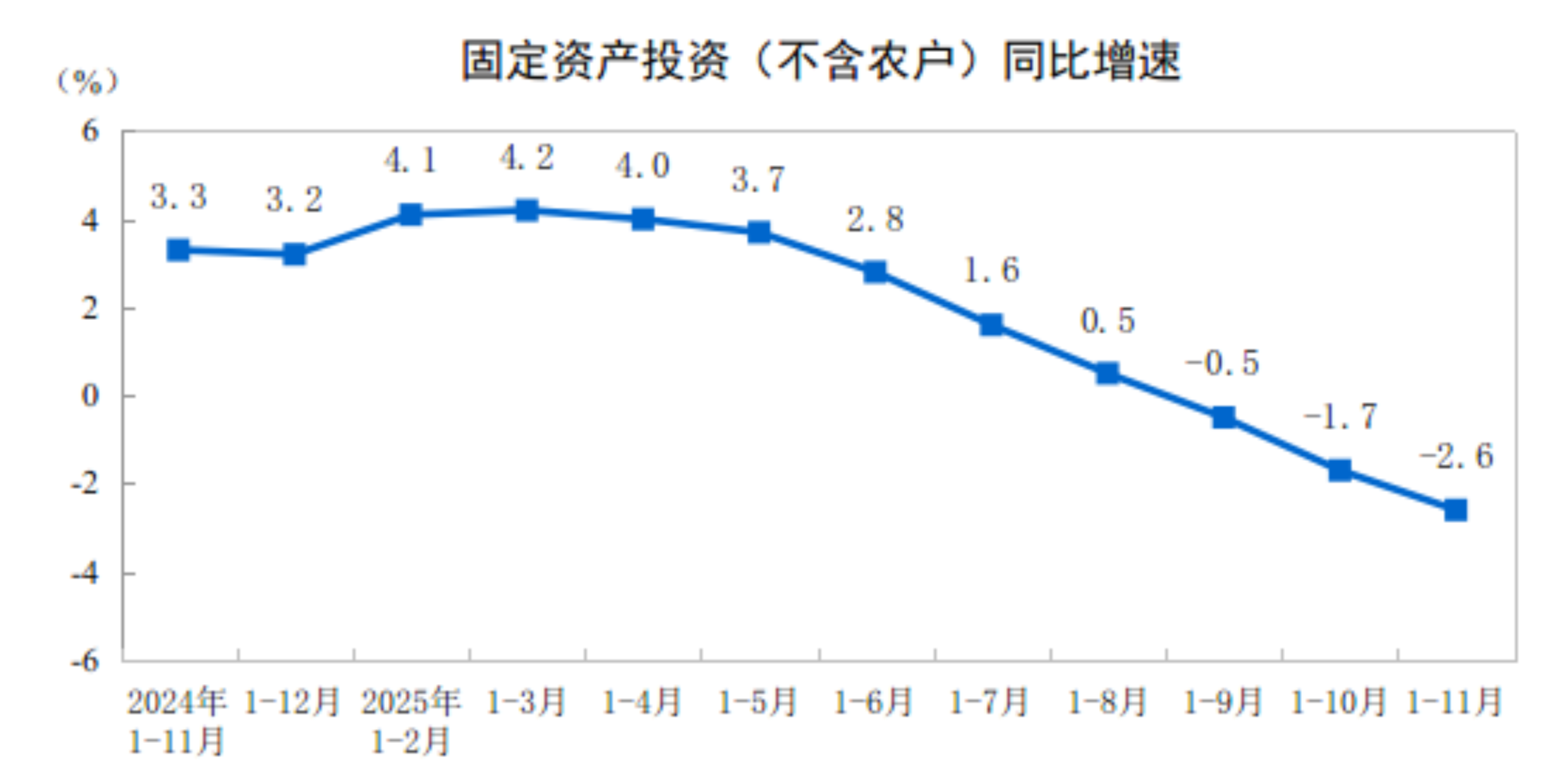
Core Viewpoint - In the first eleven months of 2025, China's fixed asset investment (excluding rural households) reached 444,035 billion yuan, showing a year-on-year decline of 2.6% [1][4]. Investment by Industry - Investment in the primary industry was 8,770 billion yuan, with a year-on-year growth of 2.7% [3][5]. - Investment in the secondary industry totaled 162,243 billion yuan, increasing by 3.9% [3][5]. - Investment in the tertiary industry was 273,022 billion yuan, reflecting a decline of 6.3% [3][5]. - Within the secondary industry, industrial investment grew by 4.0%, with mining investment also increasing by 4.0%, manufacturing investment rising by 1.9%, and investment in electricity, heat, gas, and water production and supply increasing by 10.7% [3][6]. Investment by Region - Eastern region investment decreased by 6.6%, central region investment fell by 1.7%, western region investment declined by 0.2%, and northeastern region investment saw a significant drop of 14.0% [3][6]. Investment by Registration Type - Domestic enterprises' fixed asset investment decreased by 2.6%, investment from Hong Kong, Macau, and Taiwan enterprises fell by 2.2%, while foreign enterprises' investment dropped sharply by 14.1% [3][6]. Detailed Investment Data - The overall fixed asset investment (excluding rural households) showed a decline of 2.6% year-on-year, with state-controlled investment down by 1.1% and private investment down by 5.3% [5][6]. - Specific categories such as construction and installation projects saw a decline of 6.4%, while equipment and tool purchases increased by 12.2% [5][6]. Industry-Specific Performance - In the manufacturing sector, notable growth was observed in the automotive manufacturing industry at 15.3% and in the railway, shipbuilding, aerospace, and other transportation equipment manufacturing at 22.4% [6][7]. - Conversely, the pharmaceutical manufacturing industry experienced a decline of 8.2%, and the chemical raw materials and chemical products manufacturing sector saw a drop of 13.1% [6][7]. Summary of Investment Trends - The overall trend indicates a contraction in fixed asset investment across various sectors, with significant regional disparities and varying performance across industries, highlighting potential areas for investment focus and concern [1][3][4].
2025年11月份规模以上工业增加值增长4.8% - 国家统计局
Guo Jia Tong Ji Ju· 2025-12-29 09:36
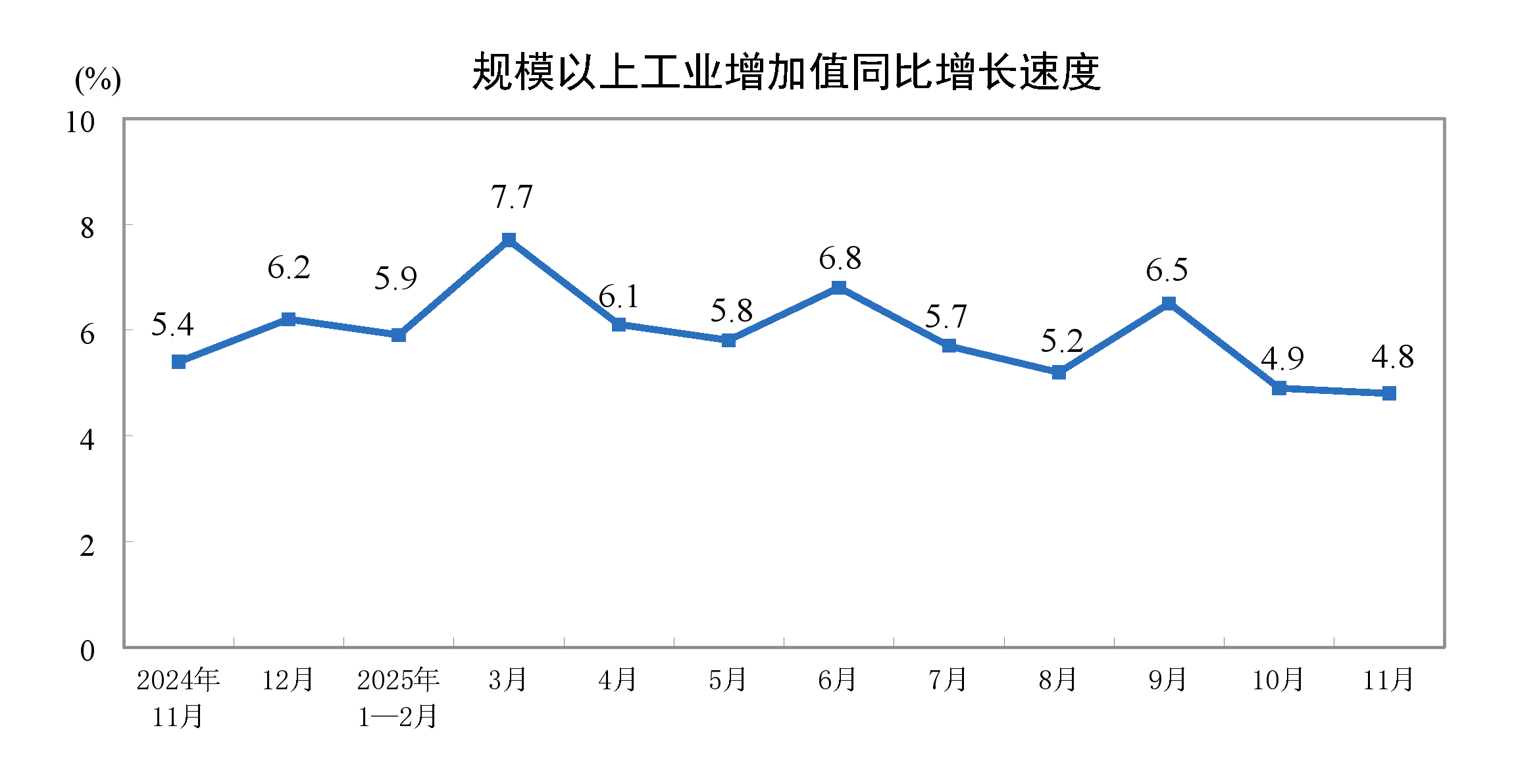
Core Insights - In November, the industrial added value of large-scale enterprises increased by 4.8% year-on-year, with a month-on-month growth of 0.44% [1] - From January to November, the industrial added value grew by 6.0% year-on-year [1] Group 1: By Industry - In November, the mining industry saw a year-on-year increase of 6.3%, manufacturing grew by 4.6%, and the production and supply of electricity, heat, gas, and water increased by 4.3% [3] - Among 41 major industries, 30 reported year-on-year growth in added value, with coal mining and washing growing by 7.5%, oil and gas extraction by 5.1%, and food processing by 1.7% [3] - The automotive manufacturing sector experienced significant growth of 11.9%, while the production of new energy vehicles surged by 17.0% [4][11] Group 2: By Economic Type - In November, state-controlled enterprises' added value increased by 4.2%, while joint-stock enterprises grew by 5.2%, foreign and Hong Kong, Macao, and Taiwan-invested enterprises by 3.4%, and private enterprises by 3.2% [3] Group 3: Product Output - Out of 623 industrial products, 310 saw year-on-year output growth in November, including ethylene at 309,000 tons (up 7.3%) and automotive production at 3.519 million units (up 2.4%) [4][14] - The sales rate of products from large-scale industrial enterprises was 96.5%, a decrease of 0.8 percentage points year-on-year [4][16] - The export delivery value of large-scale industrial enterprises was 1.361 trillion yuan, a nominal decrease of 0.1% year-on-year [4][16]
加速构建协同发展格局 2024年京津冀区域协同发展指数继续提升 - 国家统计局
Guo Jia Tong Ji Ju· 2025-12-29 09:36
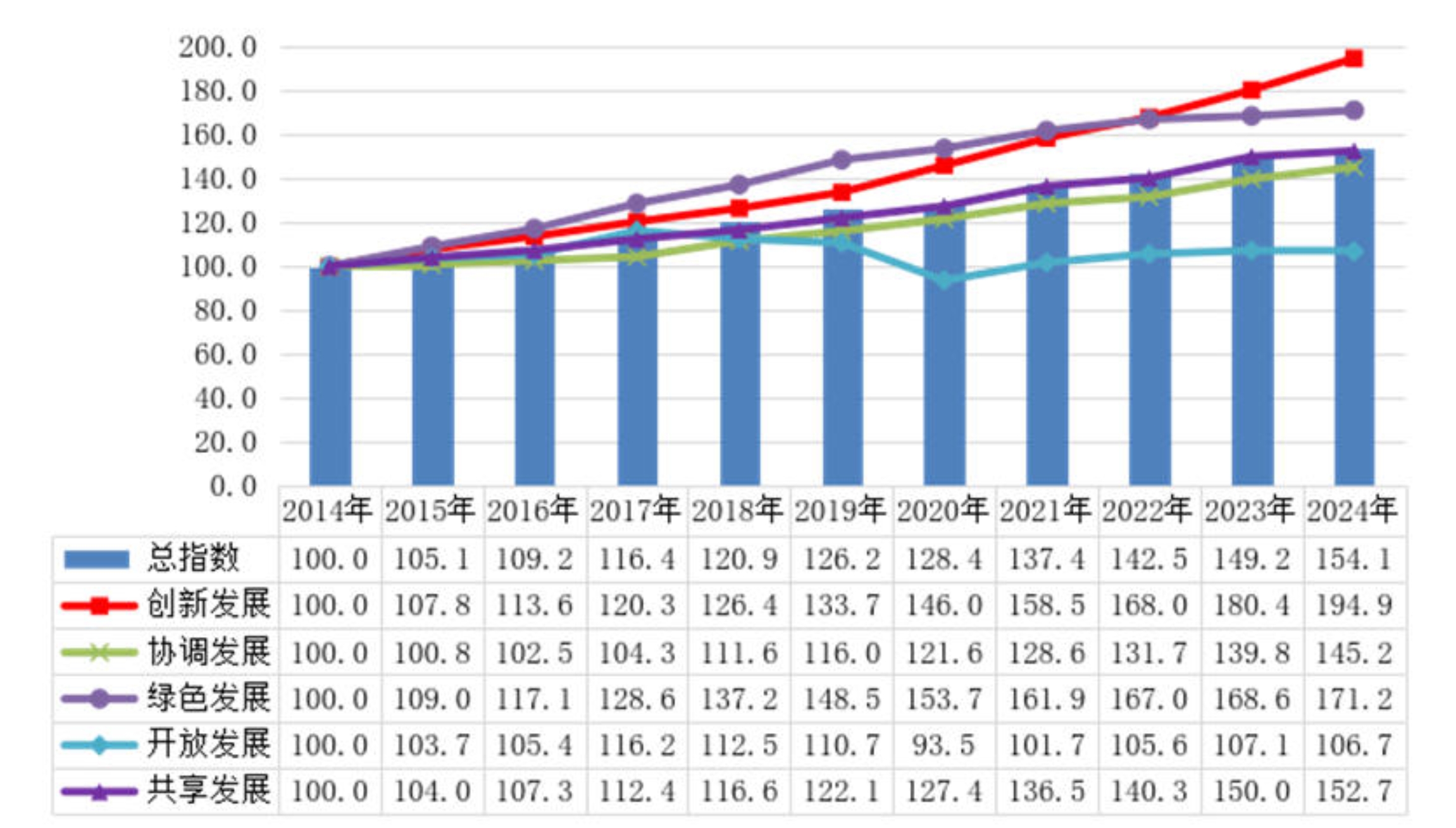
Core Viewpoint - The 2024 report on the coordinated development of the Beijing-Tianjin-Hebei region indicates significant progress in innovation, coordination, green development, openness, and shared growth, with the overall development index rising to 154.1, a 4.9 increase from 2023 [2][3]. Innovation Development - The innovation development index reached 194.9, an increase of 14.5 from 2023, marking the highest growth among sub-indices [3]. - The region's R&D expenditure intensity is 4.22%, up by 0.2 percentage points from the previous year, with Beijing leading at 6.58% [3]. - Patent authorizations totaled 355,000, a 2.9% increase, with an effective invention patent ownership of 74.3 per ten thousand people, growing by 15.7% [3]. - Labor productivity in the region is 215,000 yuan per person, reflecting a 4.4% increase from the previous year [3]. Coordinated Development - The coordinated development index improved to 145.2, up by 5.4 from 2023 [5]. - The added value of high-tech manufacturing in the region grew by 9.6%, 8.9%, and 11.2% for Beijing, Tianjin, and Hebei, respectively [5]. - Over 10,000 branch institutions of legal entities from the region were established in other areas, a 4.6% increase from the previous year [5]. - The urbanization rate in the region reached 71.2%, up by 0.6 percentage points, with the urban-rural income ratio decreasing to 2.51 [5]. Green Development - The green development index rose to 171.2, an increase of 2.6 from 2023 [6]. - PM2.5 average concentrations were 30.5, 38.1, and 37.7 micrograms per cubic meter for Beijing, Tianjin, and Hebei, respectively, with reductions of 4.7%, 8.0%, and 2.3% [6]. - The proportion of national surface water quality meeting or exceeding Class III standards is 82.6%, an increase of 2.2 percentage points [6]. - Average green space per ten thousand people increased to 23.8 hectares, up by 1.1 hectares from the previous year [6]. Open Development - The open development index decreased to 106.7, down by 0.4 from 2023 [8]. - The total import and export value for the region was 5.03 trillion yuan, a 0.1% increase, maintaining growth for four consecutive years [8]. - High-tech product exports saw significant growth, with automotive exports up by 56.4%, mobile phones by 24.7%, and wind turbine generators by 58.3% [8]. - International cargo throughput reached 820 million tons, a 10.6% increase, with 12 new direct shipping routes established [8]. Shared Development - The shared development index increased to 152.7, up by 2.7 from 2023 [9]. - The operational mileage of railways and highways in the region exceeded 11,000 kilometers [9]. - The average public budget expenditure per capita for education, social security, employment, and healthcare was 8,159.5 yuan, a 0.6% increase [9]. - The number of participants in basic pension insurance reached 86.36 million, an increase of 747,000 from the previous year [9].