
光伏设备及元器件制造业

Search documents
高端制造业成为我国用电量增长核心引擎
Ke Ji Ri Bao· 2026-02-03 03:13
Core Insights - In 2025, China's total electricity consumption is projected to exceed 10 trillion kilowatt-hours, marking the first time a single economy has reached this milestone, driven by robust economic growth and structural optimization in electricity consumption [1][2] Group 1: Electricity Demand Growth - The report indicates that electricity consumption in high-tech and equipment manufacturing industries will grow by 6.4% year-on-year in 2025, surpassing the average growth rate of the manufacturing sector by 3 percentage points [2] - The automotive manufacturing sector is expected to see a double-digit growth in electricity consumption, with a growth rate of 10.9% [2] - The photovoltaic equipment and components manufacturing industry will experience a significant increase, with a growth rate of 11.3% in the fourth quarter, reflecting positive responses to the "anti-involution" policies [2] Group 2: Structural Changes in Industries - The report highlights that all nine sectors within high-tech and equipment manufacturing will achieve positive growth in electricity consumption, indicating a shift towards high-end and green transformation in manufacturing [2] - The third sector, including services like charging and swapping services, mobile internet, big data, and cloud computing, is experiencing rapid growth, showcasing the vitality of the digital economy and new infrastructure development [2] Group 3: Future Projections - For 2026, the total electricity consumption in China is expected to reach between 10.9 trillion and 11 trillion kilowatt-hours, with a year-on-year growth of 5% to 6% [2] - The report anticipates that by the end of 2026, the installed capacity of solar power will surpass that of coal power for the first time, with the combined installed capacity of wind and solar power reaching half of the total installed generation capacity [2]
国家统计局解读2025年11月份CPI和PPI数据
Guo Jia Tong Ji Ju· 2025-12-10 01:43
Group 1: CPI Analysis - The Consumer Price Index (CPI) increased by 0.7% year-on-year, marking the highest growth since March 2024, with a rise of 0.5 percentage points from the previous month [2] - Food prices shifted from a decline of 2.9% to an increase of 0.2%, contributing positively to the CPI, with fresh vegetable prices rising by 14.5% after nine months of decline [2] - Core CPI, excluding food and energy, rose by 1.2%, maintaining above 1% for three consecutive months, driven by increases in service prices and industrial consumer goods [2][3] Group 2: PPI Analysis - The Producer Price Index (PPI) increased by 0.1% month-on-month, marking two consecutive months of growth, influenced by seasonal demand increases in certain domestic industries [4] - Year-on-year, the PPI decreased by 2.2%, with the decline slightly widening by 0.1 percentage points compared to the previous month, primarily due to high comparison bases from the previous year [6] - The prices in key industries such as coal mining and photovoltaic equipment manufacturing showed a narrowing decline, indicating improvements in market competition and policy effectiveness [6]
邯郸市智德新材料科技有限公司成立 注册资本20万人民币
Sou Hu Cai Jing· 2025-12-05 21:50
Core Insights - Handan Zhide New Materials Technology Co., Ltd. has been established with a registered capital of 200,000 RMB [1] Company Overview - The legal representative of the company is Qin Lei [1] - The company operates in various sectors including manufacturing and sales of metal signs for traffic and public management, metal chains and other metal products, construction steel products, photovoltaic equipment and components, and electrical cables [1] Business Scope - The business scope includes general projects such as: - Manufacturing and sales of traffic and public management metal signs [1] - Manufacturing and sales of metal chains and other metal products [1] - Sales of construction steel products [1] - Manufacturing and sales of photovoltaic equipment and components [1] - Sales of electrical wires, cables, and optical cables [1] - Sales of non-ferrous metal alloys and distribution switch control equipment [1]
解读:2025年10月份CPI由降转涨 PPI降幅收窄
Guo Jia Tong Ji Ju· 2025-11-10 07:31
Group 1: CPI Analysis - The Consumer Price Index (CPI) increased by 0.2% month-on-month and 0.2% year-on-year, with the core CPI (excluding food and energy) rising by 1.2%, marking the highest increase since March 2024 [1][3] - Service prices shifted from a decline of 0.3% to an increase of 0.2%, driven by strong travel demand during the National Day and Mid-Autumn Festival, with hotel accommodation, flight tickets, and tourism prices rising by 8.6%, 4.5%, and 2.5% respectively [2][3] - Food prices increased by 0.3%, contrasting with a seasonal decline of 0.1%, with significant price rises in fresh vegetables, lamb, fresh fruits, and seafood ranging from 0.5% to 4.3% [2][3] Group 2: PPI Analysis - The Producer Price Index (PPI) shifted from flat to an increase of 0.1% month-on-month, marking the first increase of the year, with improvements in supply-demand relationships contributing to price rises in several industries [4][5] - Year-on-year, the PPI decreased by 2.1%, but the decline narrowed by 0.2 percentage points for the third consecutive month, with significant price increases in sectors like photovoltaic equipment manufacturing and coal mining [4][5] - Input factors led to a mixed price trend in domestic non-ferrous metals and oil-related industries, with international metal prices rising and domestic oil and gas extraction prices declining by 2.3% [4][5]
国盛固收:黄金有色影响较大,物价有待继续观察
Ge Long Hui· 2025-11-10 01:40
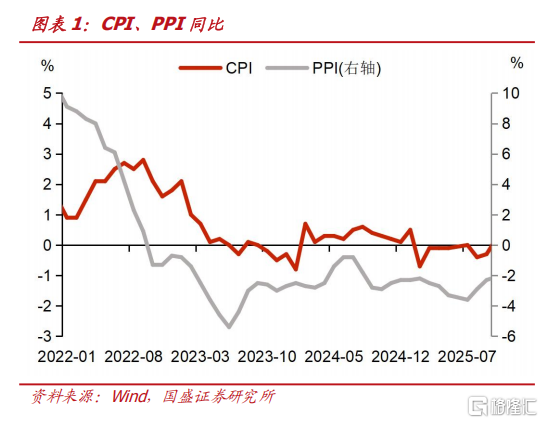
Core Insights - October inflation data shows a shift in CPI from decline to increase, with PPI's rate of decline narrowing, significantly influenced by prices of gold and non-ferrous metals [1][4][25] - October CPI increased by 0.2% year-on-year, reversing a 0.3% decline from the previous month, marking the highest value since February of this year [1][6] - PPI's year-on-year decline narrowed by 0.2 percentage points to -2.1%, marking the third consecutive month of narrowing [1][21] CPI Analysis - Food prices showed slight improvement, with a 2.9% decline, but the drop was less severe than the previous month, impacting CPI by approximately 0.54 percentage points [2][14] - Core CPI rose by 1.2% year-on-year, the highest since March 2024, with gold prices being a major driver [2][10] - Domestic gold futures prices increased by 52.8% year-on-year, significantly higher than the previous month's growth rate [2][10] PPI Analysis - PPI for October showed a year-on-year decline of 2.1%, with notable performance in the non-ferrous sector, particularly in mining and metal processing [3][21] - The prices in the non-ferrous mining and metal processing industries increased by 5.3% and 2.4% respectively, the highest among all sectors [3][21] - Life goods PPI decreased by 1.4% year-on-year, with a narrowing decline compared to the previous month [3][21] Market Outlook - The rise in prices is influenced by multiple factors, including the increase in gold prices and extreme weather affecting vegetable prices, leading to an unexpected overall price increase [4][25] - Future price trends remain uncertain, with a potential decline in gold prices in early November and weak terminal demand affecting price transmission from upstream to downstream sectors [4][26] - The bond market is entering a recovery phase, with a recommendation for a barbell strategy to manage risks and capitalize on potential interest rate declines [4][26]

CPI同比转正 PPI环比年内首涨
Jin Rong Shi Bao· 2025-11-10 01:37
Group 1: CPI Analysis - In October, the Consumer Price Index (CPI) increased by 0.2% month-on-month and year-on-year, driven by policies to expand domestic demand and the impact of the National Day and Mid-Autumn Festival holidays [1][2] - The core CPI, excluding food and energy prices, rose by 1.2% year-on-year, marking the sixth consecutive month of growth [1][2] - Significant rainfall and increased holiday demand led to a 4.3% month-on-month rise in vegetable prices, contributing to a narrowing of the year-on-year decline in food prices to -2.9% [2][3] Group 2: PPI Analysis - The Producer Price Index (PPI) saw a month-on-month increase of 0.1%, marking the first rise of the year, despite a year-on-year decline of 2.1% [1][4] - The improvement in supply-demand dynamics in various industries, particularly due to anti-involution policies, has supported price increases in sectors like coal and black metals [4][5] - Prices in the coal mining and washing industry rose by 1.6%, while prices for photovoltaic equipment and components increased by 0.6%, indicating a positive trend in certain high-tech manufacturing sectors [4][5] Group 3: Future Outlook - Analysts expect a gradual recovery in PPI year-on-year by 2026, while CPI is anticipated to remain at low levels, indicating a moderate inflationary trend [6]
年内首次上涨!10月PPI环比上涨0.1%
Zhong Guo Jing Ying Bao· 2025-11-09 12:45
Group 1: CPI Analysis - In October, the Consumer Price Index (CPI) increased by 0.2% month-on-month and year-on-year, driven by policies to expand domestic demand and the impact of the National Day and Mid-Autumn Festival holidays [1][2] - The core CPI, excluding food and energy, rose by 1.2% year-on-year, marking the sixth consecutive month of growth [1] - Food prices decreased by 2.9% year-on-year, but the decline narrowed by 1.5 percentage points compared to the previous month, contributing to a reduction in the overall CPI decline [2] Group 2: PPI Analysis - The Producer Price Index (PPI) shifted from flat to an increase of 0.1% month-on-month, marking the first rise of the year, while the year-on-year decline was 2.1%, a narrowing of 0.2 percentage points from the previous month [1][2] - The rise in PPI was attributed to improved supply-demand relationships in certain industries and the upward trend in international commodity prices [2][3] - Specific industries such as coal mining and photovoltaic equipment manufacturing saw price increases of 1.6% and 0.6% respectively, indicating a recovery in pricing due to improved demand [3][5] Group 3: Future Outlook - The CPI is expected to rise to around 0.6% year-on-year in November, with low price levels providing room for growth-stabilizing policies and potential interest rate cuts by the central bank [2] - The PPI is projected to remain stable at around -2.1% year-on-year in November, with the possibility of a slight increase in the decline due to external economic pressures [6]
中国10月PPI环比由平转涨,为年内首次上涨
Ge Long Hui A P P· 2025-11-09 02:11
Core Viewpoint - The Producer Price Index (PPI) has increased by 0.1% month-on-month for the first time in 2023, indicating an improvement in supply-demand relationships across various industries [1] Group 1: PPI Trends - The month-on-month PPI has shifted from flat to an increase of 0.1%, marking the first rise this year [1] - Key industries experiencing price increases include coal mining and washing (up 1.6%), coal processing (up 0.8%), and photovoltaic equipment manufacturing (up 0.6), all of which have seen continuous price rises for over two months [1] - Other sectors such as cement manufacturing, computer assembly, lithium-ion battery manufacturing, and integrated circuit manufacturing have also transitioned from price declines to increases, with respective rises of 1.6%, 0.5%, 0.2%, and 0.2% [1] Group 2: Impact of External Factors - Domestic prices in the non-ferrous metals and petroleum-related industries have shown a divergence due to external factors [1] - The rise in international non-ferrous metal prices has led to a 5.3% increase in domestic non-ferrous metal mining prices and a 2.4% increase in non-ferrous metal smelting and rolling prices, with gold and copper smelting prices rising by 8.7% and 4.3%, respectively [1] - Conversely, the decline in international oil prices has resulted in a 2.3% decrease in domestic oil and natural gas extraction prices and a 0.8% decrease in refined petroleum product manufacturing prices [1]
利好来了,刚刚公布
Zhong Guo Ji Jin Bao· 2025-11-09 02:11
Group 1: CPI Analysis - In October 2025, the Consumer Price Index (CPI) increased by 0.2% month-on-month and year-on-year, marking a shift from a decline to an increase [1][3] - The core CPI, excluding food and energy, rose by 1.2% year-on-year, the highest increase since March 2024, and has expanded for six consecutive months [3][6] - Service prices turned from a decline of 0.3% last month to an increase of 0.2%, driven by high travel demand during the National Day and Mid-Autumn Festival [2][3] Group 2: PPI Analysis - The Producer Price Index (PPI) saw a month-on-month increase of 0.1%, marking the first rise of the year, while the year-on-year decline narrowed to 2.1%, a reduction of 0.2 percentage points from the previous month [1][4] - Key industries such as coal mining and photovoltaic equipment manufacturing experienced price increases due to improved supply-demand relationships [4][5] - The year-on-year decline in PPI has been narrowing for three consecutive months, indicating a potential stabilization in industrial pricing [5][18] Group 3: Price Changes by Category - Food prices decreased by 2.9% year-on-year, with significant declines in pork (16.0%) and eggs (11.6%), impacting the overall CPI [3][8] - Non-food prices increased by 0.9% year-on-year, with notable increases in other categories such as medical care (1.4%) and education (0.9%) [6][12] - The average CPI for the first ten months of 2025 showed a decline of 0.1% compared to the same period last year [6][12]
国家统计局:2025年10月份CPI由降转涨 PPI降幅收窄
Guo Jia Tong Ji Ju· 2025-11-09 01:39
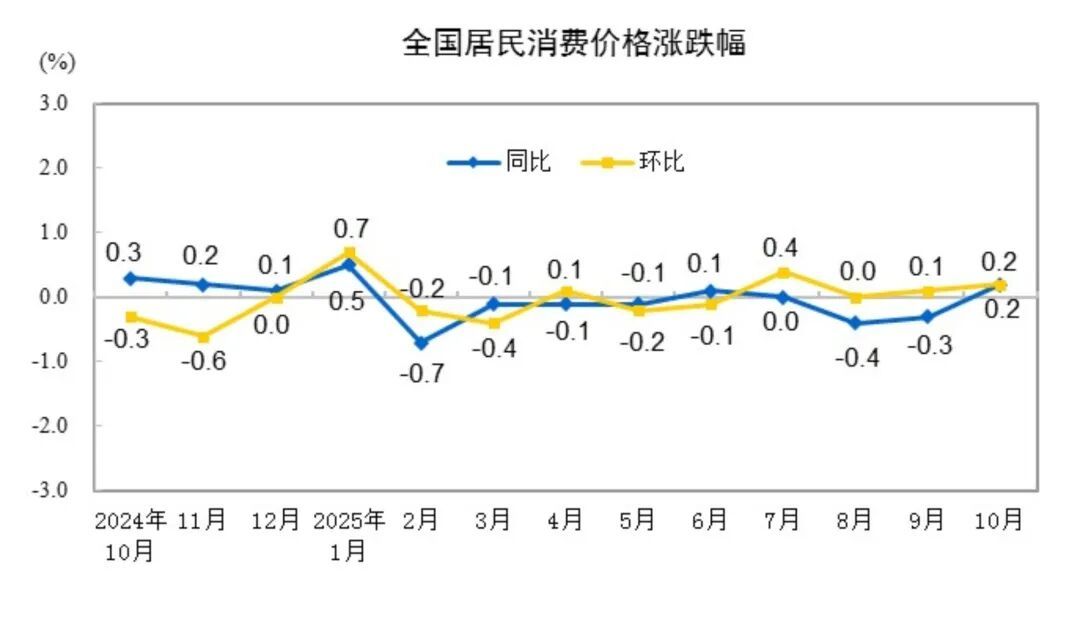
Group 1: CPI Analysis - The Consumer Price Index (CPI) increased by 0.2% month-on-month and year-on-year, marking a shift from a previous decline to an increase [2][3] - Service prices turned from a decline of 0.3% to an increase of 0.2%, influenced by high travel demand during the National Day and Mid-Autumn Festival, with hotel accommodation, flight tickets, and tourism prices rising by 8.6%, 4.5%, and 2.5% respectively [2][3] - Food prices rose by 0.3%, contrasting with a seasonal decline of 0.1%, driven by increased consumption during the holidays, with fresh vegetables, lamb, fresh fruits, shrimp, and beef prices increasing between 0.5% and 4.3% [2][3] Group 2: Core CPI Insights - The core CPI, excluding food and energy, rose by 1.2% year-on-year, marking the highest increase since March 2024 and the sixth consecutive month of growth [3] - Service prices have been gradually recovering since March, with a current month-on-month increase of 0.8%, driven by rising prices in air travel and hotel accommodations [3] Group 3: PPI Analysis - The Producer Price Index (PPI) shifted from flat to an increase of 0.1% month-on-month, marking the first increase of the year [4] - The rise in PPI is attributed to improved supply-demand relationships in certain industries, with coal mining and washing prices increasing by 1.6%, and prices in photovoltaic equipment manufacturing rising by 0.6% [4][5] - Year-on-year, the PPI decreased by 2.1%, but the decline has narrowed for three consecutive months, with significant improvements in the coal mining and washing industry [5] Group 4: Industry-Specific Price Movements - The prices in the non-ferrous metal mining sector increased by 5.3% month-on-month due to rising international metal prices, while oil and gas extraction prices fell by 2.3% due to declining international oil prices [4][5] - The manufacturing prices in sectors such as photovoltaic equipment, battery production, and automotive manufacturing have shown a narrowing decline, indicating a recovery trend in these industries [5]