Guo Jia Tong Ji Ju

Search documents
10月中国粗钢产量7200万吨
Guo Jia Tong Ji Ju· 2025-11-14 02:20
Core Viewpoint - The data from the National Bureau of Statistics indicates a decline in China's steel production in October 2025, with significant year-on-year decreases in crude steel and pig iron output, while steel product output shows a slight decline [1] Group 1: Production Data - In October 2025, China's crude steel production reached 72 million tons, a year-on-year decrease of 12.1% [1] - Pig iron production in October 2025 was 65.55 million tons, reflecting a year-on-year decline of 7.9% [1] - Steel product output in October 2025 totaled 118.64 million tons, showing a slight year-on-year decrease of 0.9% [1] Group 2: Year-to-Date Performance - From January to October 2025, China's crude steel production amounted to 817.87 million tons, down 3.9% year-on-year [1] - The pig iron production for the same period was 711.37 million tons, which is a year-on-year decrease of 1.8% [1] - Steel product output from January to October 2025 increased to 1,217.59 million tons, marking a year-on-year growth of 4.7% [1]
国家统计局:10月规模以上工业增加值增长4.9% 社会消费品零售总额增长2.9%
Guo Jia Tong Ji Ju· 2025-11-14 02:17
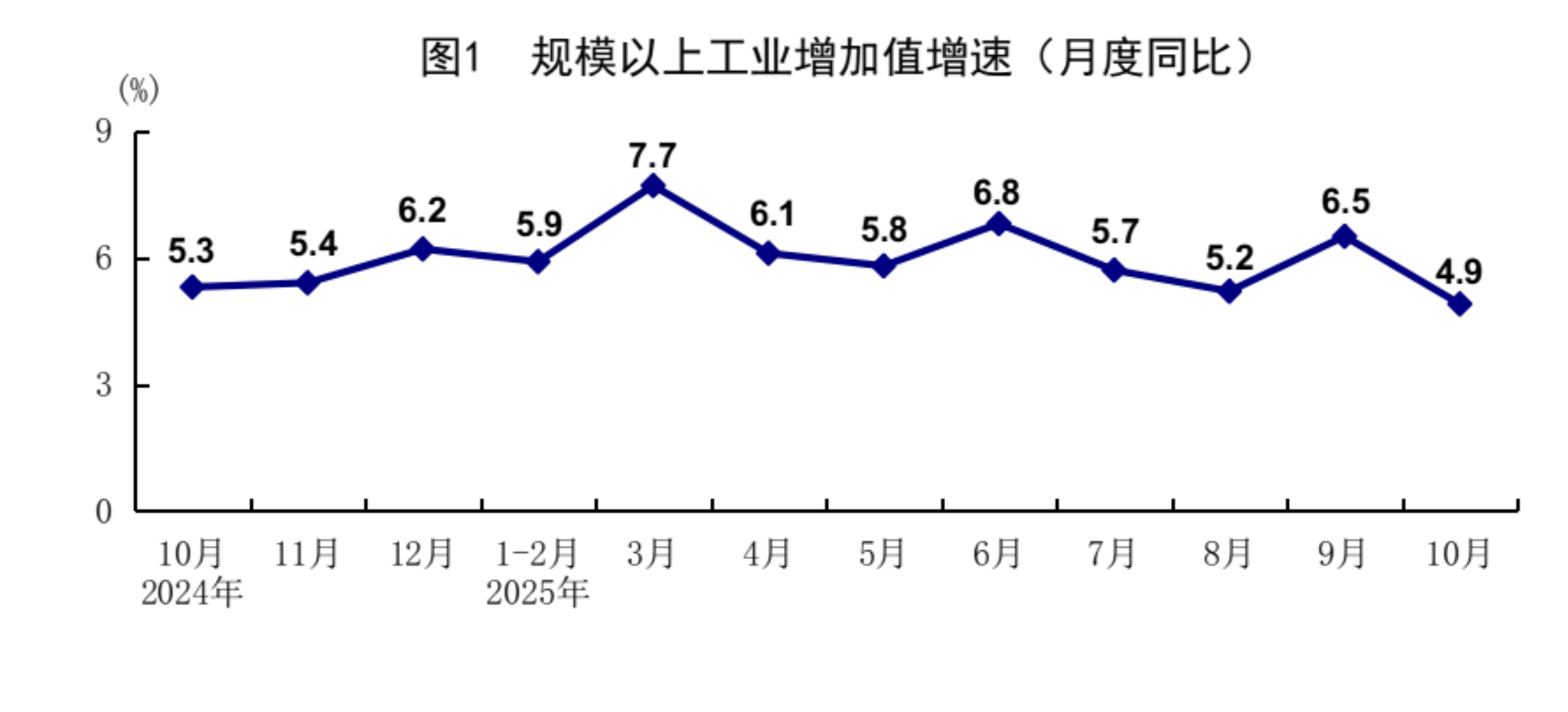
Core Viewpoint - In October, under the strong leadership of the Central Committee with Xi Jinping at its core, the national economy maintained overall stability and progressed steadily, with improvements in employment, market expectations, and price levels, while promoting the construction of a unified national market and facilitating domestic and international dual circulation [1] Industrial Production - In October, the industrial added value above designated size increased by 4.9% year-on-year and 0.17% month-on-month, with mining, manufacturing, and electricity, heat, gas, and water production and supply sectors growing by 4.5%, 4.9%, and 5.4% respectively [2] - The equipment manufacturing industry saw an 8.0% increase, while high-tech manufacturing grew by 7.2%, outpacing the overall industrial growth by 3.1 and 2.3 percentage points respectively [2] - From January to October, the industrial added value increased by 6.1%, and the manufacturing purchasing managers' index was at 49.0% [2] Service Industry - The service production index rose by 4.6% year-on-year in October, with significant growth in information transmission, software, and IT services (13.0%), leasing and business services (8.2%), and finance (5.6%) [3] - From January to October, the service production index increased by 5.7%, and the revenue of large-scale service enterprises grew by 7.6% year-on-year [3] Market Sales - In October, the total retail sales of consumer goods reached 46,291 billion yuan, a year-on-year increase of 2.9% [4] - Online retail sales amounted to 127,916 billion yuan, growing by 9.6% year-on-year, with physical goods online retail sales at 103,984 billion yuan, a 6.3% increase [4] Fixed Asset Investment - From January to October, fixed asset investment (excluding rural households) was 408,914 billion yuan, a year-on-year decrease of 1.7% [5] - Manufacturing investment grew by 2.7%, while real estate development investment fell by 14.7% [5] Trade and Exports - In October, the total value of goods imports and exports was 37,028 billion yuan, a year-on-year increase of 0.1% [6] - From January to October, the total value of goods imports and exports reached 373,090 billion yuan, up by 3.6% year-on-year [6] Employment - The urban surveyed unemployment rate was 5.1% in October, a decrease of 0.1 percentage points from the previous month [7] - The average weekly working hours for employees were 48.4 hours [7] Consumer Prices - In October, the Consumer Price Index (CPI) rose by 0.2% year-on-year, reversing from a decline of 0.3% in the previous month [8] - The Producer Price Index (PPI) for industrial producers decreased by 2.1% year-on-year, with a narrowing decline compared to the previous month [8] Overall Economic Outlook - The national economy showed overall stability in October, with solid progress in transformation and upgrading, and new growth drivers continuing to strengthen [9]

国家统计局解读2025年10月房价统计数据
Guo Jia Tong Ji Ju· 2025-11-14 02:14
10月份,一线城市二手住宅销售价格环比下降0.9%,降幅比上月收窄0.1个百分点。其中,北京、上 海、广州和深圳分别下降1.1%、0.9%、0.9%和0.9%。二线城市二手住宅销售价格环比下降0.6%,降幅 收窄0.1个百分点。三线城市二手住宅销售价格环比下降0.7%,降幅扩大0.1个百分点。 二、各线城市商品住宅销售价格同比下降 10月份,一线城市新建商品住宅销售价格同比下降0.8%,降幅比上月扩大0.1个百分点。其中,上海上 涨5.7%,北京、广州和深圳分别下降2.0%、4.2%和2.6%。二线城市新建商品住宅销售价格同比下降 2.0%,降幅收窄0.1个百分点。三线城市新建商品住宅销售价格同比下降3.4%,降幅与上月相同。 10月份,一线城市二手住宅销售价格同比下降4.4%,降幅比上月扩大1.2个百分点。其中,北京、上 海、广州和深圳分别下降4.7%、3.4%、6.4%和3.3%。二线城市二手住宅销售价格同比下降5.2%,降幅 扩大0.2个百分点。三线城市二手住宅销售价格同比下降5.7%,降幅与上月相同。 ——国家统计局城市司首席统计师王中华解读2025年10月份商品住宅销售价格变动情况统计数据 2025 ...
10月份国民经济运行基本平稳
Guo Jia Tong Ji Ju· 2025-11-14 02:12
Core Viewpoint - In October, under the strong leadership of the Central Committee with Xi Jinping at its core, the national economy maintained overall stability and progressed steadily, with improvements in employment, market expectations, and price levels, while promoting the construction of a unified national market and facilitating domestic and international dual circulation [1]. Group 1: Industrial Production - In October, the industrial added value above designated size increased by 4.9% year-on-year and 0.17% month-on-month [2]. - The equipment manufacturing industry saw an 8.0% year-on-year increase, while high-tech manufacturing grew by 7.2%, both outpacing the overall industrial growth by 3.1 and 2.3 percentage points respectively [2]. - The manufacturing purchasing managers' index was recorded at 49.0, indicating a slight contraction in manufacturing activity [2]. Group 2: Service Industry - The service production index increased by 4.6% year-on-year in October, with significant growth in information transmission, software, and IT services at 13.0% [3]. - The business activity index for the service industry was at 50.2, indicating stable activity levels [3]. - For the first ten months, the service production index grew by 5.7% year-on-year [3]. Group 3: Market Sales - In October, the total retail sales of consumer goods reached 46,291 billion yuan, a year-on-year increase of 2.9% [4]. - Online retail sales amounted to 127,916 billion yuan, growing by 9.6% year-on-year, with physical goods accounting for 25.2% of total retail sales [4]. - The growth rate of service retail sales accelerated to 5.3% year-on-year in the first ten months [4]. Group 4: Fixed Asset Investment - From January to October, fixed asset investment (excluding rural households) totaled 408,914 billion yuan, a year-on-year decrease of 1.7% [5]. - Manufacturing investment increased by 2.7%, while real estate development investment fell by 14.7% [5]. - High-tech industries, such as information services and aerospace manufacturing, saw significant investment growth of 32.7% and 19.7% respectively [5]. Group 5: Trade and Employment - In October, the total value of goods imports and exports was 37,028 billion yuan, with exports decreasing by 0.8% and imports increasing by 1.4% [6]. - The urban surveyed unemployment rate was 5.1% in October, showing a slight decrease from the previous month [7]. - The average working hours for employed persons were recorded at 48.4 hours per week [7]. Group 6: Price Trends - The Consumer Price Index (CPI) rose by 0.2% year-on-year in October, reversing from a decline of 0.3% in the previous month [8]. - The Producer Price Index (PPI) for industrial producers decreased by 2.1% year-on-year, with the decline narrowing compared to the previous month [9]. - The core CPI, excluding food and energy, increased by 1.2% year-on-year, reflecting a slight acceleration in inflationary pressures [8].
国家统计局:10月份规上工业原油产量1800万吨 同比增长1.3%
Guo Jia Tong Ji Ju· 2025-11-14 02:09
Core Insights - The production of crude oil in China continues to grow, with October output reaching 18 million tons, reflecting a year-on-year increase of 1.3%, although the growth rate has slowed by 2.8 percentage points compared to September [1] - The average daily production in October was 581,000 tons, while the cumulative production from January to October totaled 180.64 million tons, marking a year-on-year increase of 1.7% [1] Production and Processing - Crude oil processing showed stable growth, with October processing volume at 63.43 million tons, representing a year-on-year increase of 6.4% [1] - The average daily processing in October was 2.046 million tons, and the total processing volume from January to October reached 614.24 million tons, which is a year-on-year increase of 4.0% [1]
国家统计局:10月份规上工业原煤产量4.1亿吨 同比下降2.3%
Guo Jia Tong Ji Ju· 2025-11-14 02:09
国家统计局数据显示,原煤生产保持较高水平。10月份,规上工业原煤产量4.1亿吨,同比下降2.3%; 日均产量1312万吨。1—10月份,规上工业原煤产量39.7亿吨,同比增长1.5%。 (文章来源:国家统计局) ...
国家统计局:10月份规上工业天然气产量221亿立方米 同比增长5.9%
Guo Jia Tong Ji Ju· 2025-11-14 02:07
(文章来源:国家统计局) 国家统计局数据显示,天然气生产增速放缓。10月份,规上工业天然气产量221亿立方米,同比增长 5.9%,增速比9月份放缓3.5个百分点;日均产量7.1亿立方米。1—10月份,规上工业天然气产量2170亿 立方米,同比增长6.3%。 ...
国家统计局:就业形势总体稳定 城镇调查失业率下降
Guo Jia Tong Ji Ju· 2025-11-14 02:06
Core Insights - The average urban survey unemployment rate in China from January to October is 5.2% [1] - In October, the national urban survey unemployment rate decreased to 5.1%, down by 0.1 percentage points from the previous month [1] - The unemployment rate for local registered labor is 5.3%, while the rate for migrant labor is 4.7%, with agricultural migrant labor at 4.5% [1] - The unemployment rate in 31 major cities is 5.1%, also a decrease of 0.1 percentage points from the previous month [1] - The average weekly working hours for employed persons in the country is 48.4 hours [1]
国家统计局:2025年11月上旬流通领域棉花价格下跌0.1%
Guo Jia Tong Ji Ju· 2025-11-14 02:04
Core Insights - The monitoring of market prices for 50 important production materials across nine categories indicates a mixed trend in prices for early November 2025, with 26 products experiencing price increases, 23 seeing declines, and one remaining stable [1] Price Trends - Cotton (specifically, white cotton grade three) recorded a price of 14,485.8 yuan per ton, which represents a decrease of 19.6 yuan per ton, equating to a decline of 0.1% compared to the previous period [1]
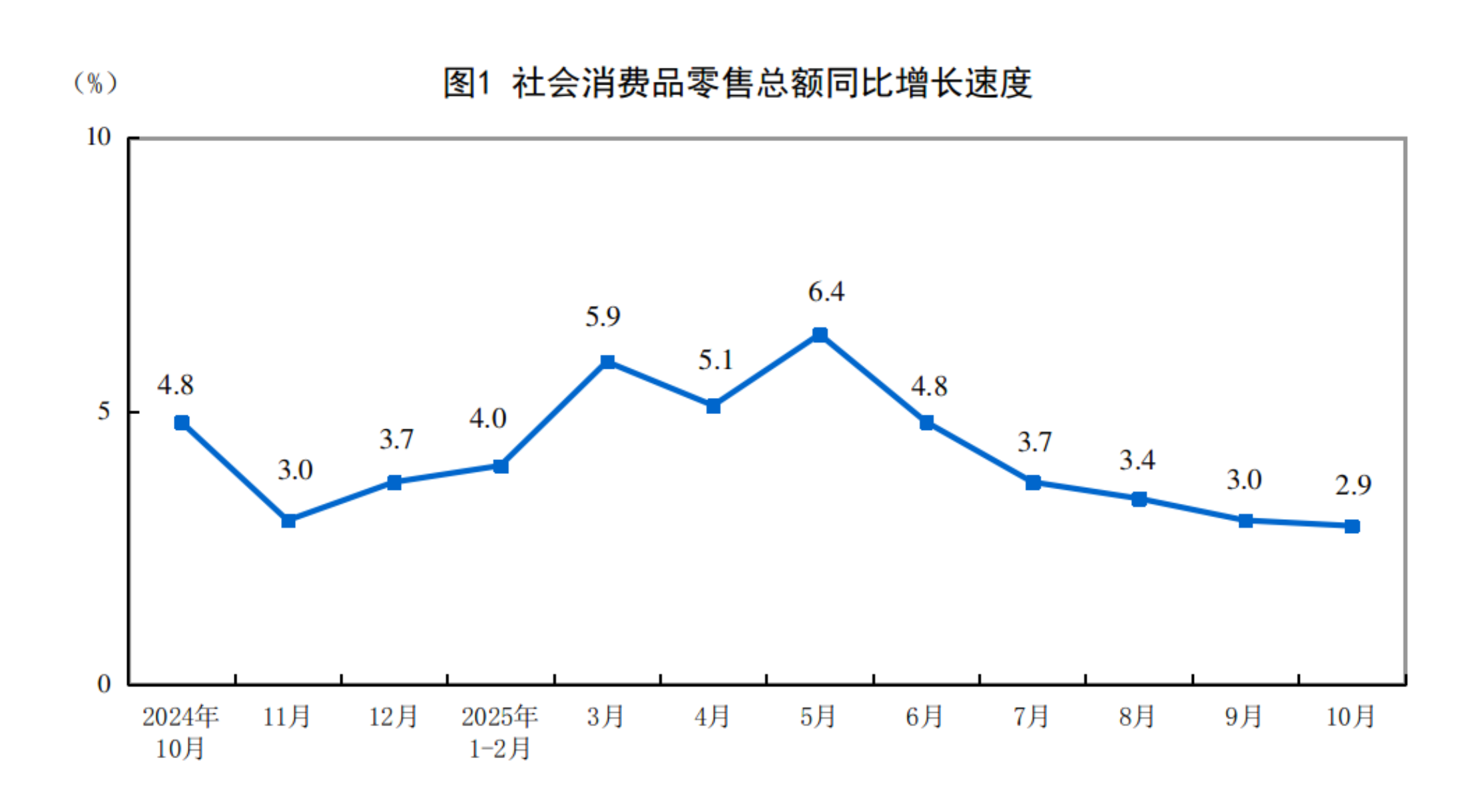
国家统计局:10月份社会消费品零售总额46291亿元 同比增长2.9%
Guo Jia Tong Ji Ju· 2025-11-14 02:04
| | 10月 | | 1-10月 | | | --- | --- | --- | --- | --- | | 指 标 | 绝对量 | 同比增长 | 绝对量 | 同比增长 | | | (亿元) | (%) | (亿元) | (%) | | 社会消费品零售总额 | 46291 | 2.9 | 412169 | 4.3 | | 其中:除汽车以外的消费品零售额 | 42036 | 4.0 | 372160 | 4.9 | | 其中:限额以上单位消费品零售额 | 17782 | 1.6 | 164935 | 4.5 | | 其中:实物商品网上零售额 | l | । | 103984 | 6.3 | | 按经营地分 | | | | | | 城镇 | 40021 | 2.7 | 356860 | 4.2 | | 乡村 | 6270 | 4.1 | 55309 | 4.6 | | 按消费类型分 | | | | | | 餐饮收入 | 2199 | 3.8 | 46188 | 3.3 | | 其中:限额以上单位餐饮收入 | 1459 | 3.7 | 13510 | 2.4 | | 商品零售额 | 41092 | 2.8 | 3 ...