
Hu Xiu

Search documents
世间再无“狗日的”,满眼全是“黑公关”
Hu Xiu· 2025-10-21 04:01
Core Insights - The article reflects on the evolution of Tencent and the media landscape over the past 15 years, highlighting a shift from critical journalism to a more protective stance by companies against negative press [1][5] - It emphasizes the need for a balanced media environment where criticism is allowed, contrasting it with the current trend of companies suppressing dissenting voices under the guise of maintaining a healthy business environment [5] Group 1: Media and Corporate Dynamics - The article recalls a pivotal moment in 2010 when a critical piece on Tencent prompted the company to reflect on its closed-off approach, leading to a strategic transformation [1] - There is a noted decline in critical media coverage, with an increase in corporate flattery and a rise in lawsuits against media outlets for negative reporting [2][3] - Companies have grown significantly in size and influence, yet they seem less tolerant of criticism, often labeling it as slander [3][5] Group 2: Corporate Behavior and Public Relations - The existence of "black public relations" is acknowledged, but the article argues that the real issue lies in companies' internal conflicts and their inability to accept criticism [4][9] - Many companies use the pretext of protecting the business environment to eliminate dissent, while simultaneously engaging in misleading practices against competitors [4][9] - The article warns against a corporate culture that only allows praise and silences criticism, questioning the sustainability of such an environment [5]

“反噬”这个词真的听烦了
Hu Xiu· 2025-10-21 03:41
Core Viewpoint - The article discusses the phenomenon of "traffic backlash" experienced by companies like Xiaomi, highlighting the relationship between user base growth, product reputation, and the challenges of scaling business in a digital environment [1][5][24]. Group 1: Traffic and Reputation - The increase in user base directly affects product reputation, creating a formula where product reputation safety coefficient = project time / user base, indicating that a larger coefficient means greater safety [4]. - Companies that focus solely on traffic without considering reputation often face backlash, as seen in the cases of Xiaomi, Alibaba, and others [5][12]. - The article emphasizes that a mature company should separate public relations and marketing functions to ensure that reputation management is not compromised for the sake of traffic [10][14]. Group 2: Understanding Backlash - Backlash is not an inevitable outcome of pursuing traffic; it can be mitigated by focusing on product quality rather than relying on individual personalities or trends [15][20]. - Successful companies like those in Silicon Valley manage to avoid backlash by aligning traffic with product performance, demonstrating that genuine product value is key [17][18]. - The article suggests that backlash can be seen as a form of validation, indicating that a company has reached a level of success where backlash is possible [24][26]. Group 3: Strategies to Mitigate Backlash - Companies should maintain open communication with users, competitors, and media to manage public perception and avoid triggering regulatory scrutiny [30][31]. - A proactive approach to criticism, including listening and adapting, is essential for companies to navigate backlash effectively [32]. - The article concludes that true strength lies in a company's ability to remain unaffected by rumors and maintain a focus on product integrity [33].



网易为啥总是“高开低走”?
Hu Xiu· 2025-10-21 03:34
Core Viewpoint - The article discusses the challenges faced by NetEase Games, highlighting the disparity between high expectations and actual performance, leading to frequent game shutdowns and concerns over player rights [1] Group 1: Company Performance - NetEase Games has a history of launching ambitious projects, promising long-term operation, yet many games are shut down within a short period, often just two years [1] - The company is criticized for its reliance on monetization strategies such as gacha mechanics, which can lead to player dissatisfaction [1] Group 2: Player Experience - Players express frustration over the "养猪场模式" (pig farming model), which refers to the grind and financial investment required to progress in games [1] - The emotional investment of players is contrasted with the reality of monetization, where long wait times for content updates do not align with player expectations [1]

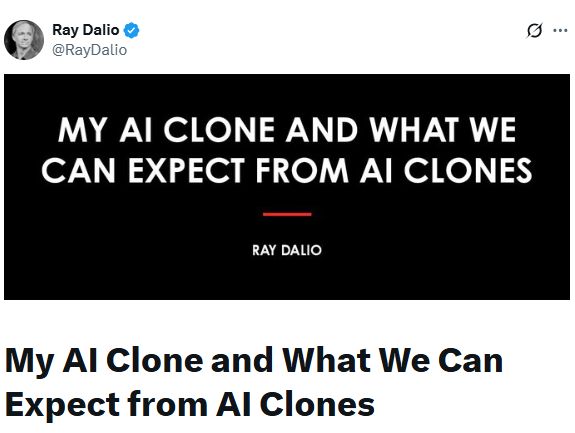
达利欧复制了“AI达利欧”
Hu Xiu· 2025-10-21 03:16
Core Insights - Ray Dalio, founder of Bridgewater Associates, is developing an AI clone named "Digital Ray" to digitize his investment principles and decision-making framework for broader audience engagement [1][2][6] - The AI clone aims to facilitate unlimited conversations, allowing users to explore the thought processes of one of the world's most successful investors [7][8] Group 1: AI Clone Development - The AI clone is a natural extension of Dalio's work over the past 40 years, designed to replicate his unique perspectives and decision-making style [3][19] - "Digital Ray" has achieved an 80% effectiveness in discussing market and investment topics and a 95% effectiveness in discussing life and work principles compared to Dalio himself [3][23] - The AI clone is distinct from general language models (LLMs) as it focuses on specific individual values and preferences, rather than being a generic product [5][14] Group 2: Investment Philosophy and Impact - Dalio's investment insights are highly regarded, with a personal wealth of $19.2 billion and Bridgewater managing $92 billion in assets [6] - The introduction of the AI clone may signify a transformation in how financial expertise is disseminated, moving from static formats to interactive, personalized channels [7][8] - Dalio's approach emphasizes the importance of integrating individual values and principles into decision-making processes, which he believes enhances the effectiveness of AI in providing guidance [9][28] Group 3: Future Prospects - The AI clone is currently in its early stages, with ongoing testing and improvements expected to enhance its capabilities [17][24] - Dalio envisions a future where personalized AI can serve as trusted decision-making partners, surpassing the limitations of current general AI models [29][30] - The development of "Digital Ray" reflects a broader trend towards creating individualized AI that aligns with users' preferences and values, potentially revolutionizing personal and professional decision-making [29][30]

从秀场到工厂,人形机器人落地为何这么快?
Hu Xiu· 2025-10-21 03:16
技术突破、政策加持、资本涌入,共同推动人形机器人从实验室迈向生活,2025年迎来"人机共生"的量 产新纪元。 ...

每个月房贷3500,意味着什么?
Hu Xiu· 2025-10-21 02:32
Core Viewpoint - The article discusses the financial pressures faced by ordinary families, particularly in relation to housing costs and the impact on lifestyle and job security. Group 1: Financial Pressures - Families are experiencing significant financial stress due to housing costs, with monthly mortgage payments around 3,500 yuan [11] - The burden of a mortgage can lead to a lack of financial flexibility, making it difficult for individuals to consider job changes or take risks [41][42] - Ordinary families often rely on dual incomes to manage expenses, highlighting the vulnerability of households with only one income source [28][30] Group 2: Lifestyle Impacts - The presence of children increases monthly expenditures significantly, with families spending around 150,000 yuan annually [20] - The need to balance work and family responsibilities can lead to exhaustion, as seen in the case of individuals taking on additional jobs to support their families [32][35] - The article emphasizes the dual nature of homeownership, providing comfort and stability while also imposing financial strain [44]
曹德旺辞职,将1700亿福耀玻璃传承给曹晖
Hu Xiu· 2025-10-21 02:25
"曹晖,我的儿子,论水平论资历他都不如你们,但是他有一个比你们强,他是我曹德旺的儿子,"这是 多年前曹德旺在一档节目中提起自己儿子时亲口说的话。曹德旺把1700亿的福耀玻璃交给儿子曹晖,理 由很直接:"他是我儿子"。 ...
致女儿小松花的第一封信:你就这样来到这个世界上
Hu Xiu· 2025-10-21 02:19
然而10月18日凌晨5点,你本来做好悲壮准备的母亲开始感受到规律的疼痛,在疼痛持续半小时后,我们意识到情况不同以往,晚些洗澡时脱落的宫颈粘 膜更是印证了这个判断。吃完了早饭(你妈妈很后悔只吃了一根芝士香肠),我们和你的奶奶和姥姥便打车前往医院,幸运地拿下最后一个套间,在检查 室签署海量的文件。 小松花: 见信好。 此时此刻,你的生物学父亲(并不是每个男人都有我这样十足的信心,这份信心源自对你伟大母亲的信任),也就是我,正在香港大学深圳医院昏暗的待 产房里,听着中央空调和血压仪收缩的声音,窝在充满抓痕的旧沙发上,用iPad敲下这些文字,为你出生的过程做些记录,也让未来我们一起回忆这段甜 蜜时光时,能提升一点颗粒度。 套用当下最流行的MBTI十六型人格理论,你是一个很J的孩子。 你在妈妈肚子里待满40周的预产期是10月18日,由于你的很多姨姨都在满37周发动,所以早在国庆假期前,你同样很J的母亲就做好了致敬前辈的准备, 敦促我收拾好了待产包和住院的行李,还威逼我把电脑搬出你的房间。于是我丧失了独自熬夜玩《空洞骑士:丝之歌》的机会(愿你也能玩到这么好的游 戏)。只能说我因此增加的寿命,背后也有你对我的一片孝心。 但 ...

侯晓迪Alignment 2025演讲:穿越热潮周期,硬技术公司的生存之道
Hu Xiu· 2025-10-21 02:13
硅谷101的年度科技大会上,不少演讲嘉宾分享了极具价值的观点,我们将会把一些重要观点逐渐整理 上线。这期我们来看看侯晓迪对创业的看法,他认为在"后热潮时代",生存发展应该是:忘掉估值,回 归正常的商业逻辑——像经营一家餐厅一样思考成本与收入。 ...
一个原教旨主义产品经理眼中的世界
Hu Xiu· 2025-10-21 01:54
Core Insights - The discussion focuses on product methodology and the philosophy of growth rather than specific details about the company or its vehicles [2][4]. Group 1: Personal Background and Philosophy - The guest, Fan Haoyu, has 25 years of experience in product and design, having worked in various industries including mobile, gaming, and automotive [3][4]. - Fan's move to Li Auto was motivated by a desire to return to Beijing, a city he finds historically rich and vibrant [5][6]. Group 2: Observations on Beijing and Market Dynamics - Fan notes a shift in Beijing's atmosphere over recent years, with a decline in the sense of ambition and an increase in anxiety among residents [7][9]. - Despite challenges, there remains a continuous influx of young people into Beijing, indicating the city's enduring vitality and potential for innovation [12][13]. Group 3: Product Design and User Experience - Fan emphasizes the importance of observation and understanding in product design, advocating for a process that combines creativity with practical resource allocation [31][38]. - He describes his approach as a "fundamental product manager," focusing on the iterative process of observation, understanding, and combination to achieve optimal solutions [36][37]. Group 4: User Needs and Market Segmentation - The complexity of user segmentation in China is highlighted, with many feeling underrepresented despite an oversupply of "useful" products [73][75]. - Fan suggests that successful products must cater to both the recognition needs of urban consumers and the accessibility needs of lower-tier markets [79]. Group 5: Future Trends and AI Impact - The conversation touches on the transformative potential of AI in product design, suggesting that future products will become increasingly personalized and user-centric [66][69]. - Fan predicts that the role of AI will evolve to facilitate more direct and individualized interactions between users and products, potentially creating new intermediary roles [70][71]. Group 6: Product Lifecycle and User Engagement - Fan outlines a framework for evaluating product success based on user reactions, emphasizing the importance of generating surprise and delight [172][175]. - He argues that a product's ability to engage users over time is crucial for its long-term success, with "interesting" experiences being a key differentiator [55][176]. Group 7: Balancing Utility and Enjoyment - The discussion highlights the need for products to be both useful and enjoyable, with a focus on creating meaningful connections with users [198]. - Fan stresses that while data is important, personal intuition and user feedback should guide product development [120][128].