Xin Lang Ji Jin

Search documents
金融知识进社区,护好居民幸福家—工银瑞信投教基地走进方庄街道开展防非讲座
Xin Lang Ji Jin· 2025-10-17 08:35
MACD金叉信号形成,这些股涨势不错! 责任编辑:郭栩彤 为进一步加大投资者教育力度,切实提升社区居民的金融素养和对非法金融活动防范意识,在2025年世 界投资者周期间,工银瑞信投教基地以"新时代·新基金·新价值——北京公募基金高质量发展在行动"专 项工作为指引,常态化深入社区一线,于10月17日走进方庄街道办事处,开展了干货满满的防非知识讲 座,帮助居民们防范金融风险,培养科学行权维权意识,树立正确的金融观、理财观。 风险提示: 基金管理人依照恪尽职守、诚实信用、谨慎勤勉的原则管理和运用基金财产,但不保证基金一定盈利, 也不保证最低收益。基金过往业绩不预示未来表现,基金管理人管理的其他基金的业绩并不构成基金业 绩表现的保证。基金过往业绩不代表其未来表现,基金管理人管理的其他基金的业绩并不构成基金业绩 表现的保证。投资者投资基金前应认真阅读《基金合同》、《招募说明书》、《基金产品资料概要》等 法律文件,及更新等法律文件,在全面了解产品情况、费率结构、各销售渠道收费标准及听取销售机构 适当性意见的基础上,选择适合自身风险承受能力的投资品种进行投资。基金投资须谨慎。 "不明链接不乱点,陌生二维码莫扫描,个人信息保 ...
博时基金曾豪:市场结构性特征明显,科技成长与资源安全成为双主线
Xin Lang Ji Jin· 2025-10-17 08:24
博时基金资深投资总监(董事总经理级) 曾豪 日前,沪指收盘站上3900点。这是自2015年牛市后,时隔十年的重要突破,引发市场广泛关注。 沪指时隔十年再次站上3900点,具有多方面重要象征意义,这既反映了市场情绪的积极变化,也标志着 A股可能迈入全新发展阶段,充分体现了中国资本市场深化改革、经济基本面持续修复的积极成果。 从市场情绪角度看,3900点是长期以来的关键阻力位,其突破极大地提振了投资者信心。此次突破是在 多重利好因素下实现的,如央行释放流动性、国内外资金加速流入等,并非单纯的情绪宣泄。 从市场本质来看,这更可能是A股迈入全新发展阶段的标志。一方面,宏观经济的稳健增长为市场提供 了坚实支撑,上市公司业绩整体平稳,尤其是科技板块订单和业绩显著提升。另一方面,政策持续发力 支持资本市场发展,如推动中长期资金入市、深化资本市场改革等,为市场筑牢根基。此外,市场结构 性特征明显,科技成长与资源安全成为双主线,资金布局明确,显示出A股正朝着更具活力和韧性的方 向发展。 资金来源多元化 可以观察到,近期市场成交量显著放大,资金来源呈现多元化,外资回流、国内机构加仓以及居民储蓄 通过基金等方式"搬家"入市等因素均 ...
长城基金杨光:资产定价新范式与多元配置新视野
Xin Lang Ji Jin· 2025-10-17 08:17
Group 1 - The core viewpoint is that the asset pricing paradigm is undergoing a profound transformation, shifting from a static world based on certainty to a dynamic ecosystem based on uncertainty [1][2] - The financial market is transitioning from a Newtonian mechanical worldview to a quantum characteristic market, where asset prices exhibit both "particle" (real value based on cash flow) and "wave" (narrative value based on consensus) properties [2][3] - The new pricing paradigm emphasizes the importance of technology, new productivity, and collective consensus as key factors in asset valuation [12][16] Group 2 - The three pillars of asset pricing are changing: the curvature of pricing in time and space has been altered, the definition of value is expanding from "atomic value" to "bit value," and the traditional risk-return equation is being rewritten [2][3][10] - Investors need to transition from being "valuation accountants" to "paradigm geographers," utilizing tools beyond financial statements and discount models to include technology roadmaps and narrative networks [4][5] - Traditional valuation models like DCF and DDM are losing their explanatory power due to high uncertainty and sensitivity to assumptions, making them less applicable to high-growth or volatile companies [6][7][8] Group 3 - The classic economic cycle models, such as the Merrill Lynch Clock, have become ineffective due to structural changes in the macroeconomic environment, requiring a shift in asset allocation strategies [8][9] - The concept of "safe assets" is diminishing as traditional safe havens like government bonds face challenges from fiscal credit erosion and the politicization of monetary policy [10][11] - The definition of safety is evolving from unconditional trust in sovereign credit to seeking systemic resilience in extreme situations, with gold and cryptocurrencies emerging as new forms of value storage [10][12] Group 4 - The new asset pricing paradigm should focus on the sources of value creation in the digital economy, including technological advancements, new productivity, and collective consensus [12][13][14] - The A-share market is becoming a battleground for new productivity and valuation reassessment, moving away from traditional macroeconomic cycles towards sectors aligned with national strategic intentions [16] - The U.S. stock market is evolving into a core pricing arena for global technological innovation, with tech giants being valued not just on current cash flows but also on their potential as platform-based options for future infrastructure [16][17] Group 5 - Gold's role is shifting from a simple inflation hedge to a decentralized consensus vehicle, reflecting global capital's distrust in fiat currency systems [17] - Cryptocurrencies represent an extreme experiment in asset pricing, relying on technology architecture and global consensus rather than traditional fundamentals [18] - The asset allocation strategy must evolve from passive tracking of economic cycles to proactive identification of key sectors representing technological progress and new productivity [18][19]
初心不贰 拾光同行——工银瑞信20周年
Xin Lang Ji Jin· 2025-10-17 08:17
Core Viewpoint - The article highlights the formation of a MACD golden cross signal, indicating a positive trend in certain stocks [1] Group 1 - The MACD golden cross signal is a technical indicator suggesting potential upward momentum in stock prices [1] - Several stocks are experiencing notable gains as a result of this signal [1]
【公募基金高质量发展】之工银瑞信:20年,与客户伙伴知心相伴访谈特辑(第六期)
Xin Lang Ji Jin· 2025-10-17 08:14
Core Viewpoint - The article highlights the formation of a MACD golden cross signal, indicating a positive trend in certain stocks [1] Group 1 - The MACD golden cross signal is a technical indicator suggesting potential upward momentum in stock prices [1] - Several stocks are experiencing notable gains as a result of this signal [1]
【公募基金高质量发展】之工银瑞信:20年,与客户伙伴知心相伴访谈特辑(第四期)
Xin Lang Ji Jin· 2025-10-17 08:10
Core Viewpoint - The article highlights the formation of a MACD golden cross signal, indicating a positive trend in certain stocks [1] Group 1 - The MACD golden cross signal is a technical indicator suggesting potential upward momentum in stock prices [1] - Several stocks are experiencing notable gains as a result of this signal [1]
【公募基金高质量发展】之工银瑞信:20年,与客户伙伴知心相伴访谈特辑(第五期)
Xin Lang Ji Jin· 2025-10-17 08:10
Core Insights - The article highlights the formation of a MACD golden cross signal, indicating a potential bullish trend in certain stocks [1] Group 1 - The MACD golden cross signal is a technical indicator that suggests a possible upward momentum in stock prices [1] - Several stocks are experiencing notable price increases as a result of this signal [1]
【公募基金高质量发展】之工银瑞信:20年,与客户伙伴知心相伴访谈特辑(第三期)
Xin Lang Ji Jin· 2025-10-17 08:03
Core Insights - The article highlights the formation of a MACD golden cross signal, indicating a potential bullish trend in certain stocks [1] Group 1 - The MACD golden cross signal is a technical indicator that suggests a possible upward momentum in stock prices [1] - Several stocks are identified as having performed well in response to this signal, indicating positive market sentiment [1]
博时基金市场异动陪伴10月17日:沪指跌1.95%,深证成指、创业板指跌超3%
Xin Lang Ji Jin· 2025-10-17 07:42
Market Performance - On October 17, the Shanghai Composite Index fell by 1.95%, while the Shenzhen Component Index and the ChiNext Index both dropped over 3% [1] Analysis of Market Conditions - The decline in the three major indices is attributed to the ongoing risks associated with U.S. regional banks, which have revealed potential losses due to loan issues, raising global concerns about the stability of the financial system. This, combined with uncertainties from U.S.-China trade tensions, has led to a significant tightening of market risk appetite [2] - The rapid increase in gold prices reflects market vigilance towards a potential credit crisis, further suppressing equity asset performance. Additionally, some previously popular sectors in the A-share market have seen substantial gains, prompting profit-taking amid a lack of clear market direction, particularly affecting growth sectors like electric equipment and electronics [2] Domestic Financial Environment - September financial data presents a mixed signal of overall positivity and structural concerns. The M1 growth rate rebounded significantly to 7.2%, indicating enhanced corporate liquidity and improved economic vitality. However, the year-on-year growth of new social financing and credit remains weak, with household loans still lagging and corporate medium to long-term demand needing improvement, suggesting that the recovery of the real economy is not yet solid [2] - A significant decrease in non-bank deposit increments may indicate a slowdown in the willingness of new funds to enter the market, although this could also be related to high year-on-year comparisons and seasonal financial adjustments [2] Market Outlook - In the context of external risks and internal structural transitions, the A-share market may continue to experience a volatile pattern in the short term, with accelerated sector rotation. However, in the medium to long term, the stabilization of the economic fundamentals and deepening capital market reforms are expected to support the recovery of A-share valuations [3] - Defensive sectors such as dividend strategies and essential consumption, which have previously underperformed, may present valuation advantages. Additionally, technology growth sectors like new energy and semiconductors may gradually reveal medium to long-term investment value following recent adjustments. Investors are advised to consider a "core + satellite" strategy, focusing on low-valuation dividend sectors with strong cash flow for core holdings, while opportunistically investing in policy-supported technology leaders for satellite positions [3]

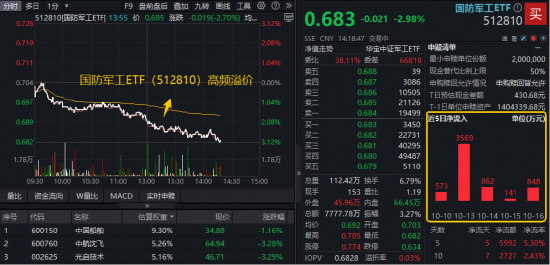
军贸重磅!事关歼-10战机!国防军工ETF(512810)下挫区间高频溢价,近5日连续吸金!
Xin Lang Ji Jin· 2025-10-17 06:44
Core Viewpoint - The defense and military industry sector is experiencing a decline, with the defense military ETF (512810) nearing a 3% drop, while there are signs of positive capital inflow as investors may be entering the market on dips [1][3]. Group 1: Market Performance - On October 17, the defense military sector continued to decline, with the Shenzhen Component Index and the ChiNext Index both dropping over 2.5% [1]. - The defense military ETF (512810) showed a significant trading volume, exceeding 77 million yuan, which is higher than the previous day's total [1]. Group 2: Fundamental Developments - Indonesia's Defense Minister confirmed on October 15 that the country will procure Chinese J-10 fighter jets, indicating potential international demand for military equipment [3]. - The National Defense Science and Technology Bureau is accelerating key tasks for the fourth quarter to ensure high-quality completion of annual work and a successful conclusion to the 14th Five-Year Plan [3]. - Market expectations for new orders are gradually increasing as the 14th Five-Year Plan concludes and the 15th Five-Year Plan begins, which is expected to solidify the foundation for the defense military market [3]. Group 3: Investment Opportunities - The defense military ETF (512810) covers various sectors including controlled nuclear fusion, commercial aerospace, low-altitude economy, large aircraft, deep-sea technology, and military AI, making it an efficient tool for investing in core defense military assets [3].