高工锂电

Search documents
开年新车公告:宁德“LFP+三元”电池上车零跑、小米SU7更新三元Max版
高工锂电· 2026-01-10 12:19
摘要 高压平台 + 超快充电池已成高端 SUV 标配。 2026 年工信部新车第一弹来袭。 据第 403 批《道路机动车辆生产企业及产品公告》,开年共有 82 款新车公示,纯电车型 49 款,混动 / 增程共 33 款。其中,比亚迪系新车公示 最多,共 32 款,弗迪电池配套车型包括王朝、海洋系列,以及方程豹、领汇、腾势品牌。 宁德时代紧跟弗迪其后,拿下 28 款新车配套,三元车型共 16 款, LFP 车型 11 款," LFP+ 三元"电池 1 款,该电池上车零跑 SUV D19 。 从零跑的官方宣传来看, D19 部分车型搭载了宁德时代 115KWh 超混电芯,能量密度提升了 18.5% ,率先满足 2026 年最新电池国标。 值得一提的是,宁德时代此前已提出 AB 电池概念,可实现" LFP+ 三元"以及" LFP+ 钠电"等组合。而最新双核电池的概念在其去年首个科技日上 着重强调,成为行业焦点。 事实上,宁德时代双核电池可视为 AB 电池的加强版。 具体来看,宁德时代"双核架构"的其中一个矩阵为,骁遥 " 三元铁/ 双三元 " 双核电池(三元+铁锂/ 三元自生成负极电池),输出功率大于 1000kW ...


锂电年报预告集体转暖 紫金矿业、华友钴业等领衔
高工锂电· 2026-01-09 10:46
Core Viewpoint - The lithium battery industry chain is showing signs of recovery, with financial performance improving significantly in the resource and material sectors, indicating a potential investment opportunity [3]. Resource Sector - Salt Lake Co. expects a net profit of 8.29 to 8.89 billion yuan for 2025, with a year-on-year increase of nearly 91%, attributed to rising potassium fertilizer prices and a rebound in lithium carbonate prices [5]. - Zijin Mining anticipates a net profit of 51 to 52 billion yuan for 2025, reflecting a year-on-year growth of approximately 59% to 62%, driven by increased mineral product prices and operational efficiency [6]. - Zijin Mining has included lithium in its growth strategy, projecting a lithium carbonate equivalent production of about 25,000 tons for 2025 and a target of 120,000 tons for 2026, indicating a shift towards large-scale supply [7]. - Zijin Mining is expanding its lithium business beyond mining, with the establishment of Fujian Zixin Lithium Battery Materials Co., focusing on manufacturing and R&D of electronic materials [8]. - The recovery of profits in the resource sector is often the first sign of an early-stage recovery in the cycle [10]. Integrated Companies - Huayou Cobalt expects a net profit of 5.85 to 6.45 billion yuan for 2025, with a maximum year-on-year increase of about 55%, attributed to the advantages of industrial integration and the recovery of cobalt and lithium prices [11][12]. - The profit growth of integrated companies is linked to the ability to combine resource elasticity and manufacturing efficiency, leading to accelerated profit growth [13]. Material Sector - Tianqi Lithium expects a net profit of 1.1 to 1.6 billion yuan for 2025, with a potential year-on-year growth of over 230%, driven by demand from new energy vehicles and energy storage [14]. - Lichun Group reported that its lithium hexafluorophosphate business has turned profitable since November 2025, benefiting from price recovery [15]. - The profit recovery in the midstream material sector is transitioning from expectation to realization [16]. Market Dynamics - The rapid recovery of profits raises questions about future valuation methods, with a shift from growth narratives to cyclical profit pricing as a potential outcome [17]. - The focus is on the sustainability of excess profits rather than immediate profitability [18]. - Concerns exist regarding potential supply expansion and competition due to short payback periods in the industry [19][20]. Overall Outlook - The current scenario resembles a typical early-stage recovery, with leading companies showing profit improvements as the first signal [21].


固态电池冲刺量产,评价体系亟待重构
高工锂电· 2026-01-09 10:46
Core Viewpoint - The article discusses the current state and future potential of solid-state batteries, emphasizing that polymer-based solid-state batteries may offer a more feasible path to commercialization compared to inorganic alternatives due to their manufacturing compatibility and lower costs [2][8][18]. Group 1: Industry Developments - The CES 2026 showcased a collaboration between Verge electric motorcycles and Donut Lab on solid-state batteries, reigniting discussions on the readiness for mass production [2]. - A national standard for solid-state batteries in China is in the public consultation phase, establishing definitions and classifications for future standards [2]. Group 2: Research Insights - A report from Morgan Stanley highlights safety testing as a significant hurdle for solid-state batteries, with some testing results being less favorable than high-end liquid lithium batteries [5][6]. - The research team from Huazhong University of Science and Technology emphasizes the need to shift the evaluation of solid-state batteries from laboratory metrics to industrial constraints, focusing on scalability, supply chain maturity, and lifecycle costs [9]. Group 3: Technical Challenges and Solutions - The article identifies three main challenges for solid-state batteries: safety concerns, the need for high pressure to maintain solid-solid interface contact, and the cost being potentially more than double that of liquid batteries despite only a modest increase in energy density [6]. - The research team presents advancements in polymer electrolytes, achieving room temperature ionic conductivity of 10⁻³ S·cm⁻¹, enhancing electrochemical stability beyond 5V, and improving thermal stability through engineering solutions [12][13]. Group 4: Manufacturing and Supply Chain Advantages - Polymer-based solid-state batteries are noted for their manufacturing advantages, including compatibility with existing lithium-ion battery production processes, requiring minimal equipment modifications and significantly lower capital investment [15]. - Over 90% of the raw materials for polymer systems can be sourced from existing chemical supply chains, reducing reliance on scarce strategic metals [15]. Group 5: Comparative Analysis of Battery Technologies - The article contrasts the challenges faced by inorganic solid-state batteries, which require complex manufacturing processes and have higher production costs, with the more straightforward upgrade path of polymer systems [16]. - Investment in dedicated production lines for inorganic systems can reach $100 million to $200 million per GWh, significantly higher than the costs associated with polymer systems [17]. Group 6: Future Outlook - The research team concludes that polymer-based solid-state batteries are likely to achieve large-scale commercial application by 2026, driven by their technical maturity and industrial adaptability [18].
电解液企业扎堆港股IPO,释放了哪些信号?
高工锂电· 2026-01-09 10:46
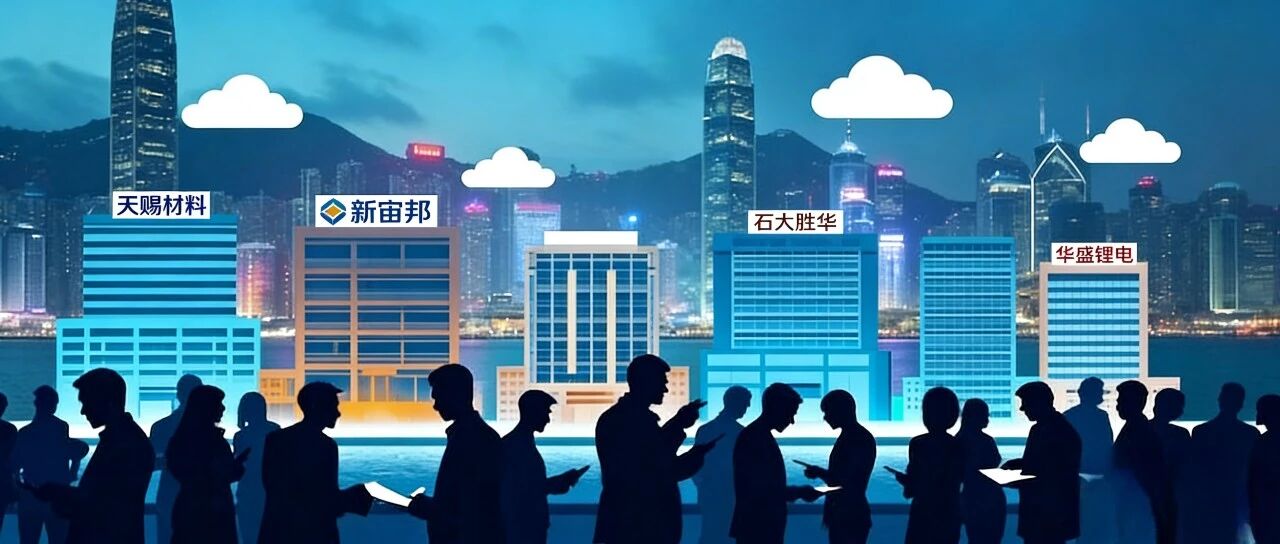
Core Viewpoint - The surge of electrolyte companies going public in Hong Kong is driven by industry dynamics and capital opportunities, reshaping the competitive landscape of lithium battery exports [1] Group 1: IPO Trends and Market Dynamics - Leading electrolyte additive company Huasheng Lithium announced plans for an H-share issuance and listing on the Hong Kong Stock Exchange, marking a significant event in the industry [2] - Since the second half of 2025, major players like Tianci Materials, Xinzhou Bang, and Shida Shenghua have also disclosed plans for IPOs in Hong Kong, indicating a collective push [2] - The easing of IPO regulations and the need for financing in the context of industry transformation have created a favorable environment for these listings [3] Group 2: Industry Growth and Financial Performance - The global electrolyte market is expected to experience explosive growth in 2025, with shipments projected to exceed 2.3 million tons, and Chinese companies holding over 90% market share [3] - Tianci Materials forecasts a net profit of 1.1 to 1.6 billion yuan for 2025, representing a year-on-year increase of 127.31% to 230.63% [3] - The average price of lithium iron phosphate electrolytes surged from 19,000 yuan per ton at the beginning of the year to 35,000 yuan per ton, indicating a structural reversal in the industry [3] Group 3: Global Expansion and Financing Needs - Major battery companies like CATL and Guoxuan High-Tech are accelerating overseas expansion, creating a pressing need for financing among electrolyte material companies [4] - The construction of overseas bases in countries like Hungary and Morocco requires substantial long-term funding, making IPOs in Hong Kong a necessary option [4] Group 4: Differentiated Strategies Among Companies - Tianci Materials aims to use 80% of its IPO proceeds to support global business development, particularly in establishing a lithium-ion battery material integration base in Morocco [7] - Shida Shenghua plans to focus on collaborative projects across the entire supply chain, while Xinzhou Bang seeks to enhance its international brand influence through the IPO [7] - Huasheng Lithium's IPO strategy is centered on niche market breakthroughs, with funds directed towards expanding production capacity and R&D for additive materials [7] Group 5: Impact on Competitive Landscape - The IPO wave is expected to significantly impact the lithium battery supply chain, driving demand for upstream materials and enhancing the global competitiveness of Chinese electrolyte companies [8] - The financing from IPOs will likely widen the gap between leading companies and smaller firms, as top players accelerate technological development and capacity expansion [8] - This trend marks a shift from "product export" to "capacity and technology export," fostering global collaboration within the lithium battery industry [8] Group 6: Future Outlook - The electrolyte industry is poised for high-quality development, supported by ongoing investments in technology and the establishment of overseas production capacities [9] - The Hong Kong capital market will provide continuous funding support, enhancing corporate governance and international operational capabilities [9]


八部门启动“AI+制造”:大模型下沉产线,锂电智造将吃红利
高工锂电· 2026-01-08 10:47
Core Viewpoint - The article discusses the implementation of the "AI + Manufacturing" initiative by eight government departments in China, outlining a roadmap for the deep integration of AI in manufacturing by 2027, including the development of general large models and industrial intelligent bodies [2][3]. Group 1: Implementation Goals - By 2027, the initiative aims to promote the deep application of 3-5 general large models in the manufacturing sector, launch 1,000 high-level industrial intelligent bodies, create 100 high-quality data sets in industrial fields, and promote 500 typical application scenarios [2]. - The document emphasizes the establishment of 2-3 leading ecological enterprises and the selection of 1,000 benchmark enterprises [2]. Group 2: Technical Focus - The initiative shifts focus from "smart factories" to a framework of "computing power, models, data, and scenarios," highlighting the need for enhanced computing power supply and the development of key technologies such as training chips and AI servers [3]. - It proposes the cultivation of industry-specific large models and the development of a "cloud-edge-end" model system to facilitate lightweight deployment in industrial scenarios [3]. Group 3: Application in Lithium Battery Manufacturing - The document indicates that AI will transition from isolated algorithms to replicable capabilities at the production line level in the lithium battery industry, focusing on quality, safety, and consistency [5]. - Key applications identified include production scheduling, process optimization, predictive maintenance, machine vision quality inspection, and real-time monitoring [5]. Group 4: Safety and Compliance - The initiative addresses safety by proposing the development of technologies for deep synthesis authentication, algorithm security protection, and training data protection, aiming to build industrial safety large models [6][7]. - It emphasizes the importance of auditing, traceability, data security, and evaluation standards as prerequisites for deploying models in sensitive industries like lithium batteries [7]. Group 5: Support and Incentives - The document encourages local governments to provide support such as "computing power vouchers" and "model vouchers" to guide differentiated development and prevent excessive competition [8]. - It also mentions the need for a project list that includes data sets, open scenarios, benchmark factories, and readiness assessments to facilitate the implementation of the initiative [9].
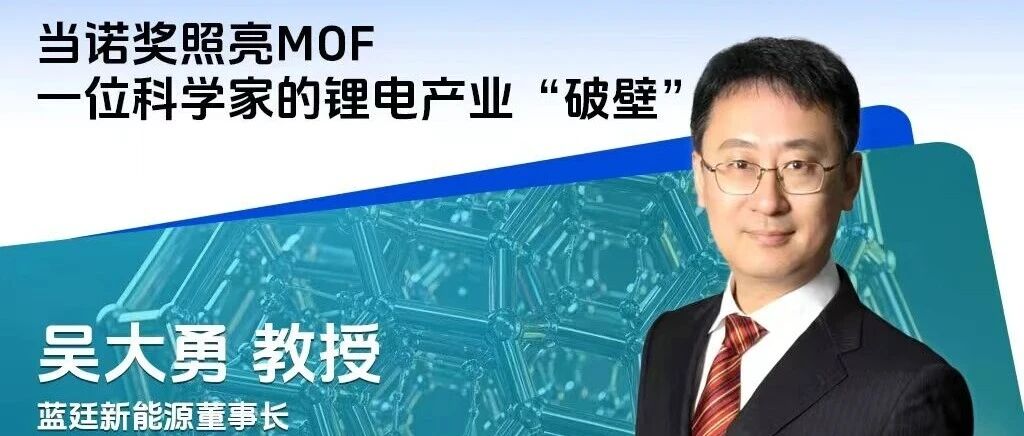
当诺奖照亮MOF:一位科学家的锂电产业“破壁”
高工锂电· 2026-01-08 10:47
Core Viewpoint - The article discusses the potential of Metal-Organic Frameworks (MOF) in breaking the performance boundaries of batteries, particularly in the lithium battery industry, following the recognition of MOF in the 2025 Nobel Prize in Chemistry [1][2]. Group 1: MOF's Industrial Relevance - MOF has gained attention in the lithium battery industry after years of research, with companies beginning to explore its industrial applications [2]. - The focus is on whether MOF can enhance battery performance and achieve stable production, rather than being a completely new material [2]. Group 2: MOF's Structural Advantages - MOF's unique properties, such as its electrical characteristics and designable structure, can influence electrolyte dissociation and lithium ion migration [4]. - The material's porous structure and functional group design provide a basis for capturing by-products and improving interface conditions [4]. Group 3: Research and Development Focus - The research has shifted from feasibility to practical questions regarding the effectiveness of specific MOF types, industrial synthesis capabilities, and cost and environmental control [5]. - MOF's design allows for precise control over its structure, which is crucial for enhancing battery performance [6]. Group 4: Application in Solid-State Batteries - Certain MOF materials, like UIO-66, maintain structural stability under high temperatures and pressures, making them suitable for solid-state battery applications [7]. - MOF can enhance lithium ion migration rates and improve overall battery performance, particularly in high-demand applications like drones and high-end electric tools [9]. Group 5: Competitive Landscape - The future competition in the MOF space will hinge on both the design of new structures and the efficiency of synthesis and production capabilities [11]. - The synthesis of MOF is not overly complex, but industrialization poses challenges that affect the consistency and electrochemical behavior of the final product [12]. Group 6: Product Development Strategy - The company is focusing on developing MOF-based functional materials for battery applications, particularly in enhancing ion migration and interface stability [16]. - The strategy includes creating a "super solid electrolyte" that combines high-performance solid electrolytes with MOF materials, aiming to differentiate from competitors in the lithium battery market [16].
打破“信息差”,华为与高德落地30省份超充地图
高工锂电· 2026-01-07 10:11
Core Viewpoint - The collaboration between Huawei and Gaode Map aims to enhance the efficiency and convenience of charging services for new energy vehicle owners by providing real-time information on charging station locations and availability [3][4]. Group 1: Collaboration and Integration - Huawei's supercharging alliance has integrated with Gaode Map, allowing users to find charging stations more easily and transparently [3]. - This partnership addresses the "information gap" faced by new energy vehicle owners regarding public charging stations, which often suffer from a lack of transparency in location, status, and pricing [4]. - The collaboration transforms the charging experience from a cumbersome process into a seamless one, reducing issues like queuing and wasted trips to malfunctioning stations [4][5]. Group 2: Market Dynamics and Demand - There is a current supply-demand gap between the number of vehicles compatible with the 800V high-voltage platform and the rapidly increasing number of supercharging stations, with only about 16% of vehicles supporting this technology as of mid-2025 [6]. - Huawei's strategy includes integrating vehicles, charging stations, and platforms, indicating a mature synergy in supercharging technology [6]. Group 3: Future Developments - The supercharging business is expected to evolve into a model of cooperation amidst competition, with various players in the market, including Tesla and BYD, also investing in supercharging infrastructure [7]. - Huawei plans to expand its supercharging alliance to include heavy-duty trucks by 2025, indicating a broader strategy that encompasses both passenger and commercial vehicles [8][9]. - The company aims to establish 20 megawatt supercharging stations in Shenzhen by 2025 and expand to 500 stations in the Bay Area by 2026 [8].

GGII:2025年国内电池产业链投资扩产总结
高工锂电· 2026-01-07 10:11
Core Viewpoint - The article suggests that 2026 is expected to mark the beginning of a new healthy and orderly development cycle for China's lithium battery new energy industry [3][19]. Investment Overview - In 2025, over 282 public investment projects related to the lithium battery industry chain in China are anticipated, with a total investment exceeding 820 billion yuan, representing a year-on-year growth of over 74% [4]. - The investment projects are primarily concentrated in East and Central China, with regions like Fujian, Shandong, and Jiangsu leading in lithium battery and material manufacturing due to their rich chemical resources and strategic enterprise layouts [6]. Regional Distribution - The Southwest region, particularly Sichuan, is expected to dominate the investment in lithium battery positive materials, accounting for 59% of the projects, with a significant production capacity of over 350 GWh [11]. - Negative materials investment is more evenly distributed, with North and Northwest China favored due to lower electricity costs [11]. - The electrolyte projects are mainly concentrated in East China, benefiting from a robust industrial chain and proximity to downstream markets [11]. Overseas Expansion - Chinese lithium battery companies are increasingly focusing on overseas markets, with significant investments in Thailand, Spain, and Portugal, driven by favorable geopolitical conditions and local demand [7]. - Notable projects include the establishment of a zero-carbon AI super factory in Portugal and a joint venture factory in Spain by CATL and Stellantis [7]. Solid-State and Sodium Battery Development - In 2025, solid-state battery projects are expected to be concentrated in East China, with planned capacities of 74 GWh and total investments of 28 billion yuan [15]. - The sodium battery sector is projected to see significant growth, with planned capacities of 81 GWh and total investments of 32.2 billion yuan, primarily in the Southwest region [15]. Market Outlook - The lithium new energy industry is emerging from a challenging period characterized by supply-demand imbalances and declining prices, with positive signals indicating a recovery starting in 2025 [18]. - The demand for solid-state batteries and sodium batteries is expected to accelerate, with the latter projected to achieve a 100% increase in shipments by 2026 [19].




2026CES电池创新:全固态、场景化、软件定义
高工锂电· 2026-01-07 10:11
Core Viewpoint - The article discusses the emergence of innovative battery technologies showcased at the 2026 CES, highlighting the potential of solid-state batteries to revolutionize the electric mobility sector, while also addressing skepticism regarding their feasibility due to undisclosed technical details [2][4]. Group 1: Donut Lab's Solid-State Battery - Donut Lab claims to have developed the world's first mass-producible all-solid-state battery with an energy density of 400 Wh/kg, capable of full charge in 5 minutes and maintaining over 99% capacity in extreme temperatures from -30°C to above 100°C [4]. - The battery is set to be integrated into Verge Motorcycles' TS Pro and Ultra models, with the upgraded TS Pro expected to be delivered in Q1 2026 [4][5]. - Despite the promising specifications, the lack of disclosed core technology and mass production details has led to widespread skepticism within the industry [4]. Group 2: Other Innovations at CES - A new generation solid-state battery module was jointly presented by Huineng Technology and Germany's FEV Group, based on Huineng's all-inorganic solid-state lithium ceramic battery technology, which is currently at the prototype stage [7]. - This module aims for a target range of 1000 kilometers and offers flexibility for vehicle manufacturers through its integration of solid-state cell technology and advanced system design [9][10]. - Electra Vehicles introduced the EVE-AI™ battery control layer, which supports over-the-air optimization of charging strategies and energy management, aiming to extend battery life by 25% and improve energy utilization by 10% [12]. Group 3: Trends in Battery Technology - The CES showcased three core trends in battery innovation: acceleration of solid-state battery mass production, the rise of software-defined batteries for enhanced lifecycle value, and the development of customized battery solutions for specific applications like robotics and electric vehicles [17]. - Companies are focusing on tailored solutions to meet the unique demands of different sectors, unlocking new application potentials [17].
百层之上,锂电焊接工艺走到哪一步了?
高工锂电· 2026-01-06 10:47
Core Viewpoint - Welding is transitioning from a backend process to a front-line capability in lithium battery manufacturing, significantly impacting internal resistance, temperature performance, yield stability, and production costs [2][3]. Group 1: Current Challenges in Welding Technology - The mainstream welding methods for multi-layer current collectors and covers typically use a "three-step" or "two-step" process, which is becoming less viable as cell capacities increase and layer counts rise [3][4]. - Traditional welding processes are revealing issues such as lengthy procedures, accumulated defects, and increased difficulty in stability control, particularly as the number of layers continues to rise [5][6]. Group 2: Technical Aspects of Pressure Melting Welding - Pressure melting welding seeks to balance heating and pressure to achieve atomic bonding by breaking down surface layers, with a focus on high energy density and controllability [6][7]. - This method involves simultaneous application of pressure and electrical current, utilizing the Joule effect for localized melting, which distinguishes it from traditional resistance welding [6][7]. Group 3: Performance and Validation of Pressure Melting Welding - In tests involving over a hundred layers, pressure melting welding achieved stable welds without splatter or defects, with mechanical strength exceeding the industry standard of 120N and a peel residual rate of 100% [9][10]. - The process demonstrated a peak temperature rise of less than 100°C during welding, ensuring minimal thermal risk to surrounding components [9][10]. Group 4: Innovations and Future Applications - Pressure melting welding is not only applicable to multi-layer current collectors but also enhances existing two-step or three-step production lines by reducing debris generation [10]. - The technology is adaptable for lightweight and miniaturized designs, and it offers new manufacturing possibilities for dissimilar metal welding, which is crucial as the industry shifts towards manufacturing capability-driven innovations [10].