digihuman(835670)

Search documents
数字人民币今起升级,2.0版有何好处?对你我有何影响?
Sou Hu Cai Jing· 2026-01-01 07:14
Core Viewpoint - The People's Bank of China will implement a new action plan to enhance the management and service system of the digital renminbi, transitioning from a cash-like version to a deposit currency version starting January 1, 2026 [1][2]. Group 1: Transition to Digital Deposits - The digital renminbi will shift from being classified as "digital cash" to "digital deposits," allowing banks to pay interest on customer balances in digital renminbi wallets [2][6]. - Digital renminbi deposits will be included under deposit insurance, providing a protection limit of up to 500,000 yuan for customers in case of bank risks [2][8]. - Major banks, including ICBC and ABC, will start paying interest on digital renminbi wallet balances at the same rate as regular savings accounts [2][8]. Group 2: Implications for Banks - The new framework allows banks to manage digital renminbi as liabilities, enabling them to earn interest and comply with reserve requirements, thus integrating digital renminbi into their balance sheets [7][9]. - Previously, digital renminbi existed in M0 form, which did not allow for monetary creation; the new structure will allow it to be categorized under M1 or M2, improving liquidity in the banking system [8][9]. - The transition to digital deposits will enhance banks' motivation to promote digital renminbi, addressing previous cost burdens without corresponding revenue [9]. Group 3: Technological and Regulatory Aspects - The digital renminbi will incorporate distributed ledger technology and smart contracts, facilitating efficient payment processes and regulatory compliance [9]. - The new system aims to support real-time cross-border transactions, reducing intermediary costs and enhancing settlement efficiency, which may aid in the internationalization of the renminbi [9].



今日起,数字人民币开始计息,这些变化影响你的钱包
Sou Hu Cai Jing· 2026-01-01 06:56
Core Viewpoint - The People's Bank of China has officially launched a new generation of digital RMB framework, marking the transition of digital RMB from cash to deposits, with wallet balances now earning interest [1][3]. Group 1: Digital RMB Implementation - The new digital RMB management service system and financial infrastructure will be fully implemented by January 1, 2026, transitioning its core positioning from cash in circulation to deposits [3]. - Digital RMB wallet balances will be treated as commercial bank liabilities, allowing users to "deposit" their digital RMB back into bank accounts [3][5]. - The digital RMB wallet will be categorized into four types, with only real-name wallets (types one to three) earning interest, while non-real-name wallets (type four) will not [4]. Group 2: Benefits for Users and Banks - The new system allows both individual and corporate users to earn interest on their digital RMB balances, similar to regular savings accounts, enhancing the appeal of holding digital RMB [5]. - The convenience of personal payments will increase, as digital RMB will facilitate direct and convenient interbank transfers and cross-border transactions [5]. - For commercial banks, digital RMB deposits will provide a new source of funds, encouraging banks to develop more deposit, wealth management, and credit products, thus creating a comprehensive "payment + finance" ecosystem [5][6]. Group 3: Security and Regulatory Framework - The digital RMB will be backed by the central bank, ensuring security and regulatory oversight, while commercial banks will be responsible for customer safety and compliance [7]. - Digital RMB transactions will not incur fees for transfers in or out of wallets, and they can be conducted without internet or power, enhancing user experience [7]. - The deposit insurance for digital RMB will have a maximum compensation limit of 500,000 RMB, providing additional security for users [7].

多家国有银行发布公告,数字人民币余额按0.05%付息
Xin Lang Cai Jing· 2026-01-01 06:24
Core Viewpoint - The People's Bank of China (PBOC) announces the transition of digital RMB from the "digital cash era" to the "digital deposit currency era" after ten years of research and pilot programs [1] Group 1: Digital RMB Development - The PBOC's new action plan will officially implement on January 1, 2026, introducing a new measurement framework, management system, operational mechanism, and ecosystem for digital RMB [1] - Major banks including Industrial and Commercial Bank of China, Agricultural Bank of China, China Construction Bank, Bank of Communications, and Postal Savings Bank will start paying interest on digital RMB wallet balances at the same rate as current deposit rates from January 1, 2026 [1] Group 2: Interest Mechanism - The introduction of an interest mechanism for digital RMB wallet balances is a significant highlight of the new action plan, aligning it with traditional savings accounts [1]





数字人民币彻底告别“无息时代”,早晚普及数字人民币,世界的趋势!要与时俱进,与时偕行
Sou Hu Cai Jing· 2026-01-01 06:01
Core Viewpoint - The introduction of interest-bearing digital renminbi marks a significant transformation in China's digital currency landscape, transitioning from a cash-like version to a deposit currency model, reflecting an irreversible trend towards the widespread adoption of digital currencies [1][8] Economic Perspective - The interest mechanism establishes a market foundation for the digital renminbi, addressing previous challenges in its promotion, as it now offers value storage attributes similar to traditional banking [3] - The policy allows digital renminbi balances in commercial banks to earn interest, incentivizing users to actively choose digital wallets, thus enhancing payment scenarios [3] - The integration of digital renminbi into the reserve system and macro-prudential assessment framework improves its adaptability for macroeconomic control, ensuring regulated monetary creation and enhancing the efficiency of monetary policy transmission [4] Social Perspective - The proliferation of digital renminbi is fundamentally reshaping the payment ecosystem and enhancing governance efficiency, with the interest policy accelerating its social penetration [5] - As of November 2025, digital renminbi has processed 3.48 billion transactions worth 16.7 trillion yuan, with significant user adoption across various sectors, indicating its comprehensive coverage [5] - The dual attributes of "security + value addition" will reduce resistance to digital payments among older demographics and underserved markets, promoting inclusive digital finance [5] Global Context - The shift to an interest-bearing digital renminbi aligns with global trends in central bank digital currencies (CBDCs), positioning China as a leader in this space with a significant share in cross-border applications [6] - Compared to other countries' CBDC initiatives, China's digital renminbi has evolved from a payment tool to a complete monetary function carrier, providing a model for global CBDC development [6] Strategic Implications - The transition to an interest-bearing digital renminbi is part of a broader strategy to enhance market vitality, optimize regulatory frameworks, and lead in global monetary reform [8] - Embracing digital technology and continuously improving the technical, institutional, and ecological systems will ensure that the digital renminbi becomes a core support for China's digital economy and a competitive player in the global financial landscape [8]

六大国有银行公告:数字人民币实名钱包余额明起计付利息
Sou Hu Cai Jing· 2026-01-01 04:42
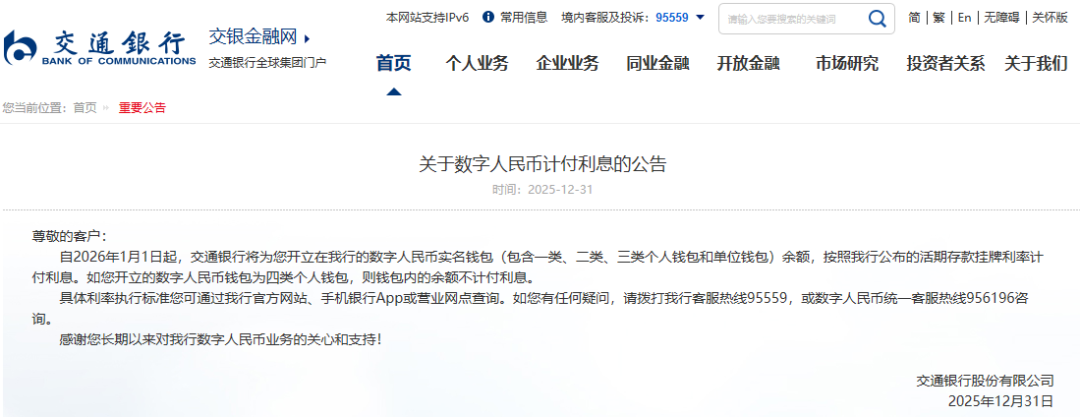
Core Viewpoint - Starting January 1, 2026, several major banks in China, including Industrial and Commercial Bank of China, Agricultural Bank of China, Bank of China, China Construction Bank, Bank of Communications, and Postal Savings Bank, will offer interest on the balances of digital RMB real-name wallets at the same rate as current deposit rates [1] Group 1 - The interest calculation rules for digital RMB wallets will align with those of current deposits [1] - China Construction Bank's announcement specifies that four types of wallets are excluded from this interest policy [1] - Bank of Communications states that if a customer opens a type four personal digital RMB wallet, the balance will not earn interest [1]

从现金到存款:数字人民币的一次飞跃
Hua Xia Shi Bao· 2026-01-01 03:35
Core Viewpoint - The evolution of digital RMB is progressing towards becoming a true credit currency, with the upcoming "Digital RMB Action Plan" integrating it into the reserve requirement system, thereby enhancing its role in the banking system [2][3]. Group 1: Digital RMB Framework - Digital RMB will be managed under the reserve requirement system, with wallet balances subject to reserve requirements, and non-bank payment institutions required to implement 100% reserve for digital RMB [2]. - The transition from digital RMB as mere cash to a deposit-like status means it will now be treated as a liability of both the central bank and commercial banks, similar to existing bank deposits [3]. Group 2: Monetary Control and Risks - The integration of digital RMB into bank accounts allows for better control of monetary policy by the central bank, mitigating risks associated with cash leakage and financial disintermediation seen in other digital currencies [3][4]. - Digital currencies, including Bitcoin and stablecoins, pose risks due to their anonymity and decentralization, which can lead to challenges in macroeconomic regulation [3]. Group 3: Technological Integration - The "account system + digital currency + smart contract" framework aims to enhance the digitalization and intelligence of RMB issuance, circulation, and payment processes [4]. - The application of smart contracts in digital RMB can improve financial solutions across various sectors, including supply chain finance and consumer protection [5]. Group 4: Environmental and Social Applications - Digital RMB can facilitate carbon reduction initiatives by providing value confirmation and payment services for energy-saving behaviors, thus promoting public participation in carbon reduction efforts [6]. - The use of blockchain technology in digital RMB enhances trust among multiple stakeholders, particularly in cross-border payments, offering advantages such as efficiency, low cost, and security [6].

今日正式实施!揭秘新一代数字人民币计量框架:从数字现金到数字存款货币 对银行机构和个人有何实质影响?
Sou Hu Cai Jing· 2026-01-01 01:53
根据行动方案,新一代数字人民币计量框架、管理体系、运行机制和生态体系将于2026年1月1日正式启 动实施。对此,智通财经记者采访多位专家,从数字人民币到底有何变化,对商业银行及个人投资者有 何影响,进行多维度解读。 "新"在哪里? "首先,数字人民币的负债主体有了变化。"一位专家对智通财经记者表示,此前,数字人民币是中国人 民银行发行的法定数字货币,是数字现金,即现金的数字形式。 来源:智通财经 近日,中国人民银行出台《关于进一步加强数字人民币管理服务体系和相关金融基础设施建设的行动方 案》。 "如今,变成数字人民币存款后,商业银行就可以对数字人民币钱包的余额开展资产负债经营管理,这 有助于调动商业银行展业的积极性。"管涛进一步解释。 "这意味着,此前,数字人民币是中央银行对公众的负债。"专家指出,"新一代数字人民币计量框架 中,数字人民币负债主体有了变化,不再是中央银行对公众的负债,而成为商业银行的负债。" "这就标志着,数字人民币由现金型1.0版,进入了存款货币型数字人民币2.0版。"另一位行业专家对智 通财经记者表示,"也就是说,现阶段,从货币角度,数字人民币的定位,从流通中现金转变为了存 款。" 专家 ...
数字人民币计息
Nan Fang Du Shi Bao· 2025-12-31 23:18
Group 1 - The current interest rate for demand deposits at the six major state-owned banks is set at 0.05% [2] - Digital RMB wallets are categorized into four types, with decreasing levels of real-name verification [2] - The balance limits for the different wallet types are as follows: Type 1 has no limit, Type 2 is capped at 500,000, Type 3 at 20,000, and Type 4 at 10,000 [2]

从政务展厅到大屏一体机,数字人公司世优科技深耕全场景护城河
Sou Hu Cai Jing· 2025-12-31 16:53
Core Insights - The article highlights the evolution of digital humans from a novel concept to a transformative force in various industries, driven by the integration of AI technology by companies like Shiyou Technology [1][14]. Technology Foundation - Shiyou Technology has developed a comprehensive technology stack for digital humans, including proprietary algorithms, hardware, and application platforms [1][3]. - The digital human engine features over 180 facial control points, achieving over 95% accuracy in lip-syncing and supporting 24 emotional modes, enabling lifelike interactions [3]. - The "Pota" AI digital human integrates self-developed AI platforms and large language models, supporting multimodal interactions with a high accuracy rate of 98% [3]. - The company offers flexible product forms, including AI digital human all-in-one machines and software solutions that can be easily integrated into existing business systems [3][14]. Industry Empowerment - Shiyou Technology has successfully implemented its technology in various sectors, creating replicable benchmark cases [1][4]. - In smart governance, the "Fengxiaoshu" digital guide in Beijing's Fengtai District has reduced average waiting times by 58% and improved service efficiency [5]. - In corporate exhibition halls, Shiyou Technology has transformed static displays into interactive experiences, enhancing brand perception and visitor engagement [7]. - In education, the AI virtual assistant in classrooms has increased interaction frequency and alleviated teachers' workloads [8]. - In transportation, AI digital humans at airports provide 24/7 multilingual services, improving efficiency and passenger satisfaction [9]. Innovative Integration - Shiyou Technology combines digital humans with VR and MR technologies to enhance cultural tourism experiences [10][11]. - The "Luwushan VR Space" project allows visitors to interact with digital representations of mythological characters, creating immersive experiences [10]. - The MR project in Xinjiang brings historical figures to life, enhancing visitor engagement and interaction [11]. - The company also participates in large-scale cultural events, merging digital humans with real-world performances to create visually stunning experiences [13]. Ecosystem Development - Shiyou Technology is focused on building an industry ecosystem, collaborating with partners to create domestically produced AI digital human solutions [14]. - The company aims to lower deployment costs and promote the safe and widespread adoption of digital human technology [14]. - By participating in the development of national standards for customer service digital humans, Shiyou Technology is contributing to the standardization of the industry [14].

六大行集体官宣,事关数字人民币
Zhong Guo Zheng Quan Bao· 2025-12-31 12:28
Core Viewpoint - The announcement by six major banks in China regarding interest payments on digital RMB wallet balances marks a significant transition from "digital cash (M0)" to "digital deposit currency," indicating a shift in the nature of liabilities from the central bank to commercial banks [1][2] Group 1: Announcement Details - Starting from January 1, 2026, the six major banks will pay interest on the balances of real-name digital RMB wallets at the rate of the current deposit interest rate [1] - The current deposit interest rate for the Bank of Communications is set at 0.05% [1] - Balances in type four personal wallets will not earn interest, and specific interest rate standards can be checked through the bank's official website, mobile banking app, or physical branches [1] Group 2: Implications and Effects - This move enhances user willingness to hold digital RMB, promoting its adoption and dissemination [2] - It incorporates banking institutions into the reserve requirement framework, improving monetary statistics and macroeconomic regulation [2] - Establishing this mechanism is a crucial step towards the maturity of digital RMB, maintaining a dual-layer operational structure while achieving functional upgrades [2]