
BANK OF E ASIA(00023)

Search documents
东亚银行系统将在12月6日至12月13日进行维护升级
Jin Tou Wang· 2025-12-03 03:48
Core Points - East Asia Bank announced system maintenance scheduled for December 6, 2025, from 10:00 to 12:00 and December 13, 2025, from 5:00 to 7:00 [1] - During the maintenance period, the East Asia China Dongda remittance service will be temporarily suspended [1] - The bank expressed apologies for any inconvenience caused and thanked customers for their understanding and support [1] - Customers are advised to make necessary arrangements in advance [1]

东亚银行发布识别、防范假冒名义从事非法金融活动声明
Jin Tou Wang· 2025-12-03 03:29
Core Points - East Asia Bank has issued a statement regarding fraudulent activities where individuals have impersonated the bank to deceive the public into applying for loans, damaging the bank's reputation and clients' rights [1][2] Group 1: Fraudulent Activities - Fraudsters have been using the name of East Asia Bank (China) Limited and its Shanghai branch to forge documents and misrepresent loan services [1] - The bank emphasizes that all its services are conducted through official channels and has not authorized any individuals or entities to engage in such activities [1] Group 2: Bank's Response - East Asia Bank has established a comprehensive seal management system and strictly follows approval processes for seal usage [1] - The bank disclaims any knowledge or recognition of documents or actions involving the misuse of its name or forged seals, stating that it will not bear any responsibility for losses or disputes arising from such actions [1] Group 3: Public Advisory - The bank urges the public to remain vigilant and not to trust investment or loan information from unknown sources to avoid financial losses [1] - In case of suspicious activities, the public is advised to verify information through official channels or report to law enforcement [1]
经络:香港11月份现楼按揭宗数跌逾25% 楼花按揭跌逾60%
Zhi Tong Cai Jing· 2025-12-01 05:57
Core Insights - The mortgage market in Hong Kong has shown a significant decline in November 2025, with existing home mortgages dropping by 25.7% compared to October, reaching a seven-month low [1] - Conversely, year-on-year comparisons indicate a 59.9% increase in existing home mortgages compared to November 2024, suggesting a recovery trend over the past year [1] - The overall sentiment in the housing market is optimistic, with expectations of a gradual increase in transactions and mortgage numbers in the coming year [1] Group 1: Mortgage Statistics - In November 2025, the number of existing home mortgages was 4,951, down from 6,662 in October, marking a decrease of 1,711 mortgages [1] - The number of pre-sale mortgages also fell to 232 in November, a decrease of 61.3% from 599 in October, reaching a 19-month low [1] - For the first 11 months of 2025, existing home mortgages totaled 59,179, an increase of 27.7% from 46,336 in the same period last year [1] Group 2: Market Share of Banks - Bank of China Hong Kong leads the existing home mortgage market with a 25.6% market share, followed by HSBC at 21.4% and Hang Seng Bank at 9.9% [2] - In the pre-sale mortgage market, Bank of China Hong Kong also ranks first with a market share of 28%, while HSBC holds 22.4% [2] - The market share of the four major banks for existing home mortgages dropped to 65.9% in November, a decline of 8.4% from the previous month, indicating a competitive environment among banks [2]


东亚银行(00023) - 截至二零二五年十一月三十日止股份发行人的证券变动月报表
2025-12-01 01:33
FF301 第 1 頁 共 11 頁 v 1.1.1 FF301 II. 已發行股份及/或庫存股份變動 | 1. 股份分類 | 普通股 | 股份類別 | 不適用 | | 於香港聯交所上市 (註1) | 是 | | | --- | --- | --- | --- | --- | --- | --- | --- | | 證券代號 (如上市) | 00023 | 說明 | | | | | | | | | 已發行股份(不包括庫存股份)數目 | | 庫存股份數目 | | 已發行股份總數 | | | 上月底結存 | | | 2,641,380,142 | | 0 | | 2,641,380,142 | | 增加 / 減少 (-) | | | 50,000 | | 0 | | | | 本月底結存 | | | 2,641,430,142 | | 0 | | 2,641,430,142 | 第 2 頁 共 11 頁 v 1.1.1 股份發行人及根據《上市規則》第十九B章上市的香港預託證券發行人的證券變動月報表 | 截至月份: | 2025年11月30日 | 狀態: 新提交 | | --- | --- | --- | | 致:香 ...
东亚银行向香港大埔宏福苑援助基金捐赠1000万港元
Guo Ji Jin Rong Bao· 2025-11-28 14:17
Group 1 - East Asia Bank announced a donation of 10 million HKD to the "Tai Po Wang Fuk Court Assistance Fund" established by the Hong Kong SAR government to help affected residents meet immediate needs and assist in rebuilding their homes [1] - The bank's co-CEOs expressed deep sorrow over the fire incident at Tai Po Wang Fuk Court and extended condolences to the affected residents and the families of the deceased [1] - In addition to the donation, East Asia Bank has implemented a series of measures, including extending the operating hours of its Tai Po branch and increasing staff to provide necessary services to affected customers [1] Group 2 - East Asia Bank has set up a 24-hour support hotline at +852 2211 1812 to provide banking service support to those in need [1]

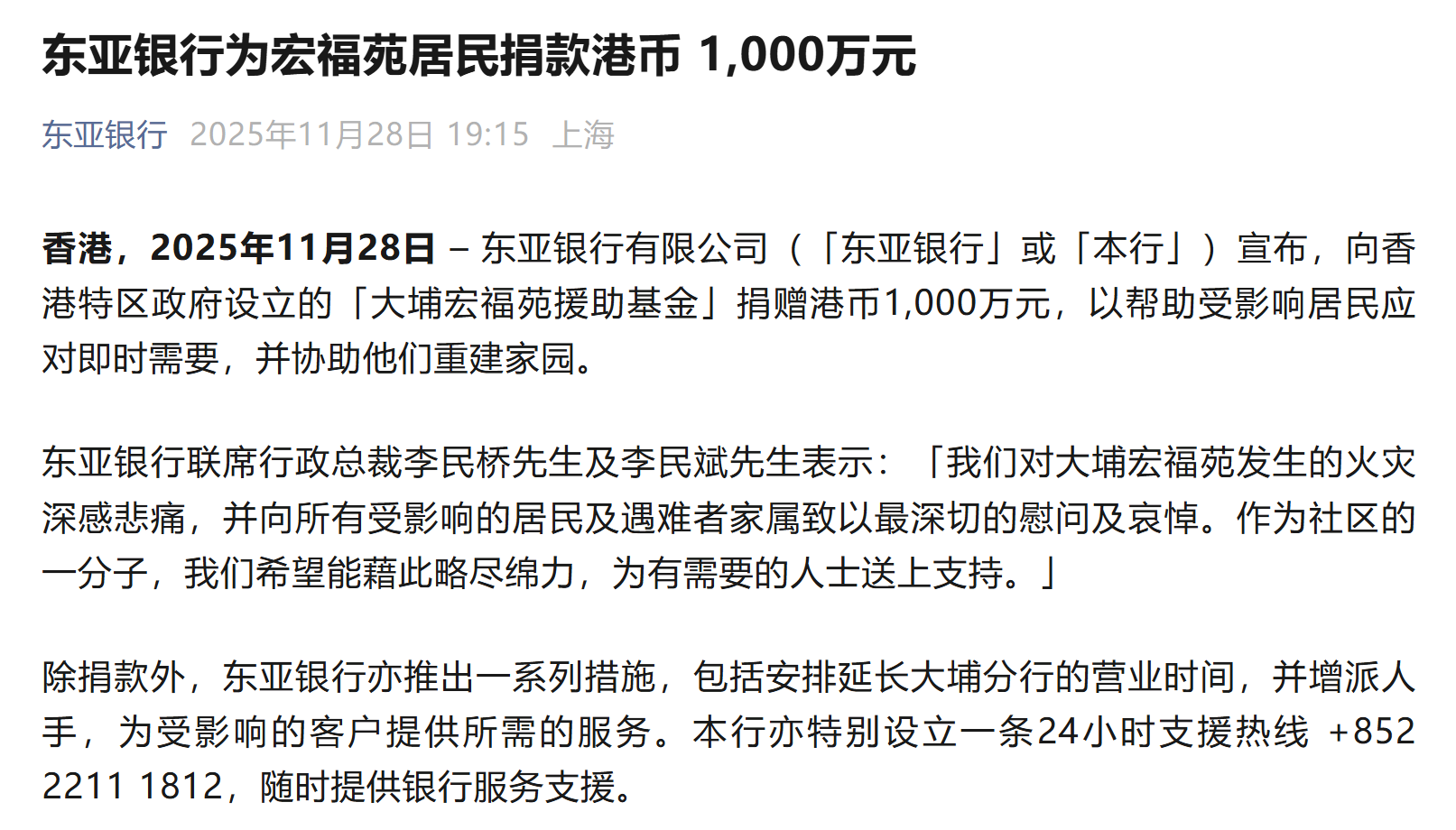
东亚银行(00023) - 薪酬委员会的职权范围
2025-11-20 08:50
( 1918 年在香港註冊成立之有限公司) (股份代號: 23) The Bank of East Asia, Limited 東亞銀行有限公司 薪酬委員會 2. 成員 3. 會議次數 委員會須每年召開最少一次會議。 1 「高層管理人員」包括本集團之執行主席、聯席行政總裁、副行政總裁及所有職級 3 的總經理。 職權範圍 東亞銀行有限公司 職權範圍—薪酬委員會 1. 組成 董事會已議決成立一個名為薪酬委員會(「委員會」)的委員會,負責訂立及審議 薪酬政策及本集團(以下包括東亞銀行有限公司(「本行」)受香港金融管理局 綜合監管的所有海外分行及附屬公司)的董事、高層管理人員 1 及主要管理人員 2 的薪酬待遇。 2 「主要管理人員」包括資本市場及流動資金管理部主管。 2025 年 11 月 第1頁 2.1 委員會之成員,應由董事會首先從現任之非執行董事中委任,並須包括不 少於兩名成員。委員會的大部分成員須為獨立非執行董事。 2.2 委員會主席須為由董事會委任的獨立非執行董事。 2.3 委員會任何會議的法定人數為兩名成員,其中至少一名須為獨立非執行董 事。 2.4 委員會成員一經委任,其任期將於其擔任本行董事(執行或 ...
东亚银行(00023) - 提名委员会的职权范围
2025-11-20 08:47
The Bank of East Asia, Limited 東亞銀行有限公司 ( 1918 年在香港註冊成立之有限公司) 提名委員會 東亞銀行有限公司 職權範圍—提名委員會 1. 組成 東亞銀行有限公司(「本行」,連同其附屬公司,統稱「本集團」)董事會(「董 事會」或「董事」)議決成立一個委員會名為提名委員會(「委員會」),負責 (其中包括 )物色、挑選及提名可擔任董事、行政總裁/聯席行政總裁、副行政 總裁、集團總稽核、集團合規總監、集團財務總監、集團風險總監及其他高層管 理人員1 的合適候選人,並就其委任、撤職及繼任安排向董事會提出建議;訂定董 事會成員多元化的計劃;及評估董事會及每位董事的工作成效。 在本「職權範圍」中,除另有釋義外,所有單性詞包括其他性別。 2. 成員 3. 會議 1 「高層管理人員」包括本集團之聯席行政總裁、副行政總裁及所有總經理。 2025年11月 第1頁 職權範圍 (股份代號: 23) 2025年11月 第2頁 ___________________________________________________________________ 2.1 委員會成員須由董事會自董事 ...
东亚银行(00023) - 审核委员会的职权范围
2025-11-20 08:43
The Bank of East Asia, Limited 3. 出席會議 集團財務總監、集團總稽核及外聘核數師代表通常須出席會議。委員會可於必要 時邀請任何適當人士出席會議。其他董事會成員亦有權出席。 東亞銀行有限公司 ( 1918 年在香港註冊成立之有限公司) (股份代號: 23) 審核委員會 職權範圍 東亞銀行有限公司 職權範圍 - 審核委員會 1. 組成 董事會於1998年9月29日議決成立一個名為「審核委員會」的委員會,負責協助 董事會作獨立審議東亞銀行有限公司(「本行」)及其附屬公司(統稱「本集團」) 的財務申報程序、風險管理及內部監控系統的效能。委員會根據《香港聯合交易 所有限公司證券上市規則》(「《上市規則》」)的規定成立,其職權範圍已經 及將根據不時修訂的《上市規則》的有關條文及企業管治守則(「守則」)進行 更新及修訂。 2. 成員 4. 秘書 公司秘書將擔任委員會秘書。 5. 會議次數 審核委員會須每年召開最少四次會議,並於必要情況下召開特別會議。外聘核數 師可在其認為必要時,要求召開會議。 6. 授權 6.1 委員會獲董事會授權於其職權範圍內調查任何活動。委員會獲授權向任何僱員索 取任 ...
智通港股沽空统计|11月20日
智通财经网· 2025-11-20 00:24
Core Insights - The article highlights the top short-selling stocks in the market, indicating significant investor sentiment and potential market movements [1][2]. Short Selling Ratios - AIA Group (81299), Li Ning (82331), and JD Health (86618) have the highest short-selling ratios at 100.00% each [1][2]. - JD Group (89618) follows closely with a short-selling ratio of 98.73%, while Tencent Holdings (80700) has a ratio of 94.71% [2]. Short Selling Amounts - Xiaomi Group (01810) leads in short-selling amount with 2.524 billion, followed by Alibaba (09988) at 2.305 billion and Tencent Holdings (00700) at 1.140 billion [1][2]. - Other notable mentions include Pop Mart (09992) with 1.016 billion and Lenovo Group (00992) at 676 million [2]. Deviation Values - Zhongyuan Bank (01216) has the highest deviation value at 62.66%, indicating a significant difference from its average short-selling ratio over the past 30 days [1][2]. - East Asia Bank (00023) and Autohome (02518) follow with deviation values of 38.85% and 38.65%, respectively [2].





东亚银行将在11月29日进行快捷支付系统升级
Jin Tou Wang· 2025-11-17 03:19
Core Points - East Asia Bank announced an upgrade to its quick payment system scheduled for November 29, 2025, from 03:10 to 08:00 Beijing time [1] - The upgrade may affect services such as quick payment card binding, quick payment, withdrawals, and refunds during the upgrade period [1] - Both individual and corporate customers may experience disruptions in transactions between East Asia Bank accounts and payment institutions [1] Summary by Category Service Impact - The upgrade is aimed at improving service quality and efficiency [1] - Customers are advised to make necessary arrangements in advance due to potential service disruptions [1] Customer Communication - East Asia Bank expresses gratitude for customer understanding and support during the upgrade [1] - A customer service hotline is available for inquiries related to the upgrade [1]