
Sinopec Corp.(00386)

Search documents
“绿色航油”巨头崛起!中国石化、中国航油官宣重组
Zhong Guo Dian Li Bao· 2026-01-09 05:50
Core Viewpoint - The merger between China Petroleum & Chemical Corporation (Sinopec) and China Aviation Oil Group (China Aviation Oil) marks a significant strategic move in the energy sector, aiming to create a new giant in "green aviation fuel" while enhancing fuel supply security for the aviation industry and increasing low-carbon competitiveness in international markets [1][5][7]. Group 1: Merger Details - The merger was approved by the State Council and is seen as a collaboration between the world's largest refining company and Asia's largest aviation fuel service provider [1][3]. - China Aviation Oil is the largest integrated aviation fuel service provider in Asia, while Sinopec is the largest aviation fuel producer in China, covering various sectors including oil and gas, logistics, and aviation [3][4]. - The merger is expected to streamline operations and reduce costs by eliminating intermediaries, thus enhancing the efficiency of the entire supply chain from refining to distribution [4][6]. Group 2: Market Context - The global aviation industry is experiencing a strong recovery, with a projected demand for aviation fuel of 389 million tons in 2025, reflecting a year-on-year increase of 3.9% [3][4]. - By 2040, China's aviation fuel consumption is expected to grow from 39.28 million tons in 2024 to 75 million tons, indicating a significant increase in demand [4][6]. - The merger is a strategic response to the competitive landscape dominated by integrated oil and gas companies like Shell and ExxonMobil, which have established advantages in the aviation fuel market [6][7]. Group 3: Green Transition - The merger is positioned as a critical step towards enhancing the competitiveness of China's aviation fuel industry and promoting green transformation [5][7]. - Sustainable aviation fuel (SAF) is recognized as a key pathway for reducing carbon emissions in the aviation sector, with global SAF consumption projected to reach 1.8 million tons by 2030 [7]. - Sinopec is noted for being one of the first companies in China to produce SAF, which can reduce carbon emissions by over 50% compared to traditional aviation fuel [7][8]. Group 4: Strategic Implications - This merger is part of a broader initiative to optimize the layout of state-owned enterprises and concentrate state capital in critical industries related to national security and economic lifelines [8]. - The restructuring aligns with the strategic goals set forth by the State-owned Assets Supervision and Administration Commission (SASAC) to enhance the core functions and competitiveness of state-owned enterprises [8].

多家能源央企负责人2024年薪酬披露
中国能源报· 2026-01-09 05:43
Core Viewpoint - The article discusses the 2024 annual salary disclosures of executives from several major energy state-owned enterprises in China, highlighting the pre-tax remuneration and additional benefits for key personnel. Group 1: China National Petroleum Corporation (CNPC) - The chairman, Ma Yongsheng, has a pre-tax salary of 935,500 RMB, with additional social insurance and pension contributions totaling 237,600 RMB [3] - Other executives, such as Da Dong and Zhong Ren, also have salaries around 935,500 RMB and 842,000 RMB respectively, with similar additional benefits [3] Group 2: China Petroleum and Chemical Corporation (Sinopec) - Chairman Wang Dongjin's pre-tax salary is 966,900 RMB, with social insurance contributions of 264,800 RMB [5] - Other executives, including Zhou Xinhai and Wang Dehua, have salaries ranging from 289,200 RMB to 867,800 RMB, with similar additional benefits [5] Group 3: China National Offshore Oil Corporation (CNOOC) - Chairman Wang Dongjin earns 966,900 RMB, with social insurance contributions of 264,800 RMB [5] - Other executives have salaries from 14,510 RMB to 867,800 RMB, with additional benefits [5] Group 4: China Huaneng Group - Chairman Wen Shugang's pre-tax salary is 961,700 RMB, with social insurance contributions of 270,000 RMB [9] - Other executives, such as Zhang Wenfeng and Deng Jianling, have salaries ranging from 400,700 RMB to 860,000 RMB [9] Group 5: China Datang Corporation - Chairman Ren Jian's pre-tax salary is 922,100 RMB, with social insurance contributions of 283,200 RMB [11] - Other executives have salaries from 7,680 RMB to 824,900 RMB, with similar additional benefits [11] Group 6: China Huadian Corporation - Chairman Jiang Yi's pre-tax salary is 961,100 RMB, with social insurance contributions of 310,400 RMB [13] - Other executives have salaries ranging from 43,260 RMB to 865,000 RMB, with additional benefits [13] Group 7: China Longyuan Power Group - Chairman Liu Ming's pre-tax salary is 885,700 RMB, with social insurance contributions of 237,000 RMB [14] - Other executives have salaries from 7,250 RMB to 860,000 RMB, with similar additional benefits [14] Group 8: China Energy Investment Corporation - Chairman Yu Bing's pre-tax salary is 953,700 RMB, with social insurance contributions of 292,000 RMB [17] - Other executives have salaries ranging from 42,650 RMB to 850,000 RMB, with additional benefits [17] Group 9: China National Coal Group - Chairman Wang Shudong's pre-tax salary is 910,200 RMB, with social insurance contributions of 287,300 RMB [23] - Other executives have salaries from 15,170 RMB to 819,200 RMB, with similar additional benefits [23]



中国石化(600028):公司有望受益于重组后的一体化优势
HTSC· 2026-01-09 05:16
Investment Rating - The report maintains a "Buy" rating for both A and H shares of the company, with a target price of RMB 7.98 and HKD 6.26 respectively [6]. Core Insights - The proposed restructuring between Sinopec Group and China Aviation Oil is expected to enhance the competitiveness of China's aviation fuel industry by integrating aviation fuel production and sales, optimizing the retail system, and facilitating overseas trade [2][3]. - The demand for aviation fuel is anticipated to grow steadily due to the recovery in air travel and fleet expansion, which will support moderate growth in aviation fuel demand [3]. - The company is expected to benefit from the integration advantages post-restructuring, although it may face increased related-party transactions [3][4]. Summary by Sections Company Overview - Sinopec Group is the world's largest refining company and China's largest aviation fuel producer, with crude processing and aviation fuel production volumes of 186.4 million tons and 25.7 million tons respectively in the first three quarters of 2025, showing a year-on-year change of -2.2% and +6.5% [2]. Financial Forecasts - The net profit forecast for 2025 has been adjusted down to RMB 35.9 billion, a decrease of 2.3%. The net profit forecasts for 2026 and 2027 are maintained at RMB 46.3 billion and RMB 54.6 billion respectively, with corresponding EPS of RMB 0.30, 0.38, and 0.45 [4][10]. - The revenue for 2025 is projected to be RMB 297.3 billion, reflecting a year-on-year decline of 3.3% [10]. Valuation - The report assigns a price-to-earnings (P/E) ratio of 21.0x for A shares and 15.0x for H shares for 2026, based on the company's integrated advantages and transformation into new materials and non-oil businesses [4][11].
中石化取得有机膦化合物及阻燃纤维复合材料专利
Sou Hu Cai Jing· 2026-01-09 04:44
Group 1 - The State Intellectual Property Office of China has granted a patent to China Petroleum & Chemical Corporation for "Organic Phosphorus Compounds, Flame Retardant Fibers, Composite Material Compositions and Their Applications," with the announcement number CN119930690B and application date of November 2023 [1] - China Petroleum & Chemical Corporation, established in 2000 and based in Beijing, primarily engages in oil and gas extraction, with a registered capital of 12,173,968.9893 million RMB [1] - The company has invested in 268 enterprises, participated in 5,000 bidding projects, holds 45 trademark registrations, 5,000 patents, and possesses 41 administrative licenses [1] Group 2 - Sinopec Shanghai Petrochemical Company Limited, founded in 1993 and located in Shanghai, focuses on the oil, coal, and other fuel processing industries, with a registered capital of 1,054,261.75 million RMB [1] - The company has invested in 21 enterprises, engaged in 5,000 bidding projects, holds 51 trademark registrations, 1,352 patents, and has 12,791 administrative licenses [1]
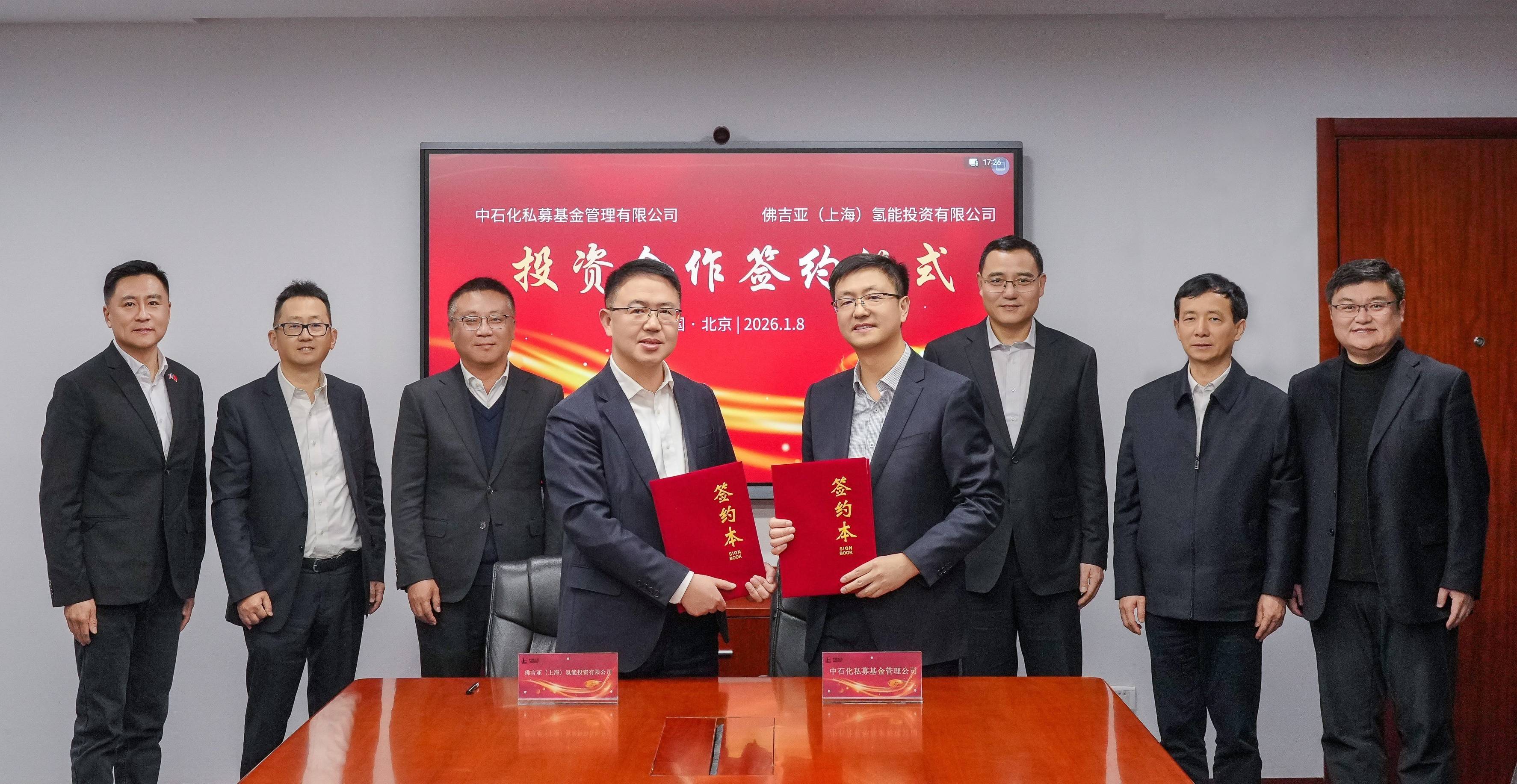
FORVIA佛瑞亚集团与中国石化资本携手驱动中国氢能产业发展
Sou Hu Cai Jing· 2026-01-09 04:22
Core Viewpoint - FORVIA Group has announced a strategic investment of 300 million RMB (approximately 40 million Euros) from Sinopec Capital into its hydrogen energy subsidiary, enhancing its market positioning in China's rapidly growing hydrogen sector [1][4]. Group 1: Investment Details - Sinopec Capital, through its private equity management arm, is investing in FORVIA's hydrogen energy subsidiary, indicating a strong commitment to the hydrogen energy market [1][4]. - The hydrogen fund managed by Sinopec is the largest in China focused on the hydrogen industry chain, having invested in 13 hydrogen-related companies [4]. Group 2: Market Context - The hydrogen industry has been elevated to a national priority in China, alongside gasoline and natural gas, to accelerate its industrialization [5]. - China's hydrogen production is projected to reach 36.5 million tons in 2024, a 3.5% increase from 2023, with significant applications in the chemical industry and growing use in transportation and steel manufacturing [5]. - China remains the largest single market for hydrogen fuel cell vehicles, with cumulative sales exceeding 30,000 units and 559 hydrogen refueling stations established nationwide [5]. Group 3: Strategic Collaboration - The partnership with Sinopec Capital is expected to enhance FORVIA's supply chain optimization and accelerate growth and value creation in the hydrogen sector [6]. - Executives from FORVIA emphasize that this collaboration will strengthen their market position in China and enhance their ability to provide innovative solutions [6]. - Sinopec Capital aims to become the leading hydrogen company in China and plans to leverage this investment to foster deep business cooperation and promote high-quality development in the global hydrogen industry [6].
中国石化、中国航油官宣重组 机构:将重塑传统能源市场的竞争格局
2 1 Shi Ji Jing Ji Bao Dao· 2026-01-09 04:19
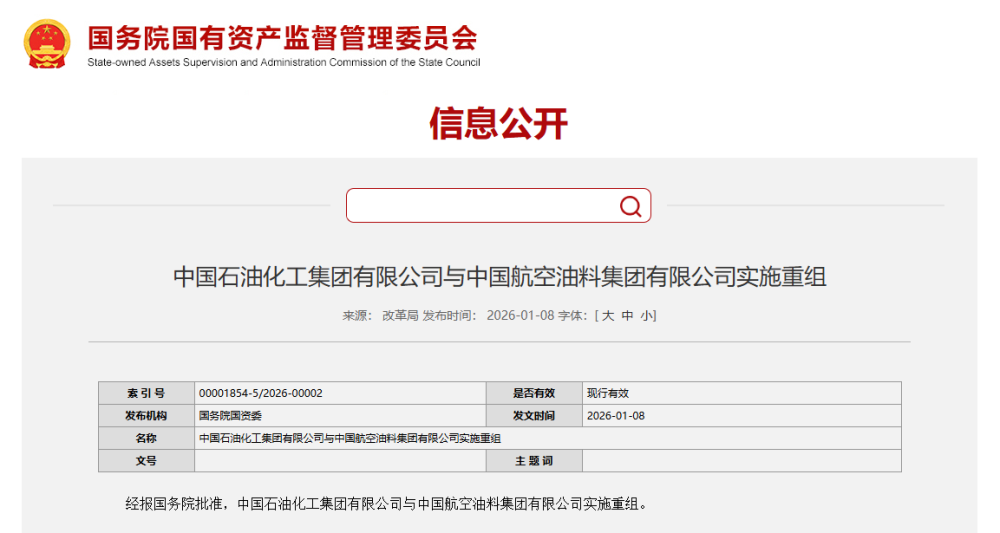
Core Viewpoint - The restructuring between China Petroleum & Chemical Corporation (Sinopec) and China Aviation Oil Group is approved by the State Council, aiming to enhance market competitiveness and achieve strategic synergies [1][4]. Group 1: Restructuring Details - The restructuring requires further procedures and approvals but is not expected to significantly impact the normal operations of the companies involved [4]. - China Aviation Oil Group is the largest aviation fuel service provider in Asia, serving 258 transport airports and 454 general airports, and has been listed in the Fortune Global 500 for 13 times since 2011 [4]. Group 2: Strategic Benefits - The merger is anticipated to create significant strategic complementarity and synergy, enhancing the overall market competitiveness of both companies [5]. - Sinopec can leverage China Aviation Oil Group's distribution network to expand its market share in aviation fuel and integrate production and sales [5]. - China Aviation Oil Group will gain more stable upstream resource supply, improving its bargaining power in the international aviation fuel market [5]. Group 3: Green Transition - The restructuring aligns with China's "dual carbon" goals, as the civil aviation sector is a key area for achieving these targets, with approximately 99% of carbon emissions from aviation coming from fuel consumption [5]. - Sinopec is focusing on the development of sustainable aviation fuel (SAF) as a critical path for emissions reduction, having made significant advancements in this area since 2014 [5][6]. - The collaboration is expected to reshape the competitive landscape of the traditional energy market and have a profound impact on the green transition of China's aviation industry [6].
开年首例央企重组大戏,为何花落中石化中航油合并?市场影响几何?
Xin Lang Cai Jing· 2026-01-09 04:16
Core Viewpoint - The restructuring of China Petroleum & Chemical Corporation (Sinopec) and China Aviation Oil Group (CAOG) marks a significant shift in the domestic aviation fuel market, creating a powerful entity that connects refining to airport fuel sales, thereby reshaping competition in the sector [1][3]. Group 1: Restructuring Details - The restructuring was approved by the State-owned Assets Supervision and Administration Commission (SASAC) and is the first major merger among oil and gas state-owned enterprises since the establishment of the National Oil and Gas Pipeline Group in December 2019 [1]. - Sinopec is the world's largest refining company and the second-largest chemical company, while CAOG is Asia's largest aviation fuel service provider [1][2]. Group 2: Market Implications - The merger is expected to reshape the competitive landscape of the domestic aviation fuel market, with CAOG gaining direct access to stable revenue streams from aviation fuel sales, while Sinopec strengthens its upstream supply chain [1][3]. - China's aviation fuel consumption is projected to grow significantly, with a 13% increase expected in 2024, reaching 39.28 million tons, and a forecast of 75 million tons by 2040 [3]. Group 3: Strategic Considerations - The merger aligns with global trends of vertical integration in the energy sector, enhancing the combined entity's strength in both upstream and downstream operations [4]. - The focus on sustainable aviation fuel (SAF) is critical, as it is seen as a key pathway for decarbonizing the aviation industry, with Sinopec being a pioneer in SAF production in China [5][6]. Group 4: Concerns and Challenges - There are concerns regarding market barriers that may arise from the merger, particularly for private SAF producers, as the new entity may leverage its integrated advantages to dominate the market [7]. - Other suppliers and airlines are apprehensive about potential reductions in market space and the impact on pricing power due to the consolidation of the largest supplier and distributor in the aviation fuel sector [7].
石油股早盘走高 国际油价反弹创两周新高 中国石化与中国航油官宣重组
Zhi Tong Cai Jing· 2026-01-09 04:14
Group 1 - Oil stocks rose in early trading, with Shanghai Petrochemical (00338) up 4.29% at HKD 1.46, CNOOC (00883) up 1.74% at HKD 21.04, PetroChina (00857) up 1.38% at HKD 8.08, CNOOC Services (601808) (02883) up 0.82% at HKD 7.38, and Sinopec (00386) up 0.43% at HKD 4.69 [1] - International oil prices rebounded on Thursday after two days of decline, with Brent crude oil rising by as much as 5%, reaching a two-week high [1] - A tanker heading to Russia was attacked by a drone in the Black Sea, and Iraq is moving towards nationalization of the West Qurna 2 oil field due to US sanctions on Russia's Lukoil [1] Group 2 - Iran is facing nationwide protests due to economic difficulties and has implemented internet restrictions [1] - On January 8, the State Council approved the restructuring of China National Petroleum Corporation (601857) and China Aviation Oil Group [1] - According to Everbright Securities, the merger between Sinopec Group (600028) and China Aviation Oil Group will enhance Sinopec's competitiveness in the refined oil business by integrating the entire industrial chain of aviation fuel production, sales, and refueling [1]
港股异动 | 石油股早盘走高 国际油价反弹创两周新高 中国石化与中国航油官宣重组
智通财经网· 2026-01-09 04:04
Core Viewpoint - Oil stocks experienced an upward trend in early trading, driven by a rebound in international oil prices following two days of decline, with Brent crude oil reaching a two-week high [1] Group 1: Stock Performance - Shanghai Petrochemical Co. (00338) rose by 4.29% to HKD 1.46 [1] - CNOOC (00883) increased by 1.74% to HKD 21.04 [1] - PetroChina (00857) gained 1.38% to HKD 8.08 [1] - CNOOC Services (02883) saw a rise of 0.82% to HKD 7.38 [1] - Sinopec (00386) climbed 0.43% to HKD 4.69 [1] Group 2: Market Influences - International oil prices rebounded, with Brent crude oil experiencing a peak increase of 5% [1] - A drone attack on an oil tanker heading to Russia in the Black Sea contributed to market volatility [1] - Iraq is advancing the nationalization of the West Qurna 2 oil field due to U.S. sanctions on Russia's Lukoil [1] - Iran is facing nationwide protests due to economic difficulties, leading to an internet blackout [1] Group 3: Corporate Developments - On January 8, the restructuring of China Petroleum & Chemical Corporation and China Aviation Oil Group was approved by the State Council [1] - According to Everbright Securities, this merger will enhance the competitiveness of China Petrochemical Group's refined oil business by integrating the entire industrial chain of aviation fuel production, sales, and refueling [1] - Listed companies under China Petrochemical Group are expected to benefit from the integrated advantages of the entire industrial chain [1]


2026央企首单!中国石化与中国航油实施重组,石油ETF(561360)连续5日迎资金净流入
Mei Ri Jing Ji Xin Wen· 2026-01-09 03:59
Group 1 - The core point of the news is the restructuring between China Petroleum & Chemical Corporation (Sinopec) and China Aviation Oil Group, which has been approved by the State-owned Assets Supervision and Administration Commission of the State Council [1] - The oil and petrochemical, refining, and trading industries are expected to benefit from the sustained high volatility of international crude oil prices, with ongoing increases in global and domestic oil and gas capital expenditures [1] - The domestic strategy of increasing reserves and production is driving industry demand due to the rising dependence on foreign crude oil [1] Group 2 - High-tech barrier enterprises are anticipated to gain advantages in overseas markets, particularly in unconventional land oil and gas and offshore oil development, which are becoming new growth areas [1] - The oil price and energy security are expected to drive continued industry prosperity [1] - The oil ETF (561360) tracks the oil and gas industry index (H30198), which reflects the overall performance of listed companies in the oil and gas industry chain, providing an effective investment tool for investors focusing on the energy sector [1]