CHINA UNICOM(00762)

Search documents
一年多次分红蔚然成风 A股中期红包密集派发
Zhong Guo Zheng Quan Bao· 2025-10-23 20:12
Core Viewpoint - The A-share market is experiencing a significant increase in cash dividends, with over 600 listed companies distributing more than 300 billion yuan in cash dividends for the first half of the year, indicating a shift towards a return-focused capital market [1][2]. Group 1: Dividend Distribution - As of October 24, over 30 A-share companies, including China Ping An and China Unicom, have completed their cash dividend distributions for the first half of 2025 [2]. - The total cash dividend amount for A-share companies reached 649.7 billion yuan, with a payout ratio of 31.97%, slightly up from the previous year [2][3]. - Central enterprises are leading the way in dividend distribution, with companies like China Mobile and China Petroleum distributing over 100 billion yuan each [2]. Group 2: Future Dividend Plans - More than 3 billion yuan in cash dividends are still pending distribution, with major banks and coal companies expected to contribute significantly [3]. - The third-quarter dividend window has opened, with over 30 companies planning to distribute more than 4 billion yuan in dividends [3]. - Companies are increasingly adopting a multi-dividend strategy, with firms like WuXi AppTec and CRRC announcing their first interim dividends this year [3]. Group 3: Dividend Yield and Investor Sentiment - The average dividend yield for companies that have distributed dividends is 2.52%, with over 90 companies yielding more than 3% [4]. - The proactive approach of companies in returning capital to shareholders has been recognized, with total distributions over the past five years reaching 10.6 trillion yuan, significantly higher than previous periods [4]. - Companies are making long-term commitments to shareholder returns, with some planning to distribute at least 70% of their net profits as dividends from 2025 to 2027 [4]. Group 4: Investment Perspective - The stable dividend distribution in the A-share market is attracting more attention to dividend assets, which are viewed as long-term investments rather than short-term speculative plays [5]. - Investors are encouraged to focus on the sustainability of dividend payments rather than short-term stock price fluctuations, reinforcing the long-term logic behind dividend investments [5].



港股通央企红利ETF天弘(159281)涨0.59%,成交额4517.94万元
Xin Lang Cai Jing· 2025-10-23 13:07
Core Insights - The Tianhong CSI Hong Kong Stock Connect Central State-Owned Enterprises Dividend ETF (159281) closed up 0.59% on October 23, with a trading volume of 45.18 million yuan [1] - The fund was established on August 20, 2025, with an annual management fee of 0.50% and a custody fee of 0.10% [1] - As of October 22, the fund's latest share count was 292 million, with a total size of 296 million yuan [1] - Over the past 20 trading days, the fund's cumulative trading amount reached 1.099 billion yuan, with an average daily trading amount of 54.94 million yuan [1] - The current fund manager is He Yuxuan, who has managed the fund since its inception, achieving a return of 1.32% during the tenure [1] Holdings Summary - The top holdings of the Tianhong CSI Hong Kong Stock Connect Central State-Owned Enterprises Dividend ETF include: - COSCO Shipping Holdings (0.85% holding, 218,000 shares, market value of 2.9175 million yuan) [2] - Orient Overseas International (0.40% holding, 10,500 shares, market value of 1.3717 million yuan) [2] - China Foreign Transport (0.33% holding, 270,000 shares, market value of 1.1396 million yuan) [2] - China Petroleum (0.32% holding, 162,000 shares, market value of 1.0973 million yuan) [2] - CITIC Bank (0.32% holding, 175,000 shares, market value of 1.1136 million yuan) [2] - CNOOC (0.29% holding, 58,000 shares, market value of 1.0041 million yuan) [2] - China Shenhua Energy (0.29% holding, 30,500 shares, market value of 982,600 yuan) [2] - China People's Insurance Group (0.29% holding, 164,000 shares, market value of 1.0107 million yuan) [2] - China Unicom (0.28% holding, 104,000 shares, market value of 952,800 yuan) [2] - Agricultural Bank of China (0.27% holding, 189,000 shares, market value of 933,900 yuan) [2]


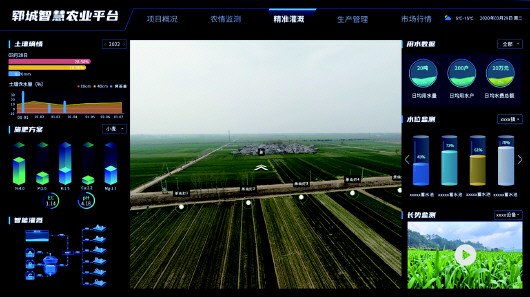
菏泽联通以数字技术赋能农业现代化谱写乡村振兴新篇章
Qi Lu Wan Bao· 2025-10-23 09:32
Core Viewpoint - The agricultural sector in Heze is undergoing a significant digital transformation, driven by China Unicom's implementation of smart agriculture initiatives that enhance productivity, increase farmers' income, and contribute to rural revitalization [2][8]. Group 1: Digital Transformation in Agriculture - Heze, a major agricultural city in Shandong Province, has historically relied on traditional farming methods, but is now embracing a data-driven approach to agriculture [3]. - China Unicom has established a "smart agriculture" platform that integrates various IoT devices to monitor environmental conditions and crop health, enabling farmers to make informed decisions based on real-time data [3][4]. - The platform covers 10,000 acres of high-standard farmland, providing farmers with a digital toolbox for efficient farming practices, including real-time updates on optimal planting strategies and weather conditions [4]. Group 2: Technological Integration - In Dongming County, the integration of 5G, AI, and SaaS technologies in watermelon cultivation has led to a sophisticated monitoring and control system that optimizes growing conditions [5]. - The AI algorithms used in the smart greenhouses allow for dynamic adjustments to irrigation and lighting, resulting in improved crop quality and reduced deformity rates by over 20% [5]. - A traceability system has been established for watermelons, providing consumers with detailed information about the production process, which enhances consumer trust and increases revenue by over 15% per watermelon [6]. Group 3: Enhanced Market Connectivity - In Caoxian, the use of 5G and gigabit broadband has transformed the asparagus supply chain, allowing for real-time live streaming of harvests to consumers, thereby increasing sales and consumer confidence [6][7]. - The asparagus planting area in Caoxian has reached 100,000 acres, accounting for 60% of the national total, with an annual production of 120,000 tons, showcasing the scale and quality of the industry [7]. Group 4: Improved Agricultural Management - The "digital greenhouse" system in Dingtao District allows for remote monitoring and intelligent adjustment of environmental conditions across over 300 greenhouses, significantly enhancing operational efficiency [7]. - Farmers report that digital tools have reduced their workload and improved their ability to respond to extreme weather conditions, leading to greater satisfaction and a sense of security in their agricultural practices [7]. Group 5: Future Outlook - China Unicom's initiatives in Heze represent a commitment to leveraging technology for agricultural modernization and rural revitalization, with plans to further enhance the application of 5G, IoT, big data, and AI in the agricultural sector [8].


瑞银:降中国联通(00762)目标价至11港元 维持“买入”评级
智通财经网· 2025-10-23 08:49
Core Viewpoint - UBS has lowered the target price for China Unicom (00762) from HKD 11.6 to HKD 11 while maintaining a "Buy" rating, reflecting adjustments in profit forecasts due to macroeconomic headwinds affecting business growth [1] Financial Performance - For Q3 2025, China Unicom reported service revenue of RMB 83.3 billion, a year-on-year increase of 0.2% [1] - EBITDA for the same period was RMB 25.4 billion, showing a year-on-year growth of 0.1% [1] - Both service revenue and EBITDA figures were below market consensus by 1-2%, but in line with industry peers [1] - Net profit increased by 5.3% year-on-year, consistent with the 5% growth rate observed in the first half of 2025 [1] Depreciation Policy Change - Starting from October 1, 2024, China Unicom will extend the depreciation period for its 4G assets from 7 years to 10 years, benefiting from depreciation savings [1] - This change is expected to contribute to profit growth in Q3 2025, allowing China Unicom to outperform its peers [1]
iPhone Air 正式开售,在办理 eSIM 前你需要知道的 9 件事
3 6 Ke· 2025-10-23 07:37
Core Points - The iPhone Air has officially launched in mainland China, marking the first phone in the region to support eSIM technology [1] - The eSIM service is currently supported by major carriers in mainland China, including China Unicom, China Telecom, and China Mobile, while China Broadcasting Network does not support it [3][4] - The eSIM business is still in its early stages in mainland China, with ongoing improvements in processes and policies [19] Carrier Support - China Unicom, China Telecom, and China Mobile support eSIM services for the iPhone Air (model: A3518), while China Broadcasting Network does not [3] - Not all physical stores support eSIM services; only designated stores of China Unicom can process eSIM applications [3] - China Unicom previously announced a door-to-door eSIM service in Shenzhen, but the status of this service is currently unclear [3] Requirements for eSIM - The requirements for obtaining an eSIM are similar to those for traditional SIM cards, with a limit of 5 active cards per carrier and a total of 10 across all carriers in mainland China [4] - There are no restrictions on the type of plans available for eSIM services, allowing both new applications and transfers from existing cards [5] Application Process - The application process for eSIM is reported to be convenient, taking approximately 10 minutes for activation at a physical store [6] - eSIM services are available for both local and some cross-province applications, but there are limitations on cross-city and cross-province services depending on the carrier [8][9] Eligibility for Foreign Residents - Residents from Hong Kong, Macau, and Taiwan can apply for eSIM services using specific travel documents, but cannot do so from different locations [11] - Foreigners can also apply for eSIM services using their passports or permanent residency documents, but China Telecom does not support this group [12] eSIM Management - Users can manage their eSIMs directly through their device settings, including deleting and switching eSIMs [15][16] - Deleting an eSIM does not cancel the number; users must visit a physical store to transfer or reactivate the eSIM [18] Conclusion - The launch of the iPhone Air signifies the beginning of the eSIM era in mainland China, with expectations for further development and improvements in eSIM services from various brands and products [19]




恒指跌245點,滬指跌2點,標普500跌35點
宝通证券· 2025-10-23 05:17
Market Performance - Hang Seng Index (恒指) fell by 245 points or 0.9%, closing at 25,781 points[1] - Shanghai Composite Index (滬指) decreased by 2 points or 0.07%, ending at 3,913 points[1] - S&P 500 dropped by 35 points or 0.5%, closing at 6,699 points[2] Trading Volume - Total trading volume in the Hong Kong market reached 227.54 billion HKD[1] - Shanghai Stock Exchange's trading volume was 741.5 billion CNY[1] - Shenzhen Component Index (深證成指) recorded a trading volume of 926.3 billion CNY[1] Currency and Monetary Policy - The central parity rate of RMB against USD was adjusted down by 24 points to 7.0954[1] - People's Bank of China conducted a 138.2 billion CNY reverse repo operation at a rate of 1.4%[1] - Net injection of liquidity was 94.7 billion CNY after 43.5 billion CNY reverse repos matured[1] Corporate Earnings - Sands China (金沙中國) reported a net revenue increase of 7.5% year-on-year to 1.9 billion USD for Q3[3] - China Unicom (中國聯通) posted a revenue of 292.985 billion CNY, up 1% year-on-year, with a net profit growth of 5.1%[3]
联通,大动作!
Sou Hu Cai Jing· 2025-10-23 04:33
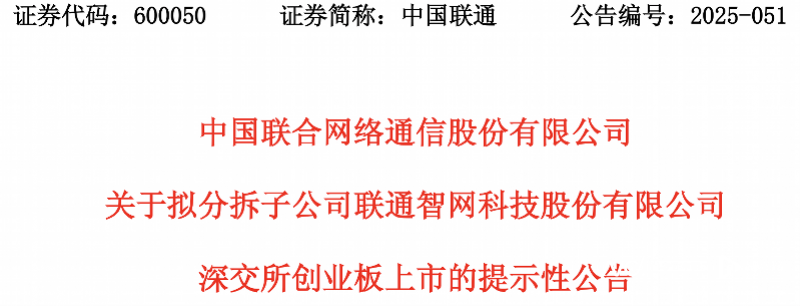
Core Viewpoint - China Unicom plans to spin off its subsidiary, Unicom Smart Network Technology Co., Ltd. (Smart Network Technology), for an independent listing on the Shenzhen Stock Exchange's Growth Enterprise Market, pending approval from its controlling shareholder [1][2]. Group 1: Spin-off Details - The spin-off is expected to enhance the long-term development of Smart Network Technology, allowing it to achieve independent listing and diversify its financing channels, which will support its high-quality growth [2][6]. - Smart Network Technology, established in August 2015, is a wholly-owned subsidiary of China Unicom Group, focusing on digital operation services for the automotive sector, with three main business segments: vehicle networking connection, operation, and innovative applications [2][4]. Group 2: Shareholder Structure - China Unicom holds 68.88% of Smart Network Technology, with other notable shareholders including major automotive companies such as FAW and Dongfeng, indicating a strong automotive industry presence within the company [5][6]. Group 3: Financial Performance - For the first three quarters of 2025, China Unicom reported a revenue of approximately RMB 293 billion, a year-on-year increase of 1.0%, with service revenue accounting for over 90% of total revenue [10][11]. - The company achieved a pre-tax profit of approximately RMB 24.7 billion, with net profit attributable to shareholders reaching about RMB 20 billion, reflecting a year-on-year increase of 5.1% [10][11]. Group 4: Cloud Revenue and Growth - China Unicom's cloud revenue reached RMB 52.9 billion, marking a significant growth point for the company, alongside a notable increase in data center revenue by 8.9% to RMB 21.4 billion [11][14]. - The company is focusing on integrating 5G, AI, and industrial internet technologies to enhance its service capabilities and drive high-quality development [14].
奔驰计划裁员3万人;苹果将推可折叠iPad丨新鲜早科技
2 1 Shi Ji Jing Ji Bao Dao· 2025-10-23 03:37
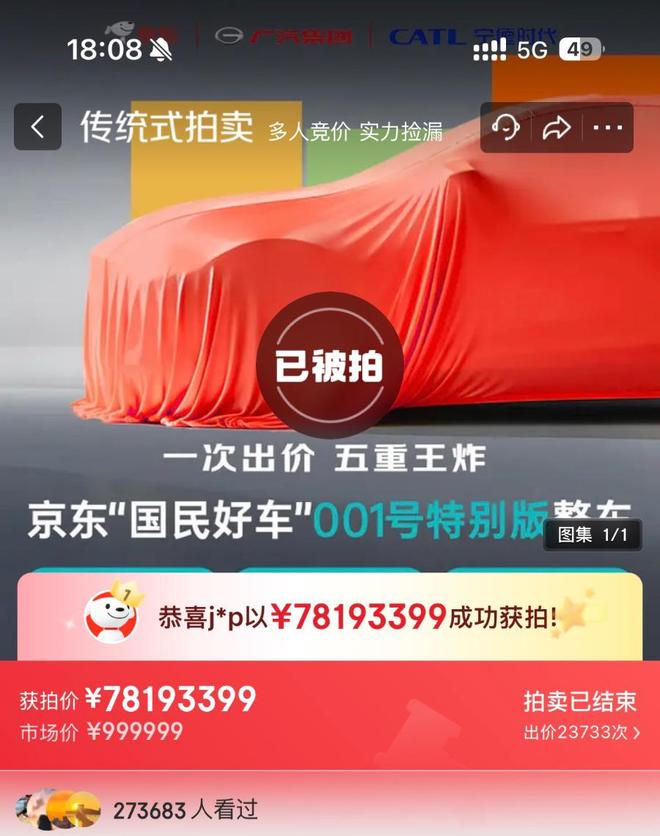
Group 1: Technology Developments - JD.com launched a new car auction that attracted nearly 300,000 participants, with the highest bid exceeding 78 million [2] - Over 800 tech leaders, including Steve Wozniak and Richard Branson, signed a public statement calling for a halt to the development of superintelligent AI, warning of risks ranging from economic collapse to human extinction [4] - Huawei officially released HarmonyOS 6, with over 23 million devices now running HarmonyOS, and the new system features significant performance improvements and enhanced security [5] Group 2: Corporate Actions - SpaceX identified and disabled over 2,500 Starlink devices near a suspected scam center in Myanmar [6] - Mercedes-Benz is implementing its largest-ever layoff plan, targeting 30,000 employees, with around 4,000 already accepting severance packages [6] - Apple is set to launch its first foldable iPad, with a projected price close to $3,000, although its release has been delayed to 2029 due to engineering challenges [7] Group 3: Financial Performance - Tesla reported third-quarter revenue of $28.1 billion, a 12% year-over-year increase, but net profit decreased by 37% to $1.37 billion [9] - China Unicom's revenue for the first three quarters reached 292.985 billion yuan, a 1% increase, with net profit growing by 5.2% to 8.772 billion yuan [10] - Qianfang Technology announced a 1,099% increase in net profit for the first three quarters, reaching 189 million yuan [11][12] - Dazhu Laser reported a third-quarter net profit of 375 million yuan, an 86.51% year-over-year increase, with total revenue for the year-to-date at 12.713 billion yuan [13] Group 4: Investment Activities - LiblibAI completed a $130 million Series B funding round, marking the largest financing in China's AI application sector this year [14] - Uniphore raised $260 million in Series F funding, with participation from major investors including NVIDIA and AMD [15] - Uber and Nebius invested a total of $375 million in autonomous driving technology developer Avride, which plans to launch a self-driving taxi service in Dallas by the end of 2025 [16] Group 5: New Product Launches - LoMo announced a partnership with PostBus to launch an autonomous driving service called AmiGo in Switzerland, with plans for full operation by early 2027 [17] - Nubia released its flagship smartphone Z80 Ultra, featuring a gaming engine and advanced photography capabilities, starting at a price of 4,999 yuan [18]


超导概念龙头 拟重大资产重组
Zhong Guo Zheng Quan Bao· 2025-10-22 23:25
Group 1: Mergers and Acquisitions - Shenzhen has issued the "Action Plan for Promoting High-Quality Development of Mergers and Acquisitions and Restructuring (2025-2027)", aiming for a total market value of listed companies to exceed 20 trillion yuan by the end of 2027 and to complete over 200 merger projects with a total transaction amount exceeding 100 billion yuan [1][2] - The plan includes the establishment of a matrix of merger funds to foster a trillion-level "20+8" industrial fund group, promoting collaborative mergers in key industrial chains [1] Group 2: Company Performance - China Unicom reported a net profit of 8.772 billion yuan for the first three quarters, a year-on-year increase of 5.2%, with a revenue of 292.985 billion yuan, up 1% [3][6] - Q3 results for various companies include: - Q3 revenue of 1.946 billion yuan for Qianfang Technology, up 5.69%, with a net profit of 19.224 million yuan, up 445.61% [3] - Q3 revenue of 2.4 billion yuan for Kaisheng New Materials, up 19.96%, with a net profit of 27.2706 million yuan [4] - Q3 revenue of 10.6 billion yuan for Taotao Vehicle, up 27.73%, with a net profit of 264 million yuan, up 121.44% [5] - Q3 revenue of 1.05 billion yuan for *ST Chengchang, up 266.57%, with a net profit of 33.7253 million yuan, up 565.20% [5] Group 3: Corporate Actions - Farsen plans to sell a 10% stake in China Belkalt Steel Cord Co., which is expected to constitute a major asset restructuring [5] - Time Space Technology announced plans to acquire 100% of Shenzhen Jiahe Jingwei Electronics Technology Co., which is also expected to constitute a major asset restructuring [5] - China Unicom intends to spin off its subsidiary Zhinet Technology for a listing on the Shenzhen Stock Exchange's Growth Enterprise Market [6] - Meili Ecology has received a notice from a creditor applying for restructuring due to inability to repay debts, indicating potential financial distress [6]




战新业务“引擎”发力三大电信运营商前三季度业绩稳增长
Shang Hai Zheng Quan Bao· 2025-10-22 18:07
Core Insights - China Unicom reported a revenue of 293 billion yuan for the first three quarters of 2025, a year-on-year increase of 1.0%, with a total profit of 24.6 billion yuan and a net profit attributable to the parent company of 8.8 billion yuan, reflecting a 5.2% increase year-on-year [2] - The performance of the three major telecom operators, including China Mobile, China Telecom, and China Unicom, showed steady growth in both revenue and net profit, driven by strategic emerging industries such as artificial intelligence, satellite internet, data centers, and quantum technology [2] Business Growth - China Unicom's mobile user base reached 356 million, with a net increase of 12.48 million users, while fixed broadband users reached 129 million, with a net increase of 6.79 million users, marking the highest net increase in recent years [3] - The number of IoT connections exceeded 700 million, and the revenue from cloud services reached 52.9 billion yuan, with data center revenue increasing by 8.9% year-on-year to 21.4 billion yuan [3] - The company is enhancing its network capabilities through high-standard construction and efficient operations, achieving significant improvements in user experience [3] Technological Advancements - China Unicom is focusing on next-generation internet, big data, artificial intelligence, and cybersecurity, with increased investment in R&D, which grew by 5.9% year-on-year [4] - The company has received a business license for satellite mobile communication from the Ministry of Industry and Information Technology, indicating a strong commitment to advancing in cutting-edge technologies [4] Strategic Initiatives - China Unicom plans to spin off its subsidiary, Unicom Smart Network Technology Co., Ltd., for listing on the Shenzhen Stock Exchange's Growth Enterprise Market, aiming to enhance innovation and competitiveness in the vehicle networking industry [5] - This spin-off is part of a broader strategy to optimize industrial layout and strengthen core competitiveness, leveraging market opportunities for growth [5] Financial Performance of Subsidiary - Unicom Smart Network Technology reported revenues of 437 million yuan, 574 million yuan, and 809 million yuan for the years 2020, 2021, and 2022, respectively, with net profits of 75 million yuan, 117 million yuan, and 100 million yuan [6] - The subsidiary focuses on vehicle networking and smart transportation, aligning with national strategies to build a strong transportation and digital economy [6]