
CHINA LIT(00772)

Search documents
AI应用股集体走强,MINIMAX涨超7%
Ge Long Hui· 2026-02-10 04:00
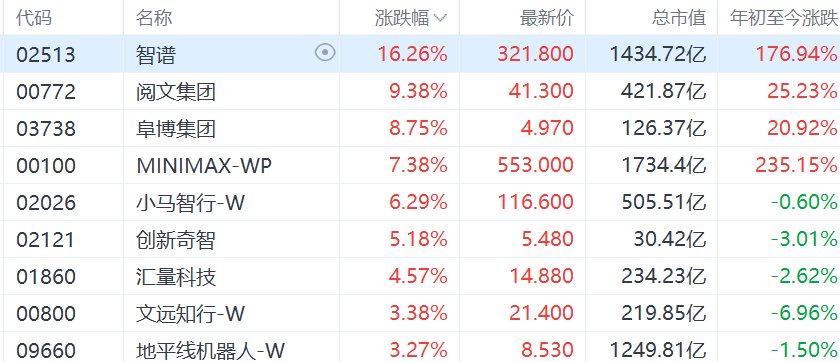
Group 1 - The Hong Kong stock market saw a strong performance in AI application stocks, with notable gains from companies such as Zhizhu (up over 16%), Yuedu Group (up over 9%), and Fubo Group (up over 8%) [1][2] - The recent launch of the AI video generation model Seedance 2.0 by ByteDance on the Jimeng platform has sparked widespread evaluation and discussion within the AI industry, showcasing impressive capabilities in multi-modal thinking and video generation [1] - Seedance 2.0 supports various input types including text, images, videos, and audio, and has achieved breakthroughs in key areas such as self-operated and distributed shooting, audio-visual synchronization, and multi-angle storytelling [1] Group 2 - Zhizhu's stock price increased by 16.26% to 321.800, with a total market capitalization of 143.472 billion and a year-to-date increase of 176.94% [2] - Yuedu Group's stock rose by 9.38% to 41.300, with a market cap of 42.187 billion and a year-to-date increase of 25.23% [2] - Fubo Group's stock gained 8.75% to 4.970, with a market capitalization of 12.637 billion and a year-to-date increase of 20.92% [2]

seedance2.0火爆多模态能力提升百花齐放,内容IP漫剧短剧下游受益
2026-02-10 03:24
Summary of Conference Call on AI Video Models and Their Impact on the Content Industry Industry Overview - The conference focused on the impact of AI video models, specifically ByteDance's CDS 2.0 and K3.0, on the film and entertainment industry, particularly in the realm of content generation and IP development [1][2][3]. Key Points on AI Video Models - **Significant Enhancements**: Both ByteDance's CDS 2.0 and K3.0 have shown remarkable improvements in film production capabilities, including better understanding of multiple modalities (text, video, images, sound) and cross-modal logical reasoning [2][7]. - **Automated Scene Planning**: CDS 2.0 can automatically plan shots and sequences based on the storyline, which is crucial for understanding camera movements and spatial dynamics [2][3]. - **Audio-Visual Synchronization**: The models support synchronized generation of audio and visuals, ensuring that expressions and tones match appropriately [3]. - **High Consistency in Multiple Subjects**: The models maintain high consistency in character actions and scene coherence, enhancing the overall quality of generated content [3][4]. - **Improved Success Rate**: The success rate for generating usable content has increased significantly, with CDS 2.0 achieving over 90% success compared to the previous average of around 20% [4][5]. - **Cost and Time Efficiency**: The improvements in success rates and production capabilities are expected to lower production costs and time, making AI tools more accessible for generating content [5][6]. Competitive Landscape - **Market Potential**: The multi-modal market space is vast, with applications extending beyond film production to include advertising and content creation for social media [11][12]. - **Leading Companies**: Key players in the domestic market include Kuaishou, Keling, and ByteDance, with ongoing competition to enhance model performance and application [11][12]. - **No Major Generational Gaps**: Current models from leading companies show no significant generational gaps, indicating a competitive environment focused on continuous iteration and improvement [12][13]. AI Manju (AI Comic) Market Insights - **Growth Potential**: The AI comic sector is viewed as a promising area, with expectations for rapid growth and profitability, distinguishing it from the saturated real-life short drama market [15][17]. - **Market Size**: The AI comic market is projected to reach nearly 20 billion, while the real-life short drama market was around 67 billion, with a growth rate of approximately 30% [20]. - **Token Consumption**: AI comics require significant token consumption for production, making them a vital customer for video models [21][23]. - **Platform Competition**: Major platforms are aggressively competing for AI comic content, with companies like Tencent and Baidu launching dedicated apps and channels to support this genre [24][25]. Company Strategies and Developments - **Investment in AI Comics**: Companies like Zhongwen Online and Zhangyue Technology are actively developing platforms for AI comic production, leveraging existing IP resources [26][27]. - **Market Positioning**: The competitive landscape is characterized by companies focusing on their unique strengths and user understanding to capture market share [12][14]. Conclusion - The advancements in multi-modal models are expected to revolutionize content production across various formats, providing significant opportunities for companies in the entertainment sector. The AI comic market, in particular, is poised for rapid growth, driven by technological advancements and strategic investments from key players in the industry [14][29].




港股异动丨阅文集团大涨近10% CEO阐述三大战略重心
Ge Long Hui· 2026-02-10 03:07
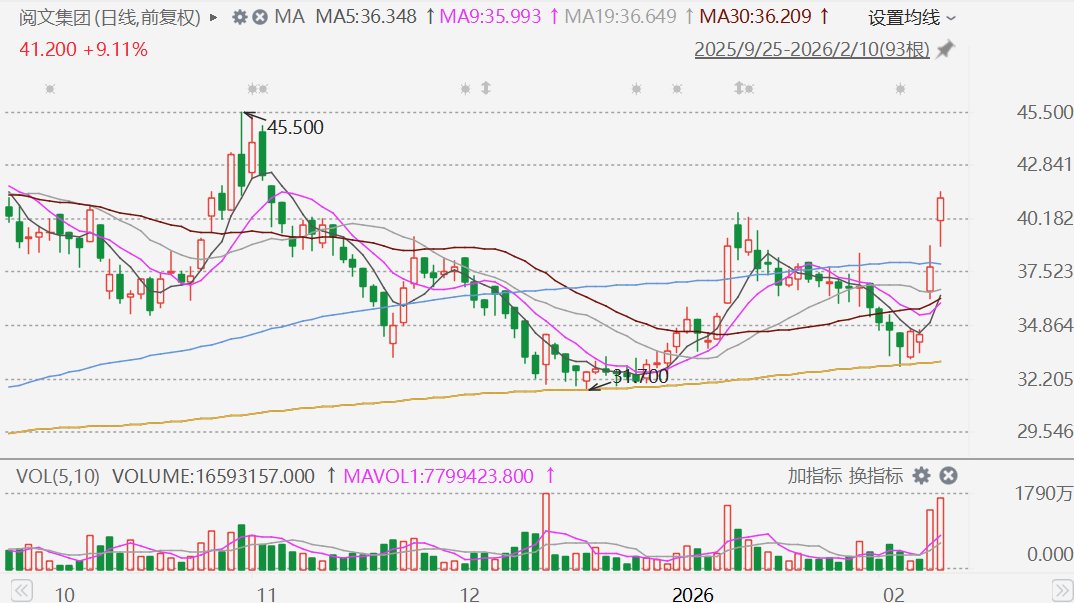
Group 1 - The core strategy of the company for this year includes "evergreen content, IP+AI, and globalization" as highlighted by the CEO in an internal letter [1] - The company aims to create "evergreen content" by supporting core writers and advantageous categories, nurturing new talents, and accelerating the development of film sequels and quality animations [1] - The "IP+AI" creative ecosystem will leverage AI advancements to enhance the value of original content, with plans to embrace AI in content incubation, quality content production, and IP development [1] - The company is focused on building a long-term globalization engine, promoting multilingual expansion while deepening efforts in key regions to create internationally influential benchmark IPs [1] Group 2 - The stock price of the company surged nearly 10% to HKD 41.5, marking a new high since November 5, 2025, and this is the second consecutive day of significant volume increase [3] - The company issued 600 shares through the exercise of stock options, contributing to the stock movement [3]
港股异动丨AI应用股集体走强,MINIMAX涨超7%
Ge Long Hui· 2026-02-10 03:07
Group 1 - The Hong Kong stock market saw a strong performance in AI application stocks, with notable gains from companies such as Zhizhu (up over 16%), Yuedu Group (up over 9%), and Fubo Group (up over 8%) [1] - The AI video generation model Seedance 2.0, launched by ByteDance on its Dream platform, has garnered significant attention and positive reviews within the AI industry for its impressive capabilities [1] - Seedance 2.0 supports various input types including text, images, videos, and audio, and has achieved breakthroughs in key areas such as self-camera and multi-camera narrative capabilities [1] Group 2 - Zhizhu's stock price increased by 16.26% to 321.800, with a total market capitalization of 143.472 billion and a year-to-date increase of 176.94% [2] - Yuedu Group's stock rose by 9.38% to 41.300, with a market cap of 42.187 billion and a year-to-date increase of 25.23% [2] - Fubo Group's stock climbed by 8.75% to 4.970, with a market cap of 12.637 billion and a year-to-date increase of 20.92% [2]
“1.24风波”惹众怒,阅文为何又一次输了人心?
3 6 Ke· 2026-02-10 02:38
Core Insights - The article discusses the strategic challenges faced by the online literature platform, Yuewen, particularly in light of the recent "1.24 Incident" which highlighted the tensions between the platform and its core author community [1][6][10] - The platform's attempts to reform its recommendation mechanism have led to significant backlash from authors, revealing deeper issues of trust and strategic direction within the company [4][11][12] Group 1: Strategic Challenges - The "1.24 Incident" was triggered by a shift from a long-standing recommendation system to a new "traffic package intelligent distribution" model, which was met with criticism from authors regarding fairness and transparency [1][4] - The platform's management has faced accusations of being out of touch with the realities of authors' livelihoods, as evidenced by controversial statements from the editor-in-chief [3][6] - Historical issues, such as the "55 Suspension Festival" in 2020, have created a pattern of trust erosion between the platform and its authors, exacerbated by strategic inconsistencies and operational missteps [7][8][10] Group 2: Competitive Landscape - The rise of free reading platforms like "Tomato Novel" and "Seven Cats Novel" has posed a significant threat to Yuewen, as these competitors leverage ad-supported models and strong algorithmic recommendations to capture market share [11][12] - Yuewen's attempts to introduce free reading options have been hesitant and inconsistent, reflecting a struggle to balance its traditional paid model with the emerging free content trend [11][12] Group 3: Future Opportunities - The rapid development of AI video models presents a potential turning point for Yuewen, as the company aims to integrate AI into its content creation and IP development processes [13][14] - The CEO has outlined a strategic focus on "evergreen content, IP + AI, and globalization," indicating a shift towards leveraging technology to enhance operational efficiency and IP value [13][14] - The company's historical strength in IP management could be a key asset in navigating the current challenges, provided it can effectively adapt to the changing landscape [14]

未知机构:Seedance及Kling模型突破有望进一步强化中国短漫剧全球领先地位东-20260210
未知机构· 2026-02-10 02:05
Summary of Conference Call Records Industry Overview - The Chinese short drama industry holds a significant global leading advantage, with platforms like Reelshort, Dramabox, and Dramawave outperforming local competitors in revenue generation, supported by the comprehensive strengths of Chinese cultural enterprises in web literature IP, short drama production, and promotional strategies. Short dramas have become a crucial category for Chinese cultural exports [1][1]. Key Insights 1. **Growth in Short Drama and Comic Drama Sectors**: The comic drama sector is expected to experience accelerated growth by Q4 2025, with a notable increase in the number of projects and materials being produced [2][2]. 2. **Dramatic Increase in Comic Drama Projects**: Data from DataEye-ADX indicates that the number of comic drama projects will surge from 234 in January to 17,944 by December 2025, representing a growth of over 76 times. Similarly, the number of comic drama materials will rise from 27,000 to 1,623,000, a growth of over 59 times [2][2]. 3. **Recognition of Seedance and Kling Models**: The Seedance 2.0 and Kling 3.0 models have gained significant industry recognition, enhancing their global influence. These models have shown remarkable advancements in key areas such as intelligent camera work, consistency, and audio-visual synchronization [2][2]. 4. **Investment Opportunities in Multi-modal Fields**: The advancements in video models present investment opportunities in the multi-modal sector, with industry leaders acknowledging the impressive capabilities of AI in understanding and integrating multi-modal information [2][2]. Recommendations - **Long-term Investment in Short/Comic Drama**: It is recommended to focus on long-term investment opportunities in the short and comic drama sectors, particularly in companies with strong IP accumulation and early positioning in the comic drama field, such as Chinese Online, Huayi Brothers, Kunlun Wanwei, and others [3][3]. - **Attractive Valuation for Kuaishou**: Kuaishou is highlighted as having an attractive valuation, with the release of the Ling 3.0 model expected to further enhance the company's AI business revenue and valuation [2][2]. Financial Projections - The projected non-IFRS net profits for the company from 2025 to 2027 are estimated at 20.6 billion, 22.9 billion, and 25.2 billion yuan, respectively. The current market capitalization corresponds to a valuation of only 12 times for 2026, maintaining a "buy" rating [3][3]. Risks - Potential risks include the pace of model technology iteration not meeting expectations, slow commercialization of AI applications, and regulatory policy risks within the industry [3][3].




港股人工智能股再度拉升,云知声涨超13%
Mei Ri Jing Ji Xin Wen· 2026-02-10 02:02
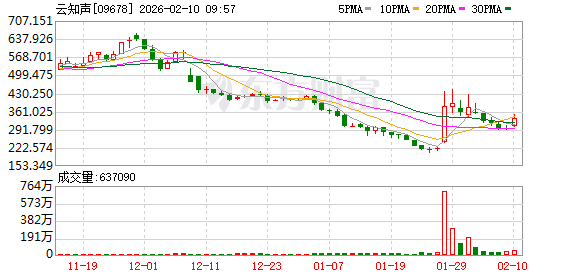
Group 1 - The core viewpoint of the article highlights a significant rise in Hong Kong's artificial intelligence stocks, indicating a positive market trend in this sector [2] - Cloud Wisdom (云知声) saw an increase of over 13%, reflecting strong investor interest and confidence in its performance [2] - Other companies such as Reading Group (阅文集团), Zhiyun (智谱), and MINIMAX-WP experienced gains exceeding 6%, showcasing a broader rally in AI-related stocks [2] - Companies like Zhihu (知乎), Kuaishou (快手), and Horizon Robotics (地平线机器人) also reported increases of over 4%, further emphasizing the momentum in the AI market [2]

港股阅文集团高开逾6%
Mei Ri Jing Ji Xin Wen· 2026-02-10 01:42
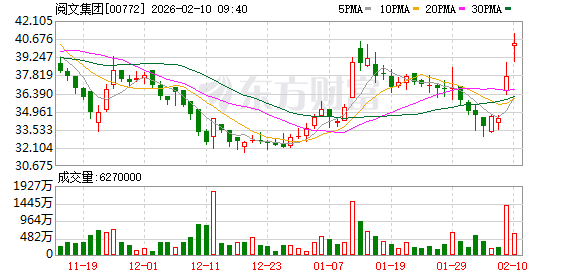
(文章来源:每日经济新闻) 每经AI快讯,阅文集团(00772.HK)高开逾6%,截至发稿,涨6.14%,报40.08港元,成交额2370.7万港 元。 ...
阅文集团高开逾6% 公司内部信明确加速布局AI漫剧
Zhi Tong Cai Jing· 2026-02-10 01:32
Core Viewpoint - The stock of China Literature Group (阅文集团) opened over 6% higher and surged nearly 10% yesterday, reflecting positive market sentiment driven by the company's strategic embrace of AI in content creation and IP development [1] Company Summary - CEO Hou Xiaonan emphasized the increasing value of original content in the face of rapid AI development, suggesting that good stories will become more precious [1] - The company plans to fully embrace AI across various stages including content incubation, high-quality content production, IP development, and global industry expansion [1] - China Literature Group aims to enhance the efficiency and value of IP development by focusing on new scenarios such as AI-generated comic dramas [1] Industry Summary - ByteDance has launched a new AI video generation model, Seedance 2.0, which significantly enhances production capabilities [1] - According to data from Xinhua News, as of January 2026, China Literature Group has over ten works with view counts exceeding 100 million and more than 80 comic drama works with view counts over 10 million [1] - The introduction of Seedance 2.0 is expected to lower production costs and improve production quality, potentially accelerating industry growth [1]
港股异动 | 阅文集团(00772)高开逾6% 公司内部信明确加速布局AI漫剧
智通财经网· 2026-02-10 01:27
Core Viewpoint - The rapid development of AI is making original content increasingly valuable, and the company is poised to leverage its extensive IP portfolio to capitalize on new opportunities in visual storytelling [1] Company Summary - The stock of the company,阅文集团, opened over 6% higher and experienced a nearly 10% increase the previous day, currently trading at 40.08 HKD with a transaction volume of 23.707 million HKD [1] - CEO and President, 侯晓楠, emphasized in an internal letter that the company will fully embrace AI across various stages including content incubation, quality content production, IP development, and global industry expansion [1] - The company plans to enhance the efficiency and value of its IP development by focusing on new scenarios such as AI-generated comic dramas [1] Industry Summary - The recent launch of ByteDance's new AI video generation model, Seedance 2.0, significantly enhances production capabilities, reducing costs and improving outcomes [1] - According to data from Xinhua News, by January 2026, the company has over ten works with view counts exceeding 100 million and more than 80 comic drama productions with over 10 million views [1] - The industry is expected to accelerate its development with the advancements brought by Seedance 2.0 [1]