
CCB(00939)

Search documents
谁是银行贵金属之王?
Xin Lang Cai Jing· 2025-12-26 10:11
Core Viewpoint - The global market is experiencing a rare super cycle in precious metals, driven by a reassessment of the dollar's credibility and real demand from new industrial revolutions such as AI and hydrogen energy [2][24]. Group 1: Market Dynamics - As of December 24, spot gold reached $4500 per ounce, with international silver and platinum increasing over 140% for the year [2][24]. - The demand for precious metals has shifted from traditional safe-haven assets to being driven by monetary credit, geopolitical factors, and green technology [10][34]. Group 2: Banking Sector Adjustments - Major banks like ICBC, CCB, and CITIC are cleaning up personal precious metal accounts that have been inactive, indicating a strategic shift towards focusing on quality clients rather than quantity [3][26]. - This move is not a retreat but a strategic adjustment to enhance service quality, risk control, and long-term trust [27][36]. Group 3: Asset Growth and Competition - By Q3 2025, ICBC led the market with precious metal assets of 385.43 billion yuan, followed by Bank of China, China Construction Bank, Agricultural Bank of China, and Shanghai Pudong Development Bank, all surpassing 100 billion yuan [29][31]. - The growth in precious metal assets is built on a solid foundation from 2024, with ICBC showing consistent expansion from 254.30 billion yuan in Q1 to 385.43 billion yuan in Q3 2025 [32][33]. Group 4: Future Outlook - Goldman Sachs predicts that gold prices may reach $4900 per ounce by 2026, with several financial institutions forecasting gold to potentially hit $5000 per ounce [21][41]. - The competition in the precious metals sector will focus on compliance, customer trust, and long-term strategies, with the true "king of precious metals" being the bank that retains the most engaged and trusting clients after account clean-ups [42].





商业银行出海,谁在悄然发力
21世纪经济报道· 2025-12-26 09:17
Core Viewpoint - Chinese banks are expanding their global presence, establishing a comprehensive service network that supports domestic enterprises going abroad, particularly in emerging markets along the Belt and Road Initiative [1][2]. Group 1: Global Expansion Strategy - Chinese banks are transitioning from focusing primarily on traditional markets in Europe and the US to diversifying their operations in emerging markets such as Southeast Asia, the Middle East, and Latin America [1]. - The overseas expansion strategy of Chinese banks has evolved from rapid growth through new branches and acquisitions before 2019 to a more focused approach on strategic value and risk control since 2020 [11]. Group 2: Bank Performance and Revenue - As of June 2025, Bank of China leads with 783.13 billion yuan in overseas revenue, marking a 14.4% increase from the previous year, with overseas revenue accounting for 23.77% of its total [14]. - Agricultural Bank of China reported a 21.03% increase in overseas revenue, while Construction Bank's overseas revenue grew by 40.92% [14][15]. - In contrast, Everbright Bank experienced a 12.72% decline in overseas revenue, indicating varying performance among banks [16]. Group 3: Regional Distribution and Focus - The distribution of overseas institutions varies among banks, with Bank of China having the most extensive network, followed by Industrial and Commercial Bank of China, which has a significant presence in 49 countries [4][5]. - Joint-stock banks tend to focus their internationalization efforts on key financial hubs like Hong Kong and London, aiming for niche markets in cross-border finance and wealth management [9]. Group 4: Challenges and Opportunities - Chinese banks face challenges in compliance with differing regulatory environments, cultural integration, and brand recognition in international markets [18]. - The demand for diversified financial services is increasing among Chinese enterprises going abroad, with a shift towards high-value industries and a need for localized services [19][20]. Group 5: Future Directions - To enhance competitiveness, Chinese banks must focus on global collaboration, local market adaptation, compliance risk management, and financial technology innovation [22]. - The future of internationalization for Chinese banks will hinge on their ability to create value in a complex global environment, moving from broad network expansion to deep operational excellence [22].

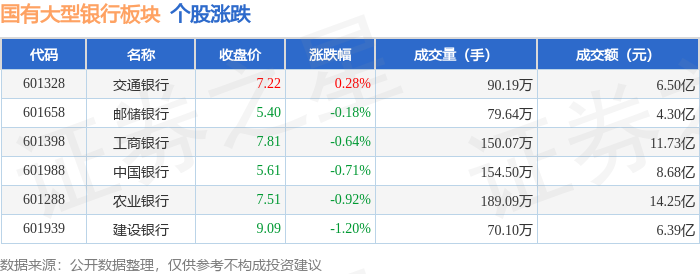
国有大型银行板块12月26日跌0.71%,建设银行领跌,主力资金净流出5.13亿元
Zheng Xing Xing Ye Ri Bao· 2025-12-26 09:07
证券之星消息,12月26日国有大型银行板块较上一交易日下跌0.71%,建设银行领跌。当日上证指数报 收于3963.68,上涨0.1%。深证成指报收于13603.89,上涨0.54%。国有大型银行板块个股涨跌见下表: 从资金流向上来看,当日国有大型银行板块主力资金净流出5.13亿元,游资资金净流入1.74亿元,散户资 金净流入3.39亿元。国有大型银行板块个股资金流向见下表: | 代码 | 名称 | 主力净流入 (元) | 主力净占比 游资净流入 (元) | | 游资净占比 散户净流入 (元) | | 散户净占比 | | --- | --- | --- | --- | --- | --- | --- | --- | | 601939 建设银行 | | > 664.58万 | 1.04% | 494.59万 | 0.77% | -1159.17万 | -1.82% | | 601658 邮储银行 | | -2904.10万 | -6.75% | 643.13万 | 1.50% | 2260.97万 | 5.26% | | 601988 中国银行 | | -5258.09万 | -6.06% | 2974.07万 ...


建行取得服务调用方法专利
Sou Hu Cai Jing· 2025-12-26 06:02
Group 1 - The State Intellectual Property Office of China has granted a patent to China Construction Bank Corporation and Jianxin Financial Technology Co., Ltd. for a method, device, storage medium, and program product related to service invocation, with the authorization announcement number CN119052242B and an application date of August 2024 [1] - China Construction Bank Corporation, established in 2004 and located in Beijing, primarily engages in monetary financial services, with a registered capital of 26,160,038.1459 thousand RMB. The company has invested in 36 enterprises, participated in 5,000 bidding projects, and holds 1,908 trademark records and 5,000 patent records, along with 149 administrative licenses [1] - Jianxin Financial Technology Co., Ltd., founded in 2018 and based in Shanghai, focuses on software and information technology services, with a registered capital of 172,972.9729 thousand RMB. The company has invested in 6 enterprises, participated in 4,225 bidding projects, and possesses 297 trademark records and 5,000 patent records, in addition to 10 administrative licenses [1]
建行取得参数转换方法专利
Sou Hu Cai Jing· 2025-12-26 05:40
建信金融科技有限责任公司,成立于2018年,位于上海市,是一家以从事软件和信息技术服务业为主的 企业。企业注册资本172972.9729万人民币。通过天眼查大数据分析,建信金融科技有限责任公司共对 外投资了6家企业,参与招投标项目4225次,财产线索方面有商标信息297条,专利信息5000条,此外企 业还拥有行政许可10个。 声明:市场有风险,投资需谨慎。本文为AI基于第三方数据生成,仅供参考,不构成个人投资建议。 国家知识产权局信息显示,中国建设银行股份有限公司、建信金融科技有限责任公司取得一项名为"参 数转换方法、装置、设备、计算机存储介质及程序产品"的专利,授权公告号CN119271300B,申请日期 为2024年9月。 天眼查资料显示,中国建设银行股份有限公司,成立于2004年,位于北京市,是一家以从事货币金融服 务为主的企业。企业注册资本26160038.1459万人民币。通过天眼查大数据分析,中国建设银行股份有 限公司共对外投资了36家企业,参与招投标项目5000次,财产线索方面有商标信息1908条,专利信息 5000条,此外企业还拥有行政许可149个。 来源:市场资讯 ...
建行取得文件下载方法专利提升数据处理效率
Sou Hu Cai Jing· 2025-12-26 05:12
Group 1 - The State Intellectual Property Office of China has granted a patent to China Construction Bank Corporation and Jianxin Financial Technology Co., Ltd. for a method and device for document downloading, with the authorization announcement number CN118972382B, applied on August 2024 [1] - China Construction Bank Corporation, established in 2004 and located in Beijing, primarily engages in monetary financial services, with a registered capital of 26,160,038.1459 thousand RMB [1] - China Construction Bank has invested in 36 companies, participated in 5,000 bidding projects, holds 1,908 trademark records, 5,000 patent records, and possesses 149 administrative licenses [1] Group 2 - Jianxin Financial Technology Co., Ltd., founded in 2018 and based in Shanghai, focuses on software and information technology services, with a registered capital of 172,972.9729 thousand RMB [1] - Jianxin Financial Technology has invested in 6 companies, participated in 4,225 bidding projects, holds 297 trademark records, 5,000 patent records, and has 10 administrative licenses [1]
建行取得多系统登录方法专利
Sou Hu Cai Jing· 2025-12-26 04:31
建信金融科技有限责任公司,成立于2018年,位于上海市,是一家以从事软件和信息技术服务业为主的 企业。企业注册资本172972.9729万人民币。通过天眼查大数据分析,建信金融科技有限责任公司共对 外投资了6家企业,参与招投标项目4224次,财产线索方面有商标信息284条,专利信息5000条,此外企 业还拥有行政许可10个。 声明:市场有风险,投资需谨慎。本文为AI基于第三方数据生成,仅供参考,不构成个人投资建议。 来源:市场资讯 国家知识产权局信息显示,中国建设银行股份有限公司取得一项名为"多系统登录方法、设备、存储介 质及程序产品"的专利,授权公告号CN119583150B,申请日期为2024年11月。 天眼查资料显示,中国建设银行股份有限公司,成立于2004年,位于北京市,是一家以从事货币金融服 务为主的企业。企业注册资本26160038.1459万人民币。通过天眼查大数据分析,中国建设银行股份有 限公司共对外投资了36家企业,参与招投标项目5000次,财产线索方面有商标信息1693条,专利信息 5000条,此外企业还拥有行政许可149个。 ...
建行取得调用业务服务方法专利
Sou Hu Cai Jing· 2025-12-26 03:46
Group 1 - China Construction Bank Corporation and Jianxin Financial Technology Co., Ltd. have obtained a patent titled "Method, Device, Equipment, and Computer Readable Medium for Business Service Invocation," with authorization announcement number CN118449989B, applied for on June 2024 [1] - China Construction Bank Corporation, established in 2004 and located in Beijing, primarily engages in monetary financial services, with a registered capital of 26,160,038.1459 thousand RMB [1] - The bank has invested in 36 enterprises, participated in 5,000 bidding projects, and holds 1,908 trademark records and 5,000 patent records, along with 149 administrative licenses [1] Group 2 - Jianxin Financial Technology Co., Ltd., founded in 2018 and based in Shanghai, focuses on software and information technology services, with a registered capital of 172,972.9729 thousand RMB [1] - The company has invested in 6 enterprises, participated in 4,224 bidding projects, and possesses 297 trademark records and 5,000 patent records, in addition to 10 administrative licenses [1]
举牌、重组!银行业十大关键词,看这里!
券商中国· 2025-12-26 03:37
Core Viewpoint - In 2025, the Chinese banking industry is characterized by resilience amidst economic challenges, focusing on serving the real economy, embracing transformation, and maintaining a balance between national strategy and sustainable development [1] Group 1: Regulatory Indicators - Total assets of commercial banks are projected to grow from 380.52 trillion yuan at the end of 2024 to 409.63 trillion yuan by September 2025 [2] - The non-performing loan ratio is expected to fluctuate slightly, starting at 1.50% in December 2024 and reaching 1.52% by September 2025 [2] - The core tier one capital adequacy ratio is anticipated to decrease from 11% in 2024 to around 10.87% by September 2025 [2] Group 2: Industry Trends - The banking sector is shifting from aggressive expansion to a more cautious approach, emphasizing the need to avoid "involution" or excessive competition [3] - Regulatory bodies are actively working to curb harmful competition, leading to a collective industry effort to reduce risks and improve operational efficiency [3] Group 3: Interest Margin Protection - The banking industry is facing significant pressure on net interest margins, prompting banks to optimize asset allocation and diversify revenue sources [7][9] - Banks are focusing on cost control by reducing deposit rates and managing high-cost long-term deposits [8] Group 4: Deposit Migration - A trend of "deposit migration" is emerging as residents seek better investment channels due to low deposit rates, with bank wealth management products seeing significant growth [10] - The shift in deposit behavior is driven by a "price comparison effect," leading to a decline in demand for traditional long-term deposits [10] Group 5: Mergers and Restructuring - Over 400 banking institutions are expected to exit the market through mergers, dissolutions, or consolidations, marking a significant increase compared to previous years [11] - The restructuring efforts are focused on improving the quality of financial services rather than merely reducing the number of institutions [13] Group 6: Technological Finance - The banking sector is prioritizing technological finance, with a focus on supporting innovation and providing tailored financial products for tech companies [14][15] - The proportion of technology loans in total new loans has reached 28.8%, indicating a strong push towards financing technology-driven enterprises [15] Group 7: Capital Increases - A notable "capital increase wave" is occurring, with major state-owned banks raising 520 billion yuan through stock issuance to bolster capital adequacy [17] - Smaller banks are also responding by exploring various capital-raising methods, including targeted issuance and local state-owned capital participation [17] Group 8: Shareholder Engagement - The banking sector has seen a surge in insurance capital participation, with several banks experiencing significant shareholding increases from insurance companies [18] - Asset management companies are also actively increasing their stakes in various banks, indicating strong investor interest in the banking sector [18] Group 9: Corporate Governance Changes - A significant shift in corporate governance is underway, with many banks abolishing or not establishing supervisory boards, transitioning to a single board system [21][22] - This change aims to enhance efficiency and reduce governance costs while maintaining oversight through audit committees [22][24] Group 10: AI Integration - The banking industry is undergoing a transformation driven by artificial intelligence, with major banks adopting an "AI-first" strategy to enhance their operations [25][26] - AI applications are expanding from customer service to core business processes, indicating a shift towards value creation through technology [26]


建行取得数据处理方法专利提升养老服务管理便捷性
Sou Hu Cai Jing· 2025-12-26 02:55
Company Overview - China Construction Bank Corporation (CCB) was established in 2004 and is headquartered in Beijing, primarily engaged in monetary financial services. The registered capital is approximately 26.16 billion RMB [1] - CCB has invested in 36 companies, participated in 5,000 bidding projects, and holds 1,908 trademark records and 5,000 patent records, along with 149 administrative licenses [1] - Jianxin Financial Technology Co., Ltd. was founded in 2018 and is located in Shanghai, focusing on software and information technology services. The registered capital is approximately 172.97 million RMB [1] - Jianxin Financial Technology has invested in 6 companies, participated in 4,222 bidding projects, and holds 297 trademark records and 5,000 patent records, along with 10 administrative licenses [1] Patent Information - CCB and Jianxin Financial Technology have obtained a patent titled "Data Processing Method, System, Electronic Device, Medium, and Product," with the authorization announcement number CN115619326B, applied for on September 2022 [1]