
CCB(00939)

Search documents
智通ADR统计 | 11月18日
智通财经网· 2025-11-17 22:44
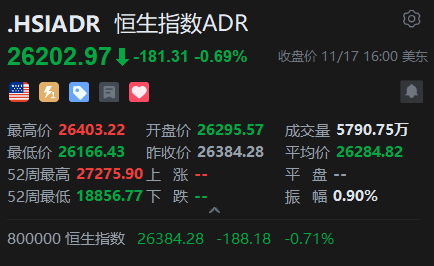
Market Overview - The Hang Seng Index (HSI) closed at 26,202.97, down by 181.31 points or 0.69% on November 17 [1] - The index's trading volume was 57.9075 million, with a daily average price of 26,284.82 [1] - The 52-week high for the index was 27,275.90, while the low was 18,856.77 [1] Major Blue-Chip Stocks Performance - Most large-cap stocks experienced declines, with HSBC Holdings closing at HKD 110.738, down 1.21% from the Hong Kong close [2] - Tencent Holdings closed at HKD 629.180, down 1.15% from the Hong Kong close [2] Stock Price Movements - Tencent Holdings (00700) saw a decrease of HKD 4.500, or 0.70%, with an ADR price of HKD 629.180, which is HKD 7.320 lower than its Hong Kong stock price [3] - HSBC Holdings (00005) dropped by HKD 0.800, or 0.71%, with an ADR price of HKD 110.738, which is HKD 1.362 lower than its Hong Kong stock price [3] - Other notable declines included AIA Group (01299) down by 1.28% and China Construction Bank (00939) down by 1.32% [3]





迈向“十五五”:金融机构如何精准赋能实体经济与雄安未来之城
Xin Hua Cai Jing· 2025-11-17 13:29
Core Insights - The article discusses the need for financial institutions to enhance their services to support the high-quality development of the real economy during the "14th Five-Year Plan" and the beginning of the "15th Five-Year Plan" [1] Group 1: Financial Institutions' Role - Financial institutions are urged to improve the precision, adaptability, and accessibility of their services, focusing on key areas and weak links in the real economy [2] - Regional banks should adjust their credit and customer strategies towards intelligent, green, and integrated directions, accelerating digital transformation to create competitive advantages [2] - The futures and securities industries are presented with development opportunities, with the futures sector encouraged to implement scenario-based services to enhance price discovery and risk management [2] Group 2: Risk Management - Financial institutions must maintain a risk baseline while serving the real economy, employing early identification and warning systems for risk management [3] - City commercial banks should respect risks but not fear development, balancing risk and return through technology empowerment and compliance culture [3] - The futures industry should establish integrated risk warning mechanisms to preemptively address systemic risks [3] Group 3: Innovative Financial Products and Services - The "five major articles" of financial work emphasize technology finance, green finance, inclusive finance, pension finance, and digital finance as core strategies for financial institutions [4] - Construction Bank has developed a comprehensive technology finance service system, including products that cater to different growth stages of enterprises [4] - Regional banks are launching tailored products to address local needs, such as order financing and pollution rights pledge loans, to support small and micro enterprises [4][5] Group 4: Industry Empowerment - Financial institutions are transitioning from traditional credit providers to industry enablers, particularly in the context of the Xiong'an New Area's development [4] - Supply chain financial products are being utilized to extend services to upstream and downstream SMEs, integrating various financial services [5] - Futures and securities firms are playing a crucial role in managing risks within the industrial chain, responding to the increasing demand for risk management from enterprises [6]


百万级项目频现!银行业密集启动科技招标,数字化转型驶入深水区
Xin Lang Cai Jing· 2025-11-17 12:24
Core Insights - Recent trends show multiple banks accelerating their technology procurement efforts, with significant budgets allocated for projects in areas such as large model development, computing infrastructure, and intelligent risk control [1][3][6] - The banking industry's IT investment is projected to reach 169.315 billion yuan in 2024, marking a 3.6% increase from 2023, and is expected to exceed 266.227 billion yuan by 2028 [7] Group 1: Technology Procurement Trends - Major banks are shifting from fragmented IT equipment purchases to systematic and ecological strategic layouts, with policy banks leading through large-scale tenders and framework agreements [3][4] - State-owned banks and national joint-stock banks dominate the technology procurement market, focusing on high-budget, long-cycle projects [3][4] - Smaller banks are adopting a more targeted approach, focusing on regional needs and core requirements with flexible budget scales [4] Group 2: Drivers of Technology Investment - The narrowing net interest margin and pressure on traditional lending businesses are pushing banks to leverage technology for competitive differentiation and cost control [6] - Regulatory policies are also driving technology projects, with over 30 "one-table" related projects initiated or completed across the industry since October [6][9] - External competition from fintech companies and internet platforms is compelling banks to accelerate their transformation efforts [6][9] Group 3: Challenges and Risks - The rapid pace of technology procurement presents challenges such as unclear risk responsibilities in outsourcing partnerships and compliance with regulatory requirements [9][10] - A notable case involving Guizhou Bank highlights issues with contract clarity and risk assessment in technology procurement [9] - The fast iteration of technology poses adaptation risks, as banks may face additional costs for upgrades if algorithms become outdated [10] Group 4: Future Considerations - The banking industry needs to establish a more systematic technology governance framework, including lifecycle management of suppliers and risk assessment mechanisms [10] - Balancing technological innovation with risk management will be crucial for banks to transform technology investments into core competitive advantages [10]



国际金价反复震荡 银行积存金投资门槛升至千元以上
Di Yi Cai Jing· 2025-11-17 00:32
随着金价持续攀升并伴随剧烈波动,银行端的黄金积存业务正在经历快速调整。中信银行、建设银行最 新公告显示,自11月15日起,两家银行均将积存金业务的月度起存金额明显上调,门槛普遍进入"千元 时代"。 11月14日,国际金价跳水,截至当天收盘,现货黄金报4082.159美元/盎司;沪金跟随下跌,当天收盘报 934.86元/克。 在国际金价高位震荡的大背景下,银行端正迎来新一轮黄金积存业务的集体调整。10月以来,多家大型 银行相继上调积存金起购门槛或调整相关交易规则,以应对价格快速波动带来的风险压力。 与此同时,国际金价近日在连续大涨后出现明显回调,市场对后续走势的判断出现分化,在机构普遍认 可黄金中长期逻辑的同时,2026年前后的短期路径仍存在较大不确定性。 银行再度抬高积存金门槛 建设银行公告称,为保护投资者权益、优化交易结构,该行修订了黄金积存业务规则,新增涉及报价机 制、巨额赎回等内容。其中,月积存金额起点由此前的较低水平提升至1200元,并按10元整数倍递增; 新规将自11月15日起正式执行。 值得注意的是,建行此次调整的核心,是将积存金买卖价差改为"动态调整模式",允许银行依据市场行 情、头寸状况及流动 ...
贴息“红包”撬动消费潜能
Xin Hua Wang· 2025-11-17 00:15
Core Viewpoint - The implementation of the "Personal Consumption Loan Interest Subsidy Policy" aims to stimulate consumer spending and support economic growth by reducing the cost of consumer credit through government subsidies [1] Group 1: Policy Implementation and Impact - The subsidy policy began in September and is designed to lower the cost of consumer loans, thereby enhancing consumer purchasing power and promoting economic recovery [1] - The policy is expected to work synergistically with other initiatives, such as the "old-for-new" consumption policy, creating a greater overall impact on consumer spending [1] - As of the end of October, nearly 1 million customers had signed subsidy agreements, with over 1.8 million transactions recognized as eligible for the subsidy [3] Group 2: Consumer Experience and Benefits - Consumers have reported significant savings; for example, one individual saved over 1,000 yuan in interest on a loan for home appliances due to the subsidy [2] - The process for consumers to access the subsidy has been streamlined, with many banks implementing systems that automatically recognize eligible transactions, making it easier for consumers to benefit from the policy [2][3] - The policy has led to a notable increase in the adoption of interest-free installment payments, particularly during major shopping events like "Double 11," where the coverage of interest-free products increased by 60% [5] Group 3: Financial Institutions' Role - Financial institutions have adapted their services to facilitate the subsidy, with banks creating dedicated teams to ensure compliance and efficiency in processing applications [3] - The Agricultural Bank of China reported that it had provided 1.2 billion yuan in subsidized loans, benefiting over 10,000 customers [8] - Traffic Bank has also streamlined its processes, issuing over 320 million yuan in personal consumption loans, with a significant portion allocated to automobile purchases [13] Group 4: Broader Economic Implications - The collaboration between fiscal and financial tools is seen as a way to enhance the effectiveness of government spending and lower consumer financing costs, ultimately improving living standards [9] - The policy has encouraged businesses to offer additional discounts and incentives, further stimulating consumer demand and contributing to economic growth [5][10]

国际金价反复震荡,银行积存金投资门槛升至千元以上
Di Yi Cai Jing· 2025-11-16 12:11
花旗更倾向于认为金价在2026年面临回调压力,或回落至3650美元/盎司。 11月14日,国际金价跳水,截至当天收盘,现货黄金报4082.159美元/盎司;沪金跟随下跌,当天收盘报 934.86元/克。 在国际金价高位震荡的大背景下,银行端正迎来新一轮黄金积存业务的集体调整。10月以来,多家大型 银行相继上调积存金起购门槛或调整相关交易规则,以应对价格快速波动带来的风险压力。 与此同时,国际金价近日在连续大涨后出现明显回调,市场对后续走势的判断出现分化,在机构普遍认 可黄金中长期逻辑的同时,2026年前后的短期路径仍存在较大不确定性。 银行再度抬高积存金门槛 随着金价持续攀升并伴随剧烈波动,银行端的黄金积存业务正在经历快速调整。中信银行、建设银行最 新公告显示,自11月15日起,两家银行均将积存金业务的月度起存金额明显上调,门槛普遍进入"千元 时代"。 建设银行公告称,为保护投资者权益、优化交易结构,该行修订了黄金积存业务规则,新增涉及报价机 制、巨额赎回等内容。其中,月积存金额起点由此前的较低水平提升至1200元,并按10元整数倍递增; 新规将自11月15日起正式执行。 值得注意的是,建行此次调整的核心,是 ...
数字金融竞速!多家银行密集招标,技术、人力采购“潮涌”
Bei Jing Shang Bao· 2025-11-16 11:16
Core Insights - The digital transformation in the banking sector has shifted from an option to a necessity for survival, prompting a competitive race focused on technology, human resources, and ecosystem development [1][4] - Multiple banks, including Shanghai Pudong Development Bank, China Construction Bank, and others, have recently announced technology procurement tenders, indicating a significant increase in technology investment and service optimization [2][3] Group 1: Technology Procurement Trends - Several banks are actively seeking external support for technology projects, with significant tenders being issued for IT services and system upgrades [2][3] - Shanghai Pudong Development Bank plans to establish an IT outsourcing resource pool with 12-18 suppliers for a three-year period, addressing the shortage of developers and enhancing IT efficiency [2] - China Construction Bank's Hubei branch has set a tender control price of 22.5 million yuan for software development and technical services, aiming to select three suppliers for a three-year collaboration [2] Group 2: Strategic Implications - The concentrated technology procurement signals that the banking industry is entering a "deep water zone" in digital transformation, moving beyond basic system maintenance to strategic planning for future competition [3][4] - The high entry barriers set by banks for suppliers reflect a shift in demand from basic services to high-quality partnerships that can deeply understand financial operations and manage complex projects [3] Group 3: Industry Challenges and Responses - The push for technology investment is driven by multiple competitive pressures, including narrowing net interest margins and challenges from fintech companies and internet platforms [4] - Banks are compelled to leverage technology to create differentiated advantages, control operational costs, and enhance customer experience, making technology investment a defensive strategy against short-term challenges [4] Group 4: Future Focus Areas - Future technology investments in the banking sector are expected to focus on three core areas: data security and application, compliance and risk control system upgrades, and comprehensive solutions for intelligent financial transformation [5]
建设银行福建省分行:以绿为笔,共绘乡村振兴新画卷
Zheng Quan Ri Bao Zhi Sheng· 2025-11-16 10:09
Core Viewpoint - Fujian Construction Bank is enhancing its support for green finance and rural revitalization through innovative financing solutions, focusing on unique agricultural industries and ecological resources in Fujian province [1][2][3][4][5][6][7] Group 1: Financial Support and Innovations - As of the end of October, Fujian Construction Bank's agricultural loan balance reached nearly 130 billion yuan, with over 110 unique agricultural industries benefiting from specialized financing services [1] - The bank has provided over 500 million yuan in "Rural Revitalization Loans" to support farmers like Zhang Wenyue, helping them reduce financing costs and invest in green agricultural technologies [2] - The bank has developed a comprehensive financing solution for forestry projects, offering 118 million yuan in loans for a 16-year period, facilitating the transformation of ecological resources into economic value [4][6] Group 2: Agricultural and Ecological Development - The bank's "Financial Spring Rain" initiative has supported over 80,000 farmers in Fujian, promoting the growth of various agricultural sectors, including mushrooms, aquaculture, and tea [3] - Fujian Construction Bank has engaged in carbon finance initiatives, such as the "Carbon Credit Loan" model, to enhance the financial attributes of forestry and promote sustainable practices [5][6] - The bank has established a rural property rights trading platform, facilitating transactions exceeding 5.8 billion yuan, covering 42 counties in Fujian and extending to neighboring provinces [5][6] Group 3: Tourism and Rural Revitalization - The bank has launched tailored "Rural Homestay Loans" to support the development of tourism in rural areas, enabling local businesses to upgrade their facilities and attract more visitors [6][7] - Fujian Construction Bank has invested over 30 billion yuan in loans related to the forestry industry, benefiting more than 1,000 stakeholders in the sector [6] - The bank's comprehensive financial services have contributed over 30 billion yuan in loans to support the integration of agriculture, culture, and tourism, enhancing the appeal of rural areas to tourists [7]
“银行直供房”大增,楼市下行经营贷续贷风险曝光
Di Yi Cai Jing· 2025-11-16 08:40
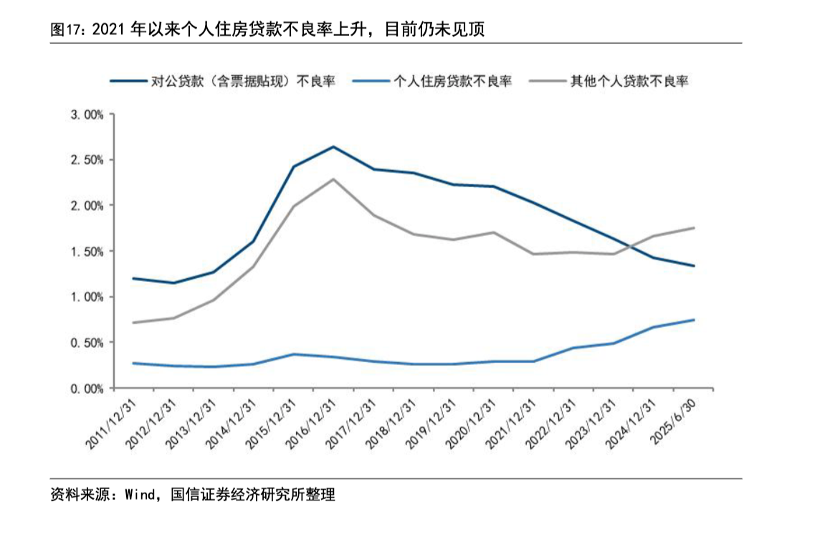
Core Insights - The article discusses the recent surge in banks directly selling properties through online platforms, with several banks, including Agricultural Bank, Construction Bank, and Transportation Bank, listing over a thousand properties for sale, indicating a significant acceleration in asset disposal [1][2] - The increase in direct property sales is attributed to multiple factors, including the expiration of operational loans, the revaluation of mortgaged properties due to a declining real estate market, and banks' need to optimize their balance sheets and release capital [1][4] Group 1: Reasons for Increased Direct Property Sales - Banks are facing challenges with loan renewals as properties are being revalued lower than their original loan amounts, leading to difficulties for borrowers and an influx of properties into the auction market [3][4] - The trend of increasing direct property sales is particularly evident among regional banks, with a notable rise in the number of properties listed for sale [2][3] - Regulatory bodies have issued warnings regarding risks associated with high valuations and lending practices, further influencing banks' decisions to expedite property sales [3] Group 2: Banks' Motivations for Accelerated Asset Disposal - Banks are motivated to accelerate the disposal of non-performing assets to reduce capital consumption, as regulations require them to dispose of such assets within a specified timeframe to avoid punitive risk weights [4][6] - Selling off distressed properties at discounted prices allows banks to recover funds quickly and supplement their profits amid ongoing revenue pressures [4][5] - The expectation of further declines in property values prompts banks to act swiftly to mitigate potential losses from prolonged holding periods [4][10] Group 3: Trends in Non-Performing Asset Management - The rising non-performing loan rates across various retail loan categories, including personal housing loans, indicate increasing financial stress within the banking sector [5][6] - Banks are diversifying their asset disposal strategies, utilizing methods such as write-offs, collections, transfers, and asset-backed securities (ABS) to manage non-performing loans effectively [6][7] - The issuance of ABS related to non-performing loans has significantly increased, with a notable rise in the volume of personal housing mortgage ABS, reflecting banks' heightened need for asset disposal [7] Group 4: Market and Risk Assessment - There are differing opinions on the impact of direct property sales on the real estate market, with some analysts suggesting potential price pressures in certain cities, while others believe the scale of sales is insufficient to affect overall market prices [8][10] - The risk associated with banks' exposure to real estate is considered manageable in major cities, although some regional banks may still face challenges [8][10] - The shift towards more transparent and diversified asset disposal methods indicates a positive trend for banks' balance sheets, as the disposal of distressed assets can lead to improved financial health [10]
消费贷贴息政策实施已逾两月 初见成效
Jing Ji Ri Bao· 2025-11-16 04:28
Core Insights - The implementation of the "Personal Consumption Loan Interest Subsidy Policy" has shown initial positive effects after over two months of execution [1] Group 1: Policy Effectiveness - Major banks have reported an increase in personal consumption loans, with China Construction Bank seeing a month-on-month and year-on-year rise in September [1] - Bank of China disbursed 47.4 billion yuan in September, which is an increase of 11 billion yuan from August and 14.7 billion yuan from September of the previous year [1] - Traffic Bank's overall consumption loan issuance grew by over 20% month-on-month in September, primarily in the household automotive and home decoration sectors [1] Group 2: Application Success Rate - Construction Bank has an application success rate of approximately 80% for interest subsidies [1] - Despite the high success rate, there are still cases that do not pass the subsidy review process, indicating some challenges in the implementation [1] - Zhejiang Commercial Bank noted a high automatic approval rate but faces specific challenges in recognition technology [1]

