CCB(00939)

Search documents
【公告】关于2026年贺岁普通纪念币和2026年贺岁纪念钞预约兑换的公告
中国建设银行· 2026-01-08 07:52
Core Viewpoint - The People's Bank of China will issue the 2026 New Year commemorative coins and banknotes through a reservation exchange system, with specific details on issuance and exchange procedures outlined [1][2][4]. Group 1: Issuance Details - The 2026 New Year commemorative coin has a face value of 10 yuan, with a total issuance of 100 million pieces, while the commemorative banknote has a face value of 20 yuan, also with a total issuance of 100 million pieces [1]. - The China Construction Bank (CCB) will handle the reservation exchange in 11 regions, including major cities and provinces such as Beijing, Inner Mongolia, and Zhejiang [1]. Group 2: Reservation Arrangement - The reservation period for the 2026 commemorative coin is from January 13, 2026, 22:00 to January 14, 2026, 24:00, while the banknote reservation period is from January 13, 2026, 22:30 to January 14, 2026, 24:00 [2]. - Each customer can reserve only once for each item, with a limit of 20 coins or 20 banknotes per person [2]. Group 3: Verification and Exchange Period - The verification period will take place from January 17 to January 19, 2026, during which the People's Bank of China will verify all reservation records [3]. - The exchange period for successful reservations is from January 20 to January 26, 2026, where customers must present their valid second-generation resident ID for exchange [4]. Group 4: Reservation Channels - Customers can reserve through various online channels, including the CCB international website, mobile portal, personal online banking, and WeChat service accounts [5]. - All online channels will open for reservations before the official start of the reservation period [5]. Group 5: Additional Information - The CCB supports cash, debit cards, and savings books for the exchange, with some branches also supporting digital RMB [8]. - A prepayment feature is available for customers who successfully reserve, allowing them to complete the payment through the CCB mobile banking app [8].


【指南】一次性信用修复政策必看操作指南
中国建设银行· 2026-01-08 07:52
Core Viewpoint - The article discusses the implementation of a one-time credit repair policy by the People's Bank of China, detailing how individuals can check their credit status with China Construction Bank (CCB) to determine eligibility for the policy and the steps required to benefit from it [3]. Group 1: Checking Credit Records - Individuals should first check their credit records with CCB to see if there are any overdue payments that would affect their eligibility for the central bank's policy [3]. - The credit status can be checked through various methods, including the CCB app, online banking, and smart teller machines [5][6]. - The credit report will display repayment information over the past five years, indicating overdue amounts and repayment status [7]. Group 2: Understanding Overdue Information - If overdue payments are found, individuals are advised to repay them promptly to qualify for the policy [11]. - Specific scenarios are outlined: if overdue debts are fully repaid by November 30, 2025, the overdue information will not be displayed from January 1, 2026 [11]. - For debts repaid between December 1, 2025, and March 31, 2026, the overdue information will be removed by the end of the following month [15]. Group 3: Repaying Debts - To benefit from the policy, individuals must ensure they repay all overdue amounts and current payments by the due date [21]. - It is essential to verify the repayment status after making payments to avoid missing the opportunity for credit repair [19][20]. - For loan repayments, all historical overdue amounts and current dues must be cleared before the agreed repayment date [21]. Group 4: Monitoring Credit Record Changes - After repaying overdue debts, individuals should check their credit reports at the end of the following month to observe any changes [22]. - The implementation of the credit repair policy will result in overdue statuses being updated to normal, and overdue amounts below 10,000 yuan will be adjusted to zero [26].


建设银行青岛长江中路支行被罚5万元:占压财政存款或者资金
Xin Lang Cai Jing· 2026-01-08 05:48
Group 1 - The People's Bank of China, Qingdao Branch, has publicly announced an administrative penalty against China Construction Bank's Qingdao Changjiang Middle Road Branch for improperly holding government deposits or funds [1] - The penalty includes a warning and a fine of 50,000 yuan [1]
金融活水润新年 元旦消费暖意浓
Jin Rong Shi Bao· 2026-01-08 01:03
Group 1 - The core viewpoint of the articles highlights the resurgence of consumer activity during the 2026 New Year holiday, driven by tailored financial products and supportive government policies aimed at stimulating consumption in various sectors such as automotive, tourism, and retail [1][2][4][6]. Group 2 - Financial institutions are actively engaging with consumers by embedding financial services into various consumption scenarios, particularly in the automotive sector, where banks are facilitating car purchases through customized financing solutions [2][3]. - The implementation of the "old-for-new" policy in December 2025 has further stimulated consumer enthusiasm for vehicle upgrades, with significant financial incentives such as government subsidies and promotional offers from car manufacturers [2][3]. Group 3 - In the tourism sector, banks are collaborating with local businesses to create promotional activities that enhance the holiday experience for consumers, thereby driving spending in the hospitality and entertainment industries [4][5]. - Various banks are launching targeted campaigns to promote consumption in diverse areas, including dining and winter sports, leveraging seasonal trends to attract consumers and stimulate spending [6][7].
智通ADR统计 | 1月8日





智通财经网· 2026-01-07 22:21
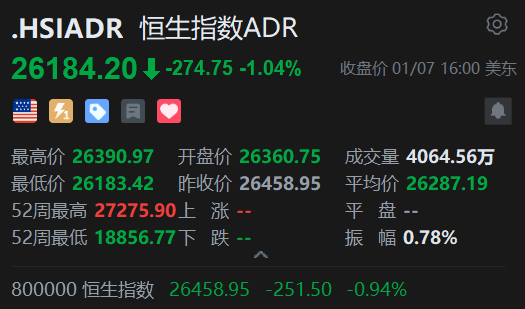
Market Overview - The Hang Seng Index (HSI) closed at 26,184.20, down by 274.75 points or 1.04% from the previous close of 26,458.95 [1] - The index reached a high of 26,390.97 and a low of 26,183.42 during the trading session, with an average price of 26,287.19 [1] Major Blue-Chip Stocks Performance - HSBC Holdings closed at 124.996 HKD, down 1.73% from the previous close [2] - Tencent Holdings closed at 619.762 HKD, down 0.76% from the previous close [2] - Alibaba Group (W) saw a decline of 3.25%, closing at 145.900 HKD [3] - Other notable declines include: - Xiaomi Group (W) down 1.55% to 38.160 HKD [3] - NetEase (S) down 2.88% to 222.600 HKD [3] - Meituan (W) down 1.51% to 104.500 HKD [3] ADR Performance - Tencent's ADR closed at 619.762, reflecting a decrease of 0.76% compared to its Hong Kong stock price [3] - HSBC's ADR was at 124.996, down 1.73% from its Hong Kong counterpart [3] - Alibaba's ADR closed at 142.841, down 2.10% compared to its Hong Kong price [3]
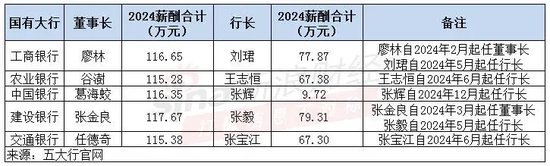
五大行董事长、行长2024薪酬大揭秘!哪位高管拿下最高年薪?
Xin Lang Cai Jing· 2026-01-07 17:31
Summary of Key Points Core Viewpoint - The five major state-owned banks in China have disclosed the salaries of their chairpersons and presidents for the year 2024, with all chairpersons earning over 1.15 million yuan annually [2][5]. Group 1: Chairpersons' Salaries - The chairperson of China Construction Bank, Zhang Jinliang, has an annual salary of 1.1767 million yuan, starting from March 2024 [5][6]. - The chairperson of Industrial and Commercial Bank of China, Liao Lin, has an annual salary of 1.1665 million yuan, starting from February 2024 [5][6]. - The chairperson of Bank of China, Ge Haiqiao, has an annual salary of 1.1635 million yuan [5][6]. - The chairperson of Bank of Communications, Ren Deqi, has an annual salary of 1.1538 million yuan [5][6]. - The chairperson of Agricultural Bank of China, Gu Shu, has an annual salary of 1.1528 million yuan [5][6]. Group 2: Presidents' Salaries - The president of Industrial and Commercial Bank of China, Liu Jun, has an annual salary of 778,700 yuan, starting from May 2024 [3][7]. - The president of Agricultural Bank of China, Wang Zhiheng, has an annual salary of 673,800 yuan, starting from June 2024 [3][7]. - The president of Bank of China, Zhang Hui, has an annual salary of 97,200 yuan, starting from December 2024 [3][7]. - The president of China Construction Bank, Zhang Yi, has an annual salary of 793,100 yuan, starting from May 2024 [3][7]. - The president of Bank of Communications, Zhang Baojiang, has an annual salary of 673,000 yuan, starting from June 2024 [3][7]. Group 3: Highest Salaries Among Executives - The highest salary among executives is held by Song Jianhua, Senior Business Director of Industrial and Commercial Bank of China, with a total of 1.4746 million yuan [9][10]. - The highest salary in Agricultural Bank of China is held by former Chief Risk Officer Wu Gang, with a total of 1.4531 million yuan [9][10]. - The highest salary in Bank of China is held by former Risk Director Zhao Rong, with a total of 1.4062 million yuan [9][10]. - The highest salary in China Construction Bank is held by Chief Financial Officer Sheng Liuyong, with a total of 1.4831 million yuan [9][10]. - The highest salary in Bank of Communications is held by Chief Risk Officer Liu Jianjun, with a total of 1.376 million yuan [12]. Group 4: Overall Salary Distribution - The total salary expenditure for Agricultural Bank of China is the highest among the five banks, exceeding 107.895 billion yuan [14][15]. - The average salary for employees in Bank of Communications is the highest at 316,400 yuan, while the other banks have average salaries below 300,000 yuan [15]. - The total salary expenditure for Industrial and Commercial Bank of China is over 95.747 billion yuan, while China Construction Bank's total is 88.276 billion yuan [14][15].



频次高结构优 上市公司分红总额屡创新高
Zheng Quan Ri Bao· 2026-01-07 17:31
Core Insights - In 2025, A-share listed companies' total cash dividends reached 2.61 trillion yuan, marking an 8.75% year-on-year increase, continuing a trend of annual growth [1][2] - The increase in cash dividends reflects improvements in corporate governance, performance, and policy guidance, indicating a profound transformation in the A-share market ecosystem [2][3] Policy and Regulatory Environment - The new "National Nine Articles" emphasizes strengthening the regulation of cash dividends and encourages measures to increase dividend yields [2] - The China Securities Regulatory Commission released a draft regulation supporting companies in formulating reasonable and stable dividend policies [2] Financial Performance - In the first three quarters of 2025, A-share companies achieved a total operating revenue of 53.46 trillion yuan, a 1.36% increase, and a net profit of 4.70 trillion yuan, up 5.50% [3] - By the end of Q3 2025, listed companies had a total cash reserve of 18.36 trillion yuan, indicating strong dividend-paying capacity [3] Dividend Frequency and Structure - The frequency of dividends has increased, with multiple distributions per year becoming the norm; over 900 companies disclosed three-year dividend plans, enhancing transparency and predictability [4][3] - In 2025, 16 companies executed four cash dividends, 88 companies executed three, and 902 companies executed two [5] Sectoral Analysis - Traditional industries like finance and oil & gas continue to dominate high dividend payouts, while technology companies are also increasing their dividend distributions [6] - In 2025, 945 companies on the ChiNext board distributed 137.45 billion yuan in cash dividends, an 8.41% increase year-on-year [6] Market Dynamics - The rise in dividend amounts is seen as a shift in the capital market's focus from financing expansion to shareholder returns, establishing predictable cash returns as a new benchmark for asset pricing [3][7] - The number of ETFs linked to dividend indices has grown, with 42 new products launched in 2025, and the total scale of these ETFs reached 1520.18 billion yuan by the end of 2025, a 70.11% increase from the previous year [7]
建设银行1月7日大宗交易成交497.20万元
Zheng Quan Shi Bao Wang· 2026-01-07 14:49
Core Viewpoint - On January 7, a block trade of China Construction Bank occurred with a transaction volume of 550,000 shares and a transaction amount of 4.972 million yuan, with the transaction price at 9.04 yuan, indicating a stable trading price compared to the closing price of the day [1] Group 1: Trading Activity - The block trade involved a total volume of 550,000 shares and a transaction amount of 4.972 million yuan, with a transaction price of 9.04 yuan, which was equal to the closing price of the stock on that day [1] - The buyer was Huatai Securities Co., Ltd. headquarters, while the seller was Guotou Securities Co., Ltd. headquarters [1] Group 2: Market Performance - On the same day, China Construction Bank's closing price was 9.04 yuan, reflecting a decline of 1.31%, with a daily turnover rate of 1.40% and a total transaction amount of 1.216 billion yuan [1] - The stock experienced a net outflow of 208 million yuan in main funds throughout the day, and over the past five days, the stock has cumulatively declined by 2.48% with a total net outflow of 158 million yuan [1] Group 3: Margin Trading Data - The latest margin financing balance for China Construction Bank is 986 million yuan, which has decreased by 25.7415 million yuan over the past five days, representing a decline of 2.54% [1]
建行临沂分行:支持沂蒙水利枢纽建设 赋能乡村振兴
Zhong Guo Jin Rong Xin Xi Wang· 2026-01-07 12:17
Core Viewpoint - The article highlights the commencement of the Menghe Shuangshuo Reservoir project in Shandong Province, which is a significant water conservancy initiative aimed at enhancing water security and supporting local community development, with a total investment of 11.6 billion yuan and a storage capacity of 1.38 million cubic meters [1]. Group 1: Project Overview - The Menghe Shuangshuo Reservoir project is the largest single water conservancy project in Shandong Province in recent years, crucial for implementing the national water security plan for the Huai River Basin during the 14th Five-Year Plan [1]. - The project will benefit 12,000 residents in the reservoir area, providing them with housing and revitalization opportunities [1]. Group 2: Financial Support - China Construction Bank (CCB) Linyi Branch has committed to providing 1.8 billion yuan in credit for the project, with 320 million yuan already disbursed to support the construction of the reservoir and the resettlement housing [2]. - CCB Linyi Branch established a four-level collaborative mechanism to ensure efficient financial support for the project, completing the entire process from research to loan approval in just one month [2]. Group 3: Resettlement and Community Impact - The project involves relocating 12,000 people, with plans for four concentrated resettlement areas comprising 98 residential buildings [3]. - CCB Linyi Branch focuses on ensuring that relocated residents can not only move but also thrive, by directing financial resources towards key aspects of resettlement housing construction [3]. Group 4: Agricultural and Industrial Development - CCB Linyi Branch is also promoting rural industrial development by organizing financial knowledge outreach and business matching events, introducing inclusive financial products like "Qilu Revitalization Loan" and "Yunong Quick Loan" [4]. - Local businesses, such as a ginger slice processing factory, have benefited from tailored financial solutions, enabling them to expand production and meet growing demand [4]. Group 5: Future Outlook - CCB Linyi Branch plans to continue enhancing the integration of finance, livelihood, and industry to support rural revitalization, aiming for a sustainable and prosperous future for the region [5].
按揭、信用卡、消费贷与经营贷深度:深度银行四大零售资产的风险分析框架
ZHONGTAI SECURITIES· 2026-01-07 11:17
Investment Rating - The report maintains an "Overweight" rating for the banking sector [2] Core Insights - The four categories of retail loans (mortgages, credit cards, consumer loans, and business loans) collectively constitute household liabilities, each with distinct collateral types, duration structures, and policy influences. The report aims to establish a risk framework for these retail assets and assess their impact on banking operations in the future [2][4] - Under stress testing, the non-performing loan (NPL) ratios for mortgages, credit cards, and consumer loans are projected to increase by 11, 12, and 20 basis points respectively in 2026, while the growth in non-performing amounts remains manageable. The overall quality of corporate assets is expected to continue improving, indicating a stable banking sector [2][4] - Retail asset risks are deemed controllable, with policies expected to maintain stability in the near term [2] Summary by Sections Retail Asset Analysis Framework: Collateral Types + Duration Structure + Policy Impact - The overall NPL ratio for retail loans of listed banks is estimated at 1.27% in the first half of 2025, slightly above the corporate NPL ratio of 1.26%, but the increase in NPL ratios is stabilizing. The composition of existing NPLs is 63% corporate and 37% retail, with business loans and mortgages showing higher proportions of both existing and newly added NPLs [2][12] - The report establishes a risk analysis framework for retail assets, highlighting the differences in collateral types, duration structures, and policy impacts among the four categories of retail loans [2][4] Consumer Loans: "High-Risk" Assets - The relationship between consumer loans and consumption trends is closely aligned, with notable deviations occurring during strict property purchase restrictions and regulatory cycles for online loans. The market structure for consumer credit (excluding credit cards and mortgages) shows that listed banks hold over 51.5% of the market, while non-listed banks account for 17% and other players for 31% [2][4] - The risk logic for consumer credit indicates that risk pricing is primarily determined by interest rates, which can be categorized into four tiers based on risk levels. The report estimates that 4.4% of consumer loans fall into the "high-risk" category, with commercial banks' high-risk consumer loans representing only 0.6% of their total consumer loans [2][4] Mortgage Loans: Risk Sources and International Comparisons - The primary sources of mortgage risk include negative cash flow and high loan-to-value (LTV) ratios, with 1.2% of respondents reporting monthly incomes below their mortgage payments. The report anticipates that the current high LTV portion, which constitutes 2.9% of total mortgage balances, will not necessarily lead to increased NPLs [2][4] - International comparisons indicate that mortgage NPL ratios in most countries remain below 2%, suggesting that the risks in the domestic market are manageable [2][4] Business Loans: High-Risk Assets - The report estimates that approximately 2 trillion yuan of high-risk business loans were outstanding at the end of 2021, with nearly one-third of these high-risk assets already exposed. The peak of risk exposure is expected in 2024 and the first half of 2025, with NPL ratios projected to rise by 18 basis points to 1.96% under stress testing conditions [2][4] Credit Cards: Early NPL Exposure - Credit cards have historically shown early exposure to NPLs, with the NPL ratio at 2.44% in the first half of 2025. The report notes that the net increase in credit card NPLs has significantly decreased, indicating that credit cards are not currently a major pressure point for banks [2][4] Investment Recommendations - The report suggests two main investment lines for bank stocks: focusing on regional banks with strong certainty and advantages, particularly in areas like Jiangsu, Shanghai, Chengdu, Shandong, and Fujian, and recommending large banks with high dividend yields such as Agricultural Bank, Construction Bank, and Industrial and Commercial Bank [2][4]