SMIC(00981)

Search documents
芯片股继续走弱 美批准对华出售英伟达H200芯片 或对国产AI芯片厂商构成压力
Zhi Tong Cai Jing· 2025-12-16 04:36
Core Viewpoint - Semiconductor stocks continue to weaken, with notable declines in companies such as SMIC, Hua Hong Semiconductor, ASMPT, and Shanghai Fudan, indicating a challenging market environment for the sector [1] Group 1: Stock Performance - SMIC (00981) fell by 3.79% to HKD 62.25 [1] - Hua Hong Semiconductor (01347) decreased by 2.97% to HKD 65.3 [1] - ASMPT (00522) dropped by 2.39% to HKD 73.4 [1] - Shanghai Fudan (01385) declined by 2.24% to HKD 40.16 [1] Group 2: Market Developments - Trump announced that NVIDIA will be allowed to export its H200 AI chips to "approved customers" including China, with the condition that the U.S. government receives a 25% share from these sales [1] - Donghai Securities indicated that this move could accelerate the AI model training process in China, while also putting pressure on domestic AI chip manufacturers in the short term [1] Group 3: Industry Insights - Broadcom is expanding its market share in the AI chip sector due to increased demand for custom chips driven by large-scale data center construction [1] - However, Broadcom's CEO expressed concerns that the gross margin for the first quarter of 2026 will be lower than the previous three quarters due to the increased proportion of AI business [1] - Investor worries are growing regarding the return on investment for large tech companies in AI [1]



亚太股市全线下跌,港股阿里、中芯国际跌近4%,金银跳水
2 1 Shi Ji Jing Ji Bao Dao· 2025-12-16 04:21
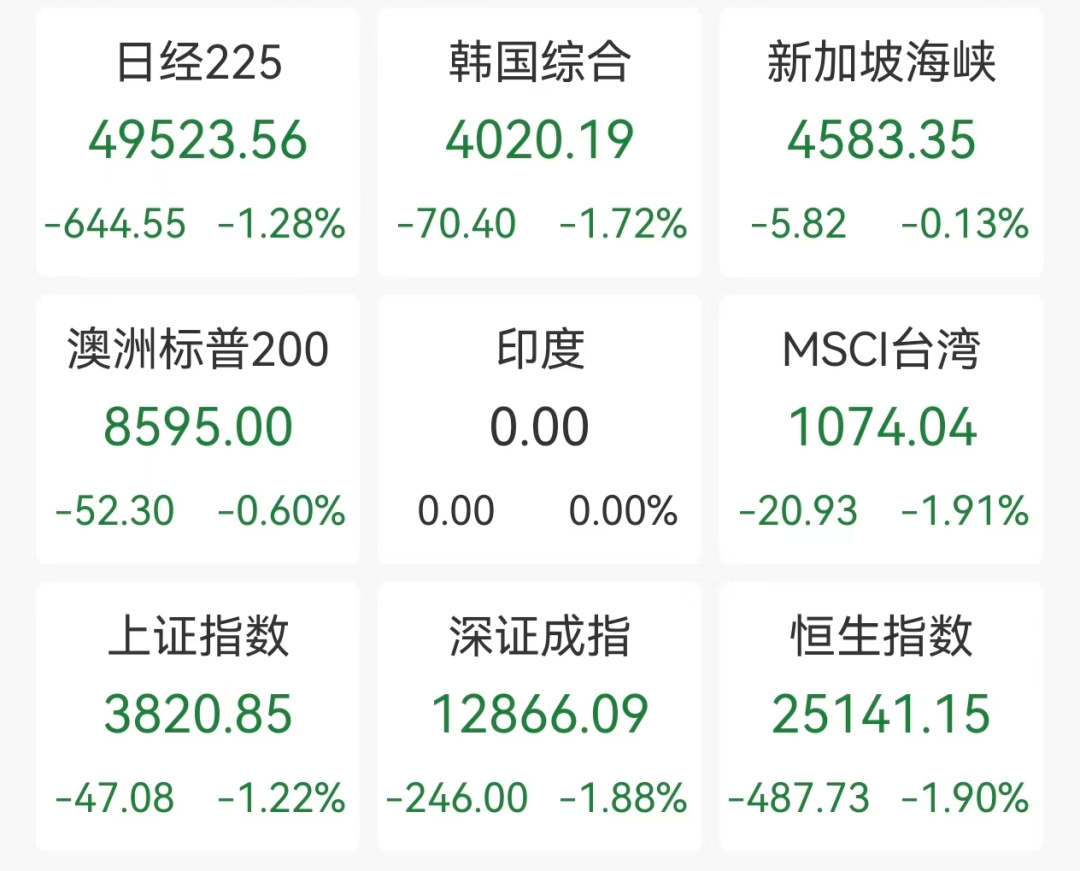
Market Overview - Major Asia-Pacific stock indices experienced a decline, with the Nikkei 225 and the KOSPI both dropping over 1% as of midday [1] - The A-share indices and the Hong Kong Hang Seng Index also fell, with the FTSE China A50 futures down more than 1% [1] A-Share Market - The A-share market showed volatility, with the Shanghai Composite Index and Shenzhen Component Index both down over 1%, while the ChiNext Index fell over 2% [2] - A total of 4,464 stocks in the market declined, indicating a broad-based sell-off [2] - Specific sectors such as photovoltaic and energy storage continued to adjust, with companies like Dongfang Risheng (300118) dropping over 10% and Zhongli Group (002309) nearing a trading halt [2] Precious Metals - The precious metals sector saw significant declines, with companies like Western Gold (601069) and Xiaocheng Technology (300139) falling over 6% [3] - International gold and silver prices also dropped, with spot silver plunging over 2% and spot gold decreasing approximately 0.4%, while New York futures gold fell below $4,310 per ounce [3] Retail and Technology Sectors - The retail sector showed resilience, with Baida Group (600865) achieving four consecutive trading limits, and Hongqi Chain (002697) and Guangbai Shares (002187) both securing two consecutive trading limits [5] - The smart driving sector gained momentum, with companies like BAIC Blue Valley (600733) hitting the upper limit, and multiple stocks such as Duolun Technology (603528) and Luchang Technology (002813) also reaching trading limits [5] Hong Kong Market - The Hong Kong Hang Seng Index fell by 1.8%, with the Hang Seng Tech Index down approximately 2.5% [5] - Major companies like Alibaba and SMIC saw their stock prices drop nearly 4% [5] Cryptocurrency Market - The cryptocurrency market continued to decline, with Bitcoin dropping below $86,000, and over 180,000 traders facing liquidation in the past 24 hours [7] - Specific price movements included Bitcoin at $85,738.7 (-4.05%), Ethereum at $2,932.23 (-6.00%), and XRP at $1.8613 (-6.67%) [8]


芯片股继续走弱 中芯国际(00981.HK)跌3.79%
Mei Ri Jing Ji Xin Wen· 2025-12-16 04:03
Group 1 - Semiconductor stocks continue to weaken, with notable declines in major companies [1] - SMIC (00981.HK) decreased by 3.79%, trading at HKD 62.25 [1] - Hua Hong Semiconductor (01347.HK) fell by 2.97%, currently priced at HKD 65.3 [1] - ASMPT (00522.HK) dropped by 2.39%, now at HKD 73.4 [1] - Shanghai Fudan (01385.HK) declined by 2.24%, with a price of HKD 40.16 [1]
港股异动 | 芯片股继续走弱 美批准对华出售英伟达H200芯片 或对国产AI芯片厂商构成压力
智通财经网· 2025-12-16 03:52
Group 1 - Semiconductor stocks continue to weaken, with notable declines in companies such as SMIC down 3.79% to HKD 62.25, Hua Hong Semiconductor down 2.97% to HKD 65.3, ASMPT down 2.39% to HKD 73.4, and Shanghai Fudan down 2.24% to HKD 40.16 [1] - Former President Trump announced that NVIDIA will be allowed to export its H200 AI chips to "approved customers" including China, with the condition that the U.S. government receives a 25% share from these sales, which may accelerate AI model training in China but could pressure domestic AI chip manufacturers in the short term [1] - Broadcom is expanding its market share in the AI chip sector due to increased demand for custom chips driven by large-scale data center construction; however, the CEO indicated that the gross margin for Q1 2026 will be lower than the previous three quarters due to a higher proportion of AI business, raising investor concerns about the return on investment in AI by large tech companies [1]
中美存储芯片竞赛的五个关键问题-Asia Semiconductors_ Five questions on the US-China memory chip race
2025-12-16 03:26
Summary of Key Points from the Conference Call on the Memory Chip Industry Industry Overview - The report focuses on the **memory chip industry**, particularly in the context of the **US-China technology competition** and its implications for **AI applications** and **semiconductor supply chains** [1][2][3][4][5][6][9]. Core Insights and Arguments 1. **Importance of Memory Chips for AI**: - High-bandwidth memory (HBM) chips are essential for AI due to their capacity to handle large data volumes quickly. Major players include **Samsung**, **SK Hynix**, and **Micron** [2][12][14]. 2. **US Export Restrictions**: - The US imposed a ban on HBM exports to China in December 2024, reflecting a shift in strategy from focusing on advanced GPUs to recognizing the strategic importance of memory chips [3][17][22]. 3. **China's Adaptation to Restrictions**: - Chinese chipmakers are increasing imports of legacy memory chips and modifying US chips to comply with restrictions. However, they face challenges in developing HBM products due to reliance on foreign chipmaking equipment [4][5][34]. 4. **Obstacles for China's HBM Development**: - A significant barrier is China's dependence on foreign suppliers for advanced chipmaking equipment, particularly lithography machines. Domestic manufacturers are improving but still lag behind global leaders [5][57][58]. 5. **Impact of US-China Tensions on Asian Memory Chipmakers**: - South Korea remains the leading memory chip producer, while ASEAN countries are attracting investments and expanding capacity. Japan, although not dominant, is a key supplier of chipmaking equipment [6][9][64][74]. 6. **Memory Chip Supply Squeeze**: - The ongoing US-China tensions are expected to exacerbate a memory chip supply squeeze, affecting electronics producers who may struggle to secure supplies for the upcoming year [7][88]. Additional Important Insights 1. **Shift in Semiconductor Strategy**: - The US semiconductor strategy has evolved from a "small yard, high fence" approach under the Biden administration to a "larger yard, lower fence" under the Trump administration, allowing for more negotiation space [19][22]. 2. **China's Memory Chip Imports**: - Despite restrictions, China's memory chip imports have surged, with nearly half sourced from South Korea. This indicates the continued demand for legacy chips among Chinese tech firms [34][39]. 3. **Long-term Self-reliance Goals**: - China aims for greater self-reliance in semiconductor production, with companies like Huawei playing a pivotal role in developing domestic capabilities [40][43]. 4. **Geopolitical Risks and Market Dynamics**: - The geopolitical landscape is shifting, with US restrictions potentially backfiring by inadvertently boosting some Chinese tech firms as they gain market share without US competition [27][45]. 5. **Investment Trends in ASEAN**: - Countries like Singapore and Malaysia are becoming critical hubs for semiconductor production, with significant investments from global firms like Micron, which is expanding its facilities in these regions [66][69]. 6. **Price Increases for Electronics**: - The supply squeeze is leading to rising prices for memory chips, which could result in higher costs for end consumers of electronic devices [87][88]. This summary encapsulates the critical aspects of the memory chip industry as discussed in the conference call, highlighting the interplay between geopolitical tensions, technological advancements, and market dynamics.

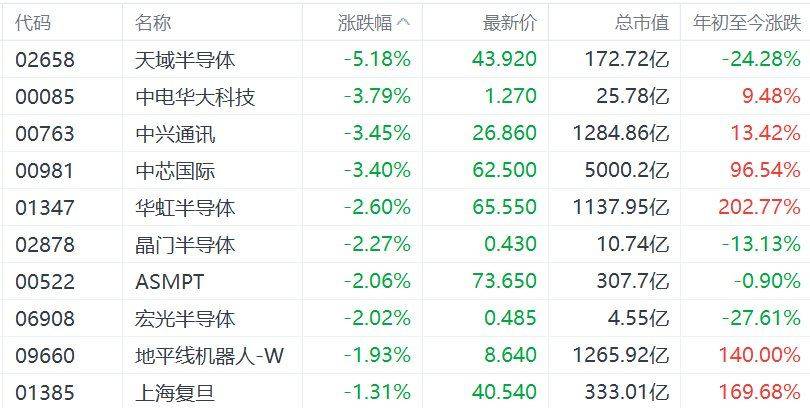
港股芯片股普跌,天域半导体跌超5%,中电华大科技、中兴通讯、中芯国际跌超3%,华虹半导体、晶门半导体、宏光半导体跌超2%
Ge Long Hui· 2025-12-16 03:10
Group 1 - The semiconductor stocks in the Hong Kong market experienced a widespread decline, with notable drops in several companies [1] - Tianyu Semiconductor fell by over 5%, while China Electric Huada Technology and ZTE Corporation both dropped by over 3% [1] - Other companies such as Huahong Semiconductor, Jingmen Semiconductor, ASMPT, and Hongguang Semiconductor also saw declines exceeding 2% [1] Group 2 - Tianyu Semiconductor's stock decreased by 5.18%, with a latest price of 43.920 and a total market value of 17.272 billion, reflecting a year-to-date decline of 24.28% [2] - China Electric Huada Technology's stock fell by 3.79%, with a latest price of 1.270 and a total market value of 2.578 billion, showing a year-to-date increase of 9.48% [2] - ZTE Corporation's stock decreased by 3.45%, with a latest price of 26.860 and a total market value of 128.486 billion, reflecting a year-to-date increase of 13.42% [2] - Huahong Semiconductor's stock fell by 2.60%, with a latest price of 65.550 and a total market value of 113.795 billion, showing a year-to-date increase of 202.77% [2] - Jingmen Semiconductor's stock decreased by 2.27%, with a latest price of 0.430 and a total market value of 1.074 billion, reflecting a year-to-date decline of 13.13% [2] - ASMPT's stock fell by 2.06%, with a latest price of 73.650 and a total market value of 30.77 billion, showing a year-to-date decline of 0.90% [2] - Hongguang Semiconductor's stock decreased by 2.02%, with a latest price of 0.485 and a total market value of 0.455 billion, reflecting a year-to-date decline of 27.61% [2]
中芯国际跌2.03%,成交额20.31亿元,主力资金净流出2.03亿元
Xin Lang Cai Jing· 2025-12-16 03:01
中芯国际今年以来股价涨17.02%,近5个交易日跌4.81%,近20日跌6.14%,近60日涨1.90%。 来源:新浪证券-红岸工作室 12月16日,中芯国际盘中下跌2.03%,截至10:55,报110.72元/股,成交20.31亿元,换手率0.91%,总市 值8857.95亿元。 资金流向方面,主力资金净流出2.03亿元,特大单买入2.85亿元,占比14.05%,卖出4.78亿元,占比 23.52%;大单买入6.35亿元,占比31.26%,卖出6.45亿元,占比31.78%。 截至9月30日,中芯国际股东户数33.62万,较上期增加33.27%;人均流通股6134股,较上期减少 25.41%。2025年1月-9月,中芯国际实现营业收入495.10亿元,同比增长18.22%;归母净利润38.18亿 元,同比增长41.09%。 今年以来中芯国际已经1次登上龙虎榜,最近一次登上龙虎榜为8月28日,当日龙虎榜净买入-4.22亿 元;买入总计16.55亿元 ,占总成交额比6.10%;卖出总计20.77亿元 ,占总成交额比7.66%。 机构持仓方面,截止2025年9月30日,中芯国际十大流通股东中,易方达上证科创板50 ...
港股芯片股普跌,中芯国际跌超3%
Ge Long Hui· 2025-12-16 02:47
格隆汇12月16日|港股市场芯片股普跌,其中,天域半导体跌超5%,中电华大科技、中兴通讯、中芯 国际跌超3%,华虹半导体、晶门半导体、ASMPT、宏光半导体跌超2%。 ...
2026年科技股策略:锚定恒生科技优质标的 财通证券推荐了这20只股
Ge Long Hui· 2025-12-16 02:29
Core Viewpoint - The report by Haitao Securities emphasizes the importance of identifying stocks with potential short-term or long-term performance discrepancies or surprises in AI advancements as a core task for 2026 [1] Group 1: Investment Strategy - The main investment strategy is to focus on value investing in the Hang Seng Technology Index, leveraging volatility from the Hong Kong stock market and short-selling mechanisms [1] - The key to successful operations lies in selecting fundamentally strong companies with sustainable development capabilities [1] Group 2: Recommended Stocks for 2026 - Stocks currently at the bottom or adjusting, with a high likelihood of fundamental reversal in 2026: Meituan, Xiaomi Group (planning next vehicle), BYD Electronics [2] - Stocks expected to benefit from EPS gains and potential valuation uplift: Tencent Holdings, Trip.com Group, JD Health, Lenovo Group [2] - Stocks with controllable elasticity: Alibaba, Baidu Group, SMIC, Hua Hong Semiconductor [2] - AI elastic stocks: Kuaishou, Bilibili, Kingdee International, Horizon Robotics, Xpeng Motors, Yueda Group, NetEase, Sunny Optical Technology, UBTECH [2] - Potential small-cap companies: Inspur Digital Enterprise, Xindong Company, Huiliang Technology [2] Group 3: Individual Stock Insights - Kuaishou, Bilibili, Horizon Robotics, Xpeng Motors, Sunny Optical Technology, UBTECH are highlighted as key stocks with positive outlooks [2] - Inspur Digital Enterprise and Huiliang Technology are noted as quality small-cap stocks with promising prospects [2] - Tencent Holdings is identified as a top pick due to its strong research framework [2] - Alibaba is considered a leading asset in AI technology [2] - Lenovo Group is expected to achieve profitability in its server business next year due to accelerated AIPC penetration [2] - Trip.com Group is positioned well for growth driven by domestic stability and overseas acceleration [2] - JD Health is recognized as a leading player in internet healthcare with a clear growth path [2] - Meituan is noted for its resilience and potential turning point in competitive landscape [2] - Kingdee International's growth is constrained by macroeconomic factors, but AI and overseas expansion provide additional elasticity [2] - Xiaomi Group is expected to see improvements as negative factors gradually clear [2] - SMIC is experiencing an increase in advanced manufacturing proportion and continuous technological breakthroughs [2] - Hua Hong Semiconductor is benefiting from growth driven by computing and consumer electronics [2] - Yueda Group focuses on IP as a core asset, with expectations for further expansion and monetization [2] - NetEase is anticipated to enter a new product cycle with upcoming releases [2] - BYD Electronics is expected to see growth from Apple's foldable phone production and has significant potential in the new energy vehicle and data center sectors [2] - Xindong Company is driven by gaming and Taptap, with expectations for the launch of an overseas version [2]



智通港股通持股解析|12月16日
智通财经网· 2025-12-16 00:37
根据2025年12月15日披露数据,中国电信(00728)、绿色动力环保(01330)、大眾公用(01635)位 居港股通持股比例前3位,分别为72.41%、70.03%、69.99%。此外,小米集团-W(01810)、招商银 行(03968)、美团-W(03690)在最近有统计数据的5个交易日内,持股额增幅最大,分别为+21.69亿 元、+19.12亿元、+10.96亿元;盈富基金(02800)、中芯国际(00981)、中国海洋石油(00883)在最 近有统计数据的5个交易日内,持股额减幅最大,分别为-15.25亿元、-9.34亿元、-7.82亿元。 具体数据如下(交易所数据根据T+2日结算): 1、港股通最新持股比例排行(前20名) | 公司名称 | 持股数量 | 最新持股比例 | | --- | --- | --- | | 中国电信(00728) | 100.50亿股 | 72.41% | | 绿色动力环保(01330) | 2.83亿股 | 70.03% | | 大眾公用(01635) | 3.74亿股 | 69.99% | | 凯盛新能(01108) | 1.70亿股 | 68.03% | | 天津 ...