SMIC(00981)

Search documents
中芯国际高管:当前存储器市场供不应求,价钱上涨非常多。
Xin Lang Cai Jing· 2025-11-14 01:02
Group 1 - The core viewpoint is that the current memory market is experiencing a supply shortage, leading to significant price increases [1] Group 2 - Company executives from SMIC have indicated that the demand for memory products is outpacing supply [1] - The price of memory products has risen substantially due to this imbalance in supply and demand [1]

高盛:维持中芯国际买入评级
Ge Long Hui· 2025-11-14 00:59
高盛:中芯国际第三季度收入高于市场预期,也超出了管理层5%-7%的季度预期;毛利率也高于指导 (18%-20%)和预期。中芯国第四季度营收预期为+0%~+2%,基本符合市场预期。在本地客户不断增 长的需求和人工智能相关机会的推动下,看好公司的长期增长。维持买入评级,目标价为117港元和人 民币211元。 ...
中芯国际(00981) - 2025 Q3 - 电话会议演示
2025-11-14 00:30
Financial Performance - Revenue for Q3 2025 was $2,382 million, up 7.8% QoQ from $2,209 million in 2Q25 and up 9.7% YoY from $2,171 million in 3Q24 [5, 11] - Gross margin was 22.0%, compared to 20.4% in 2Q25 and 20.5% in 3Q24 [6, 12] - Profit from operations was $351 million, compared to $151 million in 2Q25 and $170 million in 3Q24 [7, 13] - Profit attributable to SMIC was $192 million, compared to $132 million in 2Q25 and $149 million in 3Q24 [8, 14] - EBITDA was $1,430 million, compared to $1,129 million in 2Q25 and $1,157 million in 3Q24 [9, 15] Capital Structure and Cash Flow - Total cash on hand was $11,385 million as of September 30, 2025 [18] - Net cash generated from operating activities was $941 million for the three months ended September 30, 2025 [22] Revenue Breakdown - China accounted for 86.2% of total revenue in 3Q25 [26] - 12-inch wafers accounted for 77.0% of wafer revenue in 3Q25 [32] Capacity and Utilization - Monthly capacity reached 1,022,750 (standard logic 8-inch equivalent wafers) in 3Q25 [36] - Utilization rate was 95.8% in 3Q25 [36] Guidance - Revenue for 4Q 2025 is expected to be flat to +2% QoQ [40] - Gross margin for 4Q 2025 is guided to be between 18% and 20% [40]

中芯国际赚爆了!Q3营收创单季新高、利润大增43%
Ge Long Hui· 2025-11-14 00:24
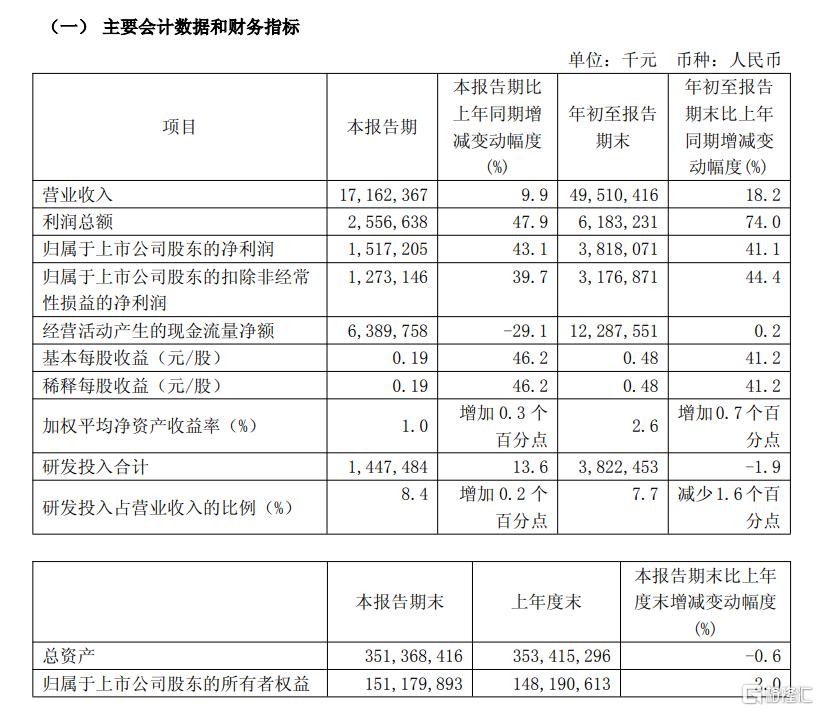
Core Insights - SMIC reported a robust growth in Q3 2025, achieving record revenue and net profit, with capacity utilization nearing full capacity [1][2][5] Financial Performance - In Q3 2025, the company achieved revenue of RMB 171.62 billion, a quarter-on-quarter increase of 6.9% and a year-on-year increase of 9.9%, marking a new quarterly revenue high [3][4] - The net profit for the same period was RMB 15.17 billion, reflecting a year-on-year growth of 43.1% [3][4] - The gross margin stood at 25.5%, up 4.8 percentage points from the previous quarter [3][4] - For the first three quarters of 2025, total revenue reached RMB 495.10 billion, a year-on-year increase of 18.2%, with net profit at RMB 38.18 billion, up 41.1% [3][4] Capacity and Production - The company’s monthly capacity increased from 991,250 wafers in Q2 2025 to 1,022,750 wafers in Q3 2025, with a capacity utilization rate of 95.8%, up 17.8% year-on-year [10] - The total assets at the end of the quarter were RMB 3,513.68 billion, with net assets attributable to shareholders at RMB 1,511.80 billion [5][10] Revenue Breakdown - Revenue by region shows that China accounted for 86.2%, the US for 10.8%, and Eurasia for 3% [7] - In terms of application, revenue contributions were 21.5% from smartphones, 15.2% from computers and tablets, 43.4% from consumer electronics, 8.0% from connected and wearable devices, and 11.9% from industrial and automotive sectors [7][9] Future Guidance - For Q4 2025, the company expects revenue to remain flat or grow by 2%, with a gross margin guidance of 18% to 20% [11][12]

重磅预告!就在今日上午10时……盘前重要消息有这些
证券时报· 2025-11-14 00:19
New Stock Offerings - Hai'an Group is offering shares with a subscription code of 001233 at a price of 48.00 CNY per share, with a subscription limit of 14,500 shares [1] Economic and Regulatory Updates - The Ministry of Commerce held a press conference discussing ongoing negotiations with the Netherlands regarding semiconductor supply chain stability, emphasizing the need for constructive solutions [4] - The People's Bank of China reported that the total social financing increased by 30.9 trillion CNY in the first ten months of 2025, which is 3.83 trillion CNY more than the same period last year, with a year-on-year growth rate of 8.5% [5] - The State Council will hold a press conference on November 14, 2025, to discuss the national economic performance for October 2025 [5] - The Financial Regulatory Bureau plans to release a revised "Commercial Bank Mergers and Acquisitions Loan Management Measures" to support mergers and restructuring, particularly for technology enterprises [5] Industry Developments - China has completed the first phase of 6G technology trials, accumulating over 300 key technology reserves [6] - The "Petroleum and Natural Gas Infrastructure Planning, Construction, and Operation Management Measures" will take effect on January 1, 2026, aiming to streamline investment mechanisms in oil and gas infrastructure [6] - The World Power Battery Conference highlighted the expanding applications of electric technology across various sectors, with a focus on high-quality development in the power battery industry [7] Company Performance - Tencent Holdings reported third-quarter revenue of 192.87 billion CNY, a year-on-year increase of 15% [9] - JD Group's third-quarter revenue reached 299.1 billion CNY, reflecting a growth of 14.9% [10] - Semiconductor Manufacturing International Corporation (SMIC) posted a net profit of 1.517 billion CNY in the third quarter, marking a significant year-on-year increase of 43.1% [11] Market Insights - Huatai Securities noted that the current A-share profit cycle is improving, with signs of recovery in asset balance sheets and orders, suggesting a positive outlook for sectors like advanced manufacturing and TMT [22] - Zhongyuan Securities reported a sustained upward trend in the lithium battery industry, advising investors to monitor raw material prices and policy developments closely [23]




四大证券报精华摘要:11月14日
Zhong Guo Jin Rong Xin Xi Wang· 2025-11-14 00:12
转自:新华财经 新华财经北京11月14日电 四大证券报内容精华摘要如下: 中国证券报 •前10个月人民币贷款增加近15万亿元 金融总量合理增长 货币政策保持力度 中国人民银行11月13日发布的10月金融数据显示,广义货币(M2)和社会融资规模同比增速均保持在 较高水平,持续为经济回升向好创造适宜的货币金融环境;贷款规模保持合理增长,信贷结构持续优 化。专家表示,未来央行将继续实施好适度宽松的货币政策,把握好力度和节奏,保持对实体经济较强 支持力度。 11月13日,A股市场低开高走,放量上涨,成交额为2.07万亿元,上证指数盘中站上4030点,创逾十年 新高,深证成指涨逾1%,创业板指涨逾2%。市场表现分化,锂电产业链全线上涨,锂电电解液、锂 矿、锂电正极、锂电负极、锂电池等板块爆发,整个A股市场超3900只股票上涨,逾100只股票涨停。 截至11月13日,A股总市值为119.90万亿元,创历史新高。11月13日沪深两市主力资金净流入超120亿 元,结束连续13个交易日的净流出,资金情绪转为乐观。分析人士认为,短期市场处于政策和业绩空窗 期,指数向上突破关键点位尚需更多催化,市场或仍以震荡为主。 近期,受产业链 ...
【财经早报】这家公司控制权拟变更,今起停牌
Zhong Guo Zheng Quan Bao - Zhong Zheng Wang· 2025-11-14 00:06
Group 1: Financial Data - In the first ten months of 2023, RMB loans increased by 14.97 trillion yuan, indicating reasonable growth in loan scale and continuous optimization of credit structure [4][10] - As of the end of October, the total social financing scale was 437.72 trillion yuan, with a year-on-year growth of 8.5% [3][4] - The broad money (M2) balance reached 335.13 trillion yuan at the end of October, reflecting a year-on-year increase of 8.2% [4] Group 2: Government Initiatives - The Ministry of Commerce plans to enhance the "Export China" initiative through various activities to facilitate the entry of quality products and services into China [4] - The Ministry of Industry and Information Technology reported significant progress in 6G technology development, with over 300 key technologies reserved and collaboration with global equipment manufacturers [4][5] Group 3: Company News - Hezhong Group announced a potential change in control, leading to a stock suspension starting November 14, with a significant increase in net profit of 1091.01% reported for Q3 2025 [6][9] - Tencent Holdings reported Q3 2025 revenue of 1928.69 billion yuan, a 15% year-on-year increase, with a notable rise in R&D spending [10][12] - JD Group's Q3 2025 revenue reached 2990.6 billion yuan, marking a 14.9% year-on-year growth, while net profit decreased compared to the previous year [13] Group 4: Market Trends - The AI-driven demand for computing power and applications in the telecommunications sector is expected to grow, with a focus on key technologies for 6G development [14]

三季度业绩超预期,国内芯片代工巨头晶圆销量大增,还有望带动设备爆发
Xuan Gu Bao· 2025-11-13 23:42
Core Insights - SMIC reported a revenue of 49.51 billion yuan for the first three quarters, representing an 18.2% year-on-year increase, and a net profit of 3.82 billion yuan, up 41.1% year-on-year [1] - In Q3, the company achieved a revenue of 17.16 billion yuan, a quarter-on-quarter increase of 6.9% and a year-on-year increase of 9.9%, with a net profit of 1.52 billion yuan, up 43.1% year-on-year [1] Group 1: Financial Performance - The increase in net profit is attributed to a rise in wafer sales and changes in product mix [2] - The company is positioned as the leading wafer foundry in mainland China with advanced process technology [2] Group 2: Market Position and Growth Potential - SMIC's global market share is expected to rise from 5.3% in 2023 to 6% in 2024, moving from the 5th to the 3rd position globally [2] - The company aims to focus on advanced processes such as 7nm and 5nm technology [2] Group 3: Industry Trends and Supply Chain - Long-term growth for SMIC is anticipated to be strong, driven by Chinese IC design companies and trends in artificial intelligence [2] - The domestic semiconductor equipment sector is crucial for the expansion of wafer foundries, with ongoing efforts to reduce reliance on foreign technology [2] Group 4: Company Relationships - Zhaoxin provides one-stop services from chip specification to finished products, primarily sourcing wafer foundry services from SMIC, which holds a 14.23% stake in Zhaoxin [3] - Shengjian Technology specializes in semiconductor process waste gas treatment and has a long-term service relationship with SMIC [4]
前10个月我国人民币贷款增加14.97万亿元|南财早新闻
2 1 Shi Ji Jing Ji Bao Dao· 2025-11-13 23:34
Group 1 - The People's Bank of China reported an increase of 14.97 trillion yuan in RMB loans in the first ten months of the year, with a cumulative social financing scale of 30.9 trillion yuan, which is 3.83 trillion yuan more than the same period last year [2] - The Ministry of Industry and Information Technology announced that China has conducted 6G technology trials for four consecutive years, completing the first phase and forming over 300 key technology reserves [2] - The Ministry of Water Resources reported that from January to October, national water conservancy construction investment reached 1,009.47 billion yuan, with 46,000 various water conservancy projects implemented [2] Group 2 - The total import and export volume through the Western Land-Sea New Corridor reached 1.35 trillion yuan from January to October, marking a year-on-year increase of 17.9% [3] - The Ministry of Commerce is accelerating the domestic approval process for the upgraded version 3.0 of the China-ASEAN Free Trade Area agreement [3] - China Aviation Engine Group announced the successful first flight test of a 3D-printed simplified turbojet engine, marking a significant breakthrough in the engineering application of 3D-printed engines [3] Group 3 - The China Securities Regulatory Commission (CSRC) chairman recently visited France and Brazil to discuss securities market regulation dynamics and deepen bilateral cooperation in capital markets [3] - Data from the Asset Management Association of China indicated that in September, 2,305 private asset management products were registered, a year-on-year increase of 230.23%, with a total establishment scale of 83.147 billion yuan, up 69.2% year-on-year [3] - The CSRC approved the initial public offering and registration application of Muxi Integrated Circuit (Shanghai) Co., Ltd. for listing on the Sci-Tech Innovation Board [3] Group 4 - Several large insurance companies have begun launching "New Year" products, transitioning more towards floating design dividend insurance products, which test the investment level and operational capabilities of insurance companies [4] - On November 13, international copper prices rose, with the main contract closing at 78,070.00 yuan per ton, an increase of 840.00 yuan, or 1.09% [4] Group 5 - Semiconductor manufacturer SMIC reported third-quarter revenue of 171.62 billion yuan, a year-on-year increase of 9.9%, with net profit of 15.1 billion yuan, up 43.1% [5] - Tencent Holdings achieved third-quarter revenue of 1,928.7 billion yuan, a year-on-year increase of 15%, with operating profit of 725.7 billion yuan, up 18% [5] - JD Group reported third-quarter total revenue of 2,990.59 billion yuan, a year-on-year increase of 14.9%, but adjusted net profit decreased by 56% to 5.8 billion yuan [5] - Bilibili reported a third-quarter net revenue of 7.69 billion yuan, a year-on-year increase of 5%, with adjusted net profit of 786 million yuan, up 233% [5] Group 6 - The U.S. stock market saw all three major indices decline, with the Dow Jones falling 1.65% to 47,457.22 points, the S&P 500 down 1.66% to 6,737.49 points, and the Nasdaq dropping 2.29% to 22,870.36 points [5] - Chinese concept stocks mostly fell, with Hesai Technology down over 8% and Pony.ai down nearly 8% [5]


中芯国际财报来了,产能近100%!
是说芯语· 2025-11-13 23:27
Core Viewpoint - SMIC reported strong financial results for Q3, with revenue of 17.162 billion RMB and a net profit of 1.517 billion RMB, reflecting a year-on-year growth of 43.1% in net profit [1][3]. Financial Performance - For the first three quarters, SMIC achieved a revenue of 49.510 billion RMB, a year-on-year increase of 18.2%, and a net profit of 3.818 billion RMB, up 41.1% [3][4]. - In Q3, revenue was 17.162 billion RMB, showing a quarter-on-quarter growth of 6.9% and a year-on-year growth of 9.9% [3][4]. - The gross margin for the first three quarters was 23.2%, an increase of 5.6 percentage points year-on-year, while Q3 gross margin reached 25.5%, up 4.8 percentage points quarter-on-quarter [3][4]. Capacity and Utilization - SMIC's capacity utilization rate reached 95.8% in Q3, a year-on-year increase of 17.8% [5]. - Monthly capacity increased from 991,250 wafers in Q2 2025 to 1,022,750 wafers in Q3 2025, measured in 8-inch equivalent logic [5]. Revenue Breakdown - Revenue by application in Q3: smartphones 21.5%, computers and tablets 15.2%, consumer electronics 43.4%, internet and wearables 8%, and industrial and automotive increased to 11.9% [4]. - Revenue contribution by region: China accounted for 86.2%, the US for 10.8%, and Eurasia for 3% [4]. Guidance - For Q4, SMIC's revenue guidance is expected to be flat to a 2% increase quarter-on-quarter, with a gross margin guidance of 18% to 20% [3].