
SMIC(00981)

Search documents
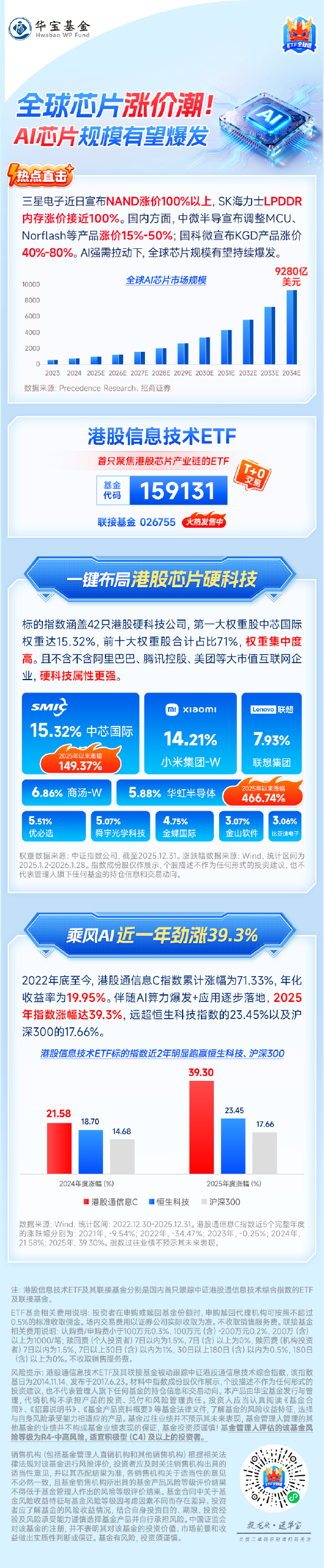
全球芯片涨价潮!AI芯片规模有望爆发
Xin Lang Cai Jing· 2026-02-02 06:38
Group 1 - The global AI chip market is projected to reach a scale of $928 billion by 2034, indicating significant growth potential in the industry [2][11] - Major companies like Samsung Electronics and SK Hynix have announced price increases for NAND and LPDDR memory chips by over 100%, reflecting strong demand driven by AI applications [1] - Domestic companies such as Zhongwei Semiconductor and Guokewai have also raised prices for their products, with increases ranging from 15% to 80% [1] Group 2 - The first ETF focusing on the Hong Kong chip industry has been launched, covering 42 Hong Kong technology companies, with a high concentration of weights in the top stocks [3][4] - The largest weight in the ETF is held by SMIC at 15.32%, and the top ten stocks account for 71% of the total weight, excluding major internet companies like Alibaba and Tencent [4][11] - The performance of the Hong Kong Information Technology ETF has outperformed major indices, with a cumulative increase of 71.33% since the end of 2022, significantly exceeding the performance of the Hang Seng Tech Index and CSI 300 [7][13] Group 3 - The Hong Kong Information Technology C Index has shown a remarkable annual growth rate of 39.3% for 2025, outperforming the Hang Seng Tech Index and CSI 300 [7][15] - Historical performance data indicates fluctuations in the index, with a notable increase of 39.3% in 2025 following a challenging period in previous years [16] - The ETF and its connected fund are designed to track the performance of the Hong Kong technology sector, providing investors with exposure to hard technology companies [17]


异动盘点0202 | 芯片股、内房股走低;科磊大跌15.24%,美国电信巨头Verizon涨11.83%
贝塔投资智库· 2026-02-02 04:00
Group 1: Semiconductor Sector - Semiconductor stocks in Hong Kong experienced a decline, with notable drops including Huahong Semiconductor down 10.04%, GigaDevice down 8.72%, and SMIC down 4.77%. This follows a significant drop in South Korea's stock index and stricter order audits by major manufacturers like Samsung and SK Hynix to mitigate market volatility caused by excessive orders and stockpiling [1][5]. - Naxin Microelectronics reported an expected revenue of RMB 3.3 billion to 3.4 billion for 2025, reflecting a year-on-year growth of 68.34% to 73.45%, but also projected a net loss of RMB 2.5 billion to 2 billion, indicating a narrowing of losses [3]. Group 2: Automotive Sector - Great Wall Motors saw a decline of over 4.9% after announcing a 10.19% year-on-year increase in total revenue for 2025, but a 21.71% decrease in net profit attributable to shareholders [2]. Group 3: Telecommunications and Technology - Verizon's stock rose 11.83% after reporting the largest increase in mobile users since 2019, with a net addition of 616,000 users in the fourth quarter, exceeding market expectations [6]. - Tesla's stock increased by 3.32% as the company shifts focus from automotive to AI and robotics, planning to convert its Fremont factory for the production of the upcoming Optimus robot [5]. Group 4: Energy and Resources - China Shenhua Energy's stock fell over 5% after announcing an expected profit of RMB 50.8 billion to 55.8 billion for 2025, a decline of 18.6% to 10.6% compared to the previous year [4]. Group 5: Real Estate Sector - Chinese property stocks continued to decline, with companies like R&F Properties and Sunac China experiencing significant drops. Reports suggest that several developers may be exempt from disclosing "three red lines," indicating increased government attention to the struggling real estate sector [4]. Group 6: Financial Performance Highlights - Yihua Tong projected a net loss of RMB 550 million to 720 million for 2025, representing an increase in losses of 20.50% to 57.74% compared to the previous year [2]. - Cloud Voice announced an expected revenue of RMB 600 million to 620 million from its large model-related business in 2025, marking a staggering year-on-year growth of approximately 1057% to 1095% [3].



集成电路ETF(159546)开盘跌3.02%,重仓股寒武纪跌0.79%,中芯国际跌1.28%
Xin Lang Cai Jing· 2026-02-02 03:51
Group 1 - The Integrated Circuit ETF (159546) opened down 3.02% at 2.084 yuan [1] - Major holdings in the ETF experienced declines, including Cambrian (down 0.79%), SMIC (down 1.28%), and others with significant drops such as Zhaoyi Innovation (down 4.47%) and Tongfu Microelectronics (down 2.88%) [1] - The ETF's performance benchmark is the CSI All-Share Integrated Circuit Index, managed by Guotai Fund Management Company, with a return of 115.09% since its inception on October 11, 2023, and a return of 15.33% over the past month [1]




芯片股早盘走低 传多家厂商严控存储芯片订单 防止客户过度囤积
Zhi Tong Cai Jing· 2026-02-02 03:47
Group 1 - Semiconductor stocks experienced a decline, with Huahong Semiconductor down 9.53% to HKD 105.4, and other companies like Zhaoyi Innovation, Shanghai Fudan, and SMIC also reporting significant drops [1] - The South Korean stock market saw a sharp decline of 4%, with major players Samsung and SK Hynix facing losses [1] - Samsung, SK Hynix, and Micron have tightened order reviews and are conducting stricter due diligence on customers to mitigate potential market fluctuations caused by over-ordering and stockpiling [1] Group 2 - Jensen Huang recently stated that no orders for the H200 chip have been received from Chinese customers, indicating a wait-and-see approach [1] - First Shanghai noted that the impact of the H200 release on the domestic computing power industry chain is limited, primarily due to the differing application scenarios between H200 and domestic computing power, which focuses on small to medium models and inference applications [1]
港股异动 | 芯片股早盘走低 传多家厂商严控存储芯片订单 防止客户过度囤积
智通财经网· 2026-02-02 03:38
Group 1 - Semiconductor stocks experienced a decline, with notable drops including Huahong Semiconductor down 9.53% to HKD 105.4, GigaDevice down 8.06% to HKD 308, Shanghai Fudan down 5.08% to HKD 49.36, and SMIC down 4.18% to HKD 72.25 [1] - The South Korean stock market saw a significant drop of 4%, impacting major companies like Samsung and SK Hynix [1] - Major chip manufacturers, including Samsung, SK Hynix, and Micron, have tightened order reviews and are conducting stricter due diligence on customers to mitigate potential market fluctuations caused by excessive orders or stockpiling [1] Group 2 - Jensen Huang recently stated that no orders for the H200 chip have been received from Chinese customers, indicating a wait-and-see approach [1] - First Shanghai noted that the impact of the H200 chip release on the domestic computing power industry chain is limited, primarily due to the differing application scenarios between H200 and domestic computing power, which focuses on small to medium models and inference applications [1]
港股芯片股持续走低,华虹半导体跌超10%
Mei Ri Jing Ji Xin Wen· 2026-02-02 03:05
Group 1 - The core viewpoint of the article highlights a significant decline in Hong Kong chip stocks, with notable drops in several companies [1] Group 2 - Hua Hong Semiconductor experienced a drop of over 10% [1] - Zhaoyi Innovation fell by more than 7% [1] - Shanghai Fudan decreased by over 5% [1] - SMIC (Semiconductor Manufacturing International Corporation) declined by nearly 4% [1]
中芯国际跌2.00%,成交额9.44亿元,主力资金净流出1.26亿元
Xin Lang Cai Jing· 2026-02-02 02:01
Core Viewpoint - SMIC's stock price has experienced a decline of 1.89% year-to-date, with a notable drop of 7.26% over the past 20 trading days, indicating a challenging market environment for the company [2]. Group 1: Stock Performance - On February 2, SMIC's stock fell by 2.00%, trading at 120.51 CNY per share, with a total transaction volume of 944 million CNY and a turnover rate of 0.39% [1]. - The stock has seen a decrease of 1.16% over the last five trading days and a decline of 3.48% over the past 60 days [2]. Group 2: Financial Performance - For the period from January to September 2025, SMIC reported a revenue of 49.51 billion CNY, reflecting a year-on-year growth of 18.22%, while the net profit attributable to shareholders was 3.82 billion CNY, up 41.09% year-on-year [2]. Group 3: Shareholder Information - As of September 30, 2025, SMIC had 336,200 shareholders, an increase of 33.27% from the previous period, with an average of 6,134 shares held per shareholder, down 25.41% [2]. - Among the top ten circulating shareholders, notable changes include a decrease in holdings by major ETFs, with E Fund's STAR 50 ETF reducing its shares by 16.50 million [3].
科创50ETF增强(588450)开盘跌0.75%,重仓股中芯国际跌1.28%,海光信息跌1.68%
Xin Lang Cai Jing· 2026-02-02 01:41
Group 1 - The core viewpoint of the article highlights the performance of the Kexin 50 ETF Enhanced (588450), which opened down by 0.75% at 1.975 yuan on February 2 [1] - Major holdings in the Kexin 50 ETF Enhanced experienced declines, including SMIC down 1.28%, Haiguang Information down 1.68%, and others such as Zhongwei Company, Lanke Technology, and Cambrian down by varying percentages [1] - The performance benchmark for the Kexin 50 ETF Enhanced is the Shanghai Stock Exchange Science and Technology Innovation Board 50 Index return rate, managed by China Merchants Fund Management Co., Ltd. [1] Group 2 - Since its establishment on May 6, 2024, the Kexin 50 ETF Enhanced has achieved a return of 99.29%, with a one-month return of 14.31% [1]

智通港股通资金流向统计(T+2)|2月2日
智通财经网· 2026-02-01 23:35
Core Insights - Tencent Holdings (00700), Pop Mart (09992), and China Life (02628) ranked as the top three stocks for net inflow of southbound funds, with net inflows of 1.207 billion, 742 million, and 566 million respectively [1] - The top three stocks for net outflow of southbound funds were the Yingfu Fund (02800), Alibaba-W (09988), and Zijin Mining (02899), with net outflows of -2.595 billion, -950 million, and -858 million respectively [1] - In terms of net inflow ratio, Southern East Selection (03441), China Traditional Chinese Medicine (00570), and Baiaosaitu-B (02315) led the market with ratios of 51.51%, 44.99%, and 44.77% respectively [1] Net Inflow Rankings - Tencent Holdings (00700) had a net inflow of 1.207 billion, representing a 7.63% increase, closing at 621.000 (+2.31%) [2] - Pop Mart (09992) saw a net inflow of 742 million, with a net inflow ratio of 14.21%, closing at 231.400 (+7.03%) [2] - China Life (02628) recorded a net inflow of 566 million, with a net inflow ratio of 16.39%, closing at 35.180 (+3.17%) [2] Net Outflow Rankings - Yingfu Fund (02800) experienced the highest net outflow of -2.595 billion, with a net outflow ratio of -7.92%, closing at 28.040 (+2.64%) [2] - Alibaba-W (09988) had a net outflow of -950 million, with a net outflow ratio of -5.41%, closing at 173.500 (+2.12%) [2] - Zijin Mining (02899) faced a net outflow of -858 million, with a net outflow ratio of -12.94%, closing at 44.760 (+3.13%) [2] Net Inflow Ratio Rankings - Southern East Selection (03441) led with a net inflow ratio of 51.51%, with a net inflow of 6.9271 million, closing at 11.410 (+1.42%) [3] - China Traditional Chinese Medicine (00570) followed with a net inflow ratio of 44.99%, with a net inflow of 42.7833 million, closing at 2.090 (-4.57%) [3] - Baiaosaitu-B (02315) had a net inflow ratio of 44.77%, with a net inflow of 44.5882 million, closing at 47.000 (+9.35%) [3] Net Outflow Ratio Rankings - Guangshen Railway (00525) had the highest net outflow ratio of -57.47%, with a net outflow of -8.3198 million, closing at 2.250 (+1.35%) [3] - Huaxin Building Materials (06655) followed with a net outflow ratio of -54.93%, with a net outflow of -26.9041 million, closing at 20.020 (+1.16%) [3] - Kunlun Energy (00135) recorded a net outflow ratio of -53.60%, with a net outflow of -100 million, closing at 8.020 (+0.88%) [3]






中芯国际取得光学邻近修正方法及系统专利
Sou Hu Cai Jing· 2026-01-31 04:12
Group 1 - The State Intellectual Property Office of China has granted a patent to Semiconductor Manufacturing International Corporation (SMIC) for a method and system related to optical proximity correction, with the announcement number CN116263558B and an application date of December 2021 [1] - SMIC Shanghai, established in 2000, focuses on manufacturing in the computer, communication, and other electronic device sectors, with a registered capital of 244 million USD. The company has made investments in 4 enterprises, participated in 129 bidding projects, and holds 150 trademark records and 5000 patent records, along with 446 administrative licenses [1] - SMIC Beijing, founded in 2002, also operates in the computer, communication, and other electronic device manufacturing sectors, with a registered capital of 100 million USD. The company has invested in 1 enterprise, participated in 53 bidding projects, and holds 5000 patent records, in addition to 225 administrative licenses [1]