SMIC(00981)

Search documents
2026年中国高带宽内存(HBM)行业政策、产业链、出货量、收入规模、竞争格局及发展趋势:行业正处于快速发展阶段,价值量占比在进一步提升[图]
Chan Ye Xin Xi Wang· 2026-02-03 01:28
Core Insights - The global High Bandwidth Memory (HBM) market is experiencing rapid growth, with shipments expected to increase from 1.5 billion gigabytes (GB) in 2023 to 5.7 billion GB by 2026, and revenues projected to rise from $4.35 billion in 2023 to $50 billion in 2026 [6][7][8]. HBM Industry Definition and Advantages - HBM is a high-performance semiconductor memory based on 3D stacking technology, offering high bandwidth and energy efficiency, primarily used in high-performance computing and networking applications [1][4]. - HBM has four main advantages over traditional DRAM: high bandwidth, high capacity, low power consumption, and small size [2][3]. HBM Industry Development Status - HBM technology is becoming a standard for AI acceleration cards (GPUs, TPUs, etc.), with its value share continuing to increase [4][6]. - The demand for HBM is driven by the needs of AI and high-performance computing, with significant growth expected in the coming years [6][10]. HBM Industry Chain - The HBM industry chain includes upstream materials (electrolytes, precursors, IC substrates) and semiconductor equipment (lithography machines, etching machines), with midstream focusing on HBM production and downstream applications in AI, data centers, and high-performance computing [8][9]. HBM Industry Competitive Landscape - The global HBM market is dominated by foreign manufacturers, with SK Hynix holding a 53% market share, followed by Samsung at 38% and Micron at 9% [14][15]. - Domestic companies in China, such as Changxin Memory, Changdian Technology, and others, are making significant progress in the HBM supply chain, aiming to increase local production capabilities [15][16]. HBM Industry Development Trends - HBM is positioned as a critical hardware component for AI and high-performance computing, with its unique 3D stacked structure providing superior bandwidth compared to traditional memory solutions [16][17]. - The future memory landscape will be heterogeneous, with HBM focusing on training scenarios, while other memory types will cater to specific workloads, creating a diverse memory ecosystem for the AI era [17].





智通港股通持股解析|2月3日




智通财经网· 2026-02-03 00:32
Core Insights - The top three companies by Hong Kong Stock Connect holding ratios are China Telecom (00728) at 70.97%, Green Power Environmental (01330) at 68.68%, and Haotian International Construction Investment (01341) at 66.96% [1] - Tencent Holdings (00700), Pop Mart (09992), and Yangtze Optical Fibre and Cable (06869) saw the largest increases in holding amounts over the last five trading days, with increases of +2.954 billion, +1.333 billion, and +1.183 billion respectively [1] - Conversely, China Mobile (00941), Zijin Mining (02899), and Alibaba-W (09988) experienced the largest decreases in holding amounts, with reductions of -2.026 billion, -1.856 billion, and -1.609 billion respectively [2] Group 1: Top Holding Ratios - China Telecom (00728) has a holding of 9.851 billion shares, representing 70.97% [1] - Green Power Environmental (01330) has a holding of 0.278 billion shares, representing 68.68% [1] - Haotian International Construction Investment (01341) has a holding of 7.430 billion shares, representing 66.96% [1] Group 2: Recent Increases in Holdings - Tencent Holdings (00700) increased by +2.954 billion, with a change of +4.9354 million shares [1] - Pop Mart (09992) increased by +1.333 billion, with a change of +5.8896 million shares [1] - Yangtze Optical Fibre and Cable (06869) increased by +1.183 billion, with a change of +13.9887 million shares [1] Group 3: Recent Decreases in Holdings - China Mobile (00941) decreased by -2.026 billion, with a change of -2.5982 million shares [2] - Zijin Mining (02899) decreased by -1.856 billion, with a change of -4.69103 million shares [2] - Alibaba-W (09988) decreased by -1.609 billion, with a change of -0.98507 million shares [2]
芯片ETF(159995)开盘跌1.49%,重仓股中芯国际跌1.28%,海光信息跌1.68%
Xin Lang Cai Jing· 2026-02-02 16:37
Group 1 - The chip ETF (159995) opened down 1.49% at 1.980 yuan on February 2 [1] - Major holdings in the chip ETF include companies like SMIC, Haiguang Information, and Cambrian, with declines ranging from 0.47% to 4.47% [1] - The performance benchmark for the chip ETF is the National Securities Semiconductor Chip Index, managed by Huaxia Fund Management Co., with a return of 100.82% since its inception on January 20, 2020, and a recent one-month return of 14.61% [1]




资金动向 | 北水抢筹腾讯超13亿港元,卖出华虹半导体、中芯国际
Ge Long Hui· 2026-02-02 11:21
Group 1: Market Movements - Tencent Holdings saw a net buy of 1.304 billion, while Xiaomi Group-W had a net buy of 0.277 billion and China Life Insurance 0.187 billion [1] - Major net sell-offs included Hua Hong Semiconductor at 0.651 billion, Zijin Mining at 0.464 billion, and Alibaba-W at 0.328 billion [1] - Southbound funds have recorded net buys in Xiaomi for three consecutive days, totaling 1.8348 billion HKD, while China Mobile has seen net sells for 21 consecutive days, amounting to 16.04415 billion HKD [4] Group 2: Company Updates - Tencent's AI application "Yuanbao" has launched a cash red envelope activity with a total scale of approximately 1 billion, allowing users to participate in cash rewards and tasks [6] - Xiaomi delivered over 39,000 vehicles in January, marking a 95% year-on-year increase, and plans to open six new stores in February [7] - Alibaba's Qianwen App announced a 3 billion investment to launch the "Spring Festival Treat Plan," set to go live on February 6, aiming to enhance user engagement during the holiday [7]
智通港股通活跃成交|2月2日
智通财经网· 2026-02-02 11:01
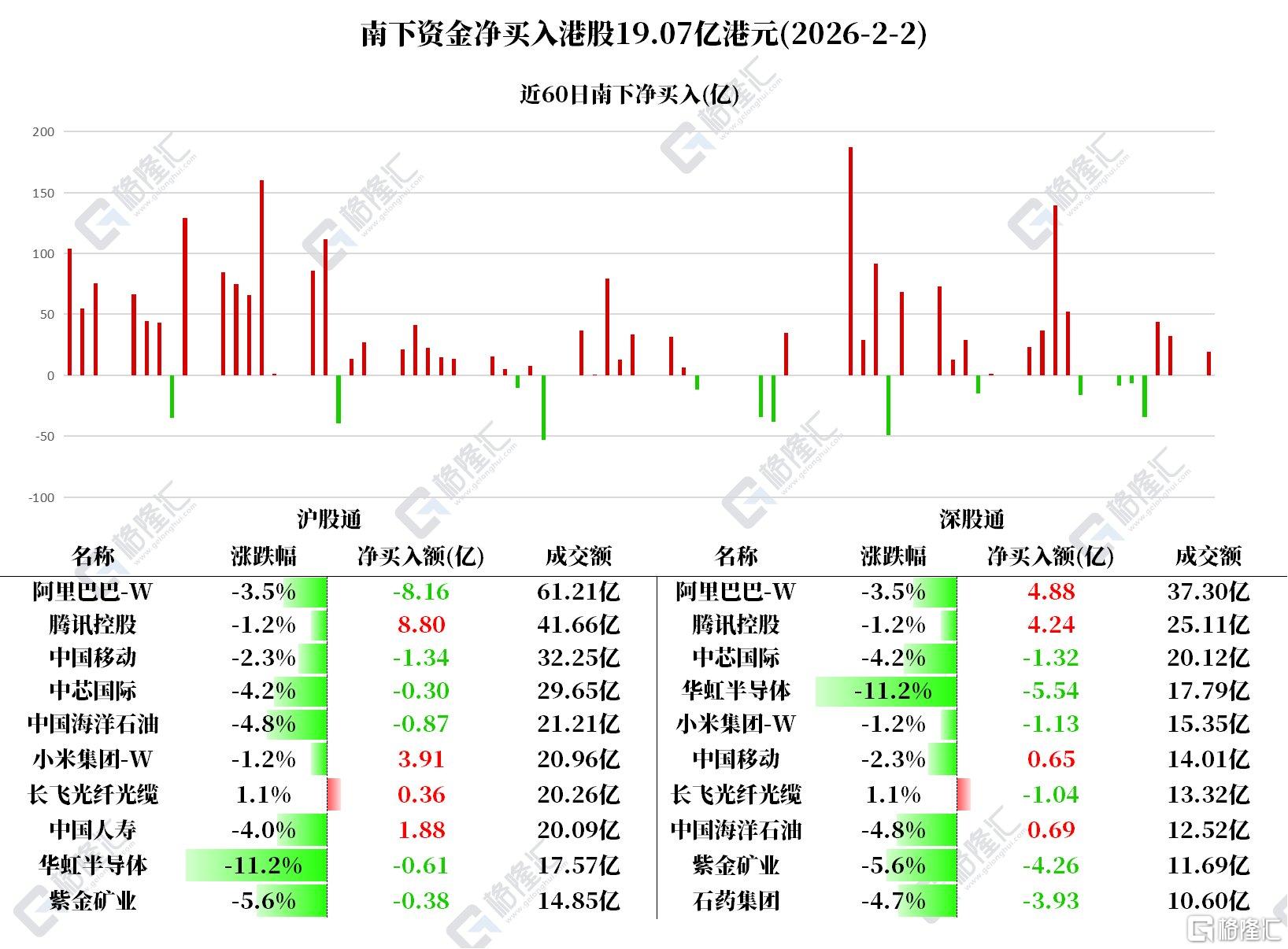
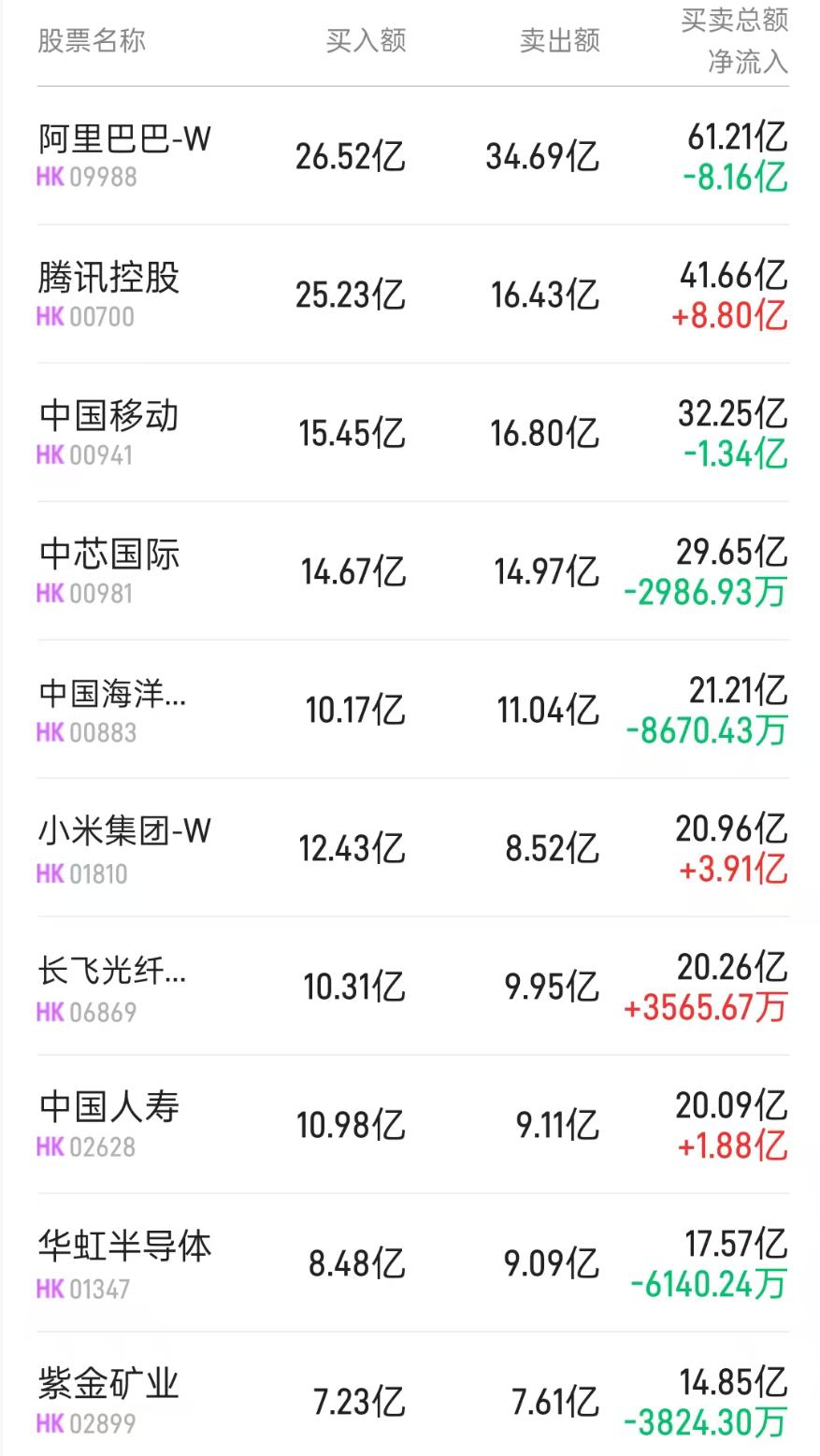
Core Insights - On February 2, 2026, Alibaba-W (09988), Tencent Holdings (00700), and China Mobile (00941) were the top three companies by trading volume in the Southbound Stock Connect, with transaction amounts of 6.121 billion, 4.166 billion, and 3.225 billion respectively [1] - In the Shenzhen-Hong Kong Stock Connect, Alibaba-W (09988), Tencent Holdings (00700), and SMIC (00981) also led the trading volume, with transaction amounts of 3.730 billion, 2.511 billion, and 2.012 billion respectively [1] Southbound Stock Connect Top Active Companies - Alibaba-W (09988) had a trading amount of 6.121 billion with a net buy of -0.816 billion [2] - Tencent Holdings (00700) recorded a trading amount of 4.166 billion with a net buy of +0.880 billion [2] - China Mobile (00941) had a trading amount of 3.225 billion with a net buy of -0.134 billion [2] - SMIC (00981) had a trading amount of 2.965 billion with a net buy of -29.8693 million [2] - Other notable companies included Xiaomi Group-W (01810) with a trading amount of 2.096 billion and a net buy of +0.391 billion [2] Shenzhen-Hong Kong Stock Connect Top Active Companies - Alibaba-W (09988) had a trading amount of 3.730 billion with a net buy of +0.488 billion [2] - Tencent Holdings (00700) recorded a trading amount of 2.511 billion with a net buy of +0.424 billion [2] - SMIC (00981) had a trading amount of 2.012 billion with a net buy of -1.32 billion [2] - Other significant companies included China Mobile (00941) with a trading amount of 1.401 billion and a net buy of +0.0651447 billion [2]




AI需求持续引领,先进晶圆代工有望大放异彩
CAITONG SECURITIES· 2026-02-02 10:52
Investment Rating - The report maintains a "Positive" investment rating for the semiconductor industry [1]. Core Insights - The demand for AI-related chips is driving significant growth in the wafer foundry sector, with TSMC's revenue reaching NT$1.05 trillion in Q4 2025, a 20.45% year-on-year increase, marking a historical high for a single quarter [6][8]. - The global advanced process capacity is expected to accelerate, with SEMI predicting that the capacity for 7nm and below advanced logic processes will grow from approximately 850,000 wafers per month in 2024 to 1.4 million wafers per month by 2028 [6][12]. - Domestic companies in China need to accelerate their technological upgrades and capacity expansions to catch up with global leaders like TSMC and Samsung, as their market share in advanced processes remains significantly low [6][11]. - The import of semiconductor manufacturing equipment in China is projected to reach a historical high of CNY 360.28 billion in 2025, indicating a strong signal for accelerated capacity expansion in advanced processes [12][13]. - The report suggests focusing on semiconductor companies such as Northern Huachuang, Zhongwei Company, Jiangfeng Electronics, and others for investment opportunities [6]. Summary by Sections 1. Global Advanced Process Wafer Foundry Development - AI computing chip demand is propelling the wafer foundry industry to new heights, with TSMC's revenue growth and a projected global wafer foundry market size increase from USD 155.6 billion in 2024 to USD 268.3 billion by 2032 [6][8]. - The complexity and larger size of AI GPU chips require more advanced process capacity, leading to a higher demand for wafer foundry services [8][9]. 2. Domestic Market in China - China's wafer foundry industry has seen rapid expansion in mature processes, but advanced process capacity and technology development face significant challenges due to export restrictions from Western countries [9][11]. - In 2021, China's share in the global advanced process wafer foundry market was only 5%, highlighting the need for further development [11]. 3. Semiconductor Equipment Imports - The import of semiconductor equipment in China is expected to reach CNY 360.28 billion in 2025, with significant investments in critical lithography equipment [12][13]. - ASML's revenue from lithography systems is projected to be EUR 24.474 billion in 2025, with 33% of that coming from the Chinese market, indicating strong demand for advanced manufacturing equipment [12][13].

净买入约19亿港元 加仓腾讯流出紫金矿业及华虹半导体
Xin Lang Cai Jing· 2026-02-02 10:16
Market Overview - Southbound funds traded approximately HKD 138.285 billion today, a significant increase of about HKD 21.8 billion compared to the previous day, accounting for 39.75% of the total turnover of the Hang Seng Index, which has been below 40% for several consecutive days [2] - Despite the Hong Kong stock market accelerating downward, southbound funds saw a net inflow of approximately HKD 1.907 billion, with the Shanghai-Hong Kong Stock Connect recording a net inflow of about HKD 2.738 billion, while the Shenzhen-Hong Kong Stock Connect experienced a net outflow of approximately HKD 0.83 billion [2] Individual Stock Performance - Tencent Holdings (0700.HK) saw a significant net buy of HKD 1.304 billion, while its stock price fell by 1.24% [2][3] - Xiaomi Group-W (01810.HK) had a net buy of HKD 0.278 billion, with a stock price decline of 1.24% [2][3] - Huahong Semiconductor (01347.HK) experienced a net outflow of HKD 0.615 billion and a sharp decline of 11.24% [2][4] - Zijin Mining (02899.HK) had a net outflow of HKD 0.464 billion, with a stock price drop of 5.58% [2][4] - CSPC Pharmaceutical Group (01093.HK) saw a net outflow of HKD 0.393 billion and a decline of 4.69% [2][4] - Alibaba-W (09988.HK) experienced a net outflow of HKD 0.329 billion, with a stock price decrease of 3.49% [2][4] - SMIC (00981.HK) had a net outflow of HKD 0.162 billion, with a decline of 4.24% [2][4] Trading Activity - In the top ten active stocks on the Hong Kong Stock Connect (Shanghai), Alibaba-W had a net outflow of HKD 0.816 billion, while Tencent Holdings had a net inflow of HKD 0.880 billion [5] - On the Shenzhen Stock Connect, Alibaba-W recorded a net inflow of HKD 0.488 billion, while Huahong Semiconductor had a significant net outflow of HKD 0.554 billion [5]


北水动向|北水成交净买入19.07亿 元宝春节红包活动启动 北水抢筹腾讯(00700)超13亿港元
智通财经网· 2026-02-02 10:01
Summary of Key Points Core Viewpoint - The Hong Kong stock market experienced significant net inflows from northbound capital, with a total net buy of HKD 19.07 billion on February 2, 2023, indicating strong investor interest in certain stocks while others faced net sell-offs [1]. Group 1: Northbound Capital Activity - Northbound capital recorded a net buy of HKD 27.38 billion through the Shanghai Stock Connect and a net sell of HKD 8.3 billion through the Shenzhen Stock Connect [1]. - The most bought stocks included Tencent (00700), Xiaomi Group-W (01810), and China Life (02628) [1]. - The most sold stocks were Hua Hong Semiconductor (01347), Zijin Mining (02899), and CSPC Pharmaceutical Group (01093) [1]. Group 2: Individual Stock Performance - Alibaba-W (09988) had a net sell of HKD 3.28 billion, with plans to invest HKD 30 billion in a "Spring Festival Treat Plan" [6][7]. - Tencent (00700) saw a net buy of HKD 13.03 billion, boosted by the launch of its "Yuanbao" Spring Festival red envelope activity, which is expected to increase downloads and user engagement [4]. - China Life (02628) received a net buy of HKD 1.87 billion, supported by positive forecasts for its individual insurance sales [5]. - Hua Hong Semiconductor (01347) faced a net sell of HKD 6.15 billion, amid tightening order reviews from major chip manufacturers [6]. - Zijin Mining (02899) experienced a net sell of HKD 4.64 billion, as it announced plans to issue USD 1.5 billion zero-coupon convertible bonds for project financing [7].

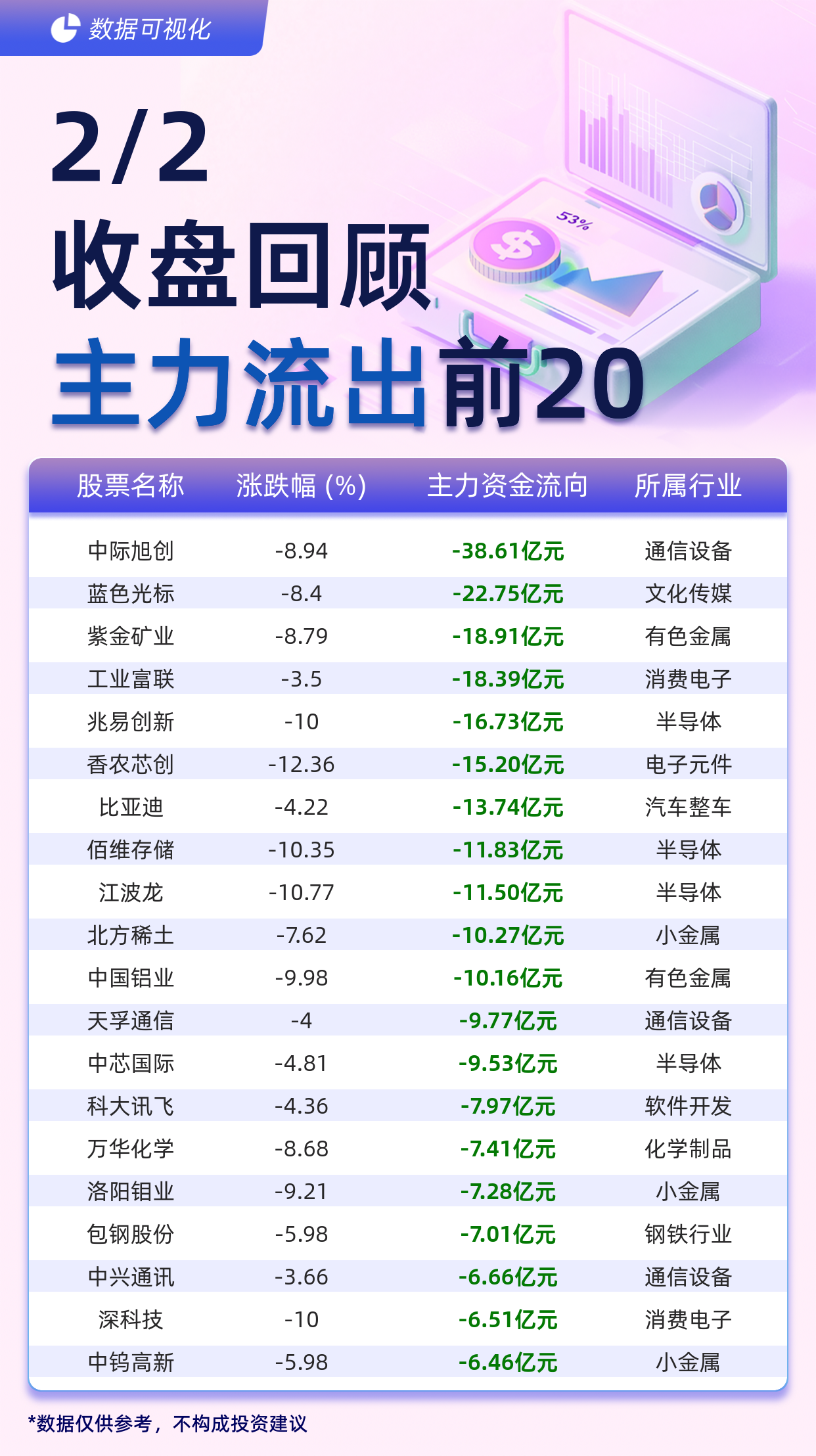
主力个股资金流出前20:中际旭创流出38.61亿元、蓝色光标流出22.75亿元
Jin Rong Jie· 2026-02-02 07:31
Core Viewpoint - The data indicates significant outflows of capital from various stocks, with notable declines in share prices across multiple sectors, suggesting a bearish sentiment in the market. Group 1: Major Stocks with Capital Outflows - Zhongji Xuchuang experienced the highest capital outflow of 3.861 billion, with a share price decline of 8.94% [1][2] - BlueFocus Media saw a capital outflow of 2.275 billion, with a decrease of 8.4% in its stock price [1][2] - Zijin Mining had an outflow of 1.891 billion, reflecting an 8.79% drop in its share price [1][2] - Industrial Fulian faced an outflow of 1.839 billion, with a 3.5% decline in stock value [1][2] - Zhaoyi Innovation reported a capital outflow of 1.673 billion, with a significant drop of 10% in its share price [1][2] Group 2: Additional Stocks with Notable Outflows - Shannon Microelectronics had an outflow of 1.520 billion, with a steep decline of 12.36% [1][2] - BYD experienced a capital outflow of 1.374 billion, with a 4.22% decrease in its stock price [1][2] - Baiwei Storage saw an outflow of 1.183 billion, with a decline of 10.35% [1][2] - Jiangbolong had an outflow of 1.150 billion, with a 10.77% drop in its share price [1][2] - Northern Rare Earth reported an outflow of 1.027 billion, with a 7.62% decline [1][2] Group 3: Other Stocks with Capital Outflows - China Aluminum faced an outflow of 1.016 billion, with a stock price decrease of 9.98% [1][2] - Tianfu Communication had an outflow of 0.977 billion, with a 4% decline in its share price [1][3] - SMIC reported an outflow of 0.953 billion, with a 4.81% drop [1][3] - iFlytek experienced an outflow of 0.797 billion, with a 4.36% decline [1][3] - Wanhua Chemical had an outflow of 0.741 billion, with an 8.68% decrease [1][3]


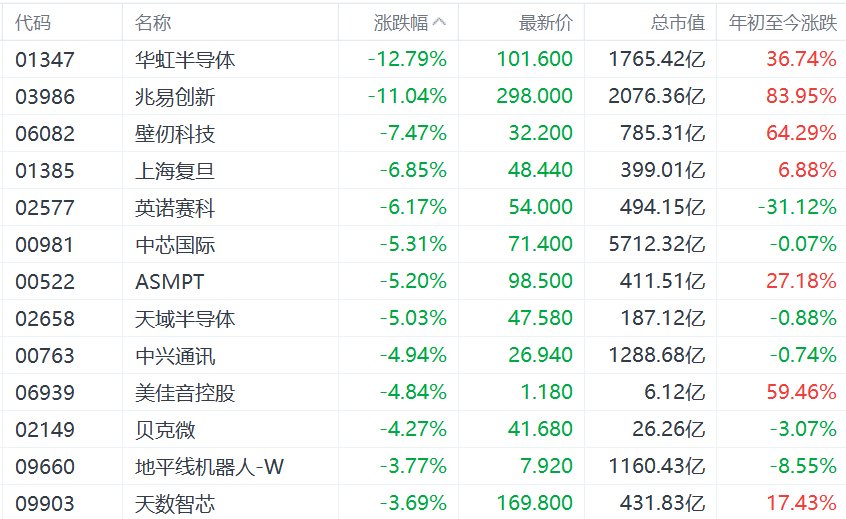
港股芯片股集体下挫,华虹半导体跌超12%,中芯国际跌超5%
Ge Long Hui A P P· 2026-02-02 07:05
Group 1 - The Hong Kong chip stocks experienced a collective decline, with notable drops in several companies' stock prices [1] - Hua Hong Semiconductor fell over 12%, while Zhaoyi Innovation dropped 11%, and Wallin Technology decreased by over 7% [1] - Other companies such as Shanghai Fudan and InnoCare also saw declines exceeding 6%, with SMIC, ASMPT, and Tianyu Semiconductor dropping more than 5% [1] Group 2 - Hua Hong Semiconductor's stock price decreased by 12.79%, reaching 101.600, with a total market capitalization of 176.54 billion and a year-to-date increase of 36.74% [2] - Zhaoyi Innovation's stock fell by 11.04% to 298.000, with a market cap of 207.64 billion and a year-to-date increase of 83.95% [2] - Wallin Technology's stock price dropped by 7.47% to 32.200, with a market cap of 78.53 billion and a year-to-date increase of 64.29% [2] - Shanghai Fudan's stock decreased by 6.85% to 48.440, with a market cap of 39.90 billion and a year-to-date increase of 6.88% [2] - InnoCare's stock fell by 6.17% to 54.000, with a market cap of 49.42 billion and a year-to-date decrease of 31.12% [2] - SMIC's stock price declined by 5.31% to 71.400, with a market cap of 571.23 billion and a year-to-date change of -0.07% [2] - ASMPT's stock decreased by 5.20% to 98.500, with a market cap of 411.51 billion and a year-to-date increase of 27.18% [2] - Tianyu Semiconductor's stock fell by 5.03% to 47.580, with a market cap of 18.71 billion and a year-to-date change of -0.88% [2]