
LENOVO GROUP(00992)

Search documents
中国大陆最新PC出货量TOP5出炉:联想稳居市场第一
Zhi Tong Cai Jing· 2025-09-04 10:39
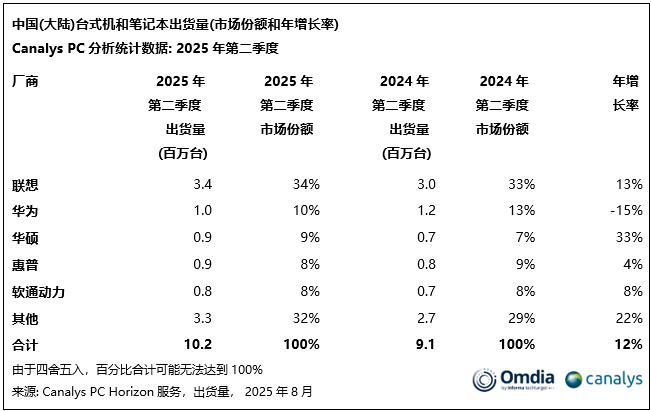
Core Insights - The Chinese PC market (excluding tablets) is projected to show strong performance in Q2 2025, with shipments reaching 10.2 million units, a year-on-year increase of 12% [1][2] - Lenovo continues to solidify its leadership position in the Chinese PC market, particularly in the AI PC segment, which is gaining significant traction [1][4] - The tablet market also experienced an 18% year-on-year growth, with shipments totaling 9.1 million units, showcasing Lenovo's competitive strategy [1][3] PC Market Performance - In Q2 2025, Lenovo's desktop and laptop shipments reached 3.4 million units, reflecting a 13% increase, and its market share grew to 34% [2] - The growth in the PC market is primarily driven by government consumption subsidies and strong procurement from state-owned enterprises [1][4] - The AI PC segment accounted for 28% of the overall PC market in Q2 2025, with Lenovo's AI PC shipments making up 27% of its total notebook shipments in China [2] Tablet Market Performance - The tablet market saw a total shipment of 9.1 million units in Q2 2025, with Lenovo achieving a 54% year-on-year growth rate, increasing its market share to 8% [3] - Competitors such as Huawei and Xiaomi also showed significant performance, with Huawei leading the tablet market with a 28% share [3] Future Outlook - Canalys forecasts a 2% year-on-year growth for the Chinese PC market in 2025, driven by subsidies and replacement demand, with AI PC penetration expected to rise to 34% [4] - By the end of 2029, approximately 107 million AI PCs are expected to be shipped in the Greater China region, laying a solid foundation for widespread AI application [4] - The government's "AI+" initiative is anticipated to accelerate local AI infrastructure development and the commercialization of AI PCs, benefiting companies like Lenovo [4]

联想摩托罗拉引领全球折叠屏手机市场复苏:每售出四部就有一部是摩托罗拉
Zhi Tong Cai Jing· 2025-09-04 05:13
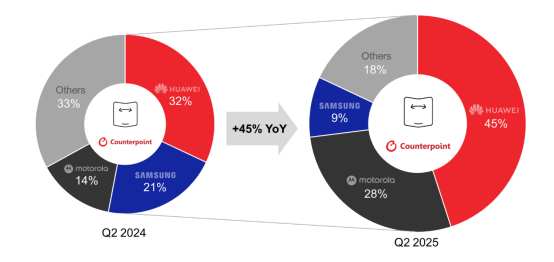
Core Insights - The global foldable smartphone shipments surged by 45% year-on-year in Q2 2025, indicating a significant recovery in the market driven by strong performances in China and explosive growth in the U.S. [1] - Motorola's Razr 60 series has emerged as a key driver of this growth, particularly in the U.S. market, where its pricing strategy has positioned it as the most cost-effective foldable smartphone [1] - Huawei leads the Chinese market with its high-end Mate X6, which accounts for over one-third of its foldable smartphone shipments in the quarter [1] Market Dynamics - In Q2 2025, Motorola's market share in the global foldable smartphone segment rose dramatically to 28%, with one in four foldable smartphones sold being a Motorola product [3] - Samsung's market share halved from 21% in Q2 2024 to 9% in Q2 2025, despite achieving record sales with its Galaxy Z Fold and Flip7 models in Q3 [3] - The competitive landscape has shifted significantly, with Motorola's rise impacting Samsung's dominance in the foldable smartphone market [3]
二季度折叠屏智能手机市场复苏:联想摩托罗拉份额翻倍 反超三星居全球第二
Ge Long Hui· 2025-09-04 03:13
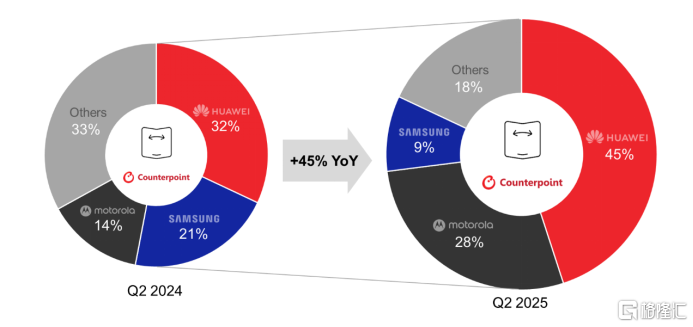
Core Insights - The global foldable smartphone shipments surged by 45% year-on-year in Q2 2025, indicating a significant recovery in the market driven by strong performances in China and explosive growth in the U.S. [1] - Motorola's Razr 60 series has emerged as a key driver of this growth, particularly in the U.S. market, where its pricing strategy has positioned it as the most cost-effective foldable smartphone [1][3] Market Performance - In Q2 2025, Motorola's market share increased dramatically to 28%, with one in four foldable smartphones sold being a Motorola product, up from just 14% in Q2 2024 [3] - Samsung's market share halved from 21% in Q2 2024 to 9% in Q2 2025, despite achieving record sales with its Galaxy Z Fold and Flip7 models in Q3 2025 [3] Competitive Landscape - Huawei led the Chinese market with its high-end Mate X6, accounting for over one-third of its foldable smartphone shipments in the same quarter [1] - The competitive pricing of Motorola's Razr series, starting at $699, has not been matched by any competitors, contributing to its success in the U.S. market [1]
智通港股沽空统计|9月4日
智通财经网· 2025-09-04 00:22
Group 1 - The top three stocks with the highest short-selling ratios are China Resources Beer (100.00%), Lenovo Group (100.00%), and Anta Sports (100.00%) [1][2] - The top three stocks with the highest short-selling amounts are Alibaba (2.283 billion), Tencent Holdings (1.289 billion), and Xiaomi Group (1.113 billion) [1][2] - The top three stocks with the highest deviation values are China Resources Beer (50.97%), Lenovo Group (46.84%), and Tencent Holdings (44.51%) [1][2] Group 2 - The top ten short-selling ratio rankings include China Resources Beer, Lenovo Group, and Anta Sports, all at 100.00% [2] - The top ten short-selling amounts show Alibaba leading with 22.83 billion, followed by Tencent Holdings and Xiaomi Group [2] - The top ten deviation values highlight China Resources Beer and Lenovo Group with significant deviations from their average short-selling ratios [2]





“人工智能+”行动破局:产业链迎重构机遇,联想控股高管谈AI如何从“技术”变“生产力”
21世纪经济报道· 2025-09-03 14:41
Core Viewpoint - The "Artificial Intelligence +" initiative has been elevated to a strategic level, signaling a transformation that will reshape the economic structure and create trillion-level market opportunities across various industries [1][2]. Group 1: Strategic Goals and Implementation - The State Council has issued a plan with clear developmental goals for AI by 2027, 2030, and 2035, aiming to integrate AI deeply into various sectors of the economy and society [1][2]. - The initiative outlines six major actions and eight supporting measures to guide the application of AI, enhancing overall productivity and market vitality [2][3]. Group 2: Industry Opportunities - The shift in focus from large model development to vertical applications presents a significant opportunity for domestic companies to leverage their strengths in application and market integration [2][4]. - The "Artificial Intelligence +" action plan will facilitate the integration of AI infrastructure with vertical industries, providing essential support for industrial upgrades [3]. Group 3: Key Insights from Industry Leaders - Industry leaders emphasize the importance of high-quality data and valuable application goals for the successful implementation of the "Artificial Intelligence +" initiative [5]. - AI companies must focus on solving real-world problems and identifying structural bottlenecks within core industry processes to ensure AI becomes a necessity rather than an added value [6]. Group 4: Lenovo's AI Initiatives - Lenovo has established a comprehensive AI ecosystem, investing in over 270 AI companies and developing a full-stack intelligent technology system that includes hardware and software solutions [9][10]. - Lenovo's AI-driven manufacturing model has significantly improved production efficiency, reducing scheduling time from 6 hours to 1.5 minutes and increasing delivery efficiency by over 20% [7][11]. Group 5: Market Opportunities in AI Applications - The healthcare sector is seeing significant advancements through AI, with applications in drug discovery and surgical planning, demonstrating the technology's potential to enhance efficiency and reduce costs [14]. - The integration of AI in the renewable energy sector is also promising, as AI can optimize supply-demand balance in power systems, addressing bottlenecks in energy consumption [14]. Group 6: Future of Work and AI - The introduction of AI is expected to change the nature of work, enhancing knowledge acquisition and communication methods, while also creating new job opportunities in AI-related fields [18][19]. - Historical trends suggest that technological advancements typically lead to increased demand for labor rather than job losses, indicating that AI could serve as a powerful engine for job creation [19].
联想集团(00992) - 股份发行人的证券变动月报表(截至2025年8月31日)
2025-09-03 09:20
股份發行人及根據《上市規則》第十九B章上市的香港預託證券發行人的證券變動月報表 | 截至月份: | 2025年8月31日 | 狀態: | 新提交 | | --- | --- | --- | --- | | 致:香港交易及結算所有限公司 | | | | | 公司名稱: | 聯想集團有限公司 | | | | 呈交日期: | 2025年9月3日 | | | | I. 法定/註冊股本變動 不適用 | | | | FF301 第 1 頁 共 11 頁 v 1.1.1 FF301 II. 已發行股份及/或庫存股份變動 | 1. 股份分類 | 普通股 | | 股份類別 | 不適用 | | 於香港聯交所上市 (註1) | 是 | | | --- | --- | --- | --- | --- | --- | --- | --- | --- | | 證券代號 (如上市) | 00992 | | 說明 | 港幣櫃台 | | | | | | 多櫃檯證券代號 | 80992 | RMB 說明 | | 人民幣櫃台 | | | | | | | | 已發行股份(不包括庫存股份)數目 | | | 庫存股份數目 | | 已發行股份總數 | | ...
汇丰维持联想 “买入” 评级:PC 业务稳当现金牛 目标价12.9港元潜在涨幅18%
Zhi Tong Cai Jing· 2025-09-03 08:13
Core Viewpoint - HSBC maintains a "buy" rating on Lenovo, citing its PC business as a cash cow and ongoing investments in the server business, with a target price of HKD 12.9, indicating a potential upside of 18% [1] Group 1: PC Business Performance - Lenovo shows strong momentum in both consumer and commercial PC segments, with market share increasing in multiple markets and robust demand for gaming PCs, particularly in China [2] - The activation rate of Lenovo's PC products remains stable, and channel inventory is at a healthy level [2] - Lenovo's management is optimistic about the commercial PC upgrade cycle, with approximately 250 million devices globally still running Windows 10, which are expected to drive future growth in the PC upgrade cycle [2] Group 2: Impact of Tariffs and Production Strategy - Lenovo has shifted production capacity for PCs sold in the U.S. to Vietnam, limiting the impact of tariffs on its PC business [2] - Despite uncertainties in tariff policies, Lenovo's global production layout provides greater flexibility to respond to market dynamics [2] Group 3: Server Business Investments - The Infrastructure Solutions Group (ISG) is in a phase of continuous investment, with increased strategic investments in the small and medium-sized enterprise sector and enhancements in AI server capabilities to achieve better operational leverage [2]
联想SSG:AI落地进入加速期,场景与ROI成为核心焦点
3 6 Ke· 2025-09-03 07:29
Core Insights - The AI industry is transitioning from a parameter competition to a focus on value return, emphasizing the importance of ROI as a key metric for businesses [1][2] Group 1: ROI and Application Value - This year marks the fifth anniversary of Lenovo's SSG, witnessing the shift of generative AI from a "fever phase" to a rational implementation stage, with ROI becoming the critical standard for measuring input-output [2] - Companies need to identify suitable tools and scenarios to effectively leverage AI technology, focusing on cost-effectiveness rather than merely pursuing larger model parameters [2] - In the B2B sector, the emphasis is on whether AI can deliver value in specific scenarios rather than the model's inherent capabilities [2][3] Group 2: Challenges and Solutions - The issue of hallucination rates remains a significant challenge in the application of large models, which cannot be completely eliminated in the short term [4] - Solutions to hallucination rates require a systematic approach, optimizing the entire process from model engineering to multi-modal interaction [4] - Lenovo's iChain supply chain AI demonstrates the effectiveness of a multi-agent collaboration approach, achieving a 90% accuracy in risk identification and reducing response time by four times [4] Group 3: Strategic Insights - The advancement of AI is not solely about technological breakthroughs but also involves a comprehensive system engineering approach, requiring a full-stack layout from infrastructure to industry-specific practices [6] - There is a notable difference in market preferences, with overseas clients favoring SaaS models for AI consumption, while domestic clients prioritize localization and hybrid deployment for data security and flexibility [6] - Lenovo's strategy of "internalizing and externalizing" its practices across 180 countries allows for tailored solutions that meet local demands [6]
一体化交付会是企业级AI落地的解么?丨ToB产业观察
Tai Mei Ti A P P· 2025-09-03 04:04
Group 1 - The core viewpoint of the articles highlights the challenges and opportunities in AI deployment across enterprises, with many still in the early stages and facing issues like unclear ROI, weak data foundations, and insufficient expertise [2][3][4] - The Chinese market's understanding and maturity regarding software and SaaS are less developed compared to overseas markets, presenting unique opportunities for AI delivery in China [2][3] - The Chinese government's "Artificial Intelligence+" initiative outlines a three-phase development goal for AI integration across key sectors, aiming for over 70% application penetration by 2027 and 90% by 2030 [3][4] Group 2 - Companies like Alibaba, Huawei, Tencent, and Lenovo are actively promoting innovative models such as "Model as a Service" and "Intelligent Agent as a Service" to explore AI applications in various scenarios [5][6] - Despite the potential for AI applications, many enterprises face significant challenges in actualizing enterprise-level AI, with 73% of companies experiencing discrepancies between expectations and reality [6][10] - The "hallucination" problem in AI, which can lead to significant business impacts, remains a critical challenge, necessitating solutions that include human oversight and risk assessment [6][7][8] Group 3 - Data quality and availability are major obstacles, with effective data for AI training often below 10%, leading to a situation where "data-rich but information-poor" is common [9][10] - The lack of integration between departments creates "data silos," hindering the full potential of enterprise-level AI [10][11] - Companies are increasingly focused on quantifiable business outcomes from AI investments, shifting from merely pursuing advanced technology to seeking tangible benefits [10][11] Group 4 - The need for integrated delivery capabilities is emphasized, as many enterprises mistakenly believe that purchasing hardware equates to adopting AI [11][12] - Lenovo's recent upgrade of its "Hybrid AI Advantage Set" aims to enhance its full-stack AI capabilities, facilitating efficient AI deployment across diverse applications [12] - As AI transitions from pilot projects to large-scale applications, companies require comprehensive service providers capable of delivering end-to-end solutions across various dimensions [12]

联想集团(00992.HK)获贝莱德增持299万股
Ge Long Hui· 2025-09-01 23:56
Group 1 - BlackRock, Inc. increased its stake in Lenovo Group (00992.HK) by purchasing 2.99 million shares at an average price of HKD 10.9411 per share, totaling approximately HKD 32.714 million [1] - Following this transaction, BlackRock's total shareholding in Lenovo Group rose to 621,720,864 shares, increasing its ownership percentage from 4.99% to 5.01% [1]
