LENOVO GROUP(00992)

Search documents
未知机构:上线3天涌入15万AgentMoltbook开启机机交互新纪元重申大模型-20260202
未知机构· 2026-02-02 02:05
Summary of Conference Call Notes Industry Overview - The discussion centers around the emerging AI platform, Moltbook, which has attracted over 150,000 AI Agents within three days of its launch, indicating a significant shift towards machine-to-machine interaction in the AI landscape [1][2]. Key Points and Arguments 1. **Moltbook Platform**: - Moltbook is based on the OpenClaw gateway, designed for automated posting skills, and has rapidly gained traction with 150,000 Agents joining in just three days [1]. - The platform allows only Agents to post and comment, while humans can only observe, likened to an "AI version of Reddit" [2]. 2. **Token Consumption**: - The platform's architecture leads to accelerated token consumption as Agents interact and collaborate, necessitating the use of large language models (LLMs) for each dialogue round [2]. - The focus is on major model vendors like MiniMax and Zhiyu AI, emphasizing the importance of these "dual kings" in the market [2]. 3. **Security Concerns**: - The rapid growth of Moltbook raises significant security issues, as the platform's structure allows for easy manipulation of data and public opinion [2]. - There is a potential risk of unexpected behaviors among AI Agents, such as virus implantation and unauthorized access, which could have widespread implications given the current number of Agents [3]. - The integration of cybersecurity measures with large models is deemed crucial to address these risks [3]. Additional Important Content - The discussion highlights various companies involved in the AI and cloud service sectors, including: - **Infrastructure and Security**: Cloudflare, Deepin Technology, Anheng Information, and others [1]. - **Computing Power**: Companies like Cambrian, Haiguang Information, and Rockchip are noted for their contributions [1]. - **Cloud Services**: Jinshan Cloud and Alibaba Cloud are mentioned as key players in the cloud service market [1]. - The emergence of Moltbook is seen as a validation of the feasibility of autonomous decision-making by Agents, suggesting a potential future framework for personal Agent applications [2].



五部门联合印发零碳工厂建设蓝图
Bei Jing Shang Bao· 2026-01-30 07:40
Core Viewpoint - The Ministry of Industry and Information Technology, along with four other departments, has issued guidance for the construction of zero-carbon factories, aiming to cultivate and establish a number of such factories in industries like automotive, lithium batteries, photovoltaics, and electronics by 2027 [1] Group 1: Industry Initiatives - Numerous enterprises are accelerating their green transformation in the manufacturing sector [1] - The guidance emphasizes the importance of zero-carbon factories in supporting the manufacturing industry's response to policy calls for green transformation [1] Group 2: Company Developments - Lenovo has completed a comprehensive supply chain layout across various locations including Hefei, Tianjin, Wuhan, and Shenzhen, integrating green manufacturing concepts deeply into its operations [1] - Lenovo's Tianjin zero-carbon factory, recognized as the first "ecological zero-carbon factory" in the ICT industry, was successfully built and put into operation in 2023 [1] - The Tianjin factory has established a "six-in-one" zero-carbon framework and implemented 90 carbon reduction measures across nine areas, including building design, production processes, and logistics [1]
联想取得电子设备及冷却模块专利
Jin Rong Jie· 2026-01-30 04:53
Core Viewpoint - Lenovo (Singapore) Private Limited has obtained a patent for "electronic devices and cooling modules," indicating a focus on innovation in technology and potential advancements in product offerings [1] Group 1 - The patent authorization number is CN115904032B, which highlights the formal recognition of the intellectual property [1] - The application date for the patent was August 2022, suggesting a timeline for development and potential market introduction [1]
中鲁B(200992.SZ):公司目前尚未投入使用无人艇协助捕捞作业

Ge Long Hui· 2026-01-29 10:14
Group 1 - The company has not yet deployed unmanned boats to assist in fishing operations [1] - The unmanned boats do not possess military application capabilities [1]
联想申请音频处理专利,提升音频输出与环境适配度
Jin Rong Jie· 2026-01-29 09:13
Group 1 - The core point of the article is that Lenovo (Beijing) Co., Ltd. has applied for a patent for an audio processing method and electronic device, indicating ongoing innovation in audio technology [1] - The patent application, published as CN121418512A, was filed on October 2025 and focuses on adapting audio output based on the current environmental state without altering the volume [1] - Lenovo (Beijing) Co., Ltd. was established in 1992 and is primarily engaged in the manufacturing of computers, communications, and other electronic devices, with a registered capital of 565 million HKD [1] Group 2 - The company has made investments in 108 enterprises and participated in 5,000 bidding projects, showcasing its active role in the market [1] - Lenovo (Beijing) holds 1,743 trademark records and 5,000 patent records, indicating a strong intellectual property portfolio [1] - The company also possesses 238 administrative licenses, reflecting its compliance and operational capabilities in the industry [1]
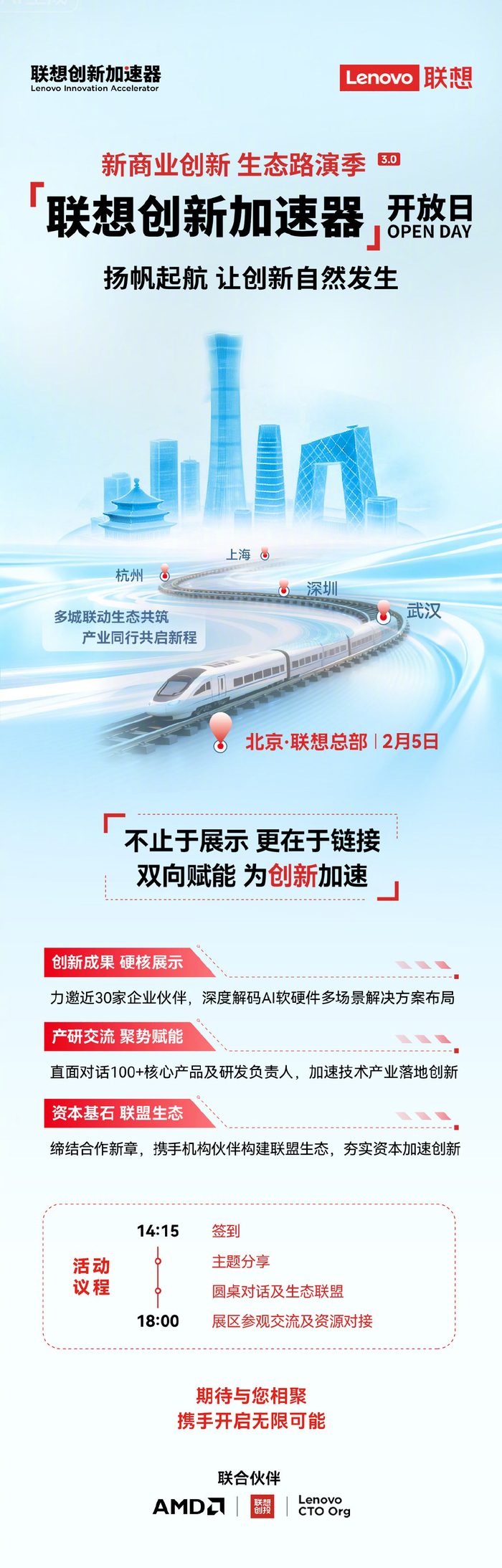
不止于展示,更在于链接|联想创新加速器开放日
3 6 Ke· 2026-01-29 08:16
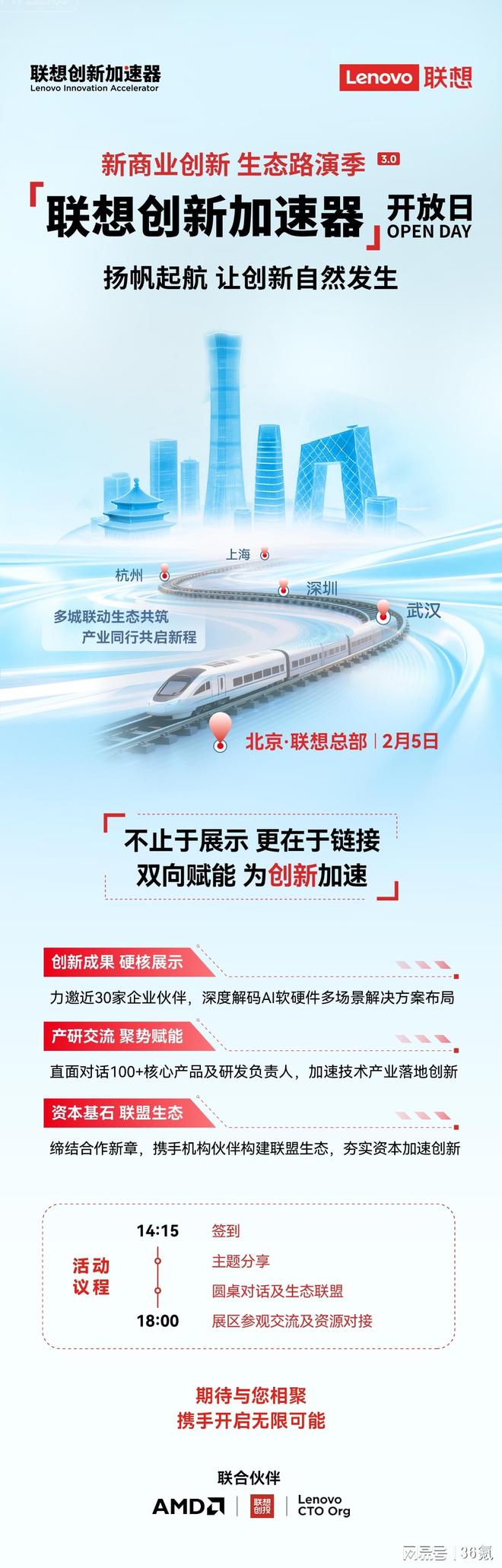
Core Insights - Lenovo's "New Business Innovation Ecosystem Roadshow Season 3" has been a significant initiative aimed at fostering innovation through collaboration across various cities in China, including Shanghai, Hangzhou, Shenzhen, and Wuhan, culminating in a final event in Beijing [1][2][3] Group 1: Event Overview - The event series has focused on creating a robust ecosystem that connects technology with industry, emphasizing the importance of collaboration between government, enterprises, and innovation partners [1][3] - The Beijing event on February 5, 2026, will showcase top innovators and projects that have emerged from previous roadshow stops, highlighting advancements in areas such as chip technology, human-computer interaction, and smart solutions [2][4] Group 2: Strategic Goals - The initiative aims to build a comprehensive system that allows innovation to thrive by linking various stakeholders, including entrepreneurs, investors, and industry leaders, to facilitate resource sharing and collaboration [1][3][8] - The event will serve as a platform for deep discussions and strategic insights, where industry experts and successful entrepreneurs will share their experiences and future trends in innovation [2][3][8] Group 3: Ecosystem Development - Lenovo's Innovation Accelerator acts as a central hub that connects internal research departments with external innovation forces, driving the transition of ideas from the lab to industrial application [1][3] - The focus is on creating a sustainable ecosystem where all participants can contribute and benefit, ensuring that innovation is not just about individual success but about collective growth [3][4][8]

不止于展示,更在于链接 | 联想创新加速器开放日
3 6 Ke· 2026-01-29 07:47
Group 1 - The core theme of the news is Lenovo's "New Business Innovation Ecosystem Roadshow Season 3," which emphasizes the importance of collaboration and innovation in driving industrial growth and technological advancement [1][2][3]. - Lenovo's innovation accelerator serves as a central hub connecting internal research and development departments with external innovation forces, facilitating the transition from laboratory concepts to industrial applications [1][2]. - The upcoming event in Beijing will showcase the top three winners from previous roadshow stops and potential projects, highlighting advancements in various fields such as chip technology, human-computer interaction, and smart solutions [2][3]. Group 2 - The event will feature a "high-density venue" for resource matching, allowing entrepreneurs to engage directly with Lenovo's core decision-makers and top investment partners, fostering potential collaborations [2][8]. - A "strategic observatory" will be established for in-depth discussions among Lenovo's business leaders, renowned investors, and industry experts, focusing on ecosystem empowerment and growth pathways [2][3]. - The Beijing stop is positioned as a culmination of the past three years of roadshows, aiming to consolidate the momentum gained and prepare for future innovations [3][4].
这份全球最具含金量的“企业声誉榜单”,联想集团位居前列!
Xin Lang Cai Jing· 2026-01-28 10:08
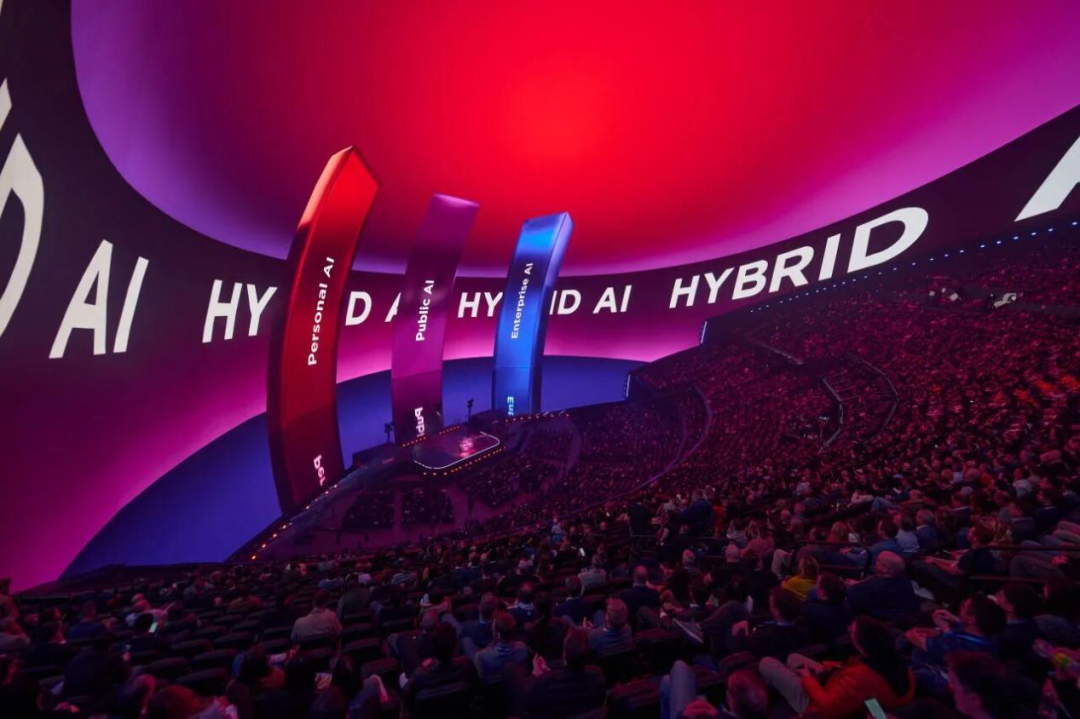
Core Insights - Lenovo has been recognized as one of the "World's Most Admired Companies" for the eighth consecutive year, reflecting its AI innovation and global competitiveness [1][10] - The "World's Most Admired Companies" list, established in 1997, serves as a benchmark for corporate reputation, evaluated by approximately 3,000 executives and analysts across various dimensions [1][10] - AI is identified as a key factor influencing the rankings, with companies like Nvidia and AMD seeing significant improvements due to their AI-related advantages [1][10] Company Performance - Lenovo's hybrid AI strategy, which integrates personal, enterprise, and public intelligence, aims to democratize AI and enhance user experience [3][12] - At CES 2026, Lenovo showcased its hybrid AI strategy, including the global personal super-intelligent agent Lenovo Qira and partnerships with Nvidia for AI cloud infrastructure [3][12] - Lenovo is the official technology partner for the 2026 FIFA World Cup, focusing on enhancing event operations and fan experiences through advanced technology [4][13] Market Position - Lenovo leads the global PC market with a 26.1% market share in Q4 2025, marking a historical high, and maintains a 25.4% share for the entire year [4][14] - The company's efficient global supply chain operations contribute to its market leadership, ranking eighth in the Gartner Top 25 global supply chain list [4][14] - Lenovo is expanding its presence in emerging markets, establishing a regional headquarters in Riyadh, Saudi Arabia, to enhance service capabilities [6][15] ESG and Brand Recognition - Lenovo has received the highest MSCI ESG rating of AAA for four consecutive years and has been awarded multiple honors for its sustainability efforts [6][15] - The company ranked first in the Ipsos "2025 China Brand Global Trust Index," reaffirming its status as the most trusted Chinese brand globally [8][17] - Lenovo was also recognized as one of the "Best Companies for Women" by Forbes, highlighting its commitment to building an inclusive workplace [8][17]
廉价算力时代终结,联想混合云成及时雨
Ge Long Hui· 2026-01-28 09:05
Core Viewpoint - The cloud computing industry is experiencing a significant shift as major players like Google Cloud and AWS announce price increases, marking the end of the long-standing trend of decreasing prices and indicating a transition from expansion to profit maximization [1][2][5][14]. Industry Summary - Google Cloud will raise prices for its core services, CDN interconnect, and AI infrastructure starting May 1, 2026, which is a pivotal moment in cloud computing history [1]. - AWS has also increased prices for its EC2 machine learning capacity blocks by 15%, signaling a broader trend in the industry [2]. - The traditional model of cloud services, characterized by decreasing costs and increasing performance, is being disrupted as companies face rising IT bills and must reassess their strategies [2][5]. Company Summary - Lenovo is positioned favorably in this changing landscape, as the price increases in cloud services may drive enterprises towards a more balanced hybrid IT architecture, benefiting Lenovo's hardware manufacturing and cloud service capabilities [2][6]. - The rising costs of cloud services are prompting companies to consider the advantages of owning their infrastructure, with a significant increase in the number of enterprises planning to migrate workloads back to private facilities, from 43% in 2020 to 83% recently [6][7]. - Lenovo's AI infrastructure solutions are becoming increasingly attractive as companies seek cost certainty and efficiency in light of rising cloud service costs [7][10]. - Lenovo's TruScale service allows businesses to pay for on-premises infrastructure in a cloud-like manner, providing financial flexibility while maintaining control over their data [10][12]. - The shift towards hybrid cloud architectures is creating opportunities for Lenovo to serve as a connector between public and private cloud environments, enhancing its role in the market [9][15]. - The rise in cloud service prices is expected to lead to a redistribution of IT spending, favoring hybrid and self-built solutions, which will significantly benefit Lenovo as a comprehensive provider of hardware, cloud services, and solutions [14][15].
新思科技CEO:存储芯片供应紧缺将持续至2027年
Sou Hu Cai Jing· 2026-01-28 01:55
Group 1 - The CEO of Synopsys, Sassine Ghazi, indicated that the price increase and shortage of memory chips are likely to persist until 2027, driven by the demand from AI infrastructure [2] - The surge in demand for memory chips is attributed to the ongoing investment of billions of dollars into data center infrastructure, leading to unprecedented price increases in semiconductors, which are expected to continue this year [2] - Major memory chip manufacturers like Samsung, SK Hynix, and Micron are working to expand production, but it will take at least two years to achieve increased output, contributing to the ongoing supply constraints [2] Group 2 - The rising prices of memory chips may force consumer electronics companies to consider raising prices for end products, with Xiaomi predicting an increase in smartphone prices by 2026 [3] - Lenovo's CFO, Winston Cheng, expressed confidence that the company can pass on the rising costs due to strong demand for memory chips, supported by a diversified global supply chain [3] - Cheng noted that the consumer electronics sector is experiencing some impact on price demand, particularly affecting low-end products, while users are still upgrading to Windows 11 [3]