CNCB(00998)

Search documents
银行业周度追踪2025年第42周:房地产贷款三季度增速转负-20251027
Changjiang Securities· 2025-10-26 23:30
Investment Rating - The investment rating for the banking industry is "Positive" and is maintained [10] Core Insights - The A-share risk appetite has temporarily rebounded, with the banking index lagging behind, while H-shares of major banks have outperformed. The proportion of southbound holdings has increased, indicating a sustained interest in H-shares due to their undervaluation and high dividend characteristics [2][9] - The central bank's report for Q3 2025 indicates a negative growth rate for real estate loans, with a year-on-year decline of 0.1%. This marks the first negative growth in real estate development loans since Q2 2022, primarily driven by weak sales [6][7][39] - The performance of banks that have disclosed their Q3 results shows an upward trend in profit growth, with interest income rebounding. Chongqing Bank reported a surprising growth of over 10% in the first three quarters [8][49] Summary by Sections Banking Index Performance - The banking index rose by 1.3% this week, underperforming compared to the CSI 300 and ChiNext indices, which saw excess returns of -1.9% and -6.7% respectively. Agricultural Bank of China H-shares led the gains with a 7.9% increase, while the A/H share growth for Agricultural Bank reached 56.4% and 43.6% respectively [2][9][18] Loan Trends - The central bank's Q3 report shows that the proportion of corporate loans has increased, while industrial medium- and long-term loan growth has declined to 9.7%, down 1.5 percentage points from the previous quarter. Real estate loans have turned negative, with development loans down 1.3% year-on-year, reflecting weak sales [6][38][39] - Personal housing loans also saw a year-on-year decline of 0.3%, with a net decrease of 292.1 billion yuan in Q3, indicating ongoing weakness in the housing market [7][39] Bank Earnings Reports - As of October 24, banks such as Huaxia Bank, Ping An Bank, and Chongqing Bank have reported their Q3 earnings. Chongqing Bank's performance exceeded expectations with over 10% growth, while Huaxia and Ping An faced challenges due to non-interest income declines [8][49][51] Market Dynamics - The market dynamics indicate a recovery in trading volumes and turnover rates for bank stocks, with a notable increase in the turnover rate for joint-stock banks. The overall trading environment for bank stocks is expected to improve as previous funding pressures ease [29][30]

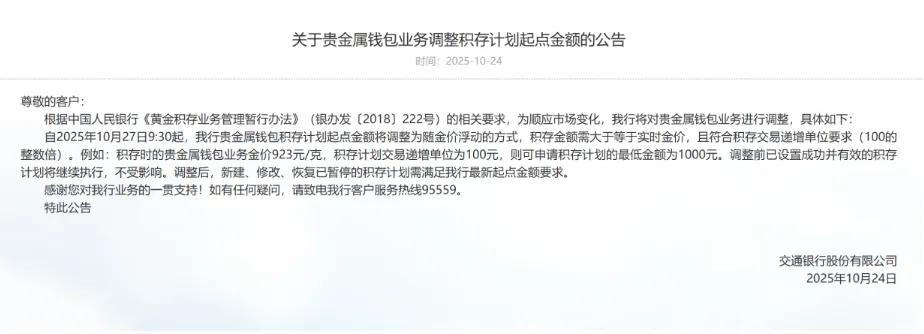
又有银行开启“随金价浮动”机制!业内人士:怕追高可以这样做
Xin Lang Cai Jing· 2025-10-26 22:35
Core Viewpoint - The recent adjustments by multiple banks in China to their gold accumulation plans reflect a response to the volatile gold market, with banks shifting to a pricing mechanism linked to real-time gold prices to better align with market fluctuations [5][10]. Group 1: Bank Adjustments - Bank of Communications announced that starting from October 27, 2025, the starting amount for its "Gold Wallet" accumulation plan will no longer be fixed but will instead fluctuate with gold prices, requiring the set amount to be at least equal to the real-time gold price [1][2]. - Agricultural Bank of China has also adjusted its gold accumulation plan to a floating pricing model, effective from September, to comply with regulatory requirements and enhance customer convenience [4]. - Several banks, including Industrial and Commercial Bank of China and China Bank, have raised their minimum investment thresholds for gold accumulation plans in October, indicating a trend among banks to increase entry barriers [6][7][8]. Group 2: Market Dynamics - The recent surge in gold prices is attributed to three main factors: the inverse relationship between gold prices and real interest rates, rising geopolitical tensions increasing demand for gold as a safe-haven asset, and central banks in emerging markets increasing their gold reserves [10]. - Analysts suggest that the floating pricing mechanism adopted by banks helps avoid delays in adjusting entry thresholds during periods of significant price volatility, thus providing a more responsive investment environment [8][9]. Group 3: Investor Guidance - Financial institutions have issued risk warnings to investors regarding the heightened volatility in precious metal prices, urging them to assess their risk tolerance and manage their investment positions carefully [9]. - Experts recommend that investors focus on long-term strategies for gold accumulation, emphasizing the importance of gradual investment rather than attempting to capitalize on short-term price movements [11].




关注信贷需求修复:银行业周报-20251026
Xiangcai Securities· 2025-10-26 14:50
Investment Rating - The industry investment rating is maintained at "Overweight" [4][7]. Core Insights - The new policy financial tools have been implemented to boost credit demand, with over 330 billion yuan allocated by three policy banks [3][27]. - A total of 500 billion yuan in new policy financial tools has been initiated, with 250 billion yuan already invested in 12 major economic provinces, focusing on infrastructure, foreign trade, and emerging sectors like digital economy and AI [4][5]. - The expected leverage effect of the 500 billion yuan policy financial tools could generate approximately 5 trillion yuan in investments and 4 trillion yuan in loans [4][29]. - The rapid deployment of these financial tools is anticipated to enhance credit demand in the fourth quarter, particularly benefiting regional banks due to the demonstration effect from major economic provinces [5][29]. Summary by Sections Market Review - The banking index increased by 1.40% during the period from October 20 to October 26, 2025, underperforming the CSI 300 index by 1.84 percentage points [9]. - The performance of major banks was relatively strong, with Agricultural Bank of China leading with a 4.86% increase [9]. Financial Market - The central bank's net injection in the open market was 198.1 billion yuan, maintaining a loose monetary environment [18]. - The average issuance rates for one-year interbank certificates of deposit were 1.68% for state-owned banks and 1.74% for regional banks, with a notable increase in net financing of 425.3 billion yuan in October [22][26]. Industry Dynamics - The policy financial tools are expected to support long-term public loans and improve loan term structures, with a focus on sustainable credit demand release during project operation cycles [29]. - Investment in emerging industries, particularly AI, is projected to maintain strong financing demand, with technology innovation loans expected to grow rapidly [5][29]. Investment Recommendations - The report suggests focusing on state-owned banks for their stable high dividend yields and potential valuation recovery opportunities for joint-stock and regional banks amid improving economic expectations [7][30].



中信银行郑州分行为企业海外项目保驾护航
Sou Hu Cai Jing· 2025-10-25 16:40
Core Viewpoint - CITIC Bank Zhengzhou Branch has successfully opened a cross-border RMB guarantee for a cable enterprise, facilitating the company's international cooperation opportunities and demonstrating the bank's commitment to supporting the real economy through financial services [1] Group 1: Financial Services and Support - The cable enterprise is an outward-oriented company that previously won a bid for a cable procurement project in a South American country, requiring the issuance of bid guarantees, advance payment guarantees, and performance guarantees [1] - CITIC Bank Zhengzhou Branch provided a tailored cross-border RMB financial service plan after multiple visits to understand the enterprise's financial needs during its internationalization process [1] - The bank's services align with the national "dual circulation" development strategy and the ongoing push for enterprises to expand internationally, highlighting the increasing importance of foreign exchange financial services as a link between domestic and international markets [1] Group 2: Strategic Initiatives - CITIC Bank aims to create a comprehensive cross-border financial service system by developing a full account, full scenario, and full lifecycle product map for foreign exchange business [1] - The bank actively collaborates with various channels, including CITIC Insurance, to enhance services for enterprises in import and export trade, cross-border settlement, foreign exchange trading, and exchange rate risk management [1] - The bank plans to continue its customer-centric service philosophy and leverage its professional advantages and innovative capabilities in the foreign exchange business to provide high-quality and innovative financial services for enterprises [2]
中信专场招聘会走进中南大学
Chang Sha Wan Bao· 2025-10-25 11:18
Group 1 - The core viewpoint of the news is the collaboration between CITIC Group and Central South University to enhance talent recruitment and create a talent development platform through a joint campus recruitment event [1][2] - The recruitment event involved CITIC Bank Changsha Branch and six other subsidiaries, aiming to provide more job opportunities for graduates from Central South University, a prestigious "Double First-Class" university [1][2] - The event attracted over 200 graduates, with a significant turnout for the presentations and interviews, indicating strong interest in the job opportunities offered [1][2] Group 2 - The joint campus recruitment is a key initiative to implement the strategic cooperation between CITIC Group and Central South University, focusing on the recruitment of versatile talents [2] - CITIC Bank Changsha Branch has actively engaged with Central South University throughout the year, visiting various engineering colleges to strengthen the recruitment of composite talents [2] - The recruitment effort was supported by Central South University's career services, which sent nearly 10,000 recruitment messages to graduates, contributing to the successful outcome of the event [2]

济南圣都整装资金存管服务上线 客企银三方共建家装安全生态
Huan Qiu Wang· 2025-10-25 05:59
Core Viewpoint - The launch of the renovation fund custody service by Beike's direct home decoration brand, Shengdu, aims to rebuild consumer trust in home decoration transactions through a three-party fund supervision system involving customers, banks, and enterprises [1][3]. Group 1: Fund Custody System - The fund custody system introduced by Shengdu includes three main measures: establishing a third-party supervision account, releasing funds based on construction milestones, and ensuring that interest during the frozen period belongs to consumers [3][5]. - This system addresses risks associated with the traditional "pay first, then construct" model, which has led to consumer concerns over construction delays and quality issues [3][5]. Group 2: Industry Impact - The initiative reflects Shengdu's commitment to social responsibility and sets a new benchmark for the healthy development of the home decoration industry, contributing to the "reassured consumption in Jinan" city brand [3][5]. - The introduction of the fund custody model is seen as a significant step in mitigating fund misappropriation risks and enhancing consumer confidence in the home decoration sector [5][7]. Group 3: Strategic Goals - Beike's overall strategy includes integrating products, delivery, technology, and services, with fund custody being a starting point for enhancing customer satisfaction [9][11]. - The company aims to leverage technology, such as lightweight BIM and smart construction sites, to improve efficiency and consumer trust in the industry [9][11]. Group 4: Performance Metrics - Since the launch of the fund custody model in November last year, it has been implemented in over 30 cities, safeguarding 3.3 billion yuan for more than 20,000 users, with a completion release rate exceeding 99% [15]. - In Jinan, since the service went live on September 27, it has provided fund custody services for over 80 families, amounting to 4.3 million yuan [15].

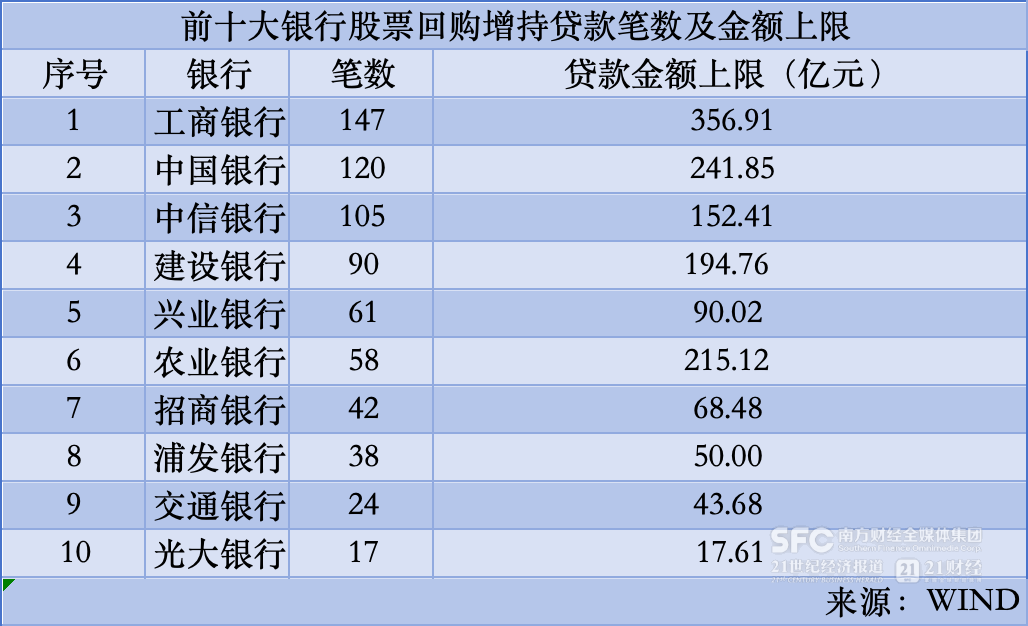
回购增持再贷款超1500亿元:工行发放最多,机构期待名单扩容
2 1 Shi Ji Jing Ji Bao Dao· 2025-10-24 12:09
Core Insights - The People's Bank of China and multiple departments issued a notification regarding the establishment of stock repurchase and increase loans, marking one year since its implementation, with significant participation from listed companies and state-owned enterprises [1][6][8] Summary by Sections Policy Overview - The policy was officially launched on October 18, 2024, with a total re-loan quota of 300 billion yuan and an interest rate of 1.75%, aimed at providing low-cost credit support for stock repurchase and increase activities [6][7] - Over the past year, 712 listed companies have disclosed 754 repurchase or increase loan plans, with a total loan amount ceiling of 1,524.84 billion yuan [1][8] Participation and Impact - Major state-owned banks have been the primary participants, with Industrial and Commercial Bank of China leading with 147 loan plans totaling 356.91 billion yuan, followed by Bank of China and CITIC Bank [2][3] - The policy has effectively acted as a stabilizer in the capital market, particularly during periods of market volatility, enhancing investor confidence and liquidity [8][9] Market Response and Future Directions - The market has shown a positive response, with significant increases in stock indices, indicating the effectiveness of the policy in stabilizing market sentiment [9][10] - There is a growing demand for expanding the participant base to include local small and medium-sized banks, which could enhance service coverage and efficiency [5][11] - Future improvements are suggested, including optimizing loan mechanisms, expanding the range of eligible participants, and ensuring compliance and risk management [6][11]

港股通央企红利ETF天弘(159281)涨0.59%,成交额4517.94万元
Xin Lang Cai Jing· 2025-10-23 13:07
Core Insights - The Tianhong CSI Hong Kong Stock Connect Central State-Owned Enterprises Dividend ETF (159281) closed up 0.59% on October 23, with a trading volume of 45.18 million yuan [1] - The fund was established on August 20, 2025, with an annual management fee of 0.50% and a custody fee of 0.10% [1] - As of October 22, the fund's latest share count was 292 million, with a total size of 296 million yuan [1] - Over the past 20 trading days, the fund's cumulative trading amount reached 1.099 billion yuan, with an average daily trading amount of 54.94 million yuan [1] - The current fund manager is He Yuxuan, who has managed the fund since its inception, achieving a return of 1.32% during the tenure [1] Holdings Summary - The top holdings of the Tianhong CSI Hong Kong Stock Connect Central State-Owned Enterprises Dividend ETF include: - COSCO Shipping Holdings (0.85% holding, 218,000 shares, market value of 2.9175 million yuan) [2] - Orient Overseas International (0.40% holding, 10,500 shares, market value of 1.3717 million yuan) [2] - China Foreign Transport (0.33% holding, 270,000 shares, market value of 1.1396 million yuan) [2] - China Petroleum (0.32% holding, 162,000 shares, market value of 1.0973 million yuan) [2] - CITIC Bank (0.32% holding, 175,000 shares, market value of 1.1136 million yuan) [2] - CNOOC (0.29% holding, 58,000 shares, market value of 1.0041 million yuan) [2] - China Shenhua Energy (0.29% holding, 30,500 shares, market value of 982,600 yuan) [2] - China People's Insurance Group (0.29% holding, 164,000 shares, market value of 1.0107 million yuan) [2] - China Unicom (0.28% holding, 104,000 shares, market value of 952,800 yuan) [2] - Agricultural Bank of China (0.27% holding, 189,000 shares, market value of 933,900 yuan) [2]


中信银行焦作分行联合人行焦作市分行开展境外人员支付服务宣传活动
Zhong Guo Jin Rong Xin Xi Wang· 2025-10-23 08:29
Core Viewpoint - The event aims to enhance the payment convenience for foreign visitors in China during the 12th China Jiaozuo International Tai Chi Competition and the 2025 Yuntai Mountain Tourism Festival, showcasing various payment tools and services [1] Group 1: Payment Services Promotion - The bank conducted promotional activities at foreign currency exchange points and competition venues, introducing payment tools such as QR code payments and mobile banking [1] - A consultation desk for foreign payment services was set up outside the opening ceremony venue, providing multilingual payment service guides to foreign athletes, tourists, and staff [1] - Staff demonstrated mobile payment processes on-site to help foreign visitors quickly learn how to use mobile payment methods [1] Group 2: Financial Services Strategy - Optimizing payment services and enhancing payment convenience have become significant initiatives in China's financial sector to meet diverse payment needs and stimulate consumption and economic growth [1] - The bank has a history of providing efficient overseas remittance and visa processing services for clients with study abroad and travel needs, indicating a commitment to comprehensive outbound financial services [1] - The bank plans to continue improving payment service levels to support high-quality regional economic development [1]
多家银行,密集提示!
券商中国· 2025-10-23 03:45
Core Viewpoint - Recent fluctuations in precious metal prices have led several banks to issue risk alerts and increase the investment threshold for gold accumulation products to above 1000 yuan [1][2]. Group 1: Market Trends - There has been a noticeable increase in the popularity of gold investments, with a rise in customer inquiries and purchases of related products [2]. - On October 21, Industrial Bank announced an adjustment to its gold accumulation business, raising the minimum purchase amount from 1000 yuan to 1200 yuan for monetary transactions, while maintaining a minimum of 1 gram for weight-based transactions [2]. - Similarly, Ping An Bank announced an increase in the minimum investment amount for its gold accumulation plan from 900 yuan to 1100 yuan, effective from October 24, 2025 [2]. Group 2: Risk Management - Banks are adjusting the minimum investment amounts in response to rapid increases in gold prices, which serves as a risk alert for investors [2][3]. - A number of banks, including China Construction Bank, have issued multiple risk warnings regarding gold prices since late September, with the latest warning on October 17 [2][3]. - Financial institutions are emphasizing the importance of risk awareness among clients, particularly regarding the non-refundable nature of gold products once sold [3]. Group 3: Market Dynamics - On October 21, the international precious metals market experienced significant adjustments, with notable declines in gold and silver prices due to various factors, including profit-taking and shifts in macroeconomic policy expectations [3]. - The global political, military, and economic landscape remains complex, suggesting that gold will continue to have strong safe-haven attributes, although high volatility in gold prices is expected [4].