
BYD(01211)

Search documents
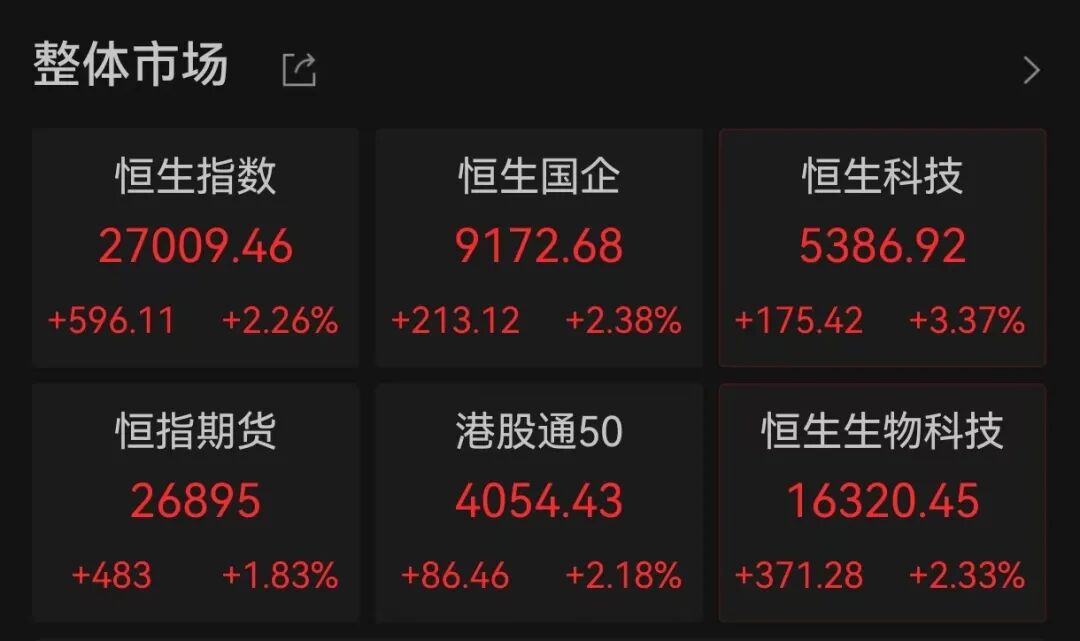
恒生科技指数涨超4%、恒指现涨2.8%
Mei Ri Jing Ji Xin Wen· 2026-02-23 02:55
Group 1 - The Hang Seng Technology Index increased by over 4%, while the Hang Seng Index rose by 2.8% [1] - Meituan (03690.HK) saw its share price rise by 8.1% [1] - Sunny Optical Technology (02382.HK) experienced a 4.5% increase in its stock price [1] - JD.com (09618.HK) shares rose by 5.2% [1] - BYD Company (01211.HK) saw a 4.9% increase in its stock price [1]



汽车股早盘普遍上涨 赛力斯及比亚迪股份均涨近5%
Xin Lang Cai Jing· 2026-02-23 02:29
Group 1 - The automotive stocks experienced a general increase in early trading, with notable gains among several companies [1] - Seres (09927) rose by 4.87%, reaching HKD 96.85 [1] - BYD Company (01211) increased by 4.77%, trading at HKD 100 [1] - Xpeng Motors-W (09868) saw a rise of 3.83%, priced at HKD 70.45 [1] - Li Auto-W (02015) gained 4.07%, with a share price of HKD 72.95 [1]


港股汽车股今日普涨 赛力斯涨近5%
Mei Ri Jing Ji Xin Wen· 2026-02-23 02:18
Core Viewpoint - The Hong Kong automotive stocks experienced a broad increase today, indicating positive market sentiment in the sector [1] Group 1: Stock Performance - Seres (09927.HK) rose by 4.87%, trading at HKD 96.85 [1] - BYD Company (01211.HK) increased by 4.56%, with shares priced at HKD 99.8 [1] - Xpeng Motors-W (09868.HK) saw a rise of 3.83%, reaching HKD 70.45 [1] - Li Auto-W (02015.HK) gained 3.57%, trading at HKD 72.6 [1]
港股异动 | 汽车股今日普涨 赛力斯(09927)涨近5% 机构看好后续政策落地与出口韧性双重催化
智通财经网· 2026-02-23 02:11
Core Viewpoint - The automotive sector experienced a broad increase in stock prices, driven by recent legal and market developments [1] Group 1: Stock Performance - Seres (09927) rose by 4.87%, reaching HKD 96.85 - BYD Company (01211) increased by 4.56%, reaching HKD 99.8 - Xpeng Motors-W (09868) saw a rise of 3.83%, reaching HKD 70.45 - Li Auto-W (02015) grew by 3.57%, reaching HKD 72.6 [1] Group 2: Legal and Market Developments - On February 20, the U.S. Supreme Court ruled that the Trump administration's large-scale tariff policy was illegal, which included a proposed increase of global import tariffs from 10% to 15% [1] - Cui Dongshu, Secretary-General of the China Passenger Car Association, indicated that China's automotive overseas production and sales system has completed a critical transformation towards "industrial going out" [1] Group 3: Industry Outlook - According to a report from Founder Securities, the automotive market faced short-term pressure in January due to seasonal factors and previous policy impacts, but demand is expected to recover as local replacement subsidy policies are implemented [1] - Exports are expected to continue strong performance, helping to smooth industry fluctuations, with projections indicating that by 2026, China's automotive exports will reach 6.34 million units, a year-on-year increase of approximately 13%, potentially exceeding 20% of total production [1]
春节后第二个交易日 港股高开高走 科网股集体上涨 智谱盘中跌超20%、MINIMAX跌超10%|开盘播报
Mei Ri Jing Ji Xin Wen· 2026-02-23 02:07
Market Performance - The Hang Seng Index and Hang Seng Tech Index opened high, with the Hang Seng Index rising by 1.46% and the Hang Seng Tech Index increasing by 1.77% [1] - As of the report, the Hang Seng Tech Index had risen over 3%, currently at 5368.750 points, while the Hang Seng Index was up by 2% [1] Stock Movements - Technology stocks collectively opened higher, with notable increases: NetEase up 3%, Meituan up 2%, Alibaba nearly 2%, Tencent up 1%, and Kuaishou over 3% [3] - Semiconductor stocks also showed strength, with Hua Hong Semiconductor rising by 4% and SMIC increasing by over 3% [3] - Gold stocks performed well, with China Gold International up nearly 7% and Shandong Gold up over 5% [3] Individual Stock Performance - Specific stock performances included: - NetEase-S at 186.000, up 3.74% - JD Health at 58.750, up 3.34% - Kuaishou-W at 68.500, up 3.01% - JD Group-SW at 106.500, up 2.60% - Meituan-W at 82.750, up 2.48% - Ctrip Group-S at 424.400, up 2.07% - Tencent Music-SW at 59.650, up 2.05% - Alibaba-W at 149.900, up 1.90% [4] Declines in Specific Stocks - Zhipu experienced a significant decline, dropping over 20% at one point, and MINIMAX also fell over 10%, with Zhipu's decline narrowing to nearly 13% by the time of reporting [4][5] - Zhipu issued an apology letter addressing issues related to the GLM-5 release, including transparency concerns and slow upgrade mechanisms for existing users, and proposed compensation measures [5]





春节后第二个交易日,港股高开高走,科网股集体上涨,智谱盘中跌超20%、MINIMAX跌超10%|开盘播报
Mei Ri Jing Ji Xin Wen· 2026-02-23 01:58
Market Performance - The Hang Seng Index and the Hang Seng Tech Index opened high, with the Hang Seng Index rising by 1.46% and the Hang Seng Tech Index increasing by 1.77% [1] - As of the report, the Hang Seng Tech Index had risen over 3%, currently at 5368.750 points, while the Hang Seng Index was up by 2% [1] Stock Movements - Tech stocks collectively opened higher, with notable increases: NetEase up 3%, Meituan up 2%, Alibaba nearly 2%, Tencent up 1%, and Kuaishou over 3% [3] - Semiconductor stocks also showed strength, with Hua Hong Semiconductor rising by 4% and SMIC increasing by over 3% [3] - Gold stocks performed well, with China Gold International up nearly 7% and Shandong Gold up over 5% [3] Individual Stock Performance - Notable stock performances included: - NetEase-S at 186.000, up 3.74% [4] - JD Health at 58.750, up 3.34% [4] - Kuaishou-W at 68.500, up 3.01% [4] - Meituan-W at 87.750, up 7.180% [4] - Other stocks like Tencent Music-SW and Alibaba-W also saw increases of 2.05% and 1.90%, respectively [5] Declines in Specific Stocks - Zhipu experienced significant declines, with a drop of over 20% at one point, and MINIMAX also fell by over 10%, although the declines narrowed by the time of reporting [6] - Zhipu's apology letter addressed issues related to the GLM-5 release, citing problems with transparency and upgrade mechanisms, which contributed to the stock's volatility [6]

韩媒称韩国“唯一领先战略技术”二次电池,被中国反超
Guan Cha Zhe Wang· 2026-02-22 10:27
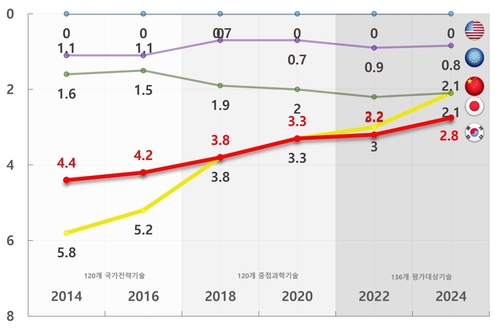
Core Insights - The technology gap between South Korea and China in key strategic sectors is widening, particularly in the secondary battery field, where China has overtaken South Korea as of 2024 [1][3] - South Korea's overall technology level is assessed at 82.8% compared to the United States, with a significant gap of 2.8 years, while the gap with China has increased to 0.7 years [3] Group 1: Technology Assessment - In the secondary battery sector, South Korea was leading by 0.9 years in 2022 but has fallen behind China by 0.2 years in 2024 [1] - The evaluation covered 136 core technologies across 11 sectors, analyzing papers and patents from South Korea, China, Japan, Europe, and the United States [1] - South Korea's semiconductor and display sectors have also seen a decline, with a lag of 0.7 years behind the U.S. and 0.8 years behind China as of 2024 [3] Group 2: Market Dynamics - The global market share of South Korean electric vehicle battery manufacturers has decreased from 35% in 2020 to 23% in 2023, with projections of further decline to 16% by October 2025 [5] - Despite the growth in global electric vehicle sales, the growth rate is expected to drop significantly from 25%-28% to around 15% by 2025 [4] - South Korean battery companies are facing intense competition from Chinese firms like CATL and BYD, which have a substantial market presence [5] Group 3: Domestic Market Disparities - The domestic market for South Korean secondary batteries is only about 2% of China's, with the energy storage market at approximately 1% [6] - South Korean companies have over 90% of their production facilities located overseas, while Chinese firms like CATL and BYD have about 97% of their capacity concentrated domestically [6] - The market share of South Korean companies in Europe has dropped from over 60% in 2022 to below 40% recently due to strong competition from Chinese firms [6] Group 4: Material Dependency - South Korean battery manufacturers are heavily reliant on China for core materials that constitute 60% of secondary battery costs, with Chinese companies controlling around 80% of the global market for these materials [7]


崔东树:1月我国电池供需逐步改善 重卡电池暴增
智通财经网· 2026-02-22 06:12
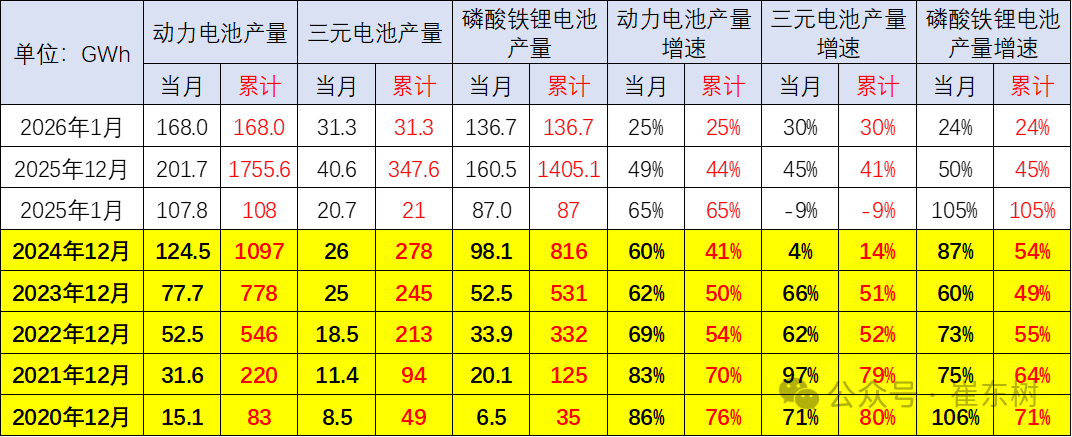
Core Insights - The overall performance of the power battery market in January 2026 is weak, with both exports and domestic sales showing mediocre results, leading to a decline in the growth rate of battery production from over 40% to 25% year-on-year [1][3][9] Group 1: Battery Production and Demand - In January 2026, the total production of power and other batteries reached 168 GWh, marking a 25% increase year-on-year [1] - The demand for installed batteries is heavily reliant on the surge in heavy-duty vehicle batteries due to high subsidies [1][3] - The installation rate of power batteries has decreased significantly, dropping to 25% in January 2026, with ternary batteries at 30% and lithium iron phosphate batteries at 24% [2][4] Group 2: Market Trends and Changes - The demand for batteries in the energy storage sector has increased rapidly, influenced by the global energy crisis stemming from the Russia-Ukraine conflict, leading to a notable decline in the proportion of installed batteries [3][8] - The growth rate of power batteries has lagged behind the growth of complete vehicles in 2021 and 2022, with a low installation rate expected for 2023 and 2024 [3][4] - The market for pure electric passenger vehicles continues to dominate, while plug-in hybrid passenger vehicles have risen to second place in terms of battery demand [7][8] Group 3: Competitive Landscape - The competitive landscape of battery manufacturers remains relatively stable, with the number of supporting battery companies at a low of 33 in January 2026 [10][11] - CATL's market share increased to 50.1% in the first quarter of 2026, while BYD's share decreased to 17.5%, indicating a significant concentration of market power among leading manufacturers [15] - The trend of vehicle manufacturers increasingly collaborating with battery producers is becoming more pronounced, suggesting a shift towards integrated supply chains in the industry [12][15]
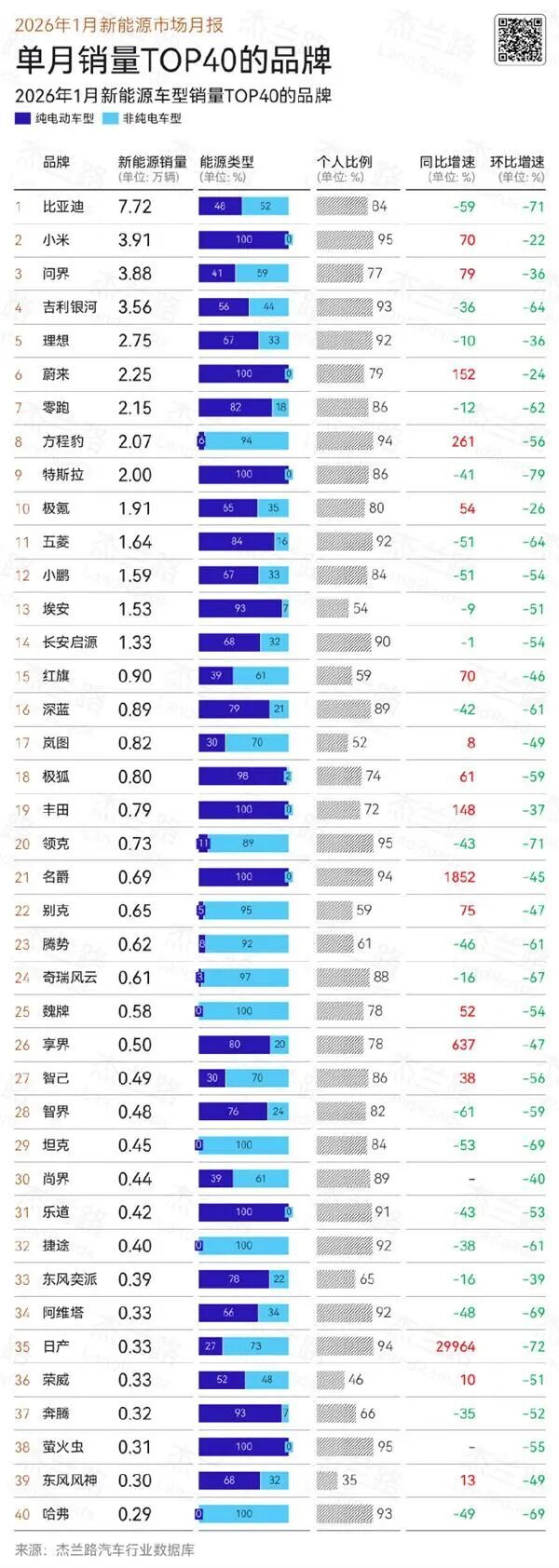
2026年1月新能源车销量:比亚迪第一,小米力压问界跃升至第二
Hang Zhou Ri Bao· 2026-02-21 10:20
Core Insights - The report from LandRoads indicates that Xiaomi has risen to the second position in the domestic new energy passenger vehicle market as of January 2026 [1]. Market Overview - Total sales of new energy passenger vehicles in January 2026 reached 563,000 units, representing a year-on-year decline of 20% and a month-on-month decline of 58% [2]. - The penetration rate of new energy vehicles in the passenger car market was 36.3%, down from 57.4% the previous month and slightly lower than 38.5% in January 2025 [2]. Sales Breakdown by Vehicle Type - Pure electric vehicle sales totaled 344,000 units, down 11% year-on-year and 56% month-on-month [2]. - Plug-in hybrid vehicle sales were 152,000 units, down 35% year-on-year and 63% month-on-month [2]. - Range-extended vehicle sales reached 67,000 units, down 15% year-on-year and 52% month-on-month [2]. Top Selling Models - The top-selling new energy sedan in January was the Geely Galaxy Star Wish, with sales of 14,900 units [2]. - The best-selling new energy SUV was Xiaomi YU7, with sales of 37,900 units, making it the overall sales champion for the month [2][3]. Company Rankings - BYD maintained its leading position with sales of 77,200 units, while Xiaomi sold 39,100 units, surpassing Aion's 38,800 units [3]. - The sales rankings for new energy vehicle manufacturers in January were as follows: 1. BYD: 77,200 units 2. Xiaomi: 39,100 units 3. Aion: 38,800 units [4][3]. Detailed Sales Data - The detailed sales data for January 2026 shows that BYD's sales decreased by 59% year-on-year and 71% month-on-month [4]. - Xiaomi's sales increased by 70% year-on-year but decreased by 22% month-on-month [4]. - Other notable manufacturers included Geely with 35,600 units and Ideal with 27,500 units [4].

比亚迪股份股价下跌,受市场环境与业绩压力影响
Jing Ji Guan Cha Wang· 2026-02-21 09:48
Core Viewpoint - BYD's stock price decline on February 20, 2026, is attributed to a combination of overall market conditions, industry performance, and recent fundamental factors affecting the company [1]. Market Environment - The Hong Kong stock market weakened on that day, with the Hang Seng Index dropping by 1.10% and the Hang Seng Tech Index falling by 2.91%. The automotive sector showed overall weakness, declining by 2.24%, which negatively impacted BYD as a key component stock in the sector [2]. Performance and Operating Conditions - According to a report from Guolian Minsheng Securities published on February 3, 2026, BYD's wholesale sales of new energy passenger vehicles in January 2026 were 205,000 units, representing a year-on-year decline of 30.7% and a month-on-month decrease of 50.5%, indicating significant short-term sales pressure. Additionally, the Q3 2025 financial report showed a revenue decrease of 3.05% year-on-year and a net profit decline of 32.6%, raising ongoing concerns about the company's profitability [3]. Financial and Technical Aspects - In terms of capital flow, despite a net inflow of HKD 56.736 million from major funds on that day, the stock price remained under selling pressure. Technically, the stock price was below key moving averages such as the 5-day and 30-day averages, with the Bollinger Band middle line (HKD 96.51) acting as resistance. Although the MACD histogram was positive, the momentum was limited, reflecting short-term adjustment pressure [4]. Company Status - The decline in BYD's stock price is a result of market sentiment, weak industry performance, and short-term pressures on sales and earnings [5].