PICC(01339)

Search documents
A股保险板块短线拉升,*ST天茂涨停,新华保险、中国人保、中国人寿、中国太保跟涨。
news flash· 2025-07-22 01:45
Group 1 - The A-share insurance sector experienced a short-term surge, with *ST Tianmao hitting the daily limit up [1] - Other major insurance companies such as Xinhua Insurance, China Pacific Insurance, China Life Insurance, and China Reinsurance also saw increases in their stock prices [1]




中证港股通非银行金融主题指数上涨1.19%,前十大权重包含中国平安等
Jin Rong Jie· 2025-07-21 12:02
Group 1 - The core index, the CSI Hong Kong Stock Connect Non-Bank Financial Theme Index, rose by 1.19% to 3984.14 points, with a trading volume of 22.457 billion yuan [1] - Over the past month, the index has increased by 11.28%, by 36.78% over the last three months, and by 35.47% year-to-date [1] - The index consists of up to 50 listed companies that meet the non-bank financial theme criteria from the Hong Kong Stock Connect securities, reflecting the overall performance of these companies [1] Group 2 - The top ten weighted companies in the index include China Ping An (15.24%), Hong Kong Exchanges (13.97%), AIA Group (13.55%), China Life (8.76%), China Pacific Insurance (6.94%), China Property & Casualty Insurance (6.21%), New China Life (3.96%), People's Insurance Group of China (3.73%), CITIC Securities (2.9%), and Shandong Hi-Speed (2.46%) [1] - The index is composed entirely of financial sector companies, with a 100% allocation to this industry [1]



从“一年一考”到“五年一盘”,A股市场的慢变量来了
和讯· 2025-07-21 09:40
Core Viewpoint - The recent policy shift by the Ministry of Finance aims to guide insurance funds towards long-term and stable investments, moving from an annual assessment to a five-year evaluation cycle, which is expected to enhance the stability and structure of the A-share market [1][2][5] Group 1: Policy Changes and Implications - The new assessment mechanism for state-owned commercial insurance companies will focus on a combination of annual, three-year, and five-year performance indicators, with weights adjusted to 30%, 50%, and 20% respectively [2] - This adjustment is intended to align financial performance assessments with the actual operational cycles of insurance products, reducing the pressure for short-term financial results [2][3] - The policy is seen as a dual approach to encourage long-term investment behavior while providing clear guidelines for fund allocation in the A-share market [2][5] Group 2: Market Impact and Predictions - It is anticipated that the allocation of insurance funds in the A-share market will increase from approximately 11% to 15% or higher over the next two to three years, with a potential net increase of 300 billion to 500 billion yuan annually [5] - The long-term investment focus is expected to optimize the investment structure of insurance funds, leading to a gradual shift from defensive to a balanced investment strategy [5] - The influx of long-term capital is likely to reduce market volatility and enhance the market's resilience to external shocks, contributing to overall market stability [5][6] Group 3: Investment Preferences and Concerns - There are concerns that insurance funds may concentrate their investments in high-dividend stocks, which could contradict the goal of enhancing market vitality and structure [7][8] - However, high-dividend companies are typically stable and well-governed, and their attractiveness to insurance funds could lead to improved valuations and governance practices [8] - The regulatory framework encourages diversified investments, suggesting that insurance funds will not be limited to specific sectors but will consider a balanced risk-return profile [8][9] Group 4: Risk Management and Regulatory Considerations - The dual nature of insurance funds as stabilizers in the market and potential sources of systemic risk has been highlighted, emphasizing the need for robust regulatory frameworks [9][10] - Recommendations include strict monitoring of investment ratios, dynamic risk management, and enhanced transparency in risk disclosures to mitigate potential financial instability [9][10] - Historical lessons from the UK and US suggest that developing insurance products where investment risks are borne by policyholders could be a viable strategy for promoting insurance fund participation in the market [10]


长线资金ESG投资经验启示:保险资管篇:委外投资、组合脱碳与绿金实践
ZHESHANG SECURITIES· 2025-07-21 08:55
Group 1: ESG Investment Characteristics - Insurance funds exhibit long-term and strategic advantages in ESG and green investments, influencing other market participants as large asset owners[2] - The total balance of insurance funds in China exceeded 33 trillion yuan by the end of 2024, with life insurance companies accounting for approximately 30 trillion yuan[15] - 95% of insurance companies in the Asia-Pacific region have incorporated ESG factors into their investment considerations, up from 56% in 2018[3] Group 2: Decarbonization Goals - Large asset owners can consider two types of decarbonization targets: carbon intensity targets that allow for emissions growth with business expansion, and absolute targets that require total emissions reduction regardless of business scale[3] - By 2024, the total green investment scale of China’s major insurance companies reached approximately 1.67 trillion yuan, a year-on-year increase of 36%[44] - Allianz aims to reduce carbon emissions by 50% by 2030, with a specific target of a 50.7% reduction in carbon emissions from listed company stocks by 2024[61] Group 3: Market Influence and Integration - Insurance funds play a crucial role in integrating ESG considerations into outsourced investments, enhancing the green impact of capital allocation[28] - The global insurance fund management scale reached approximately 16.65 trillion USD by the end of 2024, accounting for 29% of total asset management[29] - Major insurance companies are increasingly diversifying their green investment types beyond traditional fixed income to include equity and alternative assets[46]
非银金融行业周报:建议重视香港RWA业务发展对估值的正向催化作用-20250720
Shenwan Hongyuan Securities· 2025-07-20 06:45
Investment Rating - The report maintains a "Positive" outlook on the non-bank financial industry, indicating an expectation for the sector to outperform the overall market [1]. Core Insights - The report emphasizes the positive catalytic effect of the development of RWA (Real World Assets) business in Hong Kong on valuations, highlighting strategic collaborations and the potential for significant market expansion [4][7]. - It notes that the insurance sector is experiencing a favorable environment with a focus on undervalued companies and mid-year performance opportunities, recommending several key players [4][11]. - The brokerage sector is also highlighted, with a recommendation for firms benefiting from improved competitive dynamics and those with strong earnings elasticity [4][11]. Summary by Sections Market Review - The Shanghai Composite Index closed at 4,058.55 with a weekly change of +1.1%, while the non-bank index closed at 1,921.37 with a change of -1.2% [7]. - The brokerage, insurance, and diversified financial sectors reported respective changes of -1.1%, -1.4%, and -2.4% [7]. Non-Bank Industry Insights - The report discusses the strategic partnership between GCL-Poly and Taiping Asset Management in Hong Kong, focusing on RWA infrastructure development and digital asset investment [4]. - It highlights the significant growth potential in the tokenization of non-liquid assets, estimating a market size of $16 trillion by 2030 [4]. - The report also notes the performance of various insurance companies, with significant year-on-year growth in premium income for several key players [35][32]. Brokerage Sector Analysis - The report indicates that 30 out of 51 listed brokerages have reported positive earnings forecasts, with net profit growth exceeding 40% for those that disclosed results [4]. - The average daily trading volume in the Shanghai and Shenzhen markets reached 1.26 trillion yuan, reflecting a 52% year-on-year increase [22]. - The report recommends several brokerage firms based on their competitive positioning and earnings potential, including Guotai Junan and CITIC Securities [4][11].






金融创新方案“精准滴灌”强链稳链
Xin Hua Cai Jing· 2025-07-19 08:46
Core Viewpoint - The financial sector is increasingly focusing on providing tailored products and services to enhance the stability and upgrade of industrial and supply chains, as demonstrated at the third China International Supply Chain Promotion Expo [1][2][3]. Group 1: Insurance Innovations - China Insurance launched exclusive insurance products targeting nine major industrial chains, including low-altitude economy, computing power, integrated circuits, energy storage, digital technology, green agriculture, and smart vehicles [1]. - These products aim to address core needs of the industrial chain such as "supplementing, stabilizing, strengthening, and expanding" the chain, shifting from a "one enterprise, one policy" model to a "one chain, one policy" approach [1]. - The combination products integrate risk protection across the entire industrial chain process, covering research, production, logistics, and sales, creating a comprehensive risk management network [1]. Group 2: Banking Innovations - Bank of China showcased its latest financial solutions and upgraded five major products to support high-level opening-up [2]. - The "Zhongyin Smart Chain" includes six sub-chains: advanced manufacturing, digital technology, smart vehicles, clean energy, healthy living, and green agriculture, aimed at promoting the circular development of industrial chains [2]. - The focus is on using intelligent products to address bottlenecks and enhance the resilience and innovation of the industrial chain ecosystem [2]. Group 3: Digital Financial Services - The "Yuntong Easy Chain" from Bank of Communications aims to alleviate financing difficulties for enterprises through a diversified product system [3]. - The "Yuntong Financial Management" showcases digital financial products for enterprise financial management and payment settlement, featuring the "Cloud Cross-Bank" platform with ten integrated functions [3]. - The innovations presented at the expo indicate a shift in financial support for industrial and supply chain modernization from traditional credit support to more in-depth risk management and efficient digital platforms [3].


年内超50家险企高管变更,人事更迭折射战略转向
Bei Jing Shang Bao· 2025-07-17 13:01
Core Insights - The insurance industry is experiencing a significant wave of personnel changes, with over 50 companies adjusting their top leadership positions in 2023, including major players like China Life and China Pacific Insurance [1][3] - A notable trend in these changes is the increasing youthfulness of management, with many "post-80s" and "pre-80s" executives taking on key roles [1][5] Group 1: Personnel Changes - More than 50 insurance companies have seen adjustments in core positions such as chairman and general manager this year, reflecting a high frequency of personnel changes in the industry [3] - Key personnel shifts include the appointment of Li Zhuyong as deputy secretary of the China Life Group and the promotion of Tian Geng to vice president of China Re [3] - The reasons for these changes vary, with larger firms often seeing changes due to retirement or internal rotations, while smaller firms are more frequently adjusting to address performance anxieties amid market uncertainties [3][4] Group 2: Management Trends - The current trend in the insurance industry is towards younger and more specialized management teams, with a growing number of executives from actuarial, financial, and fintech backgrounds [5][6] - Young executives are believed to enhance innovation and adaptability within companies, making them more appealing to younger customers and improving market competitiveness [6][7] - The industry is expected to see continued high personnel turnover as competition intensifies and companies strive to adapt to changing market demands and technological advancements [7]


上半年险企高管大洗牌
Huan Qiu Wang· 2025-07-17 03:11
Group 1 - The insurance industry is experiencing a wave of executive changes, with over 50 companies undergoing personnel adjustments in key positions such as chairman and general manager, affecting both major groups like China Taiping and China Life, as well as numerous small and medium-sized insurers [1][3] - The executive changes are seen as a proactive strategy for industry transformation, reflecting both strategic upgrades and deeper governance challenges within some institutions [1][3] - Notably, some executives have backgrounds in technology, which is viewed as a critical factor for enhancing operational efficiency and quality in insurance companies, indicating that tech-enabled leadership may hold strategic value in future industry competition [1] Group 2 - Frequent executive turnover highlights governance issues within companies, as seen with Qianhai Insurance, which has experienced three changes in the general manager position over four years, alongside declining business performance and continuous net losses [3] - The governance and talent mechanisms of companies like Qianhai Insurance require urgent improvement, especially as over half of its shares are frozen, indicating significant shareholder challenges [3] - In the context of industry transformation, executive adjustments are intended to inject new momentum for strategic upgrades, but companies must also be cautious of governance-related risks to maintain stability in a competitive market [3]
最新规模逼近75亿元!全市场孤品港股通非银ETF(513750)连续11天净流入,年内获资金净流入超60亿元!
Xin Lang Cai Jing· 2025-07-17 01:40
Group 1 - As of July 16, 2025, the Hong Kong Stock Connect Non-Bank ETF (513750) reached a record size of 7.451 billion, with a year-to-date growth of 844.35% [1] - The ETF's latest share count is 4.840 billion, also a record high since its inception [1] - The index tracking the non-bank financial theme (931024) experienced a decline of 0.82% on the same date, with mixed performance among constituent stocks [1] Group 2 - The Hong Kong Stock Connect Non-Bank ETF has seen a net asset value increase of 74.06% over the past year, ranking 57 out of 2915 index stock funds, placing it in the top 1.96% [2] - The ETF's highest monthly return since inception was 31.47%, with the longest consecutive monthly gain being 4 months and a total increase of 38.25% [2] - The top ten weighted stocks in the index account for 77.92%, with major holdings including China Ping An, AIA, and Hong Kong Exchanges and Clearing [2] Group 3 - Recent policies aimed at enhancing financial market construction and expanding high-level financial openness are expected to create significant business opportunities for non-bank financial institutions [3] - The insurance sector is anticipated to benefit from new regulations promoting long-term investments, while brokerage firms are expected to maintain high trading activity levels [3] - The Hong Kong Stock Connect Non-Bank ETF is the first and only ETF tracking the non-bank index, with over 60% of its composition in insurance stocks [3]

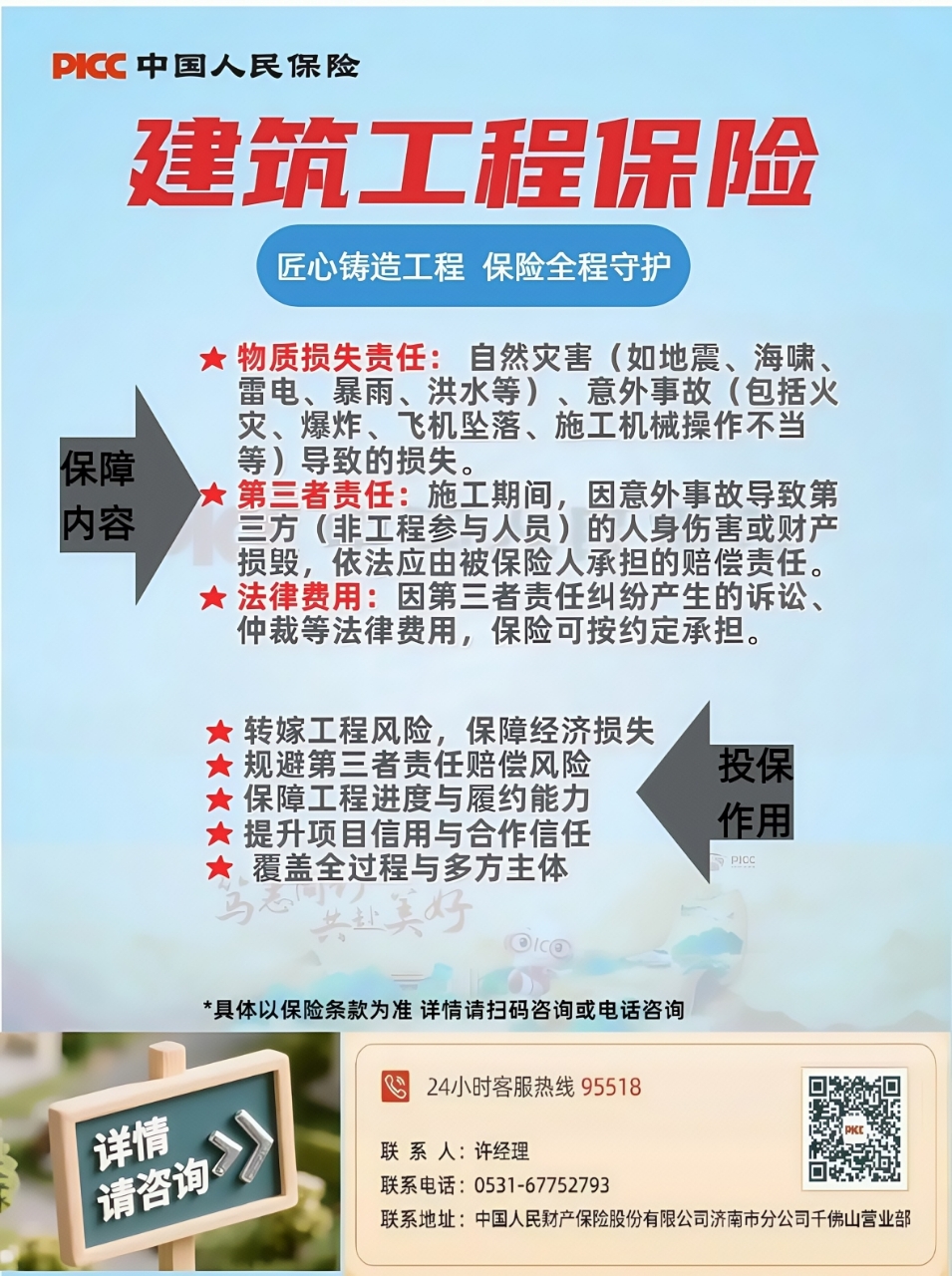
全面保障 专业护航|济南人保财险建筑工程保险,铸就工程安全基石
Qi Lu Wan Bao· 2025-07-16 08:13
建筑工程往往具有工期长、投资大、参与方多、施工环境复杂等特点,从地基开挖到主体封顶,从设备安装到竣工验收,每一个环节都潜藏着诸多风险。比 如突如其来的自然灾害,像暴雨、台风、地震等,可能会对在建工程造成严重损毁;施工过程中可能出现的意外事故,如脚手架坍塌、设备故障引发的人员 伤亡或工程损坏;还有原材料价格大幅波动、设计变更等导致的工程延误或费用增加等情况。这些风险一旦发生,不仅会给建设单位带来巨大的经济损失, 还可能影响工程进度,甚至引发一系列社会问题。为了有效化解这些风险,济南人保财险推出建筑工程保险,为建筑工程的顺利推进保驾护航。 一旦发生保险事故,济南人保财险的理赔团队会迅速响应,第一时间赶赴事故现场进行查勘定损。利用先进的查勘设备和专业的定损技术,快速确定损失范 围和程度,并简化理赔流程,加快赔付速度,让建设单位能够及时获得赔偿资金,用于工程修复和人员救治,最大限度减少事故对工程进度的影响。 选择信赖,共筑工程安全未来 全面保障,覆盖工程全周期 济南人保财险的建筑工程保险,以其全面的保障范围,为建筑工程提供全周期的风险防护。 工程物质损失保障:对于建筑工程本身,包括主体结构、墙体、屋顶以及工程所需的原 ...