
PICC(01339)

Search documents
中证香港200指数报2278.39点,前十大权重包含中国人民保险集团等
Jin Rong Jie· 2025-05-27 15:11
数据统计显示,中证香港200指数近一个月上涨6.86%,近三个月上涨3.31%,年至今上涨12.53%。 据了解,中证香港200指数从中证香港300指数样本中选取除中证香港100指数样本以外的证券作为指数 样本,以反映在香港交易所上市的中小盘证券的整体表现。该指数以2004年12月31日为基日,以1000.0 点为基点。 从指数持仓来看,中证香港200指数十大权重分别为:泡泡玛特(6.0%)、康方生物(1.92%)、中国 铁塔(1.74%)、金蝶国际(1.4%)、中远海控(1.38%)、中国人民保险集团(1.3%)、中信证券 (1.3%)、零跑汽车(1.22%)、三生制药(1.18%)、中煤能源(1.16%)。 从中证香港200指数持仓的市场板块来看,香港证券交易所占比100.00%。 从中证香港200指数持仓样本的行业来看,可选消费占比18.18%、工业占比14.62%、医药卫生占比 13.11%、金融占比11.66%、信息技术占比9.08%、原材料占比8.20%、通信服务占比6.65%、房地产占比 5.23%、公用事业占比5.21%、主要消费占比4.73%、能源占比3.33%。 资料显示,指数样本每半年调 ...
“倾听您的心声 服务您的需求”
Bei Jing Shang Bao· 2025-05-27 13:39
2025年5月18日,中国人民人寿保险股份有限公司(以下简称"人保寿险")"倾听您的心声服务您的需 求"第十七届客户节正式启动。本届人保寿险客户节紧扣国家乡村振兴战略、健康中国行动及金融消费 者权益保护政策导向,通过四大系列八项活动,生动诠释了国有企业服务国家发展大局、服务人民、服 务客户的责任担当。 作为践行"人民保险服务人民"使命的重要载体,人保寿险精心策划了"我和人保寿险的二十周年"客户大 拜访活动,通过线下拜访赠送盲盒好礼,以及"二十年相守,感恩相伴"故事征集活动,展示了国有保险 企业与客户共同成长的美好图景。此外,人保寿险积极响应健康中国战略,助力全民健康意识提升,推 出"燃情一夏,活力全开"运动季活动,线上平台设置多样化运动挑战,线下由各分支机构组织健步走等 全民健身活动,通过"保险+健康"服务模式,助力客户养成科学运动习惯,展现国企服务大健康战略的 主动作为。 本届客户节期间,"乡约2025,幸福双向奔赴"主题活动深度对接乡村振兴国家战略,其中"乡村振兴, 美美与共"项目组织客户参与产业帮扶实践,引导客户共同参与美丽乡村建设;"守护家的∞种可能"家 庭成长计划聚焦"一老一小"民生工程,开展养老规 ...


黄河奔涌见证激情 人保守护兰马征程
Cai Jing Wang· 2025-05-26 02:48
Core Points - The "2025 Lanzhou Marathon" took place on May 25, with China Pacific Insurance (CPIC) Gansu Branch providing comprehensive insurance coverage for the fourth consecutive year, totaling over 60 billion yuan in risk protection for the event [1][3][10] - The marathon serves as a significant cultural and tourism event for the city, showcasing Lanzhou's charm and confidence [3][10] - CPIC established a special working group with eight functional teams to ensure event safety, including a thorough risk assessment of the marathon route and the setup of 16 medical aid stations [3][6] - The event featured a "CPIC Red" team promoting insurance services and local tourism projects, highlighting the integration of sports, insurance, and cultural tourism [6][10] - CPIC aims to continue supporting Gansu's high-quality development and contribute to the construction of a prosperous new Gansu [12]


中泰证券:权益市场信心迎来修复窗口 紧握非银板块的β机会
智通财经网· 2025-05-22 23:29
Core Insights - The overall profit growth of listed insurance companies in Q1 2025 shows significant divergence, primarily influenced by base effect differences, while the liability side remains stable. The equity market is identified as a critical factor for performance, with regulatory policies fostering a recovery in market confidence, presenting opportunities in the non-bank sector [1] Group 1: Financial Performance - Q1 2025 net profit on a comparable basis increased by 1.4% year-on-year, with non-annualized ROE slightly declining from 4.2% in Q1 2024 to 4.0% in Q1 2025, which is better than previously pessimistic expectations [1] - The average net assets attributable to shareholders of A-share listed insurance companies remained flat compared to the beginning of the year, with life insurance showing the highest growth at 4.5%, while Xinhua reported a decline of 17.0% [1] - The ratio of other comprehensive income to net profit was -98.0%, with life insurance having the smallest difference at -20.9% [1] - Underwriting profit in Q1 2025 grew by 27.3% year-on-year, mainly due to a low base in the same period last year, with life insurance performing well and property insurance seeing a significant increase in underwriting profit [1] - The average annualized net investment return rate for listed insurance companies in Q1 2025 was 3.08%, slightly down from 3.19% in Q1 2024, while the average annualized total investment return rate was 4.06%, down from 4.08% [1] Group 2: Life Insurance Business - The average NBV growth rate for listed insurance companies in Q1 2025 was approximately 20%, with value rate improvement being the core reason [2] - NBV year-on-year growth rates from high to low were: Xinhua (67.9%), Ping An (34.9%), PICC (31.5%), Taikang (11.3%), and China Life (4.8%) [2] - New single premium growth showed significant divergence, with individual insurance affected by the "opening red" period, while the structure of bank insurance new single premiums improved [2] - The improvement in value rates is attributed to: 1) a reduction in scheduled interest rates leading to a stable decline in overall liability costs; 2) optimization of product and term structures; 3) active cost reduction and efficiency enhancement [2] Group 3: Property Insurance Business - In Q1 2025, listed insurance companies achieved property insurance service revenue of 249.635 billion yuan, a year-on-year increase of 4.0%, with a significant decrease in the combined underwriting cost ratio to 95.7%, down 2.8 percentage points [3] - Underwriting profit under the new standards reached 10.653 billion yuan, nearly doubling year-on-year, primarily due to a low base in the previous year and challenges from adverse weather conditions [3] - The total premium income from auto insurance grew by 3.2% year-on-year, with effective cost control contributing to improved underwriting profits [3] - Data from the Ministry of Emergency Management indicated that natural disasters in Q1 2025 primarily involved geological disasters, with direct economic losses of approximately 10.16 billion yuan, significantly lower than 23.76 billion yuan in Q1 2024, leading to improved claims ratios, especially in February [3]



金融地产25Q1业绩如何?板块后续怎么看?
2025-05-21 15:14
Summary of Conference Call Records Industry Overview - **Insurance Sector**: In Q1 2025, net profits for major insurers like China Ping An and China Taiping fell by 26% and 18% respectively, primarily due to declines in the bond market and equity market volatility. Conversely, PICC and China Life saw net profit growth of approximately 40%, with Xinhua also reporting positive growth, benefiting from favorable bond market and Hong Kong stock allocations [1][2]. - **Brokerage Sector**: The overall performance of 39 brokerages in Q1 2025 met expectations, with a 53% year-on-year increase in net profit, driven by a low base from the previous year and significant improvements in trading volume, which rose nearly 80% year-on-year. The number of new accounts opened increased by 32%, contributing significantly to retail business [1][3]. - **Public Fund Regulations**: New regulations for public funds shift the focus from short-term returns to long-term investor performance, potentially restoring trust and benefiting the industry's long-term development. This may exacerbate the "Matthew Effect," favoring leading fund companies [4]. - **Non-Banking Financial Sector**: The non-banking financial sector is significantly under-allocated, with only 1% of active equity funds invested compared to a standard of 6.5%. This indicates a potential recovery volume of approximately 150 billion, suggesting a sustained reallocation towards benchmark stocks, especially large-cap stocks [5][6]. Key Insights - **Brokerage Performance**: The brokerage sector is expected to see a 50% year-on-year growth in Q1 2025, with a forecasted 40% growth for the mid-year report and an overall annual growth expectation of around 25%. Current valuations remain low, with a focus on brokerages with strong retail advantages such as Guosen Securities, Huatai Securities, and GF Securities [7]. - **Insurance Recommendations**: Due to weak marginal improvements in the insurance sector, it is recommended to focus on undervalued stocks like China Taiping and China Ping An, as well as high dividend yield stocks like Jiangsu Jinzu [8]. - **Banking Sector Performance**: In Q1 2025, 42 listed banks reported a revenue decline of 1.7% and a net profit decline of 1.2%. The overall loan volume is expected to remain stable compared to 2024, with a slight narrowing of interest margins anticipated [9][14]. - **Real Estate Sector**: The real estate industry experienced a 7.5% revenue decline in Q1 2025, with a net profit loss of 10 billion yuan. The top 100 real estate companies saw a 30% drop in sales, although the decline was less severe than in previous periods. Companies with strong fundamentals in first-tier and strong second-tier cities are viewed positively [15][18]. Additional Considerations - **Market Dynamics**: The new public fund regulations may lead to a decrease in fees for banks, brokerages, and third-party sales agencies, impacting their revenues negatively but within expected limits [4]. - **Investment Strategy**: The recommendation for banks includes focusing on stable dividend strategies, with a preference for banks like CITIC Bank and Agricultural Bank of China, as well as regional banks benefiting from recovering demand from small and micro enterprises [14]. - **Future Outlook for Real Estate**: The real estate sector is expected to see a recovery in demand, particularly in first-tier and strong second-tier cities, with a focus on companies like Binjiang Group and China Merchants Shekou [18].



中证港股通非银行金融主题指数上涨0.65%,前十大权重包含中信证券等
Jin Rong Jie· 2025-05-21 11:22
Core Viewpoint - The China Securities Index Non-Bank Financial Theme Index has shown significant growth, with a 13.63% increase over the past month and a 12.54% increase year-to-date, reflecting strong performance in the non-bank financial sector within the Hong Kong Stock Connect [1][2]. Group 1: Index Performance - The China Securities Index Non-Bank Financial Theme Index rose by 0.65% to 3292.09 points, with a trading volume of 13.164 billion yuan [1]. - Over the last three months, the index has increased by 9.80% [1]. - The index was established on November 14, 2014, with a base point of 3000.0 [1]. Group 2: Index Composition - The index includes up to 50 listed companies that meet the non-bank financial theme criteria from the Hong Kong Stock Connect [1]. - The top ten weighted companies in the index are: Hong Kong Exchanges (17.71%), AIA Group (15.97%), Ping An Insurance (13.53%), China Life Insurance (7.95%), China Pacific Insurance (7.13%), People's Insurance Group of China (6.03%), China Taiping Insurance (5.39%), New China Life Insurance (5.13%), CITIC Securities (2.41%), and China Taiping (2.6%) [1]. - The index's holdings are entirely focused on the financial sector, with a 100% allocation [2]. Group 3: Index Adjustment Mechanism - The index samples are adjusted biannually, with changes implemented on the next trading day following the second Friday of June and December [2]. - In special circumstances, the index may undergo temporary adjustments, such as when a sample company is delisted or when new companies meet the criteria for inclusion [2].


多家银行保险机构取消监事会 业内:由审计委员会行使职权将为公司治理提供更多灵活选择
Mei Ri Jing Ji Xin Wen· 2025-05-21 10:41
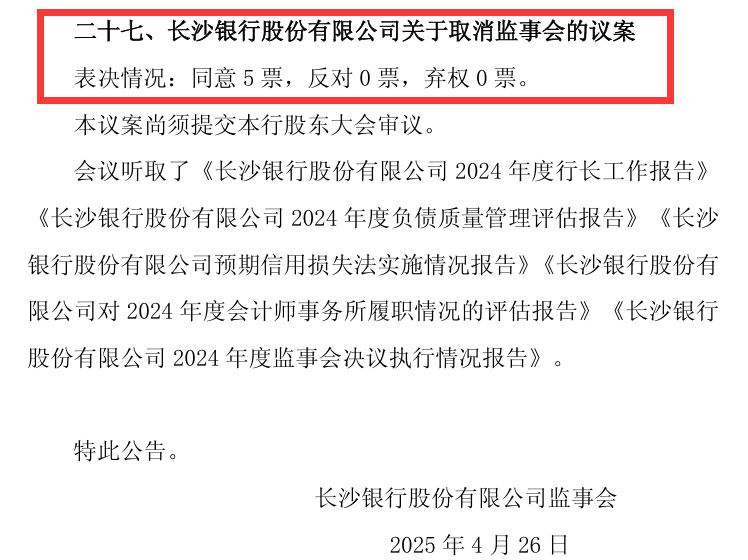
Core Viewpoint - The recent trend of financial institutions, including banks and insurance companies, to abolish supervisory boards reflects a significant reform in corporate governance, driven by changes in the Company Law of the People's Republic of China [1][6][12]. Group 1: Abolishment of Supervisory Boards - Changsha Bank has decided to abolish its supervisory board, transferring its functions to the audit committee of the board of directors [1]. - Many financial institutions, including major state-owned banks and insurance companies, are following suit, indicating a broader shift in governance practices [1][6]. - The new Company Law allows limited liability companies to establish an audit committee within the board of directors to perform the functions of a supervisory board, thus eliminating the need for a separate supervisory board [6][9]. Group 2: Regulatory Changes and Implications - The National Financial Regulatory Administration has issued new regulations that allow trust companies to set up audit committees within their boards, further promoting the idea of eliminating supervisory boards [2][6]. - The changes aim to enhance operational efficiency by reducing redundancy in oversight functions, as the roles of supervisory boards and audit committees often overlap [2][8]. - The flexibility provided by the new governance structure is expected to lead to more tailored governance models that suit the specific needs of different financial institutions [9][10]. Group 3: Impact on Corporate Governance - The shift to a single-tier governance model allows boards to exercise oversight more directly, potentially improving decision-making efficiency in a rapidly changing financial environment [9][10]. - Smaller financial institutions may benefit from reduced operational costs by not having a supervisory board, while larger institutions may require more complex oversight mechanisms [9][10]. - The transition to audit committees taking on supervisory roles is seen as a way to innovate governance structures and improve compliance management [10][12]. Group 4: Concerns and Future Considerations - There are concerns regarding the effectiveness of audit committees in fulfilling the oversight roles traditionally held by supervisory boards, particularly regarding potential conflicts of interest [11][12]. - Experts suggest that while the new structure may reduce costs, it is crucial to ensure that adequate checks and balances remain in place to maintain effective governance [11][12]. - Future modifications to the Company Law may be necessary to address the evolving needs of corporate governance in the financial sector [12].



中国人保健康保费20年年均复合增长率达43.1%
Jing Ji Guan Cha Wang· 2025-05-20 12:27
Core Insights - The report highlights the significant growth and achievements of China People's Health Insurance Co., Ltd. over the past 20 years, showcasing its commitment to social responsibility and innovation in health insurance services [1] Financial Performance - From 2005 to 2024, the risk coverage amount increased from less than 1 trillion to 170.9 trillion yuan, while the payout amount rose from less than 1 million to 22.91 billion yuan [1] - Premium income surged from 50 million to 48.7 billion yuan, with an average annual compound growth rate of 43.1% [1] - Total assets reached 141.26 billion yuan, and net assets grew to 14.64 billion yuan, with a cumulative increase of nearly 15 times [1] - The company achieved a profit of 1.93 billion yuan in 2024, maintaining a double-digit return on net assets for two consecutive years [1] Innovation in Services - The company has developed various innovative insurance service models, including the "Zhanjiang Model" for commercial insurance services, "Taicang Model" for critical illness insurance, and "Qingdao Model" for long-term care insurance, among others [1] - These models contribute to national system innovation and medical insurance governance [1] Strategic Vision - The chairman emphasized the company's mission to serve a multi-tiered medical security system and the health of the people, positioning it as an industry benchmark [1] - The company aims to focus on showcasing Chinese characteristics, enhancing functional roles, building health management advantages, and promoting high-quality development in its new journey [1]
中国人保健康20年社会责任报告发布
Zheng Quan Ri Bao Wang· 2025-05-20 10:54
Core Viewpoint - China People's Health Insurance Co., Ltd. has integrated its development into the national multi-level social security system over the past 20 years, showcasing significant growth in business scale and profitability while contributing to national system innovation and medical insurance governance [1][2]. Group 1: Company Development and Achievements - Since its establishment, the company has developed innovative insurance service models, including the "Zhanjiang Model" for commercial insurance services, the "Taicang Model" for critical illness insurance, and the "Qingdao Model" for long-term care insurance [2]. - The risk protection amount undertaken by the company increased from less than 1 trillion to 170.9 trillion yuan from 2005 to 2024, while the compensation amount rose from less than 1 million to 22.91 billion yuan [2]. - The company's premium income surged from 0.05 billion to 48.7 billion yuan during the same period, achieving an average annual compound growth rate of 43.1% [2]. - Total assets reached 141.26 billion yuan, and net assets grew to 14.64 billion yuan, with a cumulative increase of nearly 15 times from 2005 to 2024 [2]. Group 2: Future Strategy and Goals - The company aims to fully implement the financial "Five Major Articles" and the new "National Ten Articles" for the insurance industry, aligning with the strategic deployment of China People's Insurance Group to build a world-class insurance financial group [3]. - The strategic positioning focuses on becoming a first-class health insurance company with effective functionality and outstanding health management advantages, driven by deepening reform and innovation [3].
保险行业2025年一季报综述:业务策略和准则实施差异导致分化
CMS· 2025-05-20 07:43
Investment Rating - The report maintains a recommendation rating for the insurance industry [2][51][58] Core Insights - The insurance sector is expected to benefit significantly from the ongoing market risk appetite and the new public fund regulations, which will enhance performance benchmarks [1][6][51] - The first quarter of 2025 saw a comprehensive positive growth in new business value (NBV) for life insurance, with significant improvements in the liability structure [51][54] - The property and casualty (P&C) insurance sector experienced steady premium growth and a notable improvement in the combined operating ratio (COR) [51][54] - Investment performance varied among companies due to differing strategies, with a general increase in asset scale and a reduction in real estate exposure [51][54] Summary by Sections 1. Life Insurance Overview - The new business value (NBV) for listed insurance companies continued to grow, with notable increases: New China Life +67.9%, China Pacific Insurance +39.0%, China Ping An +34.9%, and China Life +4.8% [10][11] - The individual insurance channel transformation is deepening, with stable agent numbers and increasing productivity [13][16] - The efficiency of the bancassurance channel has significantly improved, supporting overall performance [16][17] 2. Property and Casualty Insurance Overview - The premium income growth for the "old three" P&C insurers was as follows: China Pacific Insurance +3.7%, Ping An Insurance +7.7%, and Taiping Insurance +1.0% [21][24] - The combined operating ratio (COR) for the "old three" insurers improved, with China Pacific at 94.5%, Ping An at 96.6%, and Taiping at 97.4% [27][30] 3. Investment Performance - The total investment assets of listed insurers showed steady growth, with China Life at 68,191.73 billion, Ping An at 59,200 billion, and China Pacific at 28,102.08 billion [31][36] - The annualized net investment yield for the first quarter was: Ping An 3.6%, China Pacific 3.2%, and China Life 2.6% [36][38] - The annualized total investment yield varied significantly, with New China Life at 5.7%, China Pacific at 4.0%, and China Life at 2.8% [38][42] 4. Profit and Net Asset Differentiation - The net profit growth rates for the first quarter were: China Re +43.4%, China Life +39.5%, New China Life +19.0%, China Pacific -18.1%, and Ping An -26.4% [45][50] - The net asset growth rates at the end of the first quarter were: China Life +4.5%, China Re +3.9%, Ping An +1.2%, China Pacific -9.5%, and New China Life -17.0% [50][53] 5. Investment Recommendations - The report suggests maintaining a positive outlook for the insurance sector, with life insurance product transformation expected to yield positive results and P&C insurance leaders likely to maintain their advantages [51][54][55] - The report highlights the potential for valuation recovery in the insurance sector due to supportive financial policies and improved market conditions [55][58]