HUA HONG SEMI(01347)

Search documents
港股机器人概念股集体下跌
Xin Lang Cai Jing· 2025-10-23 05:21
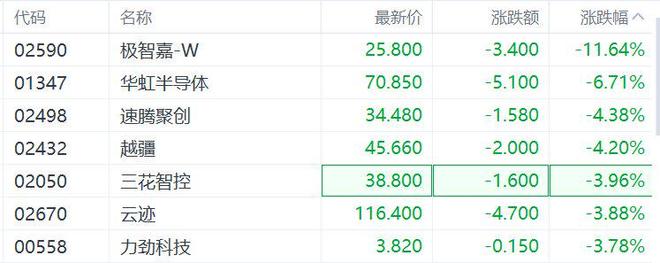
Group 1 - The core viewpoint of the article highlights a collective decline in Hong Kong's robotics concept stocks, with significant drops in key companies [1] Group 2 - The stock performance of major companies in the robotics sector includes: - Xrobotics (极智嘉-W) saw a decline of 11.64%, closing at 25.800, down by 3.400 [2] - Huahong Semiconductor (华虹半导体) decreased by 6.71%, with a closing price of 70.850, down by 5.100 [2] - Sutech (速腾聚创) fell by 4.38%, ending at 34.480, down by 1.580 [2] - Chengdu (誠讀) dropped by 4.20%, closing at 45.660, down by 2.000 [2] - Sanhua Intelligent Control (三花智控) decreased by 3.96%, with a closing price of 38.800, down by 1.600 [2] - Yunji (云迹) fell by 3.88%, closing at 116.400, down by 4.700 [2] - Lijian Technology (力劲科技) saw a decline of 3.78%, ending at 3.820, down by 0.150 [2]


港股芯片股延续跌势
Mei Ri Jing Ji Xin Wen· 2025-10-23 03:29
Core Viewpoint - The Hong Kong chip stocks continue to decline, with significant drops in share prices for several companies [1] Company Summaries - Hua Hong Semiconductor (01347.HK) has decreased by 7.5%, trading at 70.25 HKD [1] - Shanghai Fudan (01385.HK) has fallen by 6.43%, with a current price of 39 HKD [1] - Jingmen Semiconductor (02878.HK) is down by 1.96%, priced at 0.5 HKD [1] - SMIC (00981.HK) has seen a decline of 1.87%, now at 73.45 HKD [1]

芯片股延续跌势 美国拟限制关键软件出口 机构看好国内自主可控进程加速
Zhi Tong Cai Jing· 2025-10-23 03:23
Core Viewpoint - The semiconductor sector continues to decline, influenced by potential U.S. export controls on products using American software for production in China, leading to a drop in related stocks and further declines in U.S. markets [1] Group 1: Stock Performance - Huahong Semiconductor (01347) fell by 7.5%, trading at HKD 70.25 [1] - Shanghai Fudan (01385) decreased by 6.43%, trading at HKD 39 [1] - Jingmen Semiconductor (02878) dropped by 1.96%, trading at HKD 0.5 [1] - SMIC (00981) declined by 1.87%, trading at HKD 73.45 [1] Group 2: U.S. Export Controls - Reports indicate that the White House is considering regulations on products using U.S. software for exports to China, which has contributed to the decline in U.S. stocks, particularly in EDA software [1] - NVIDIA has confirmed its complete exit from the Chinese AI chip market, while Micron plans to halt server chip supplies to China [1] Group 3: Industry Analysis - According to a report from CICC, the U.S. export controls on semiconductors and rare earths signify a shift in trade friction towards core upstream technologies and raw materials, which may accelerate domestic industry self-sufficiency and promote domestic substitution [1] - According to招商证券, the ongoing U.S. export controls are expected to hasten the domestic self-sufficiency process, with an anticipated acceleration in the expansion of advanced production lines in China by 2026, which may positively impact orders in domestic equipment and components sectors [1]
港股异动 | 芯片股延续跌势 美国拟限制关键软件出口 机构看好国内自主可控进程加速
智通财经网· 2025-10-23 03:18
Core Viewpoint - Semiconductor stocks continue to decline, influenced by potential U.S. export controls on products using American software for production and export to China, leading to further drops in U.S. stock markets [1] Group 1: Stock Performance - Huahong Semiconductor (01347) fell by 7.5%, trading at HKD 70.25 [1] - Shanghai Fudan (01385) decreased by 6.43%, trading at HKD 39 [1] - Jingmen Semiconductor (02878) dropped by 1.96%, trading at HKD 0.5 [1] - SMIC (00981) declined by 1.87%, trading at HKD 73.45 [1] Group 2: Regulatory Developments - Reports indicate that the White House is considering regulations on products using U.S. software for production and export to China, which has contributed to the decline in semiconductor stocks [1] - Notably, NVIDIA has confirmed its complete exit from the Chinese AI chip market, and Micron plans to halt server chip supplies to China [1] Group 3: Industry Analysis - According to a report from CICC, U.S.-China export controls in semiconductors and rare earths signify a shift in trade friction towards core technologies and raw materials [1] - The implementation of semiconductor export controls by the U.S. is expected to accelerate the domestic industry's self-sufficiency and promote domestic substitution [1] - According to招商证券, the ongoing U.S. export controls are likely to expedite the domestic self-sufficiency process, with expectations for increased orders in domestic equipment and components as advanced production lines expand by 2026 [1]
四季度波动加剧!应如何资产配置?基本面、资金面最新分析!
Xin Lang Cai Jing· 2025-10-23 02:25
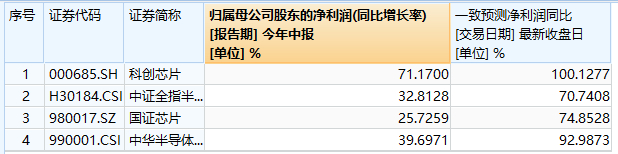
Market Overview - The market has experienced increased volatility since October, particularly in the technology sector, with renewed interest in dividend assets due to heightened risk aversion stemming from escalating trade tensions [1] - The uncertainty from trade disputes may lead to a rotation of funds from crowded trades, resulting in fluctuations in high-valuation growth sectors and a rebound in undervalued sectors [1] Asset Allocation Strategy - In the current market context, focus on sectors with positive earnings forecasts such as semiconductor technology, battery, and non-ferrous metals during the third-quarter earnings reporting period [2] - From a funding perspective, main funds are flowing into AI technology sectors like electronics and communications, while southbound funds are notably directed towards dividend sectors like banking [2] Sector Performance Semiconductor Sector - The semiconductor sector is experiencing high growth, with a significant number of companies reporting strong earnings during the third-quarter disclosures [2] - Notable companies include Cambrian, which reported a net profit of 1.605 billion yuan, marking its first profitable quarter, and Haiguang Information, with a net profit of 1.961 billion yuan, up 28.56% year-on-year [2] Non-Ferrous Metals and Battery Sectors - The non-ferrous metals sector is showing signs of recovery, with expected profit growth of 50% by 2025, driven by various favorable factors including supply-side policies and global economic conditions [4] - The battery sector, previously affected by price wars, is expected to see a turnaround with a projected profit growth of 36% by 2025, supported by demand for energy storage and advancements in solid-state battery technology [7] AI and Technology Trends - The AI sector is catalyzing growth across various industries, with significant investments from major companies like Oracle and domestic tech giants increasing their AI capabilities [8] - The Hong Kong market is well-positioned to benefit from the AI narrative, with a complete domestic AI industry chain and major tech companies included in the Hong Kong Technology ETF [8] Funding Trends - Main funds are showing a "barbell" strategy, focusing on both technology sectors and undervalued dividend sectors like banking and consumer goods [12] - Recent data indicates significant net inflows into electronic and communication sectors, with banking also receiving attention as a defensive investment [12] Conclusion - The current market dynamics suggest a strategic focus on sectors with strong earnings potential and favorable growth forecasts, particularly in technology and dividend-paying sectors, as investors seek stability and returns in a volatile environment [1][2][4][7][12]




港股半导体板块震荡走低,华虹半导体、长飞光纤光缆跌超6%
Mei Ri Jing Ji Xin Wen· 2025-10-23 02:24
每经AI快讯,10月23日,港股半导体板块震荡走低,华虹半导体、长飞光纤光缆跌超6%,上海复旦跌 超4%,中芯国际、ASMPT跌超1%。 (文章来源:每日经济新闻) ...


港股半导体板块震荡走低,华虹半导体跌超6%
Xin Lang Cai Jing· 2025-10-23 02:15
Core Viewpoint - The semiconductor sector in the Hong Kong stock market is experiencing a downward trend, with significant declines in several key companies [1] Company Summaries - Hua Hong Semiconductor has seen a drop of over 6% [1] - Changfei Optical Fiber and Cable has also decreased by more than 6% [1] - Shanghai Fudan has fallen by over 4% [1] - SMIC (Semiconductor Manufacturing International Corporation) has declined by more than 1% [1] - ASMPT has similarly dropped by over 1% [1]
智通港股通持股解析|10月23日
智通财经网· 2025-10-23 00:32
Core Insights - The top three companies by Hong Kong Stock Connect holding ratios are China Telecom (71.22%), COSCO Shipping Energy (70.13%), and GCL-Poly Energy (69.57%) [1] - In the last five trading days, the largest increases in holding amounts were seen in China Mobile (+1.929 billion), Tracker Fund of Hong Kong (+1.897 billion), and InnoCare Pharma (+1.751 billion) [1] - Conversely, Alibaba (-3.254 billion), SMIC (-2.330 billion), and Laopuhuang (-0.855 billion) experienced the largest decreases in holding amounts [2] Group 1: Hong Kong Stock Connect Holding Ratios - China Telecom (00728) has a holding ratio of 71.22% with 9.884 billion shares [1] - COSCO Shipping Energy (01138) has a holding ratio of 70.13% with 909 million shares [1] - GCL-Poly Energy (01330) has a holding ratio of 69.57% with 281 million shares [1] - Other notable companies include China Shenhua (67.74%), Kaisa Group (67.61%), and Xinte Energy (65.33%) [1] Group 2: Recent Increases in Holdings - China Mobile (00941) saw an increase of 1.929 billion in holding amount and 22.8427 million shares [1] - Tracker Fund of Hong Kong (02800) increased by 1.897 billion and 71.8145 million shares [1] - InnoCare Pharma (09606) increased by 1.751 billion and 5.5669 million shares [1] - Other companies with significant increases include Meituan-W (+1.592 billion) and Xiaomi Group-W (+1.105 billion) [1] Group 3: Recent Decreases in Holdings - Alibaba-W (09988) experienced a decrease of 3.254 billion in holding amount and 20.0969 million shares [2] - SMIC (00981) saw a decrease of 2.330 billion and 31.1261 million shares [2] - Laopuhuang (06181) decreased by 0.855 billion and 1.2141 million shares [2] - Other companies with notable decreases include Huahong Semiconductor (-0.792 billion) and Jiangxi Copper (-0.651 billion) [2]



港股通(深)净买入33.25亿港元
Zheng Quan Shi Bao Wang· 2025-10-22 14:29
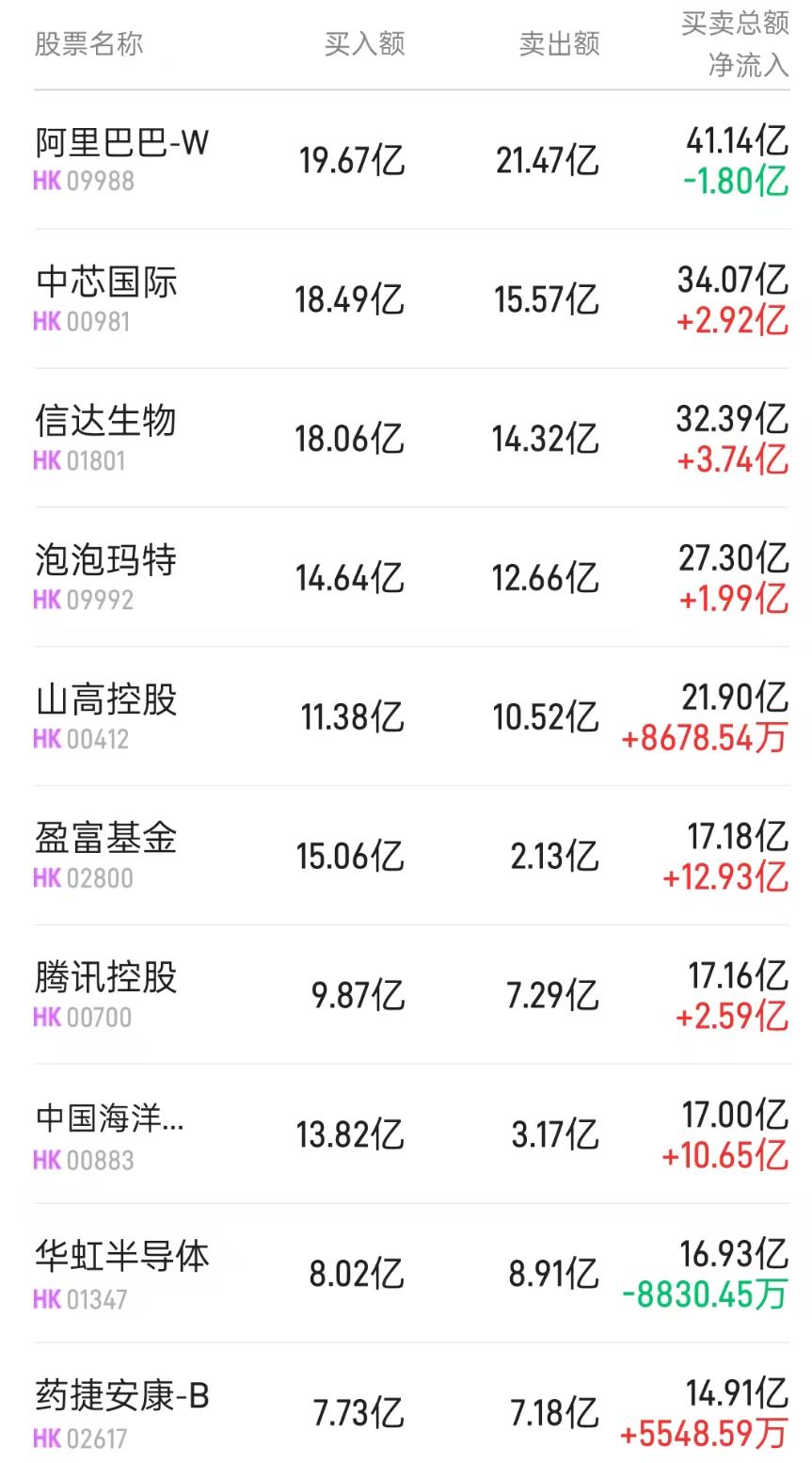
Core Viewpoint - On October 22, the Hang Seng Index fell by 0.94% to close at 25,781.77 points, while southbound funds through the Stock Connect recorded a net purchase of HKD 10.018 billion [1] Group 1: Market Activity - The total trading volume for the Stock Connect on October 22 was HKD 106.582 billion, with a net purchase of HKD 10.018 billion [1] - The Shanghai Stock Connect accounted for HKD 66.693 billion in trading volume, with a net purchase of HKD 6.693 billion, while the Shenzhen Stock Connect had a trading volume of HKD 39.887 billion and a net purchase of HKD 3.325 billion [1] Group 2: Active Stocks - In the Shanghai Stock Connect, Alibaba-W had the highest trading volume at HKD 41.14 billion, followed by SMIC and Innovent Biologics with HKD 34.07 billion and HKD 32.39 billion respectively [1] - The top net purchase stock was the Tracker Fund of Hong Kong (盈富基金) with a net purchase of HKD 12.93 billion, despite a closing price drop of 1.05% [1] - Alibaba-W recorded the highest net sell amount at HKD 1.80 billion, closing down by 1.94% [1] Group 3: Shenzhen Stock Connect Activity - In the Shenzhen Stock Connect, Innovent Biologics led with a trading volume of HKD 26.84 billion, followed by Alibaba-W and Pop Mart with HKD 24.66 billion and HKD 23.36 billion respectively [2] - The Tracker Fund of Hong Kong (盈富基金) also had a net purchase of HKD 7.02 billion, closing down by 1.05% [2] - Innovent Biologics had the highest net sell amount at HKD 2.53 billion, with a closing price drop of 1.96% [2]

北水成交净买入100.18亿 内资抢筹盈富基金近20亿港元 继续加仓中海油
Zhi Tong Cai Jing· 2025-10-22 13:29
Core Viewpoint - The Hong Kong stock market experienced significant net inflows from northbound trading, with notable buying activity in specific stocks such as China National Offshore Oil Corporation (CNOOC), Semiconductor Manufacturing International Corporation (SMIC), and Pop Mart International. Conversely, stocks like Hua Hong Semiconductor, Xiaomi, and Alibaba faced net selling pressure [2][7]. Group 1: Northbound Trading Activity - Northbound trading recorded a net inflow of 100.18 billion HKD, with 66.93 billion HKD from the Shanghai Stock Connect and 33.25 billion HKD from the Shenzhen Stock Connect [2]. - The most bought stocks included the Tracker Fund of Hong Kong (02800), CNOOC (00883), and SMIC (00981) [2]. - The most sold stocks were Hua Hong Semiconductor (01347), Xiaomi Group-W (01810), and Alibaba Group-W (09988) [2]. Group 2: Stock Performance and Analysis - SMIC saw a net inflow of 18.49 billion HKD in buying, with a selling amount of 15.57 billion HKD, resulting in a total transaction volume of 34.07 billion HKD [3]. - CNOOC received a net buy of 14.24 billion HKD, supported by reports indicating a focus on increasing reserves and production amid external uncertainties [7]. - Pop Mart reported a strong third-quarter performance with revenue growth of 245% to 250% year-on-year, leading to an upgrade in earnings forecasts by Bank of America [8]. Group 3: Sector Insights - The semiconductor sector showed divergence, with SMIC gaining net inflows of 6.42 billion HKD while Hua Hong Semiconductor faced net outflows of 2.97 billion HKD [7]. - Analysts remain optimistic about the semiconductor industry's growth driven by artificial intelligence and domestic production capabilities amid U.S. export controls [7]. - The collaboration between Innovent Biologics and Takeda Pharmaceuticals is expected to yield significant financial benefits, with potential payments reaching up to 114 billion USD [8].