
ICBC(01398)

Search documents
汇率政策组合拳如何影响流动性?
GF SECURITIES· 2026-03-02 03:26
Investment Rating - The industry investment rating is "Buy" [2] Core Insights - The central theme of the report discusses the impact of recent currency policies on liquidity, specifically focusing on the People's Bank of China's (PBOC) measures to adjust the foreign exchange risk reserve ratio and its implications for cross-border liquidity [13][22] - The report highlights that the PBOC's recent policies aim to stabilize the RMB's exchange rate and enhance the liquidity of the offshore RMB market, which is expected to support the internationalization of the RMB [16][22] Summary by Sections 1. Current Observations: How Currency Policies Affect Liquidity - The PBOC introduced two key policies: a notification regarding RMB cross-border interbank financing and a reduction of the foreign exchange risk reserve ratio for forward foreign exchange transactions from 20% to 0% [13][18] - RMB cross-border interbank financing is crucial for providing RMB liquidity to offshore markets, with the potential net outflow limit estimated at approximately 1.79 trillion CNY, significantly higher than the current balance of about 1,942 billion CNY [16][17] 2. Forward Foreign Exchange Business - The adjustment of the foreign exchange risk reserve ratio is designed to lower the costs associated with forward foreign exchange transactions, thereby increasing demand in the forward market and countering expectations of RMB appreciation [18][19] 3. Outlook on Cross-Border Liquidity - The report anticipates that while speculative inflows may slow down, the demand for foreign investment in RMB-denominated assets will remain robust, driven by fundamentals, returns, and safety differentials [22][23] - It is expected that the increase in interbank lending will tighten liquidity in the banking sector, prompting the PBOC to potentially implement additional liquidity measures through government bond transactions and open market operations [23]




银行资负跟踪20260302:月末票据利率反弹,大行净买入同比增量回落
GF SECURITIES· 2026-03-02 03:06
Investment Rating - The industry investment rating is "Buy" [2] Core Views - The report highlights a rebound in month-end bill rates, with a significant decrease in net purchases by major banks year-on-year [1][14] - The central bank's operations included a total of CNY 16,410 billion in 7-day reverse repos at a rate of 1.40%, with a net withdrawal of CNY 4,614 billion [14] - The report anticipates continued flexibility in central bank operations to stabilize liquidity fluctuations, especially with important meetings approaching [14][21] Summary by Sections Section 1: Month-End Bill Rate Rebound - The overall liquidity in the market is balanced due to post-holiday fund recovery and tax payments [14] - Major banks' net purchases of bills have significantly decreased, with only an increase of approximately CNY 320 billion year-on-year as of February 27 [17] Section 2: Central Bank Dynamics and Market Rates - The central bank's MLF (Medium-term Lending Facility) increased by CNY 6,000 billion, continuing to inject long-term liquidity into the market [14] - The end-of-period rates for DR001 and DR007 were 1.32% and 1.50%, reflecting increases of 0.68bp and 18.23bp respectively [15] Section 3: Bank Financing Tracking - The total outstanding amount of interbank certificates of deposit (NCD) reached CNY 18.77 trillion, with a weighted average issuance rate of 1.59% [19] - The issuance of interbank certificates of deposit for the period was CNY 4,545 billion, with a completion rate of 93.3% [19]
流动性观察第 122 期:当同业存款定价再自律
EBSCN· 2026-03-01 10:58
Investment Rating - The report maintains a "Buy" rating for the banking industry, indicating an expected investment return exceeding the market benchmark index by over 15% in the next 6-12 months [1]. Core Insights - The report discusses the implementation of a self-regulatory mechanism for interbank deposit pricing, which aims to manage liquidity and stabilize the banking sector's cost of liabilities. The focus has shifted from merely controlling the scale of interbank liabilities to regulating pricing behavior [4][5][6]. - The introduction of self-regulation for non-bank interbank demand deposit rates is expected to enhance the efficiency of monetary policy transmission and alleviate pressure on bank interest margins [6][9]. - The report highlights the historical evolution of interbank liability management, emphasizing the transition from risk prevention to cost control, and outlines the regulatory framework established over the past decade [4][5][6]. Summary by Sections Regulatory History Review - The regulatory framework for interbank liabilities has evolved through three main phases: establishing a risk prevention framework, deepening regulation to reduce leverage and prevent fund turnover, and focusing on cost control through pricing management [4][5][6]. Cost Management of Interbank Liabilities - The report notes that the cost of interbank liabilities remains relatively high, with significant room for further reduction. The average cost of interbank liabilities for state-owned banks was reported at 2.01%, compared to 1.52% for deposits, indicating a 48 basis point spread [13][20]. - The report emphasizes the need for enhanced management of interbank deposit pricing, particularly for time deposits, which currently do not fall under self-regulatory constraints [20][21]. Future Pathways for Self-Regulation - The report suggests that future regulatory measures may include setting upper limits on the scale of interbank demand deposits priced above self-regulatory levels and implementing self-regulation for time deposit rates [22][25]. - Preliminary estimates indicate that the self-regulation of interbank time deposits could lead to a reduction in interest expenses for banks, improving net interest margins by approximately 2 basis points [25][29]. Impact on Wealth Management Products - The report assesses the impact of interbank deposit self-regulation on wealth management products, indicating that the influence on net asset values is relatively limited due to the diverse nature of interbank deposit configurations [34][37]. - It highlights that wealth management products will continue to maintain a strong allocation to deposit-like assets, with expected fluctuations in allocation ratios [34][37].


华创金融红利资产月报(2026年2月):4Q25商业银行业绩增速回正,险资权益配置维持历史高位
Huachuang Securities· 2026-03-01 10:45
Investment Rating - The report maintains a recommendation for equity allocation in the banking sector, indicating a positive outlook for investment opportunities in this industry [1]. Core Insights - The banking sector's net profit growth has returned to positive territory, with a year-on-year increase of 2.33% in Q4 2025, driven by stable interest margins and a decrease in non-performing loans [4][5]. - The report highlights that the insurance sector's asset allocation in equities remains at a historical high, with a total of 5.70 trillion yuan allocated to stocks and funds, representing approximately 15.4% of total investments [4][5]. - The investment logic for 2026 is expected to shift from a focus on dividends to a dual drive of dividends and growth, with an emphasis on banks that can demonstrate strong performance elasticity [5]. Monthly Market Performance - In February 2026, the banking sector experienced a slight decline of 0.55%, underperforming the CSI 300 index by 0.6 percentage points, ranking 28th among 31 primary industries [9][10]. - The valuation of state-owned banks decreased from a price-to-book (PB) ratio of 0.70 at the beginning of the month to approximately 0.67 by the end, while city commercial banks saw an increase in their PB ratio from 0.65 to 0.67 [10][14]. Banking Fundamentals Tracking - The total assets of commercial banks grew by 9.0% year-on-year in Q4 2025, with loans increasing by 7.2%, although the growth rate showed a slight slowdown [4]. - The net interest margin for commercial banks remained stable at 1.42%, with a slight increase in the net interest margin for rural commercial banks [4]. - The non-performing loan ratio decreased to 1.50%, indicating an overall improvement in asset quality [4]. Insurance Capital Allocation Analysis - As of Q4 2025, the total investment balance of insurance companies reached approximately 38.5 trillion yuan, reflecting a year-to-date growth of 15.70% [4]. - The allocation to bonds was reported at 50.4%, showing a slight increase compared to the previous year [4]. Investment Recommendations - The report suggests focusing on three main investment lines for 2026: state-owned banks and leading joint-stock banks, quality joint-stock banks and city commercial banks with improving interest margins, and city commercial banks benefiting from regional policies [5].



工商银行对《牡丹国际借记卡章程》及相关合同文本进调整、完善
Jin Tou Wang· 2026-02-28 04:35
中国工商银行将不断努力,为您提供更全面优质的服务。若有疑问,请拨打中国工商银行客户服务热线 95588或通过手机银行、中国工商银行客户服务微信公众号等在线客服渠道咨询。 2026年2月28日,中国工商银行(601398)发布公告称,为向您提供更为优质的服务,中国工商银行对 现行《中国工商银行牡丹国际借记卡章程》《牡丹国际借记卡领用合约》进行了调整、完善。明确支付 功能中的验证要素、安全保密义务、增加调解作为解决争议的方式等内容。同时,优化个人信息授权体 系,新增《牡丹国际借记卡个人信息授权书》《牡丹国际借记卡敏感个人信息授权书》《牡丹国际借记 卡对外提供、委托处理和共同处理个人信息授权书》。现对修订后的《中国工商银行牡丹国际借记卡章 程》《牡丹国际借记卡领用合约》以及新增的《牡丹国际借记卡个人信息授权书》《牡丹国际借记卡敏 感个人信息授权书》《牡丹国际借记卡对外提供、委托处理和共同处理个人信息授权书》(以下简 称"新《章程》及相关合同")予以公告。新《章程》及相关合同自2026年4月1日起正式实施,中国工商 银行此前及此后发行的牡丹国际借记卡均适用新《章程》及相关合同。如您对修改有异议而决定不再继 续使用牡丹 ...
工商银行取得逻辑编排预测模型训练方法专利
Sou Hu Cai Jing· 2026-02-28 04:31
国家知识产权局信息显示,中国工商银行股份有限公司取得一项名为"逻辑编排预测模型训练方法、逻 辑编排方法和装置"的专利,授权公告号CN116757269B,申请日期为2023年6月。 天眼查资料显示,中国工商银行股份有限公司,成立于1985年,位于北京市,是一家以从事货币金融服 务为主的企业。企业注册资本35640625.7089万人民币。通过天眼查大数据分析,中国工商银行股份有 限公司共对外投资了28家企业,参与招投标项目5000次,财产线索方面有商标信息969条,专利信息 5000条,此外企业还拥有行政许可79个。 声明:市场有风险,投资需谨慎。本文为AI基于第三方数据生成,仅供参考,不构成个人投资建议。 来源:市场资讯 ...
中国工商银行申请分期管理方法、系统和相关装置专利,提升了汽车分期业务的风控精度和流程效率
Jin Rong Jie· 2026-02-28 02:57
Group 1 - The core point of the news is that the Industrial and Commercial Bank of China (ICBC) has applied for a patent related to a "Installment Management Method, System, and Related Devices," which aims to enhance risk control precision and process efficiency in auto installment financing [1] Group 2 - The patent application was published under the number CN121581988A, with an application date of November 2025 [1] - The proposed method includes several stages: pre-loan, loan, and post-loan, focusing on user and vehicle data verification, credit limit determination, loan contract generation, fund supervision, and repayment reminders [1] Group 3 - ICBC was established in 1985 and is headquartered in Beijing, primarily engaged in monetary financial services [2] - The company has a registered capital of approximately 35.64 billion RMB and has made investments in 28 enterprises, participated in 5,000 bidding projects, and holds 969 trademark records and 5,000 patent records [2]
工商银行取得基于视频平台交互关系的金融产品推荐方法专利
Sou Hu Cai Jing· 2026-02-28 02:41
来源:市场资讯 天眼查资料显示,中国工商银行股份有限公司,成立于1985年,位于北京市,是一家以从事货币金融服 务为主的企业。企业注册资本35640625.7089万人民币。通过天眼查大数据分析,中国工商银行股份有 限公司共对外投资了28家企业,参与招投标项目5000次,财产线索方面有商标信息969条,专利信息 5000条,此外企业还拥有行政许可79个。 声明:市场有风险,投资需谨慎。本文为AI基于第三方数据生成,仅供参考,不构成个人投资建议。 国家知识产权局信息显示,中国工商银行股份有限公司取得一项名为"产品推荐方法、装置、存储介质 及电子设备"的专利,授权公告号CN117033778B,申请日期为2023年8月。 ...
智通ADR统计 | 2月28日





智通财经网· 2026-02-27 23:41
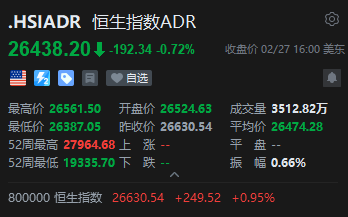
Market Overview - US stock indices experienced a decline on Friday, with the Hang Seng Index ADR closing at 26,438.20 points, down 192.34 points or 0.72% from the Hong Kong close [1] - The highest price for the ADR was 26,561.50, while the lowest was 26,387.05, with a trading volume of 35.1282 million [1] Major Blue-Chip Stocks - Most large-cap stocks fell, with HSBC Holdings closing at HKD 145.765, down 1.04% from the Hong Kong close [2] - Tencent Holdings closed at HKD 513.995, down 0.77% from the Hong Kong close [2] Stock Performance Summary - Tencent Holdings (00700) latest price: HKD 518.000, up 1.17% with an ADR price of USD 65.700, down 0.77% [3] - Alibaba Group (09988) latest price: HKD 142.900, down 0.07% with an ADR price of USD 144.110, down 1.38% [3] - HSBC Holdings (00005) latest price: HKD 147.300, up 1.59% with an ADR price of USD 93.160, down 1.04% [3] - Other notable stocks include AIA Group (01299) up 2.48%, and NetEase (099999) up 2.40% [3]

多家银行上调个人客户上金所延期合约保证金比例
Zheng Quan Ri Bao· 2026-02-27 16:37
Core Viewpoint - The recent increase in risk within the precious metals market has led several major state-owned banks in China to adjust the margin requirements for personal clients trading on the Shanghai Gold Exchange [1][2]. Group 1: Margin Requirement Adjustments - On February 24, the Bank of China announced adjustments to the margin requirements and price fluctuation limits for personal clients trading gold and silver deferred contracts [1]. - Agricultural Bank of China stated that starting from February 26, 2026, the margin requirement for Au (T+D), mAu (T+D), and Ag (T+D) contracts will be increased from 80% to 100% [1]. - Industrial and Commercial Bank of China (ICBC) also announced that from February 27, 2026, the margin requirement for various gold and silver contracts will be raised to 100% [1]. Group 2: Rationale Behind Adjustments - ICBC's customer service indicated that the adjustment to a 100% margin requirement is a response to significant price volatility in the domestic and international precious metals markets, aimed at mitigating market risk and protecting investors [2]. - The increase in margin requirements effectively reduces the leverage available to traders, meaning that for a contract valued at 1 million yuan, the required margin will increase from 800,000 yuan to 1 million yuan [2]. - Financial expert Tian Lihui noted that the current international gold prices are at historically high levels, influenced by global "reflation" expectations, geopolitical risk premiums, and the reassessment of U.S. dollar credit, with banks raising margins to create necessary risk buffers and curb potential speculative bubbles [2].