
美元信用重估

Search documents
多家银行上调个人客户上金所延期合约保证金比例
Zheng Quan Ri Bao· 2026-02-27 16:37
Core Viewpoint - The recent increase in risk within the precious metals market has led several major state-owned banks in China to adjust the margin requirements for personal clients trading on the Shanghai Gold Exchange [1][2]. Group 1: Margin Requirement Adjustments - On February 24, the Bank of China announced adjustments to the margin requirements and price fluctuation limits for personal clients trading gold and silver deferred contracts [1]. - Agricultural Bank of China stated that starting from February 26, 2026, the margin requirement for Au (T+D), mAu (T+D), and Ag (T+D) contracts will be increased from 80% to 100% [1]. - Industrial and Commercial Bank of China (ICBC) also announced that from February 27, 2026, the margin requirement for various gold and silver contracts will be raised to 100% [1]. Group 2: Rationale Behind Adjustments - ICBC's customer service indicated that the adjustment to a 100% margin requirement is a response to significant price volatility in the domestic and international precious metals markets, aimed at mitigating market risk and protecting investors [2]. - The increase in margin requirements effectively reduces the leverage available to traders, meaning that for a contract valued at 1 million yuan, the required margin will increase from 800,000 yuan to 1 million yuan [2]. - Financial expert Tian Lihui noted that the current international gold prices are at historically high levels, influenced by global "reflation" expectations, geopolitical risk premiums, and the reassessment of U.S. dollar credit, with banks raising margins to create necessary risk buffers and curb potential speculative bubbles [2].

国际金价突破5500美元关口
Sou Hu Cai Jing· 2026-01-29 00:26
Core Viewpoint - International gold prices are experiencing a significant surge, with spot gold rising over $230 to exceed $5400 per ounce, marking a daily increase of approximately 4.6%, the largest single-day gain recorded [1] Group 1: Gold Price Dynamics - As of January 29, gold prices continued to rise, approaching $5600 before retracting slightly, currently trading above $5500 per ounce [1] - The current bull market for gold has persisted for over two years since breaking the $2000 mark at the beginning of 2024, with the recent acceleration in prices being unusual [1] Group 2: Economic and Geopolitical Influences - The chief economist at Huaxi Securities, Liu Yu, attributes the heightened volatility in gold prices to a dual logic: structural shocks to the US dollar's credibility and rising geopolitical tensions [2] - Concerns over potential policy interventions were sparked by the US President's comments regarding the dollar's volatility, leading to the dollar index falling below 95.5, a new low since February 2022 [2] - Escalating risk aversion is driven by the US President's threats of military action against Iran, which has intensified the situation in the Middle East, further supporting gold prices [2] Group 3: Federal Reserve and Economic Indicators - The Federal Reserve maintained interest rates between 3.5% and 3.75%, aligning with market expectations, while indicating a potential for three consecutive rate cuts of 25 basis points in 2025 [2] - The Federal Open Market Committee (FOMC) noted that while the US unemployment rate is stabilizing and the economy is expanding, job growth remains slow, and inflation is still at elevated levels [2]

贵金属:金银抗纛,铂钯起势
Guang Da Qi Huo· 2025-12-15 05:29
Report Industry Investment Rating The provided content does not mention the report industry investment rating. Core Viewpoints of the Report - The pricing logic of gold has undergone a profound transformation, with the traditional "real interest rate" and "US dollar" pricing anchors losing effectiveness after 2022. A diversified pricing system centered on "fiat currency credit hedging" and assisted by "global geopolitical order reconstruction" has emerged. In 2026, gold is expected to verify and extend the stability of this system, with an annual operating range of $3,900 - $4,800 per ounce and an average annual price of around $4,500 per ounce [2][113]. - Silver is likely to follow the trend of gold, with a greater price elasticity. In 2026, the shortage in the silver fundamentals and inventory liquidity risks are expected to become consensus and supporting factors, with the expected regression of the gold - silver ratio as the main driving force. The London spot silver is projected to fluctuate between $50 - $80 per ounce [2][116]. - In the context of the systematic re - evaluation of gold as a core credit - hedging asset, 2026 will be a year of both opportunities and further differentiation for platinum and palladium. Their prices will not only follow the upward trend of gold's financial attributes but also continue the divergent trend of "strong platinum and weak palladium" due to their different fundamentals. The London spot platinum is expected to find strong support in the $1,450 - $1,550 per ounce area and challenge the key resistance range of $1,800 - $2,000 per ounce, with an average annual price of around $1,750 per ounce. The London spot palladium is expected to oscillate in a wider range, with support at $1,050 - $1,250 per ounce and resistance at $1,600 - $1,800 per ounce, and an average annual price of around $1,300 per ounce [5][117]. Summary According to Related Catalogs 1. 2025 Year - end Review and Influencing Factors of Precious Metals - **Gold**: In 2025, the gold market was influenced by multiple factors such as global macro - economic conditions, geopolitical changes, and market sentiment. The London spot gold fluctuated between $2,613.9 - $4,381.17 per ounce, with an average price of about $3,400.79 per ounce, a year - on - year increase of about 40%. The price increase was driven by factors including Trump's policies, Fed policy changes, and concerns about the US dollar's credit [7][8]. - **Silver**: The London spot silver achieved a historical breakthrough, fluctuating between $28.311 - $58.968 per ounce, with an average price of $38.192 per ounce, a year - on - year increase of about 33.2%. The price increase was promoted by the strong rise of gold and the expected regression of the gold - silver ratio [8]. - **Platinum and Palladium**: In 2025, the platinum and palladium markets were a game between supply - demand mismatch and financial attributes. The London spot platinum fluctuated between $878.3 - $1,770 per ounce, with an average price of about $1,253.3 per ounce, a year - on - year increase of about 30%. The London spot palladium fluctuated between $870.5 - $1,695 per ounce, with an average price of $1,165.7 per ounce, a year - on - year increase of about 18.5%. On November 27, 2025, the Guangzhou Futures Exchange officially launched platinum and palladium futures [5][10]. 2. 2025 Precious Metals Fundamental Analysis - **Gold Supply - Demand Balance**: In 2025, the supply of gold increased slightly, with a 1.2% increase in output to 3,717.4 tons in the first three quarters compared to the same period last year. The net demand for gold increased by 10% to 3,639.7 tons in the first three quarters. The gold surplus decreased to 77.7 tons, a year - on - year decrease of 78.7%. Investment demand returned, with an increase in the demand for gold bars, medals, and an increase in the holdings of gold ETFs. However, central bank gold purchases decreased by 12.5% to 633.6 tons [28][41][43]. - **Silver Supply - Demand Balance**: In 2025, the global silver supply increased slightly, reaching 32,055 tons, a year - on - year increase of about 1.5%. The total demand was 35,716 tons, a slight decrease of 1.4% compared to 2024. Industrial demand remained stable, investment demand recovered, and traditional photography, jewelry, and silverware demand declined. The silver market was in a supply shortage for the fifth consecutive year [46][47][49]. - **Platinum and Palladium Supply - Demand Balance**: The supply of platinum and palladium was unstable in 2025. Global platinum mine production was expected to decline by 6%, and palladium mine production was also expected to decline by 6%. However, recycling improved. Platinum demand was diversified, while palladium demand was highly concentrated in the automotive sector. Platinum demand was supported by the "platinum replacing palladium" trend and the growth of hybrid vehicles, while palladium demand faced a structural decline due to the increase in electric vehicle penetration and platinum substitution [58][59][62]. 3. Macro - analysis: Multiple Narratives of Gold in the Intersection of the US Mid - term Election Year and Geopolitical Fission - **US Mid - term Election Year**: In 2026, the US government may adopt expansionary fiscal and monetary policies to boost election support. Fiscal deficits are expected to widen, and the Fed may cut interest rates. However, these policies may also lead to concerns about "stagflation" or "re - inflation" and increase short - term volatility in gold prices through trade and tariff policies [74][75][76]. - **Geopolitics**: The geopolitical situation in 2026 will be more complex, with a shift from traditional military confrontation to a "composite game" in the economic, trade, and technology fields. Although the peace process in the Middle East and Ukraine may bring short - term stability, potential risks still exist. Gold will have a structural premium due to geopolitical uncertainties, and central banks and large institutional investors will continue to increase their gold holdings [91][92]. - **Financial Market Narrative**: In 2026, the narratives of "soft landing", "re - inflation", or "stagflation" of the US economy will compete, leading to further differentiation in asset prices. Gold has become an asset for hedging against the volatility of US stocks, and the impact of the US dollar on gold prices needs to be considered in terms of its short - term and long - term trends [105][110][112]. 4. Conclusion - **Gold**: In 2026, gold is expected to oscillate upward and set new historical highs, with an annual operating range of $3,900 - $4,800 per ounce and an average annual price of around $4,500 per ounce. The price may experience different stages: high - level oscillation in the first half of the year, a main upward wave in the second half, and a potential technical correction in the fourth quarter [113][115][116]. - **Silver**: Silver is expected to follow the trend of gold with greater elasticity. The London spot silver is projected to fluctuate between $50 - $80 per ounce in 2026 [116]. - **Platinum and Palladium**: Platinum is expected to show stronger price elasticity and upward potential, while palladium is likely to oscillate in a wider range with a downward - shifting center of gravity [117].
短期狂欢还是“超级周期”?基金解构有色金属
证券时报· 2025-10-14 08:25
Core Viewpoint - The recent surge in non-ferrous metal prices is driven by a combination of macroeconomic factors, including the re-evaluation of the global monetary system and the weakening of the US dollar, which has led to increased demand for these metals as a hedge against currency devaluation [3][4]. Group 1: Macro Environment - The current bull market in non-ferrous metals is rooted in a broader macroeconomic context, characterized by a long-term reassessment of the global monetary system and the creditworthiness of the US dollar [3]. - Analysts believe that the dual loosening of US fiscal and monetary discipline is a key driver of the long-term strong performance of non-ferrous metals, which are viewed as hard currencies against currency depreciation [3][4]. - The recent price movements of gold, silver, and copper reflect the volatility of the dollar's credit, with gold breaking the $4000 per ounce mark and copper nearing $11000 per ton [4]. Group 2: Supply Constraints - The supply side is facing long-term constraints, with declining ore grades requiring more mining to obtain the same amount of metal, leading to significantly higher marginal costs [7]. - There is insufficient capital expenditure in the mining sector due to lower returns on investment, which has resulted in a cautious approach to expansion despite rising commodity prices [8]. - The reduction in high-quality mines and the strategic elevation of resource commodities are further tightening supply, as countries implement measures to enhance resource value [9]. Group 3: Demand Drivers - A new demand engine centered around AI and renewable energy is emerging, significantly increasing the demand for copper and other non-ferrous metals [10]. - The demand for metals related to AI infrastructure and energy upgrades is expected to grow, with renewable energy accounting for a substantial portion of demand in traditional cyclical industries [10]. - The shift in demand dynamics is evident as the contribution of real estate and infrastructure to metal demand has decreased, while the share from the renewable energy sector has increased significantly [10]. Group 4: Market Outlook - The non-ferrous metals sector is poised for a "Davis Double Play," where both earnings and valuations could rise as the market recognizes the non-cyclical nature of high commodity prices [13]. - The combination of long-term supply constraints and increasing demand from manufacturing and strategic reserves positions non-ferrous metals as a core component of the ongoing commodity bull market [13]. - Analysts predict that non-ferrous metals will maintain a high level of prosperity in the coming years, driven by a recovery in downstream demand and a favorable capital expenditure cycle [13].


短期狂欢还是“超级周期”?基金解构有色金属
券商中国· 2025-10-14 04:09
Core Viewpoint - The recent surge in prices of precious and non-ferrous metals is driven by a combination of macroeconomic factors, supply constraints, and new demand from sectors like AI and renewable energy [2][4][9]. Group 1: Macroeconomic Factors - The current bull market in non-ferrous metals is rooted in a long-term reassessment of the global monetary system and the credit of the US dollar, with a weakening dollar driving demand for metals as a hedge against currency devaluation [4][5]. - The price of gold, which recently surpassed $4000 per ounce, is seen as a leading indicator for other metals, with copper and silver also experiencing significant price increases [5][11]. Group 2: Supply Constraints - The supply side is facing long-term constraints due to declining ore grades and high costs of new capacity, which require optimistic price expectations to stimulate investment [7][8]. - There is a notable reduction in high-quality mines and an increasing strategic value of resource commodities, as countries implement measures to enhance resource value [8]. Group 3: New Demand Drivers - The demand for non-ferrous metals is being significantly boosted by AI and renewable energy sectors, with AI-related infrastructure and electric grid upgrades driving copper demand [9]. - The share of demand from the renewable energy sector in traditional cyclical industries is expected to grow, with projections indicating that it could account for over 20% of demand for metals like aluminum and copper [9][12]. Group 4: Market Dynamics - The recent volatility in metal prices reflects market skepticism about the sustainability of high prices, but there is potential for a "Davis Double Play" where earnings and valuations could rise simultaneously if high prices are accepted as a new norm [11][12]. - The overall outlook for non-ferrous metals remains positive, with expectations of sustained high demand and supply constraints leading to a "slow bull" market over the next one to two years [12].

金价再创历史新高!黄金股ETF、黄金ETF、金ETF大涨
Ge Long Hui· 2025-10-13 08:54
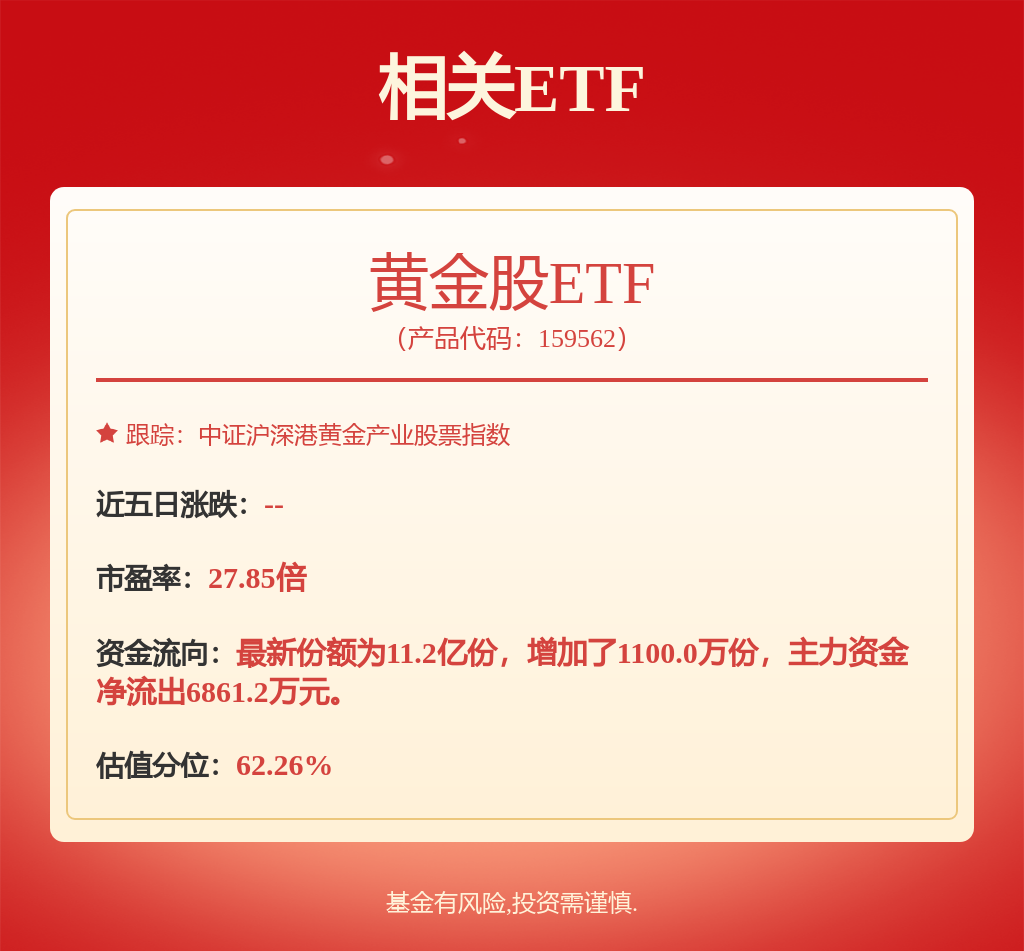
Core Insights - International gold prices continue to rise, with spot gold reaching $4,070 per ounce, marking a historical high and an increase of over 55% year-to-date [1] - The rise in gold prices is supported by central bank purchases, increased holdings in exchange-traded funds (ETFs), and the Federal Reserve's interest rate cuts [3][4] - The current market environment, characterized by high debt levels, low real interest rates, and geopolitical uncertainties, enhances gold's strategic allocation value [6] ETF Performance - Gold stock ETFs have increased by over 4%, while various other gold-related ETFs have risen by more than 3% [1] - Gold ETFs are purely price-tracking tools anchored to physical gold, reflecting fluctuations in gold prices and supporting T+0 trading [2] - The gold stock ETF primarily invests in gold-related companies listed in Hong Kong and A-shares, with significant holdings in leading gold mining firms [3] Market Dynamics - The recent surge in gold prices is attributed to speculative capital entering the market, with technical indicators showing that gold is in an overbought territory [4] - The ongoing U.S.-China trade tensions contribute to market uncertainties, which may lead to increased demand for safe-haven assets like gold [4] - The U.S. government's fiscal issues and potential new tariffs on imports are expected to further stimulate gold prices [3] Long-term Outlook - The long-term bullish logic for gold remains intact, driven by a weaker dollar and ongoing central bank gold purchases amid global economic instability [3][4] - Historical patterns suggest that gold stocks often exhibit greater elasticity following confirmed upward trends in gold prices [5] - The strategic allocation to gold is increasingly favored as a response to the inadequacies of traditional safe-haven assets in the current geopolitical climate [6]

有色金属“热浪”翻滚 基金解构新一轮超级周期
Zheng Quan Shi Bao· 2025-10-12 18:39
Core Viewpoint - The recent surge in non-ferrous metal prices, including gold, copper, and silver, is driven by a combination of macroeconomic factors and supply-demand dynamics, indicating a potential "super cycle" rather than a temporary market reaction [1][2]. Group 1: Macroeconomic Factors - The current bull market in non-ferrous metals is rooted in a long-term reassessment of the global monetary system and the credit of the US dollar, with a weakening dollar contributing to the strong performance of these metals as a hedge against currency devaluation [1][2]. - Analysts believe that the ongoing monetary expansion and the trend towards a weaker dollar, along with the initiation of a Federal Reserve rate-cutting cycle, will continue to boost precious metal prices, particularly gold [1][2]. Group 2: Supply Constraints - Supply-side constraints are expected to tighten over the long term due to declining ore grades, which require more mining to obtain the same amount of metal, leading to increased marginal costs [3][4]. - There is insufficient capital expenditure in the mining sector, as the declining returns from mining operations deter large-scale investments despite rising commodity prices [4][5]. - The number of high-quality mines is decreasing, and countries are using administrative measures to enhance the value of their resources, indicating that resource commodities are transitioning from cyclical products to strategic assets [5][6]. Group 3: Demand Drivers - A new demand engine centered around AI and renewable energy is emerging, significantly increasing the demand for copper and other metals [6][7]. - The shift in demand dynamics is evident as the share of renewable energy industries in the demand for traditional cyclical metals like copper and aluminum has risen substantially [7][8]. Group 4: Market Dynamics - The recent price volatility in major non-ferrous metals, such as copper reaching $11,000 per ton before a significant drop, reflects market skepticism about the sustainability of high commodity prices [8][9]. - Analysts suggest that if the consensus shifts to view the current high prices as a long-term trend rather than a cyclical fluctuation, the sector could experience a "Davis double play," where both earnings and valuations rise [8][9]. Group 5: Future Outlook - Non-ferrous metals are expected to be the mainstay of the current commodity bull market, driven by long-term supply constraints and increasing demand from manufacturing and strategic resource needs [9]. - The outlook for the next one to two years remains positive for industrial metals, small metals, and gold, although potential risks from tariffs and economic data deterioration in the US need to be monitored [9].
国信证券:黄金中长期继续维持乐观看法 关注市场第三浪机会
智通财经网· 2025-10-12 07:40
Core Viewpoint - The report from Guosen Securities suggests that the opportunity for the third wave of gold may be triggered by a peak in the overseas artificial intelligence technology wave, but currently, there are no signs of this occurring [1][5]. Group 1: Gold as an Asset Class - Gold plays a crucial role in asset allocation for diversification and risk hedging, with optimal allocation ratios being a topic of market interest [1]. - Ray Dalio suggests a reasonable allocation of 15% for gold, while Jeffrey Gundlach believes it could be as high as 25%, especially in the context of high inflation and government debt [1]. - The report emphasizes that holding cash and bonds is not an effective wealth preservation strategy in the current economic environment, making gold a valuable independent asset [1]. Group 2: Historical Performance and Allocation Strategies - A simple rebalancing model indicates that since 2013, a portfolio with a 25% allocation to stocks and bonds has underperformed compared to a portfolio heavily weighted in gold, which has shown a net value of 5.84 [2]. - For household asset allocation, a gold allocation of 2-10% is deemed appropriate, with historical data showing that a 10% allocation resulted in a cumulative return of 138.50% compared to 126.10% for portfolios without gold [3]. Group 3: Institutional Asset Management - For institutional asset management products, gold allocation can be increased to over 10%, with optimal allocation averaging 18% based on mean-variance optimization from 1972 to 2014 [4]. - Gold has demonstrated robust performance in various inflation environments, particularly when annual inflation exceeds 5%, and it shows positive or low negative correlation during downturns in stock, bond, and commodity markets [4]. Group 4: Current Market Outlook - Guosen Securities maintains a positive long-term outlook for gold, citing insufficient global safe-haven assets post the Ukraine crisis and concerns over the credibility of the Federal Reserve [5]. - The report notes that the third wave opportunity for gold may arise from a shift in capital flows due to a peak in the AI technology sector, although no such signals have been observed yet [5].

策略解读:黄金:配多少,何时抛
Guoxin Securities· 2025-10-12 07:28
Core Insights - The report maintains a positive long-term outlook on gold prices, with current prices at $4017.845 per ounce in London and ¥913.26 per gram in Shanghai as of November 12, 2025, driven by rising risk aversion amid declines in major U.S. stock indices [3][4] - The recommended allocation of gold in personal asset portfolios is between 2% to 10%, while institutional allocations can be increased above 10% [6][7] Allocation Strategies - Gold plays a crucial role in diversification and risk hedging within asset allocation. Ray Dalio suggests a reasonable allocation of 15%, while Jeffrey Gundlach proposes up to 25%, citing high inflation and government debt as key factors [4][5] - Historical data shows that a portfolio with 10% gold allocation from 2005 to 2019 achieved a cumulative return of 138.50%, outperforming a non-gold portfolio [6] - For institutional asset management products, the optimal allocation of gold in a traditional 60/40 stock-bond portfolio averaged 18% from 1972 to 2014, particularly effective in high inflation environments [7] Market Conditions - The report identifies two primary principles for gold allocation: the insufficiency of global safe-haven assets post-Ukrainian crisis and doubts regarding the credibility of the Federal Reserve, which could lead to a reassessment of the dollar's value [8][10] - The report suggests that the third wave of gold opportunities may arise from a potential peak in the overseas AI technology wave, although no immediate signs are present [8]