
商业银行次级债

Search documents
银行资负跟踪20260329:大行转贴净买入有限
GF SECURITIES· 2026-03-29 13:08
Investment Rating - The industry investment rating is "Buy" [3] Core Insights - The report indicates that large banks have limited net buying activity, with a monthly cumulative net purchase of 46.8 billion yuan as of March 26, which is a decrease of approximately 200 billion yuan month-on-month but an increase of about 50 billion yuan year-on-year. It is expected that credit issuance may slightly decline compared to March 2025, but the initial performance remains strong [7][20] - The central bank's operations included a net injection of 281.9 billion yuan through various monetary policy tools, with a focus on maintaining liquidity stability as the quarter-end approaches [16] - The report highlights that the liquidity environment is expected to tighten in April due to tax payments and annual settlement pressures, with potential increases in funding rates towards the end of the month [16][17] Summary by Sections Section 1: March Credit Performance - The data shows that the funding environment remains stable as the quarter-end approaches, with large banks gradually reducing their lending from 4.37 trillion yuan to 3.78 trillion yuan [16] - The report emphasizes the importance of monitoring the upcoming PMI data and bank annual reports for insights into future liquidity trends [23] Section 2: Central Bank Dynamics and Market Rates - The central bank conducted 4.742 trillion yuan in 7-day reverse repos, with a net injection of 281.9 billion yuan after accounting for maturing operations [16] - Market rates for various instruments, including treasury bonds and NCDs, have shown slight fluctuations, with the 1-year treasury yield at 1.25% and the average NCD issuance rate at 1.52% [17][18] Section 3: Bank Financing Tracking - The total outstanding amount of interbank certificates of deposit (NCDs) is 18.19 trillion yuan, with a weighted average issuance rate of 1.65% [21] - The report notes that there were no new issuances of commercial bank bonds during the period, and the total outstanding amount of commercial bank bonds is 3.32 trillion yuan [22]



银行资负跟踪20260322:通胀预期下广谱资产流动性收敛,关注负反馈
GF SECURITIES· 2026-03-22 14:06
Investment Rating - The industry investment rating is "Buy" [2] Core Insights - The report highlights that under inflation expectations, broad asset liquidity may contract, and attention should be paid to negative feedback effects [1][14] - The central bank's operations have resulted in a net injection of 215.8 billion CNY, with liquidity in the interbank market remaining ample and funding rates slightly declining [14] - The report emphasizes the potential for liquidity-driven valuation expansion to slow down in the second quarter due to rising inflation expectations and external geopolitical conflicts affecting oil prices [14][16] Summary by Sections 1. Inflation Expectations and Asset Liquidity - The interbank liquidity is currently abundant, with funding rates showing a slight decline. As of March 20, R001 and R007 rates were 1.40% and 1.48%, respectively [14] - The central bank conducted 242.3 billion CNY in 7-day reverse repos, with a maturity of 1,765 billion CNY, and a net injection of 215.8 billion CNY was achieved [14] - The report anticipates that liquidity may face contraction in Q2, influenced by inflation recovery expectations and external factors [14] 2. Central Bank Dynamics and Market Rates - The central bank's operations are characterized by small adjustments, maintaining a stable liquidity environment [15] - The report notes that government bond yields have shown mixed movements, with 1Y and 3Y yields decreasing by 2.0bp and 2.5bp, while longer-term yields have increased [16] - The report suggests that the market should prepare for potential upward pressure on long-term interest rates as economic recovery and inflation expectations evolve [16] 3. Bank Financing Tracking - The report indicates that the issuance of interbank certificates of deposit (NCD) has seen a weighted average issuance rate of 1.53%, down by 2bp from the previous period [19] - The total outstanding amount of interbank certificates of deposit is 18.17 trillion CNY, with a negative net financing of 4.042 billion CNY this period [19] - The report highlights that there were no new issuances of commercial bank bonds during this period, with a total outstanding amount of 3.35 trillion CNY [20]
银行资负跟踪:降准降息预期走弱
GF SECURITIES· 2026-03-15 09:12
Investment Rating - The industry investment rating is "Buy" [3] Core Views - The expectation for interest rate cuts and reserve requirement ratio reductions has weakened, indicating a shift towards a more cautious monetary policy approach [14] - The central bank is expected to maintain a balanced approach in using monetary policy tools, focusing on supporting the economy while ensuring bank profitability [14] - Personal mortgage rates in China are nearing the average levels seen during the zero interest rate periods in the US, UK, and Japan, reflecting a stable monetary policy stance [14] - The central bank aims to keep interbank liquidity ample without resorting to excessive liquidity injections, supporting banks in capital replenishment and reducing funding costs [14] Summary by Sections Section 1: Weakening Expectations for Rate Cuts - The central bank's recent actions indicate a preference for a "prudent choice" in monetary policy, balancing multiple objectives [14] - The current credit interest rates are at historical lows, with a focus on maintaining bank interest margins while promoting low financing costs through market regulation [14] - The central bank's operations have resulted in a net withdrawal of 2,511 billion CNY, with a focus on maintaining liquidity stability [15] Section 2: Central Bank Dynamics and Market Rates - The central bank conducted 1,765 billion CNY in 7-day reverse repos at a rate of 1.40%, with a net withdrawal of 2,511 billion CNY overall [15] - Market rates have shown slight increases, with R001 and R007 rising to 1.39% and 1.50% respectively [15] - Upcoming liquidity events include a significant reverse repo maturity and tax payment dates, which may affect market liquidity [25] Section 3: Bank Financing Tracking - The total outstanding amount of interbank certificates of deposit (NCD) is 18.47 trillion CNY, with a weighted average interest rate of 1.67% [22] - The issuance of interbank certificates of deposit totaled 8,459 billion CNY, with a completion rate of 94.1% [22] - The commercial bank bond market remains stable, with no new issuances reported during the period [22]
银行资负跟踪20260302:月末票据利率反弹,大行净买入同比增量回落
GF SECURITIES· 2026-03-02 03:06
Investment Rating - The industry investment rating is "Buy" [2] Core Views - The report highlights a rebound in month-end bill rates, with a significant decrease in net purchases by major banks year-on-year [1][14] - The central bank's operations included a total of CNY 16,410 billion in 7-day reverse repos at a rate of 1.40%, with a net withdrawal of CNY 4,614 billion [14] - The report anticipates continued flexibility in central bank operations to stabilize liquidity fluctuations, especially with important meetings approaching [14][21] Summary by Sections Section 1: Month-End Bill Rate Rebound - The overall liquidity in the market is balanced due to post-holiday fund recovery and tax payments [14] - Major banks' net purchases of bills have significantly decreased, with only an increase of approximately CNY 320 billion year-on-year as of February 27 [17] Section 2: Central Bank Dynamics and Market Rates - The central bank's MLF (Medium-term Lending Facility) increased by CNY 6,000 billion, continuing to inject long-term liquidity into the market [14] - The end-of-period rates for DR001 and DR007 were 1.32% and 1.50%, reflecting increases of 0.68bp and 18.23bp respectively [15] Section 3: Bank Financing Tracking - The total outstanding amount of interbank certificates of deposit (NCD) reached CNY 18.77 trillion, with a weighted average issuance rate of 1.59% [19] - The issuance of interbank certificates of deposit for the period was CNY 4,545 billion, with a completion rate of 93.3% [19]

银行深度:胜遇研究,华兴银行再审视
Si Lu Hai Yang· 2026-01-22 11:17
Investment Rating - The report does not explicitly state an investment rating for the company, but it highlights significant concerns regarding asset quality and capital adequacy, suggesting a cautious outlook on investment potential. Core Insights - The report revisits the operational trajectory of the company amidst declining LPR and tightening capital regulations, questioning whether previous core issues have been resolved [1] - The company faces ongoing liquidity challenges, with shareholder equity issues exacerbated by financial crises among major shareholders [3] - Asset quality remains a concern, with rising non-performing loans and a high concentration of risk in real estate [60] Company Governance - The company continues to experience liquidity issues with significant shareholder stakes being auctioned at low prices, reflecting a deteriorating confidence in the bank's equity [3] - The number of shareholders has slightly decreased, indicating potential consolidation but also ongoing challenges in shareholder confidence [3] Asset Side - As of June 2025, total assets reached 486.91 billion, primarily driven by loans and financial investments, which grew by 3.50% and 8.14% respectively [4] - The loan structure remains heavily weighted towards long-term loans, with a notable increase in short-term loans [5] Loan Quality - By the end of 2024, non-performing loans increased by 5.10% to 3.75 billion, with a non-performing loan ratio slightly decreasing to 1.53%, still above the industry average [9] - The bank's approach to classifying non-performing loans has raised concerns about the accuracy of reported asset quality [14] Investment Assets - The bank's credit loss provisions for debt investments rose by 25.12%, with a significant increase in stage three assets, indicating heightened risk exposure [22] - A high percentage of un-rated debt investments poses additional risks, particularly in the real estate sector [25] Liability Side - Total liabilities increased to 450.91 billion, with a significant reliance on deposits, which accounted for 73.55% of total liabilities [28] - The bank's dependence on high-cost deposits remains a concern, with a notable portion of its funding coming from short-term sources [29] Liquidity - Liquidity ratios have shown slight declines, indicating increased short-term repayment pressures, although still above industry averages [36] - The bank's liquidity coverage ratio improved but remains below the average for commercial banks [36] Revenue Side - Total revenue for 2024 was 8.37 billion, reflecting a slight decline, with net interest income and fee-based income both decreasing significantly [39] - Investment income saw a notable increase, contributing positively to overall revenue despite challenges in traditional income streams [44] Profitability - Net profit decreased by 5.56% to 2.85 billion, with credit impairment losses significantly impacting profitability [48] - The bank's ability to generate internal capital remains weak, raising concerns about future capital adequacy [53] Capital Adequacy - Capital adequacy ratios improved slightly due to the issuance of perpetual bonds, but core capital ratios remain below industry standards [50] - The bank's reliance on external financing for capital maintenance poses sustainability risks [53] Peer Comparison - Compared to similar-sized banks, the company ranks favorably in terms of net profit but struggles with net interest margins and asset quality [55] - In the context of regional peers, the bank's capital adequacy ratios are concerning, indicating a need for improvement [56] Summary - The company has made some progress in capital adequacy and investment performance, but significant challenges remain in asset quality and liquidity management [59] - The ongoing liquidity crisis and high-risk asset exposure suggest a cautious outlook for future performance [60]
央行四季度例会延续适度宽松货币政策,加大逆周期和跨周期调节力度
Xin Lang Cai Jing· 2026-01-04 09:04
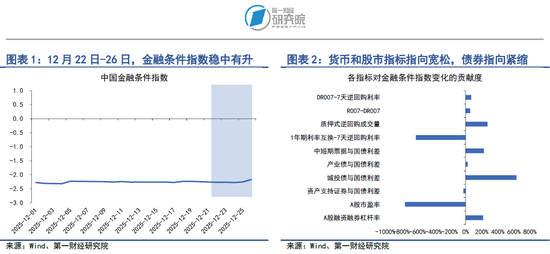
Financial Condition Index Overview - The average daily index of China's financial conditions from December 22 to December 26, 2025, was -2.25, remaining stable compared to the previous week. The index has decreased by 0.87 over the year [1][4][28] - The components of the index indicate a loose monetary and stock market, while the bond market shows signs of tightening. The central bank maintained stable monetary supply, and market liquidity was orderly with low interest rates [1][4][28] Monetary Market - The interbank market maintained stable liquidity, with an average pledged repo transaction volume of 8.48 trillion yuan, consistent with the previous week. However, there was a noticeable decline on December 26, dropping from 8.54 trillion yuan to 7.89 trillion yuan [6][30] - Major money market rates saw an increase, with overnight repo rates averaging 1.35% and 1.26%, reflecting slight changes compared to the previous week [6][30] Central Bank Monetary Policy - The People's Bank of China (PBOC) released key policy signals during the fourth quarter monetary policy committee meeting, emphasizing the need for continued moderate monetary policy and enhanced counter-cyclical adjustments [2][9][35] - The meeting highlighted the importance of integrating incremental and stock policies to effectively manage monetary policy, focusing on both short-term and long-term economic stability [3][10][36] Bond Market - The total issuance of bonds from December 22 to December 26 was 1.64 trillion yuan, a decrease of 317.94 billion yuan from the previous week, while net financing increased by 50.77 billion yuan to 235.05 billion yuan [12][38] - Government bonds saw a net financing of 266.02 billion yuan, while non-financial enterprises also achieved net financing, indicating a mixed performance across sectors [12][39] Stock Market - A-share financing totaled 29.09 billion yuan during the week, an increase of 19.19 billion yuan compared to the previous week, with total financing for the year exceeding 1.07 trillion yuan [20][46] - Major A-share indices experienced gains, with the Shanghai Composite Index rising by 1.87%, and the ChiNext Index increasing by 3.85%. Year-to-date, the Shanghai Composite Index has risen by 18.26% [22][48]

债市阿尔法追踪:6月:债市普遍上涨,超长债涨势突出
Guoxin Securities· 2025-07-13 05:10
Report Investment Rating No investment rating information is provided in the report. Core Viewpoints - In June, the bond market generally rose, with ultra-long bonds showing prominent gains. Without considering coupon income, from an industry perspective, bonds in the transportation industry had a relatively high net price increase, with a monthly increase of 0.12%, indicating a certain alpha. In terms of maturity, there was positive alpha in government bonds and local government bonds with a maturity of over 10 years in June. From a subordinated perspective, commercial bank subordinated bonds had obvious alpha in June [1][10]. Summary by Directory 1. Overview of Yields of Various Bond Types - In June, the bond market generally rose. For interest rate bonds, the yields of all interest rate bonds declined. The average yields of government bonds, policy bank bonds, and local government bonds declined by 7BP, 5BP, and 5BP respectively. For credit bonds, the yields of almost all credit bond types declined. Among them, the 20-year urban construction investment bonds with an implied rating of AA+ had the largest decline in yield, with an average decline of 17BP [1][11]. - As of June 30, the historical percentile levels of interest rate bond yields were relatively high, with most interest rate bond types having a three-year historical percentile level of over 6%. The 30-year policy bank bond had the highest three-year historical percentile level of 9.6%. For credit bonds, the historical percentile levels of most credit bond yields were low, below 3%. However, some credit bond types had relatively high historical percentile levels, such as the 7-year AA- second-tier capital bonds and 7-year AA securities company bonds, with historical percentiles of 15.2% and 14.7% respectively [14]. 2. Industry Alpha Tracking - In June, all industry credit bonds rose, with an average net price increase of 0.07%. Among them, bonds in the transportation industry had a relatively high net price increase, with a monthly increase of 0.12%, indicating a certain alpha. Urban construction investment bonds and real estate bonds had an average net price increase of 0.03%, which were relatively small increases [1][15]. - In the real estate bond sector, in June, AAA-rated and public enterprise real estate bonds had obvious positive alpha, while AA+-rated real estate bonds had negative alpha. Specifically, the average net price increase of AAA real estate bonds was 0.04%, significantly higher than other real estate bond types. Public enterprise bonds had an average increase of 0.12%, higher than real estate bonds of other enterprise types. AA+ real estate bonds had an average net price decline of 0.01%, the only declining real estate bond type. In terms of specific bonds, the bonds of Longfor Group had a net price increase of over 2%, while the bond H20 Hejing 6 had a net price decline of 3.79% [19]. - For urban construction investment bonds, in June, different types of urban construction investment bonds had different price movements. Regionally, urban construction investment bonds in Guangxi declined by 0.07% in a single month, the most significant decline, indicating obvious negative alpha. Urban construction investment bonds in Hebei and Xinjiang had relatively high increases, with an average increase of 0.14%. In terms of ratings, AA- urban construction investment bonds had negative alpha, with an average net price decline of 0.13%, significantly lower than other rated urban construction investment bonds [26]. - In the financial bond sector, in June, private enterprise financial bonds had a relatively significant net price decline, with an average monthly decline of 0.03%, the only declining financial bond type, indicating negative alpha. The bonds with relatively high increases in June were 24 Kunpeng Investment MTN003, 25 Kunpeng Investment MTN001B, and 23 CATIC Finance 08, with net price increases of 3.06%, 3.06%, and 2.36% respectively. The bonds with relatively high declines were 21 Shenzhen Jusheng 01 and 20 Shenzhen Jusheng 01, with net price declines of 7.2% and 10.59% respectively [28]. 3. Maturity Alpha Tracking - In June, government bonds and local government bonds with a maturity of over 10 years had positive alpha. Data showed that government bonds with a maturity of over 10 years rose by 1.1% and local government bonds rose by 0.93%, significantly higher than other interest rate bond types. The main reason was that ultra-long interest rate bonds had the advantage of duration leverage, and the decline in yields led to a more significant increase in prices [2][33]. - Among long-term representative bonds, the ultra-long credit bond 24 Chengtong Holdings MTN009B had the highest monthly increase of 3.63% [37]. 4. Subordinated Alpha Tracking - In June, commercial bank subordinated bonds had positive alpha. Data showed that commercial bank subordinated bonds had an average increase of 0.05%, higher than commercial bank ordinary bonds and subordinated bonds. The alpha of commercial bank subordinated bonds mainly came from the significant decline in the yields of 7-year and 10-year commercial bank second-tier capital bonds and perpetual bonds. Although the yields of 20-year and 30-year commercial bank ordinary bonds declined more significantly, due to the small scale of ultra-long commercial bank bonds, the decline in yields had little impact on the overall price movement [2][39]. 5. June Public Bond Fund Ranking - In June, hybrid bond funds of the second category had the highest average increase among public bond funds. The average increase of hybrid bond funds of the second category was 1.04%, followed by hybrid bond funds of the first category with an average increase of 0.57%, medium- and long-term pure bond funds with an average increase of 0.29%, and short-term pure bond funds with an average increase of 0.18% [2][40]. - The top five medium- and long-term pure bond funds in terms of increase in June were Huarun Yuanda Runxiang Three-Month Fixed-Term Open A, Pengyang Chunxi One-Year Fixed-Term Open, Huataibaoxing Zunyi Interest Rate Bond 6-Month Holding A, Pengyang Chunli Regularly Open A, and Minsheng Jiayin Hengyu [46]. - The top five short-term pure bond funds in terms of increase in June were Tianhong Yueyuebao 30-Day Holding A, Baoying Ansheng Medium- and Short-Term Bond A, Zheshang Huijin Shuangyuexin 60-Day Rolling Medium- and Short-Term Bond A, Great Wall Short-Term Bond A, and Zheshang Huijin Yuexiang 30-Day Rolling Holding A [47]. - The top five hybrid bond funds of the first category in terms of increase in June were Great Wall Active Income Enhancement A, Everbright Medium- and High-Grade A, Tianhong Tianli E, Golden Eagle Add Interest Medium- and Long-Term Credit Bond A, and Minsheng Jiayin Xinxiang A [48]. - The top five hybrid bond funds of the second category in terms of increase in June were Golden Eagle Yuanfeng C, Huabao Enhanced Income A, China Merchants Anrui Enterprising C, Caitong Income Enhancement C, and Minsheng Jiayin Enhanced Income A [49].
信用策略周报20250615:跨季抢跑再现?-20250616
Tianfeng Securities· 2025-06-16 00:45
Group 1 - The report indicates a continued compression of credit spreads, with a notable divergence in performance among different credit types. Short-term credit, particularly short-term perpetual bonds, experienced a slight pullback after a rapid decline in interest rates in early June. Low-rated city investment bonds saw yields decrease by over 5 basis points within a year, while mid to high-grade credit bonds extended their durations, increasing participation in bonds with maturities of 5 years or more [1][10][19] - Institutional buying power for credit bonds has significantly increased, with net purchases reaching a new high for the year. Public funds and other products contributed the majority of this buying, while banks and insurance companies showed relatively weaker support, focusing more on certificates of deposit and local government bonds [2][15][19] - Since mid-May, there has been a slight increase in the primary supply of ultra-long credit bonds (maturities over 5 years), with overall issuance not considered weak. Institutions have shown a higher bidding sentiment for ultra-long credits compared to shorter maturities [3][32][34] Group 2 - Looking ahead, the report suggests that credit bonds with favorable supply-demand dynamics may continue to experience spread compression in a fluctuating interest rate environment. Short-term credit spreads are already extremely compressed, limiting their attractiveness. The central bank's loose monetary policy may allow for some movement in line with interest rate trends, but further compression appears limited [5][44] - For mid to long-term credits, the report anticipates that spreads may still compress, with a preference for bonds with maturities of 5 years or more. The report also highlights the potential for 4-year bonds to provide attractive yields [5][44] - The report emphasizes that ultra-long bonds remain appealing for institutions with stable liabilities, as they offer better coupon advantages compared to interest rates. However, institutions with strong liquidity needs should manage their positions carefully to avoid potential capital loss risks [5][44]
7月:债市走势分化,中短期限信用债收益率下行显著
Guoxin Securities· 2025-04-03 07:15
Report Industry Investment Rating No relevant content provided. Core Viewpoints - Without considering coupon income, in the industry dimension, real estate bonds had a positive alpha with an average price change of 0.09%, leading other industry bonds in gains; transportation bonds had a negative alpha with an average price change of -0.01%, being the only industry bonds with a net price decline. In the term dimension, interest rate bonds with a maturity of over 10 years in March had a certain negative alpha. In the sub - category dimension, commercial bank ordinary bonds had an obvious alpha in March [1][2][11]. Summary by Directory 1. Overview of Yields of Various Bond Types - In March, the bond market showed a divergent trend, with the yields of short - and medium - term credit bonds declining significantly. For interest rate bonds, yields generally increased, with the average yield of treasury bonds rising by 9BP, that of China Development Bank bonds by 5BP, and that of local government bonds by 12BP. For credit bonds, the yields of all credit bond types with a maturity of 3 years or less declined, and the implied AA - rated 1 - year urban investment bonds had the largest decline in yield, with an average decline of 23BP [2][12]. - As of March 31, short - term interest rate bonds had relatively high historical yield percentile levels. Among them, the 1 - year treasury bonds and local government bonds had their three - year historical yield percentiles rising to 22% and 25% respectively. For credit bonds, low - grade long - term financial bonds had relatively high historical yield percentile levels, with the three - year historical yield percentiles of 7 - year AA - rated bank secondary capital bonds and bank perpetual bonds being 19% and 21% respectively [15]. 2. Industry Alpha Tracking - In the industry dimension, most industry credit bonds generally rose in March, with an average net price change of 0.04%. The real estate industry had a positive alpha, with an average bond price change of 0.09%, leading other industries in gains; the transportation industry had a negative alpha, with an average bond price change of -0.01%, being the only industry with a net price decline [2][18]. - In terms of real estate bonds, public enterprise bonds had an obvious negative alpha in March, with an average price change of -0.41% mainly due to the significant decline of several Vanke bonds. The top - gainers in March were 21 Longhu Expansion MTN001 (Project Income), 21 Vanke 04, and 24 Binjiang Real Estate MTN004, with net prices rising by 12%, 1.7%, and 1.5% respectively; the top - losers were H20 CIFI 2 and H21 CIFI 2, with net prices falling by 5.2% and 5.3% respectively [20]. - For urban investment bonds, those in Beijing and Tianjin had an obvious positive alpha in March, while those in Guangxi had a negative alpha. The average price changes of urban investment bonds in Beijing and Tianjin in March were both 0.11%, being the regions with the largest gains; the average price change of urban investment bonds in Guangxi in March was -0.08%, being the region with the largest decline. The overall price change of urban investment bonds in March was 0.03% [28]. - In terms of financial bonds, there was little difference in the net price changes of financial bonds of various ratings and types in March, and no obvious alpha was observed. The top - gainers were 24 Datong C2, 25 Donghai C1, and 25 Yixin Leasing PPN001, with net prices rising by 0.9%, 0.7%, and 0.6% respectively; the top - losers were 24 Kunpeng Investment MTN004B and 24 Kunpeng Investment MTN003, with net prices falling by 1.6% and 1.9% respectively [30]. 3. Term Alpha Tracking - Interest rate bonds with a maturity of over 10 years in March had a certain negative alpha. The price changes of treasury bonds, policy - financial bonds, and local government bonds with a maturity of over 10 years in March were -2.03%, -1.35%, and -1.1% respectively, significantly exceeding the decline of other term interest rate bond varieties. The reasons were that the yield increase of ultra - long - term bonds in March was significantly higher than that of short - term varieties, and the duration leverage of ultra - long - term bonds was relatively high, resulting in a more significant price decline due to the yield increase [2][36]. - Among the representative long - term bonds, the 23 Treasury Bond 07 had the largest decline in March, with a monthly decline of 2.64% [40]. 4. Sub - category Alpha Tracking - Commercial bank ordinary bonds had an obvious alpha in March. Data showed that commercial bank ordinary bonds rose by an average of 0.07% in March, while the average price changes of commercial bank sub - bonds and insurance company bonds were negative. The yields of commercial bank bonds and insurance company bonds in March showed obvious term characteristics, with the yields of short - and medium - term varieties declining and those of long - term varieties rising. Compared with other sub - bond varieties, commercial bank ordinary bonds had a relatively short duration, which was the main reason for their positive alpha in March [3][42]. 5. Ranking of Public Bond Funds in March - Short - term pure bond funds led other types of public bond funds in average price change in March. The average price change of short - term pure bond funds in March was 0.23%, that of medium - and long - term pure bond funds was 0.12%, that of hybrid bond - type secondary funds was 0.08%, and that of hybrid bond - type primary funds was 0.08% [3][47].