
INNOVENT BIO(01801)

Search documents
X @Bloomberg
Bloomberg· 2025-11-21 10:32
Market Index - Hang Seng Indexes 将生物制药公司 Innovent Biologics(信达生物)加入其香港股票基准指数 [1]
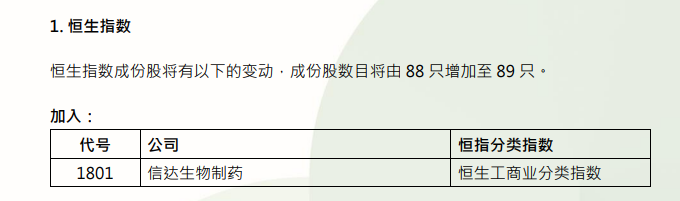
恒生指数公司发布季检结果:恒生指数纳入信达生物,成份股数目将由88只增加至89只!恒生科技指数纳入零跑汽车、剔除ASMPT


Ge Long Hui· 2025-11-21 10:29
Core Insights - The Hang Seng Index Company announced its quarterly review results, including the addition of Sinopharm to the Hang Seng Index, increasing the number of constituent stocks from 88 to 89 [1] - The Hang Seng Tech Index will include Li Auto while removing ASMPT from its constituents [1] Group 1 - The Hang Seng Index will now consist of 89 stocks following the inclusion of Sinopharm [1] - The addition of Sinopharm reflects a strategic move to enhance the index's representation of the healthcare sector [1] - The Hang Seng Tech Index's adjustment indicates a shift in focus towards electric vehicle manufacturers like Li Auto [1]
恒指公司宣布指数检讨结果,海底捞、新东方被恒生中国企业指数剔除


Xin Lang Cai Jing· 2025-11-21 10:23
Core Points - The Hang Seng Index Company announced the results of the quarterly review for the Hang Seng Index series as of September 30, 2025, with changes to be implemented after market close on December 5, 2025, and effective from December 8, 2025 [1] Group 1 - Innovent Biologics has been included in the Hang Seng Index [1] - New Hope Energy, Haidilao, and New Oriental Education have been removed from the Hang Seng China Enterprises Index [1]
恒指三季度季检结果出炉!信达生物(01801)染蓝 成份股增加至89只
智通财经网· 2025-11-21 10:21
Group 1: Hang Seng Index - Xinda Biopharmaceutical (01801) will be included in the Hang Seng Index constituent stocks, increasing the number of constituents from 88 to 89 [1][2]. Group 2: Hang Seng China Enterprises Index - China Hongqiao (01378), Xinda Biopharmaceutical (01801), and Yum China (09987) will be added to the Hang Seng China Enterprises Index, while New Energy (02688) and New Oriental Education (09901) will be removed, maintaining a total of 50 constituents [4][5]. Group 3: Hang Seng Technology Index - Leapmotor (09863) will be included in the Hang Seng Technology Index, while ASMPT (00522) will be removed, keeping the number of constituents at 30 [7][8]. Group 4: Hang Seng Composite Index - FWD Group (01828), Hesai Technology (02525), Aux Group (02580), DeepGlint (02590), Yino Pharma (02591), and Chery Automobile (09973) will be added to the Hang Seng Composite Index, increasing the number of constituents from 503 to 509 [10][11].

2026年创新药行业年度投资策略:看好工程师红利下创新突围
ZHESHANG SECURITIES· 2025-11-21 07:45
Group 1 - The report highlights the "engineer dividend" period for China's innovative drug industry, indicating that local innovations have gained full recognition from multinational corporations (MNCs) [4][5][53] - The report emphasizes the strong performance of various Chinese biotech stocks, with notable price increases observed in companies like Rongchang Biopharmaceutical (+199%) and Mawei Biopharmaceutical (+124%) in the A-share market [4][16] - The report identifies a significant increase in the number of first-in-class (FIC) drugs entering clinical trials in China, from only 9 in 2015 to an expected 120 in 2024, with China's global share of FIC drugs exceeding 30% [4][22] Group 2 - The report discusses the leading position of Chinese companies in the antibody-drug conjugate (ADC) sector, with over 50% global pipeline share in key targets such as HER2 and TROP2 [25][32] - It notes that two Chinese ADC drugs have entered the top ten global upfront payment rankings, indicating strong valuation potential for local innovations [30][31] - The report highlights the anticipated growth in bispecific antibodies (bsAbs), with Chinese companies dominating the top five global upfront payments for related assets [37][41] Group 3 - The report recommends several companies with significant global single product potential, including Kolon Biotech and Innovent Biologics, while also highlighting others like 3SBio and BeiGene as companies to watch [6][52] - It emphasizes the potential for substantial global pricing power for assets, particularly for companies like Rongchang Biopharmaceutical and Zai Lab, which are expected to see continued clinical data readouts [6][52] - The report suggests that companies like Innovent Biologics and Rongchang Biopharmaceutical are likely to turn profitable, with expectations of improved financial performance in the coming years [6][52]


抗体偶联药物ADC产业投资框架:“精准化疗”引爆千亿市场,中国创新引领全球浪潮
Shanghai Aijian Securities· 2025-11-21 06:59
Investment Rating - The report rates the industry as "Outperform" [2] Core Insights - The global market for Antibody-Drug Conjugates (ADC) is projected to exceed $100 billion, driven by the dual advantages of targeted therapy and potent cytotoxic effects [2][3] - ADCs are recognized as a promising new therapy in oncology, with the potential to redefine standard treatments for major cancers like lung and breast cancer [2][3] - China has emerged as a key player in ADC innovation, with over 50% of global ADC pipelines originating from Chinese companies, showcasing significant cost and efficiency advantages [2][3][5] Summary by Sections Section 1: ADC as a Targeted Prodrug - ADCs utilize a "Trojan horse" strategy for targeted delivery of cytotoxic agents to tumor cells, minimizing damage to normal tissues [11][13] - The mechanism involves several steps, including circulation, target binding, internalization, and release of the active drug within the tumor cell [11][13] Section 2: Market Growth and Trends - The ADC market is expected to enter a product explosion phase, with rapid growth anticipated in the coming years [2][3] - The global ADC market size is forecasted to reach $115.1 billion by 2032 [2] Section 3: Investment Opportunities - Investment in ADCs should focus on companies with innovative technology platforms and promising product candidates [2][3] - Key players to watch include those with leading ADC technology platforms and robust pipelines, such as Kelun-Biotech, Innovent Biologics, and WuXi AppTec [2][3] Section 4: Technological Advancements - ADC technology is characterized by modular upgrades and innovative combinations, with a variety of ADC types currently in development [2][3] - The report highlights the potential for ADC technology to extend into broader categories of conjugated drugs (XDC) [2][3] Section 5: Competitive Landscape - The report emphasizes the competitive nature of the ADC industry, with numerous players vying for market share and innovation [2][3] - Chinese ADC companies are recognized for their ability to lead in innovation and capture significant market opportunities [2][3][5]

海外消费周报:2026年港股医药投资策略:海外医药:聚焦创新药及产业链机会-20251121
Shenwan Hongyuan Securities· 2025-11-21 05:05
Investment Rating - The report maintains a positive outlook on the overseas pharmaceutical sector, particularly focusing on innovative drugs and industry chain opportunities, with an investment rating of "Overweight" [1][6]. Core Insights - Multiple policies are supporting the development of the innovative drug industry, with domestic innovative drug transactions reaching historical highs in both value and quantity. The sector's valuation has rebounded from a low point, and leading companies are achieving profitability through increased commercial sales and licensing income [6][8]. - Companies like BeiGene are experiencing significant growth, with global sales exceeding $1 billion in Q3 2025, marking a 51% year-on-year increase. The company anticipates a positive GAAP operating profit for the full year 2025, raising its revenue guidance to $5.1-5.3 billion [1][6]. - Innovent Biologics is expanding its pipeline with a dual focus on oncology and non-oncology products, expecting to achieve positive non-IFRS net profit and EBITDA in 2024, with continued growth projected for 2025 [2][6]. - The report highlights the increasing R&D investments by leading pharmaceutical companies, which are enhancing their innovative pipelines and accelerating their transformation towards innovation [3][7]. Summary by Sections Section 1: Overseas Pharmaceuticals - The report emphasizes the focus on innovative drugs and the opportunities within the industry chain for 2026, noting the historical highs in transaction amounts and numbers for domestic innovative drugs going overseas [6][8]. - BeiGene's overseas sales are highlighted, with Q3 2025 global sales surpassing $1 billion and a significant year-on-year profit turnaround [1][6]. - Innovent Biologics is noted for its strategic partnerships and expected profitability in the coming years [2][6]. Section 2: Pharma Sector - Leading companies are rapidly increasing their R&D investments, which is expected to strengthen their innovative pipelines and global competitiveness [3][7]. - Companies like Hansoh Pharmaceutical and China Biologic Products are projected to see substantial growth in their innovative product revenues, with significant contributions expected in the coming years [3][7]. Section 3: CXO Sector - The report indicates a recovery in investment and financing for innovative drugs, which is likely to drive early-stage R&D investments and boost demand [8]. - Emerging fields such as peptides and ADCs are expected to open new growth opportunities, with a recommendation to focus on companies like WuXi AppTec and WuXi Biologics [8].



创新药概念股跌幅居前 创新药BD已有降温迹象 降息预期降温或冲击估值及投融资
Zhi Tong Cai Jing· 2025-11-21 03:03
Group 1 - The core viewpoint of the article indicates a decline in innovative drug concept stocks, with significant drops in companies such as Heptares Therapeutics-B (down 9.15% to HKD 12.81), Tansheng Bo Pharmaceutical-B (down 7.56% to HKD 1.59), and others [1] - The report highlights a cooling trend in the business development (BD) of innovative drugs, with a total transaction amount of USD 60.8 billion in the first half of 2025, representing a year-on-year increase of 129%. However, the growth rate has started to decline since the third quarter of this year [1] - The U.S. employment report for September shows economic resilience, leading Morgan Stanley to abandon its previous prediction of a 25 basis point rate cut by the Federal Reserve in December. The new forecast suggests rate cuts in January, April, and June 2026, lowering the target policy rate to a range of 3%-3.25% [1] Group 2 - Analysts suggest that the cooling expectations for Federal Reserve rate cuts may impact the valuations of the innovative drug sector and overseas biopharmaceutical investment and financing [1]
港股异动 | 创新药概念股跌幅居前 创新药BD已有降温迹象 降息预期降温或冲击估值及投融资
智通财经网· 2025-11-21 03:00
Group 1 - The innovative drug concept stocks have experienced significant declines, with notable drops including: Heptares Therapeutics-B down 9.15% to HKD 12.81, Tiansheng Bo Pharmaceutical-B down 7.56% to HKD 1.59, Rongchang Biopharmaceutical down 5.83% to HKD 80, and Innovent Biologics down 6.18% to HKD 86.5 [1] - There are signs of cooling in the innovative drug business development (BD) sector, with data indicating that the total transaction amount in the first half of 2025 in China is projected to be USD 60.8 billion, a year-on-year increase of 129%. In the first three quarters of this year, the transaction amount reached USD 93.7 billion, reflecting a year-on-year growth of 64% [1] - The decline in growth rates for domestic innovative drug BD transactions began in the third quarter, indicating a potential slowdown in the sector [1] Group 2 - The U.S. September employment report shows economic resilience, leading Morgan Stanley to abandon its previous prediction of a 25 basis point rate cut by the Federal Reserve in December [1] - Morgan Stanley now forecasts that the Federal Reserve will lower interest rates in January, April, and June of 2026, bringing the target policy rate range down to 3%-3.25% [1] - Analysts suggest that the cooling expectations for Federal Reserve rate cuts may impact the valuations of the innovative drug sector and overseas biopharmaceutical investment and financing [1]
港股开盘再度走低,资金近期密集流入港股科技ETF
Xin Lang Cai Jing· 2025-11-21 02:27
Group 1 - Recent focus on the unlocking of restricted shares in the Hong Kong stock market, with significant declines observed in stock prices, such as a drop of 8.75% for CATL's H-shares [1] - Upcoming unlocks for companies including Sanhua Intelligent Control and Hengrui Medicine, with Hai Tian Flavor Industry scheduled for December, potentially exerting pressure on stock prices [1] - The Hang Seng Technology Index has experienced a correction of over 18% since its peak after the National Day holiday, indicating a broader market trend [1] Group 2 - Continuous inflow of funds into the Hang Seng Technology/ Hong Kong Technology/ Hong Kong Stock Connect Internet sectors, with the Hong Kong Technology ETF (159751) seeing a net inflow of 50.63 million yuan over four days [1] - The average daily net inflow for the Hong Kong Technology ETF reached 12.66 million yuan, highlighting investor interest [1] - Institutional investors are expected to have reduced pressure for profit-taking in November and December, leading to a neutral upward expectation for the index despite economic meeting forecasts [1] Group 3 - The CSI Hong Kong Stock Connect Technology Index (931573) includes top-weighted stocks such as Alibaba, Tencent, and SMIC, with the top ten stocks accounting for 66.81% of the index [2]


