XIAOMI(01810)

Search documents
耐用消费产业行业研究:关注潮玩节日催化,新型烟草日本上新,AI消费多款新品上市
SINOLINK SECURITIES· 2026-01-25 14:24
Investment Rating - The report provides a positive outlook on several sectors, indicating a recovery or growth potential in areas such as new tobacco, packaging, and AI-related products [6][11][15]. Core Insights - The report highlights the importance of seasonal marketing strategies in the collectible toy sector, particularly around Chinese New Year and Valentine's Day, with companies like Pop Mart and Blokus launching limited edition products [7][8]. - In the new tobacco sector, there is a strong push for innovation and international expansion, with major players increasing their investments in heated tobacco products (HNB) and electronic cigarettes [11][12]. - The home furnishing market is experiencing a downturn in domestic sales, but there are signs of recovery in exports, particularly to Southeast Asia [13][14]. - The packaging industry is expected to benefit from a steady recovery in downstream demand, supported by growth in consumer goods sectors [15][16]. - The pet food industry is facing increased competition, leading to higher sales expense ratios, but there are opportunities for consolidation among listed companies [21]. Summary by Sections 1.1 Collectible Toys - Focus on seasonal marketing and the integration of AI in toys, with companies like Pop Mart and Blokus leading the charge [7][8]. - The industry is seeing a shift towards cross-industry collaborations and enhanced IP value [7]. 1.2 New Tobacco - The report notes a projected decline in electronic cigarette exports in 2025, with a focus on the need for innovation in the domestic market [11]. - Major tobacco companies are increasing their investments in HNB products, indicating a significant growth potential in this segment [12]. 1.3 Home Furnishing - Domestic sales are under pressure, with a notable decline in new and second-hand home transactions [13]. - Export growth is observed, particularly to Southeast Asia, suggesting a potential recovery in international demand [14]. 1.4 Packaging - The packaging sector is expected to see a steady recovery in demand, supported by growth in consumer goods [15][16]. - Price adjustments in raw materials like aluminum may impact packaging companies' operations [16]. 1.5 Personal Care and AI Glasses - The personal care sector is focusing on high-end products and international expansion, with companies like Procter & Gamble seeing mixed results [17]. - The AI glasses market is shifting focus from VR to AI wearable technology, with major companies like Apple and Meta adjusting their strategies [17]. 1.6 Xiaomi Group - Xiaomi is initiating a share buyback program, reflecting confidence in its business outlook [18]. - The company is also focusing on its smartphone and automotive segments, with a strong emphasis on high delivery targets for 2026 [19][20]. 1.7 Pet Food and Supplies - Increased competition in the pet food sector is leading to higher sales expenses, but opportunities for consolidation exist among listed companies [21]. - New developments in pet healthcare services are emerging, indicating growth potential in this area [21]. 1.8 Silver Economy - The government is implementing a subsidy program for elderly care services, which may boost demand in the silver economy sector [25][26]. 1.9 AI and 3D Printing - The 3D printing industry is experiencing significant growth, with exports increasing substantially [27]. - Innovations in 3D printing technology are expected to drive further expansion in this sector [27]. 1.10 AI Mattresses - A new startup focusing on sleep health technology is gaining attention, with plans to develop a range of AI-integrated sleep products [32]. 1.11 Two-Wheel Vehicles - The two-wheeler market is recovering as major manufacturers comply with new regulations, leading to a resurgence in product offerings [33][34].


雷军点评小米汽车熔岩橙绝版:很帅,但敢买的人太少
Sou Hu Cai Jing· 2026-01-25 11:59
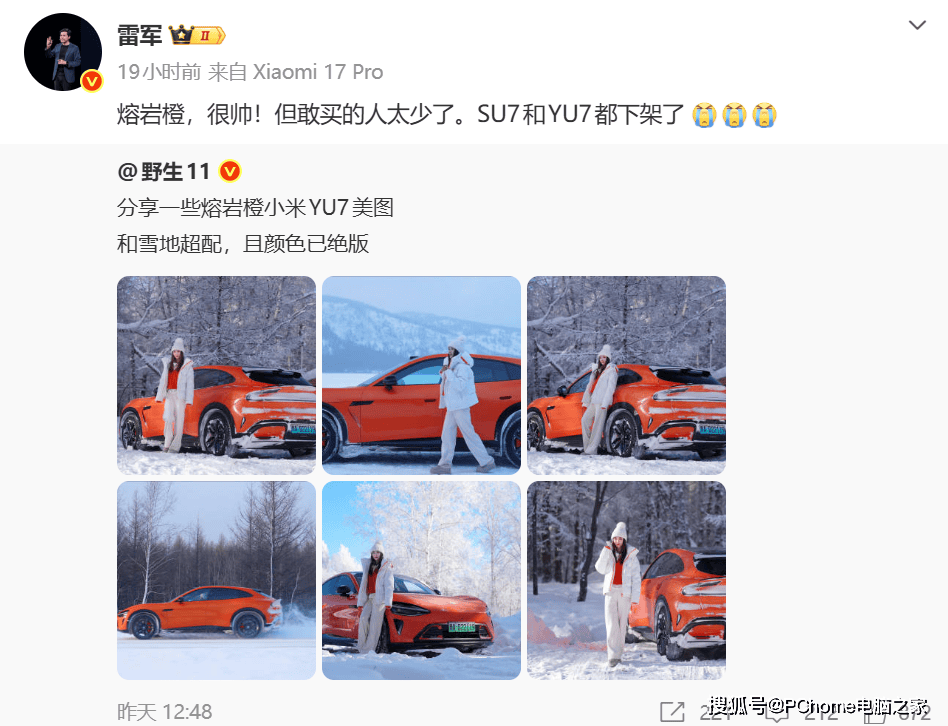
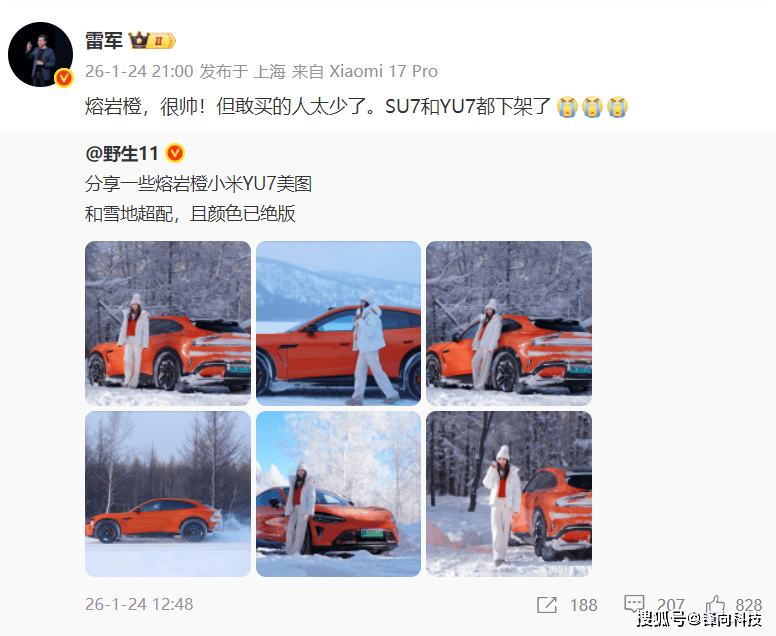
1月25日,小米创始人雷军今日转发了一位博主发布的关于小米汽车熔岩橙配色的博文,并配文"欢迎更多熔岩橙车主晒照片"。日前,另一位汽车博主分享 的熔岩橙小米YU7美图引发关注,雷军转发并连发三个泪目表情。表示该经典配色因敢买的人太少,SU7和YU7均已下架,言语间满是不舍。 熔岩橙与小米品牌色高度契合,早期是重点推荐配色。熔岩橙采用了色漆双涂层工艺,在逆光和正面高光的不同光源照射下,可呈现出截然不同的颜色状 态:低光下,第一道单色层给人以高彩度橙色目视观感,由纯粹红浆和橙浆构成,膜厚10微米左右;高光下,第二道金属珠光层完全由半透明的效果珠光构 成,涂层膜厚仅为6微米。在原材料的选择上,熔岩橙的色浆选择了苯并咪唑酮系偶氮类有机橙浆,这款橙浆的比表面积达到80m(2)/g,相当于1g颜料可以 涵盖半个标准排球场。 去年3月小米SU7上市时,雷军就曾晒出熔岩橙照片,并表示"有品位、足够自信的人才能真正驾驭,开这样的车到北京三里屯,能不能炸街"。去年7月,小 米集团合伙人卢伟冰也购入熔岩橙小米YU7。网友对熔岩橙评价不错,却多是"你买我推荐,我买我不买"。雷军也感慨一款好看且大家都敢买的车漆太难。 事实上,橙色在汽车 ...

耐用消费周报:关注潮玩节日催化,新型烟草日本上新,AI消费多款新品上市-20260125
SINOLINK SECURITIES· 2026-01-25 11:02
Investment Ratings - The report provides a positive outlook on the new tobacco industry, indicating a steady upward trend, while the home furnishing and packaging sectors are stabilizing at the bottom [6][11][15]. Core Insights - The report highlights the marketing strategies around the Spring Festival and Valentine's Day for trendy toys, with companies like Pop Mart and Blok launching limited series to enhance IP value and collectability [7][8]. - In the new tobacco sector, the necessity for domestic development is emphasized, with major players increasing investments in heated tobacco products (HNB) and innovative marketing strategies [11][12]. - The home furnishing market is experiencing a contraction in sales, with significant declines in both new and second-hand property transactions, but there are signs of potential recovery driven by policy support [13][14]. - The packaging industry is expected to benefit from a steady recovery in downstream demand, supported by growth in consumer goods sectors [15][16]. - The pet food industry is facing increased competition, leading to higher sales expense ratios, but listed companies are leveraging their financial advantages for mergers and acquisitions [21]. Summary by Sections Trendy Toys - Focus on marketing strategies for key holidays, with companies like Pop Mart and Blok launching special editions to enhance brand value [7]. - The integration of AI in toys is gaining traction, with companies like Kid King and JD.com developing AI products to meet family needs [8][9]. New Tobacco - The report notes a projected decline in electronic cigarette exports, with a focus on the need for innovation in the domestic market [11]. - Major tobacco companies are increasing their investments in HNB products, indicating a significant growth potential in this segment [12]. Home Furnishing - The report indicates a significant drop in property transactions, with new home sales down 29.23% year-on-year and second-hand home sales down 8.94% [13]. - Despite current challenges, there is optimism for recovery in the home furnishing sector due to supportive policies [14]. Packaging - The packaging sector is expected to see a recovery in demand, with growth in consumer goods contributing positively to the industry [15][16]. - The report highlights price fluctuations in raw materials, particularly in the paper and aluminum sectors, which could impact packaging costs [15]. Pet Food - Increased competition in the pet food industry is leading to higher sales expenses, but established companies are positioned to benefit from consolidation opportunities [21]. - The report suggests focusing on companies with strong brand recognition and those actively pursuing mergers and acquisitions [21].




大众ID.ERA 9X预批量生产,威然停止后续研发;雷军:新一代小米SU7争取春节前部分样车进店丨汽车交通日报
创业邦· 2026-01-25 10:33
Group 1 - Xiaomi's founder Lei Jun announced that the new generation SU7 model aims to have some sample cars in stores before the Spring Festival, with pre-orders already starting [2] - American automakers have seen a continuous decline in their overseas business, with General Motors reporting that only 8% of its revenue comes from markets outside the US, Canada, and Mexico in Q3 [2] - Ford's market share in the EU has dropped from 5% in 2020 to 3% last year, following the closure of its factory in Germany [2] Group 2 - BYD plans to increase its overseas deliveries by nearly 25%, targeting sales of 1.3 million vehicles outside China by 2026, up from 1.05 million last year [2] - SAIC Volkswagen's ID.ERA 9X is in pre-production and is expected to launch in March, while the Viloran luxury MPV has halted further development due to poor market performance [2]


雷军三次泪目!小米熔岩橙彻底停售,背后真相令人扎心
Sou Hu Cai Jing· 2026-01-25 10:33
Core Viewpoint - Xiaomi's CEO Lei Jun expressed disappointment over the poor market reception of the "Lava Orange" color for their vehicles, indicating a disconnect between consumer preferences and the company's vision for unique car designs [1][3]. Group 1: Market Response - The "Lava Orange" color option for Xiaomi's SU7 and YU7 models has been discontinued due to low sales, with consumers hesitant to pay an additional 7,000 yuan for this color option [3][5]. - The high maintenance costs and lower resale value of vibrant colors like "Lava Orange" contribute to consumer reluctance, as these colors are perceived as less practical compared to mainstream options [3][5]. Group 2: Design and Innovation - Xiaomi's foray into the automotive market has been characterized by a struggle to balance innovative design with consumer demand, as the company aims to offer more personalized choices while facing market realities [5][7]. - The controversy surrounding the design of Xiaomi's vehicles, particularly accusations of copying Porsche, highlights the challenges of establishing a unique brand identity in a competitive market [5][7]. Group 3: Future Outlook - Despite the setback with the "Lava Orange" color, the company remains committed to understanding consumer needs and may explore more practical yet unique color options in the future [7].
雷军谈小米SU7 / YU7汽车绝版配色「熔岩橙」:敢买的人太少
Sou Hu Cai Jing· 2026-01-25 07:22
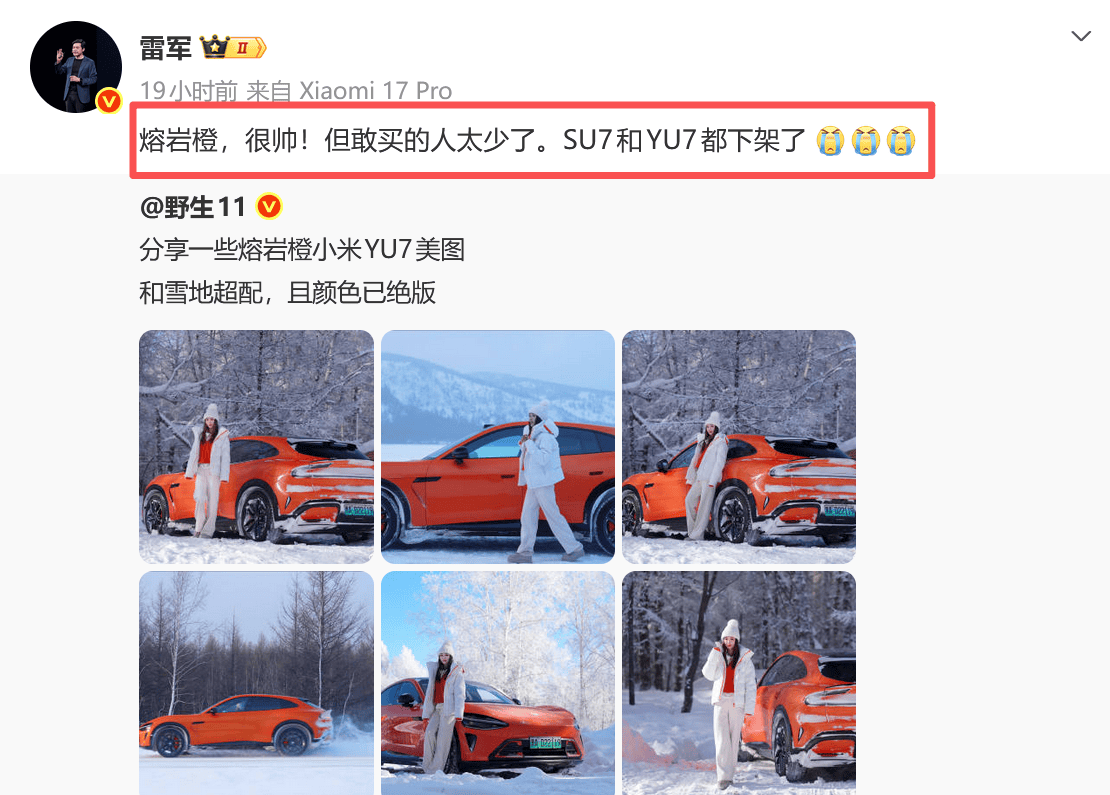
Group 1 - The founder and CEO of Xiaomi, Lei Jun, expressed his admiration for the "Lava Orange" color of the Xiaomi YU7 model, noting that very few people are willing to purchase it [1] - Lei Jun commented that it is challenging to find a car paint that is both attractive and widely accepted by consumers [3] - Xiaomi announced a total of nine color options for the SU7 model, including the newly introduced "Lava Orange," during the pre-launch event on March 28, 2024 [3] Group 2 - The Xiaomi YU7 model previously featured a "Lava Orange" wallpaper released by the official Xiaomi automotive team in May of last year [5] - Current color options for the YU7 model include Gem Green, Titanium Metal, Flowing Gold Pink, Shadow Blue, Cambrian Gray, and Pearl White [7]
熔岩橙下架,雷军泪目、周意保在辟谣、荣耀在发限量版
Sou Hu Cai Jing· 2026-01-25 06:02
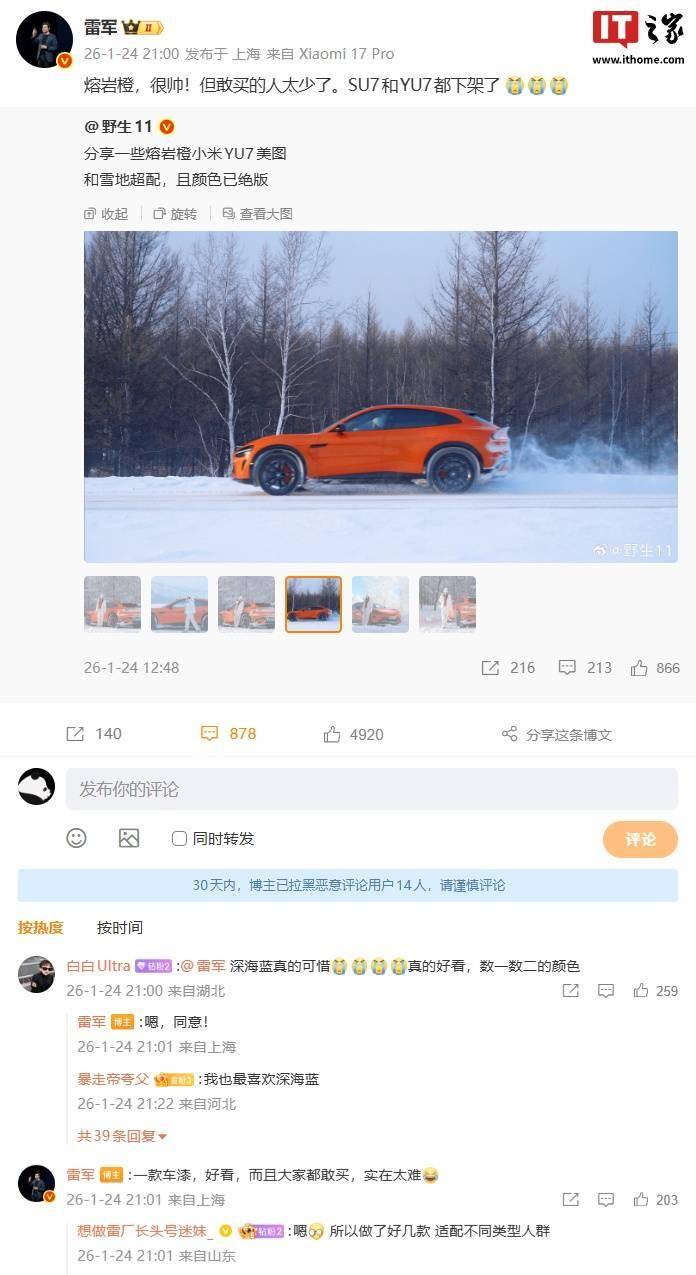
Group 1 - Xiaomi has discontinued the lava orange color for its SU7 and YU7 models, with CEO Lei Jun expressing disappointment over low sales despite the color's unique appeal and high production difficulty [5] - The Honor 500 Pro MOLLY 20th Anniversary Limited Edition has been launched, featuring a fully customized design in collaboration with Pop Mart, priced at 4,499 yuan, with a post-subsidy price of 3,999 yuan; the Honor 500 series is approaching 1 million units sold [7] - OPPO's product manager Zhou Yibao has denied rumors regarding the design of the Find X9 Ultra, stating that the leaked images are false and that the official announcement will come after the Spring Festival [8]
雷军:新一代小米SU7争取春节前部分样车进店
Mei Ri Jing Ji Xin Wen· 2026-01-25 02:38
每经AI快讯,1月25日,小米创办人、董事长兼CEO雷军发文表示,新一代SU7卡布里蓝实车非常漂 亮,争取春节前部分样车能够进店,到时候大家就可以到店感受。现在已经开始小订。 (文章来源:每日经济新闻) ...
Xiaomi Suffers EV/Smartphone Headwinds - Oversold Indicators Imply Trading Floor
Seeking Alpha· 2026-01-24 14:05
Core Viewpoint - The article emphasizes the importance of conducting personal in-depth research and due diligence before making investment decisions, highlighting the inherent risks involved in trading [3]. Group 1 - The analysis is intended solely for informational purposes and should not be interpreted as professional investment advice [3]. - There is a clear disclaimer regarding the lack of any stock, option, or similar derivative positions in the companies mentioned, indicating a neutral stance [2]. - The article expresses the author's personal opinions and does not reflect the views of any affiliated organization [4].


抖音回应演员孙涛遭网暴
21世纪经济报道· 2026-01-24 13:40
Group 1 - Douyin announced on January 24 that recent rumors regarding actor Sun Tao, including claims of him supporting Yan Xuejing during a live stream and selling grains, are false. The platform's verification team found no evidence supporting these claims, which originated from malicious marketing accounts [1] - Douyin has implemented a truth-seeking card to address the rumors, displaying it in relevant trending topics and search results. Over 8,000 videos related to the rumors have been taken down, and the original account spreading the rumors has been banned [1] - Since January 7, Douyin has activated a protection mechanism for Sun Tao's account, resulting in the removal of over 170,000 negative comments and the banning of seven violating accounts for periods ranging from 7 to 30 days [2] Group 2 - On January 23, Sun Tao publicly denied the false claims about him and revealed that he has initiated legal proceedings to protect his rights. He is a well-known comedian who has participated in over 20 Spring Festival Gala performances since 1995 [3] - Yan Xuejing recently faced backlash for comments made during a live stream about her family's income, which led to accusations of "showing off wealth." She later apologized for her remarks, indicating a sensitivity to public perception [7]