
XIAOMI(01810)

Search documents
小米取得摄像头模组和电子设备专利
Jin Rong Jie· 2026-02-06 12:45
Group 1 - The core point of the article is that Beijing Xiaomi Mobile Software Co., Ltd. has obtained a patent for "Camera Module and Electronic Device," with the authorization announcement number CN115695990B, and the application date was July 2021 [1] - Beijing Xiaomi Mobile Software Co., Ltd. was established in 2012 and is located in Beijing, primarily engaged in software and information technology services [1] - The registered capital of Beijing Xiaomi Mobile Software Co., Ltd. is 148.8 million RMB [1] Group 2 - The company has made investments in 4 enterprises and has participated in 150 bidding projects [1] - The company holds 5000 patent information records and has 123 administrative licenses [1]
小米取消SU7 Ultra专属销售岗位
Xin Lang Cai Jing· 2026-02-06 12:41
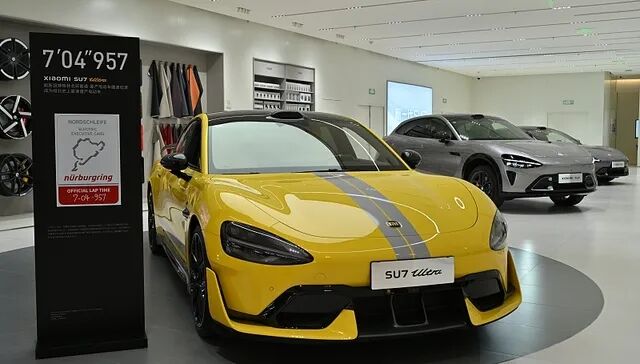
Core Viewpoint - Xiaomi Auto has adjusted its sales organization structure by eliminating dedicated sales positions for the high-end electric vehicle model SU7 Ultra, allowing all store sales personnel to sell this model starting from the end of January. This change aims to optimize the service experience for the SU7 Ultra and reflects a shift in focus towards more mainstream products due to declining demand for the model [2][3]. Sales Structure Adjustment - The sales rights for the SU7 Ultra will now be open to all sales staff, with the original dedicated sales team being reassigned to other models. The company claims that the adjustment will enhance service experience, despite rumors of a "professional team dissolution" being labeled as false [2]. - The decision follows a notable decline in SU7 Ultra sales after an initial peak, prompting Xiaomi to redirect resources towards more volume-driven products [2][3]. Sales Team Insights - A former dedicated sales representative for the SU7 Ultra reported receiving two options: to resign with compensation or to transition to a general sales role with a significantly lower base salary and potential for reduced commissions [3]. - The dedicated sales team had already seen reductions, with only about 30 members remaining nationwide before the full adjustment. The initial sales strategy aimed at high-net-worth individuals has not yielded the expected results, leading to a reassessment of the sales approach [3][5]. Sales Performance and Market Trends - The SU7 Ultra experienced a dramatic drop in sales, from over 15,000 pre-orders on launch day to just 45 units sold by December of the same year. This decline reflects broader market trends affecting high-end vehicles, with luxury car sales sensitive to economic fluctuations [5][6]. - The high-end automotive market is facing challenges, with a projected 1.5 percentage point decline in the market share for vehicles priced above 400,000 yuan by 2025 [6]. Future Outlook - Xiaomi Auto is focusing on its two main models, with the SU7's sales dropping from nearly 30,000 units per month to 11,100 units by December. The company has a backlog of around 100,000 orders, indicating a need for new product launches to maintain momentum [7]. - The company aims to sell 550,000 vehicles in 2026, representing a 34% increase from the expected 410,000 deliveries in 2025. The gross margin for Xiaomi's smart electric vehicles and AI innovation business is currently at 25.5% [7].

小米取得电子设备专利,提高电子设备的声音质量
Jin Rong Jie· 2026-02-06 12:25
Group 1 - The core point of the article is that Beijing Xiaomi Mobile Software Co., Ltd. has obtained a patent for an electronic device aimed at improving sound quality [1] - The patent, titled "Electronic Device," was authorized with announcement number CN223885417U and has an application date of December 2024 [1] - The electronic device includes a housing with a pressure relief hole, a sound module, a pressure relief component, and an elastic membrane, all designed to enhance audio performance [1] Group 2 - Beijing Xiaomi Mobile Software Co., Ltd. was established in 2012 and is primarily engaged in software and information technology services [1] - The company has a registered capital of 148.8 million RMB and has made investments in 4 enterprises, participated in 150 bidding projects, and holds 5000 patent records [1] - Additionally, the company possesses 123 administrative licenses according to data from Tianyancha [1]
小米YU7GT申报图公布,极速300km/h
Bei Ke Cai Jing· 2026-02-06 12:12
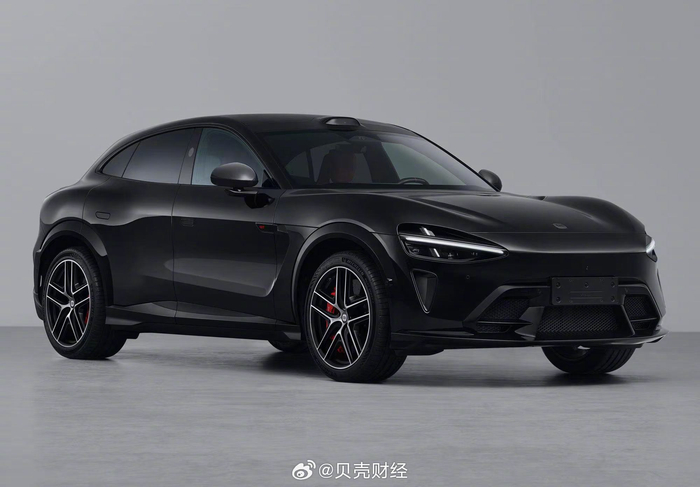
Core Viewpoint - Xiaomi's YU7 GT has been listed in the latest announcement from the Ministry of Industry and Information Technology, indicating its entry into the electric vehicle market with a focus on high performance and energy efficiency [1] Group 1 - The YU7 GT features a fully blacked-out design, appealing to consumers looking for a modern aesthetic in electric vehicles [1] - The vehicle is capable of reaching speeds up to 300 km/h, positioning it as a high-performance option in the electric vehicle segment [1] Group 2 - The announcement includes the 404th batch of vehicle production enterprises and products, highlighting regulatory approval for new models in the automotive industry [1] - The inclusion of the YU7 GT in the directory for energy-saving new energy vehicles suggests potential tax benefits, which could enhance its market competitiveness [1]
千问请喝奶茶的免费效应下,Agent会迎来爆发吗?
3 6 Ke· 2026-02-06 11:43
Core Insights - The article highlights the significant role of AI Agents in enhancing user experience and operational efficiency, particularly during the Chinese New Year, with major companies like Alibaba and Tencent leading initiatives to promote AI technology [1][2][11]. Group 1: AI Agent Development and Adoption - Alibaba's "Qianwen" app launched a "30 billion free order" campaign, allowing users to interact with AI for various tasks, marking a significant step in user education about AI capabilities [1][2]. - The integration of AI Agents into Alibaba's ecosystem, including services like Taobao and Alipay, demonstrates the potential for seamless user experiences without switching between apps [2][10]. - A survey by LangChain indicates that 57% of organizations are already running AI Agents in production environments, with predictions that the integration of autonomous AI in enterprise software will rise from less than 1% in 2024 to 33% by 2028 [6]. Group 2: Business Model and Market Strategy - AI Agents provide a viable monetization path for large model vendors, addressing the long-standing issue of high costs and low returns associated with large models [8]. - Companies can adopt a "Robots as a Service" (RaaS) model, charging clients based on delivered results, which allows for deeper integration into core business processes [8][9]. - Consumer-facing AI Agents are expected to penetrate daily life through subscription models, enhancing user efficiency and creating a complete service loop within ecosystems [10]. Group 3: Competitive Landscape - Major tech companies are accelerating their AI Agent strategies, with ByteDance and Tencent also investing heavily in this area to create comprehensive service ecosystems [11][12]. - The smartphone industry is witnessing a race to integrate AI Agent capabilities, with companies like Honor and Xiaomi positioning themselves to lead in this new competitive dimension [12]. Group 4: Challenges and Future Outlook - Despite the consensus on the importance of AI Agents, challenges remain in terms of service delivery, user trust, and the need for effective multi-Agent collaboration [13][14]. - The stability of output quality and data security are identified as primary concerns for enterprises adopting AI Agents, indicating that overcoming these barriers will be crucial for widespread adoption [14].



雷军:福特 CEO 法利试驾小米 SU7 后爱不释手,称“不想跟这车分开”
Xin Lang Cai Jing· 2026-02-06 11:26
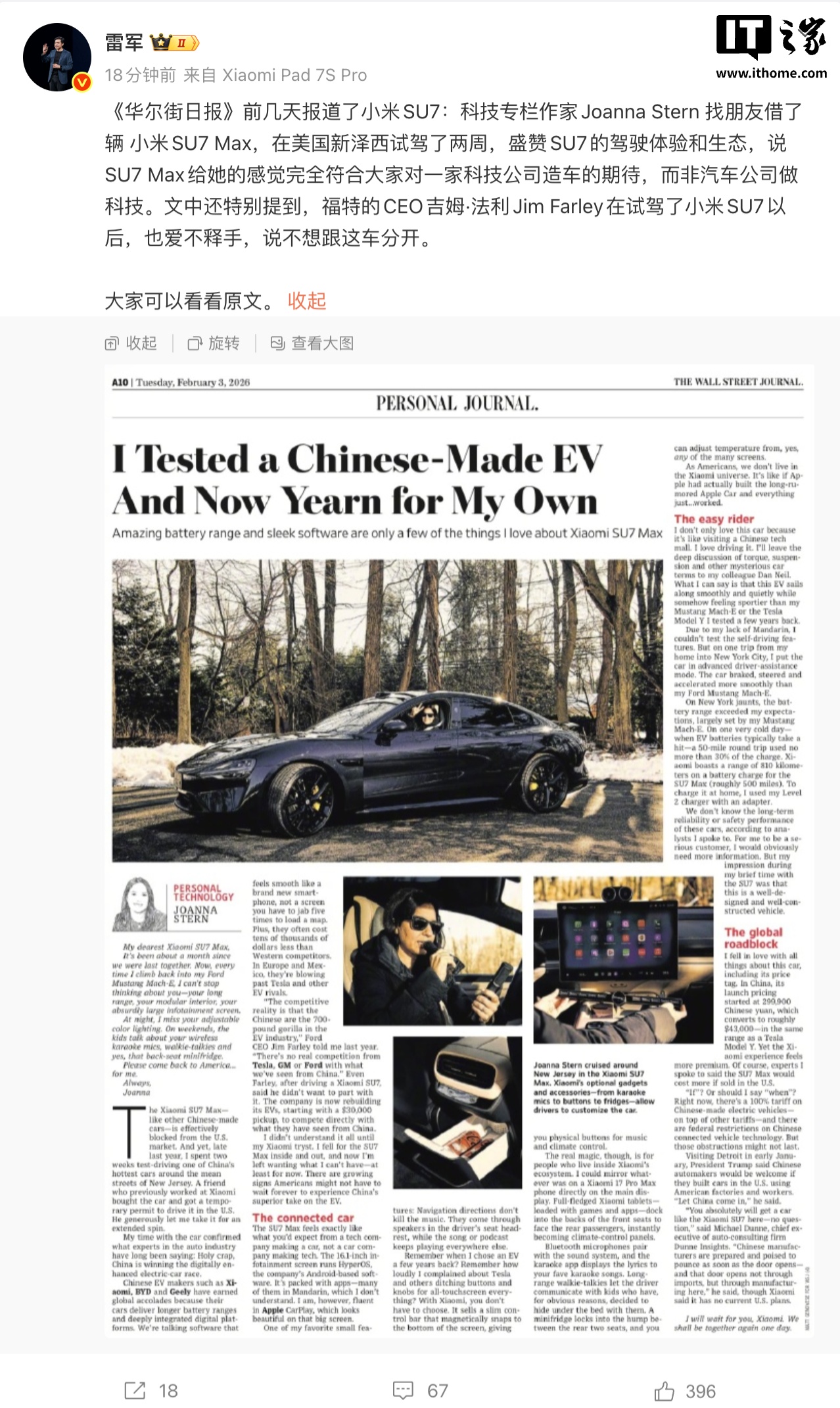
Core Insights - Xiaomi's SU7 Max has received positive reviews from notable figures, including Ford CEO Jim Farley, who praised its advanced technology and driving experience, indicating a strong alignment with consumer expectations for a tech company entering the automotive space [1][12][30] - There are ongoing discussions about potential collaborations between Xiaomi and Ford, which could facilitate the entry of Chinese automakers into the U.S. market, although both companies have denied any current negotiations [10][30] Group 1: Product Reception - Joanna Stern from The Wall Street Journal test-drove the Xiaomi SU7 Max and highlighted its impressive driving experience, stating it meets expectations for a tech company producing vehicles rather than a traditional car manufacturer [1][11] - Farley expressed that the SU7 Max's technology surpasses many European luxury brands, particularly noting its facial recognition feature that simplifies the vehicle pairing process [10][29] - Farley has been using the SU7 for six months and has consistently praised its performance and design [10][30] Group 2: Market Implications - The positive reception of the SU7 Max suggests that Chinese electric vehicle (EV) manufacturers like Xiaomi are gaining recognition for their superior battery range and integrated digital platforms, which are often more affordable than Western competitors [20][21] - The potential collaboration between Xiaomi and Ford could pave the way for Chinese EVs to enter the U.S. market, although current reports of negotiations have been denied by both parties [10][30] - The competitive landscape indicates that Chinese EV makers are becoming significant players in the global market, with Farley acknowledging the lack of competition from Western manufacturers [21]

小米取得背光模组、终端设备及其组装方法专利
Jin Rong Jie· 2026-02-06 11:21
Group 1 - The core point of the article is that Beijing Xiaomi Mobile Software Co., Ltd. has obtained a patent for "backlight module, terminal device, and its assembly method," with the authorization announcement number CN116931322B, and the application date being April 2022 [1] Group 2 - Beijing Xiaomi Mobile Software Co., Ltd. was established in 2012 and is located in Beijing, primarily engaged in software and information technology services [1] - The company has a registered capital of 148.8 million RMB [1] - According to data analysis, the company has invested in 4 enterprises, participated in 150 bidding projects, and holds 5000 patent records, along with 123 administrative licenses [1]
小米集团-W2月6日斥资2620.8万港元回购75万股
Zhi Tong Cai Jing· 2026-02-06 10:55
小米集团-W(01810)发布公告,该公司于2026年2月6日斥资2620.8万港元回购75万股股份,每股回购价 格为34.76-35港元。 ...
小米集团-W(01810)2月6日斥资2620.8万港元回购75万股
智通财经网· 2026-02-06 10:52
智通财经APP讯,小米集团-W(01810)发布公告,该公司于2026年2月6日斥资2620.8万港元回购75万股 股份,每股回购价格为34.76-35港元。 ...
小米集团-W(01810.HK)2月6日耗资2620.8万港元回购75万股
Ge Long Hui· 2026-02-06 10:48
格隆汇2月6日丨小米集团-W(01810.HK)公告,2月6日耗资2620.8万港元回购75万股。 ...