
MIXUE GROUP(02097)

Search documents
蜜雪集团发中报港股跌5.27% 近期被2投行下调评级
Zhong Guo Jing Ji Wang· 2025-08-27 09:24
Core Viewpoint - The stock price of Mixue Group (02097.HK) fell by 5.27% to HKD 460.40, following the release of its mid-year results and downgrades from two major investment banks [1]. Financial Performance - For the first half of the year, Mixue Group reported revenue of CNY 14.87 billion, representing a year-on-year growth of 39.3% [1]. - The gross profit for the same period was CNY 4.71 billion, with a year-on-year increase of 38.3% [1]. - The net profit reached CNY 2.72 billion, showing a year-on-year growth of 44.1% [1]. Investment Ratings - Recently, Bank of America and UBS downgraded their ratings for Mixue Group. UBS lowered its rating from "Neutral" to "Sell," while Bank of America downgraded from "Neutral" to "Underperform" [1].
全球门店破5.3万家,蜜雪集团上半年净利润大增44.1%
Guan Cha Zhe Wang· 2025-08-27 08:00
Core Insights - In the first half of 2025, Mixue Group reported a revenue of 14.87 billion yuan, a year-on-year increase of 39.3%, with gross profit reaching 4.71 billion yuan, up 38.3%, and net profit at 2.72 billion yuan, reflecting a growth of 44.1% [1][2][3] Financial Performance - The company achieved high double-digit growth across key financial metrics, indicating strong operational performance [1] - The product matrix expansion contributed significantly to revenue growth, with top-selling items including ice lemon water, fresh ice cream, jasmine milk green tea, pearl milk tea, and fresh orange juice [1] Product Development - New product launches included a series of innovative beverages and ice creams, with the "Qing Ti Rou Duo Duo" selling over 7 million cups within three days of its launch [1] - The coffee brand "Lucky Coffee" introduced several new product lines, achieving over 100 million yuan in sales in the month following the launch of the "True Fruit Coffee" series [1] Store Expansion - As of June 30, 2025, the total number of global stores reached 53,014, with an increase of 9,796 stores compared to the previous year [1][2] - The company focused on deepening its presence in lower-tier cities, with 27,804 stores located in tier-three and below cities, accounting for 57.6% of its domestic store count [2] Market Strategy - Mixue Group is actively expanding its overseas market presence, with new store openings in Southeast Asia, including Malaysia and Kazakhstan [2] - The company has established a robust supply chain with a global procurement network covering 38 countries and five production bases [2] Brand Development - The company is enhancing its brand IP strategy, with the "Xue Wang" IP gaining popularity across various age groups, and the "蜜雪冰城" topic accumulating over 54.2 billion views on Douyin [2][3] - The core competitive advantage of the company lies in its "supply chain + brand IP + store operations" strategy, which is expected to be further strengthened in the future [3]


蜜雪集团(02097.HK)公布中期业绩 利润大幅增长44.1% 稳步推进全球化布局
Ge Long Hui· 2025-08-27 04:32
Group 1 - The company reported a revenue of 14.875 billion RMB for the six months ending June 30, 2025, representing a year-on-year growth of 39.3% [1] - The profit for the same period was 2.718 billion RMB, showing a year-on-year increase of 44.1%, with basic earnings per share at 7.23 RMB [1] - The increase in revenue was primarily driven by higher sales from products and equipment, followed by income from franchising and related services [1] Group 2 - The company maintained steady growth in the first half of 2025, focusing on supply chain enhancement, brand IP development, and store operation optimization [2] - The number of franchise stores increased from 43,197 as of June 30, 2024, to 52,996 as of June 30, 2025, indicating high-quality expansion [2] - The number of franchisees also grew from 19,310 to 23,404 during the same period, reflecting the company's successful franchise model [2] Group 3 - As of June 30, 2025, the company has established a vast network of over 53,000 stores globally, providing high-quality and affordable products [3] - The store network in mainland China covers all provincial-level regions and over 300 cities, distinguishing the company from other beverage brands [3] - The company has initiated the testing and promotion of smart dispensing machines across its stores, with over 5,600 locations adopting this technology to enhance operational efficiency and consumer experience [3]
蜜雪集团:上半年净利润27.18亿元 同比增长44.1%
Zheng Quan Shi Bao Wang· 2025-08-27 04:28
Group 1 - The core viewpoint of the article highlights that Mixue Group (02097.HK) reported significant financial growth in the first half of the year, with revenue reaching 14.875 billion yuan, representing a year-on-year increase of 39.3% [1] - The net profit for Mixue Group was 2.718 billion yuan, showing a year-on-year growth of 44.1% [1]
蜜雪集团发布中期业绩 股东应占溢利26.93亿元 同比增加42.9%
Zhi Tong Cai Jing· 2025-08-27 04:22
Group 1 - The core viewpoint of the articles highlights the significant growth in revenue and profit for the company, with a 39.32% year-on-year increase in revenue to 14.875 billion RMB and a 42.9% increase in net profit to 2.693 billion RMB for the six months ending June 30, 2025 [1] - The increase in revenue is primarily attributed to higher sales from products and equipment, as well as growth in franchise and related services [1] - The gross margin for product and equipment sales slightly decreased from 30.5% to 30.3%, mainly due to rising raw material costs and changes in revenue structure [1] Group 2 - The company has established a vast store network with over 53,000 locations globally, providing high-quality and affordable products to consumers [2] - In mainland China, the store network covers all provincial-level regions and over 300 cities, distinguishing the company from other beverage brands [2] - The company has also opened approximately 4,700 stores outside mainland China, focusing on Southeast Asia and gradually expanding its global presence [2]
蜜雪集团(02097)发布中期业绩 股东应占溢利26.93亿元 同比增加42.9%
智通财经网· 2025-08-27 04:21
Core Viewpoint - The company, Mixue Group, reported a significant increase in its mid-term performance for the six months ending June 30, 2025, with revenue reaching 14.875 billion RMB, a year-on-year increase of 39.32% [1] Financial Performance - Revenue for the period was 14.875 billion RMB, up 39.32% year-on-year [1] - Gross profit amounted to 4.706 billion RMB, reflecting a 38.31% increase compared to the previous year [1] - Shareholders' profit reached 2.693 billion RMB, marking a 42.9% year-on-year growth [1] - Basic earnings per share were reported at 7.23 RMB [1] Revenue Sources - The increase in revenue was primarily driven by higher sales from products and equipment, followed by income from franchising and related services [1] - The gross margin for product and equipment sales slightly decreased from 30.5% to 30.3% due to rising raw material costs and changes in revenue structure [1] - Conversely, the gross margin for franchising and related services improved from 81.7% to 82.7%, attributed to the expansion of the franchise store network enhancing economies of scale [1] Store Network Expansion - As of June 30, 2025, the company has established a vast store network with over 53,000 locations globally, providing high-quality and affordable products [2] - In mainland China, the store network spans 31 provinces, autonomous regions, and municipalities, covering over 300 prefecture-level cities and all tiered cities [2] - The company has also opened approximately 4,700 stores outside mainland China, focusing on deepening its presence in Southeast Asia and gradually expanding into new markets [2]
蜜雪集团(02097) - 2025 - 中期业绩
2025-08-27 04:08
香港交易及結算所有限公司及香港聯合交易所有限公司對本公告的內容概不負責,對其準確性 或完整性亦不發表任何聲明,並明確表示,概不對因本公告全部或任何部份內容而產生或因倚 賴該等內容而引致的任何損失承擔任何責任。 MIXUE Group 蜜雪冰城股份有限公司 (於中華人民共和國註冊成立的股份有限公司) (股份代號:2097) 截至2025年6月30日止六個月 中期業績公告 蜜雪冰城股份有限公司(「本公司」,連同其附屬公司,統稱「本集團」)董事(「董 事」)會(「董事會」)謹此公佈本公司截至2025年6月30日止六個月(「報告期」)的未 經審核綜合中期業績,連同截至2024年6月30日止六個月的比較數字。 於本公告內,「我們」指本公司,或如文義另有所指,指本集團。除本公告另有界 定者外,本公告內所用詞彙與本公司日期為2025年2月21日的招股章程(「招股章 程」)所界定者具有相同涵義。 | 中期業績摘要 | | | | | --- | --- | --- | --- | | | 截至6月30日止六個月 | | | | | (未經審核)(未經審核) | | | | | 2025年 | 2024年 | | | | 人民 ...
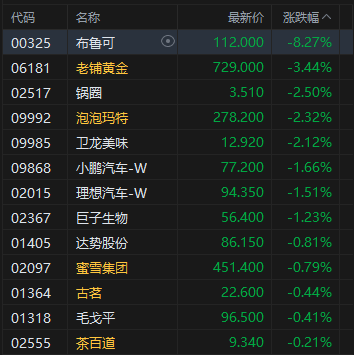
港股市场新消费概念股普跌,截至午盘,布鲁可跌超8%,老铺黄金跌超3%,锅圈、泡泡玛特跌超2%
Ge Long Hui· 2025-08-19 04:30
Group 1 - The Hong Kong stock market's new consumption concept stocks experienced a widespread decline, with notable drops in several companies [1] - Blucco (00325) saw a significant decrease of 8.27%, closing at 112.000 [2] - Other companies such as Laopu Gold (06181) and Pop Mart (09992) also faced declines of 3.44% and 2.32% respectively [2] Group 2 - Additional companies in the new consumption sector, including Qi (02517) and Weilon Delicious (09982), reported declines of 2.50% and 2.12% respectively [2] - Xpeng Motors (09868) and Li Auto (02015) experienced minor declines of 1.66% and 1.51% [2] - Other companies like Juzhi Biotechnology (02367) and Mijue Group (02097) also showed slight decreases, indicating a broader trend in the market [2]


蜜雪集团(02097.HK)拟8月27日举行董事会会议批准中期业绩
Ge Long Hui· 2025-08-14 23:03
Core Viewpoint - The company, Mixue Group (02097.HK), has announced that its board meeting will take place on August 27, 2025, to consider and approve the interim results for the six months ending June 30, 2025, along with addressing other matters [1] Group 1 - The board meeting is scheduled for August 27, 2025 [1] - The meeting will focus on the approval of the interim results for the six months ending June 30, 2025 [1] - Other matters will also be addressed during the board meeting [1]
蜜雪集团(02097) - 董事会会议通告
2025-08-14 22:15
蜜雪冰城股份有限公司(「本公司」)及其附屬公司(「本集團」)董事會(「董事會」) 謹此公佈,董事會會議將於2025年8月27日(星期三)舉行,藉以(其中包括)考慮 及批准本集團截至2025年6月30日止的六個月中期業績及其發佈,以及處理其他 事項。 承董事會命 蜜雪冰城股份有限公司 執行董事兼首席執行官 張紅甫先生 香港,2025年8月15日 香港交易及結算所有限公司及香港聯合交易所有限公司對本公告的內容概不負責,對其準確性 或完整性亦不發表任何聲明,並明確表示,概不對因本公告全部或任何部份內容而產生或因倚 賴該等內容而引致的任何損失承擔任何責任。 MIXUE Group 蜜雪冰城股份有限公司 (於中華人民共和國註冊成立的股份有限公司) (股份代號:2097) 董事會會議通告 於本公告日期,董事會成員包括(i)執行董事張紅超先生、張紅甫先生、蔡衛淼女 士及趙紅果女士,及(ii)獨立非執行董事潘慧妍女士、朱璽先生及黃宣德先生。 ...