
WUXI BIO(02269)

Search documents
多家公司上半年净利同比增长!创新药板块持续强势
Sou Hu Cai Jing· 2025-09-02 02:40
Core Viewpoint - The innovative drug sector is experiencing strong performance due to favorable policies and positive earnings reports, with significant gains in Hong Kong-listed innovative drug stocks [1][2]. Policy Aspects - The National Healthcare Security Administration has introduced a "newly listed drug initial pricing mechanism" to encourage drug research and innovation, marking the first public announcement of this mechanism since last year's consultation [1]. - The mechanism aims to ensure that high-level innovative drugs can achieve returns that correspond to their high investment and risk during the initial listing period [1]. Performance Aspects - In the first half of this year, among 80 listed companies in the innovative drug sector, 34 companies reported year-on-year growth in net profit attributable to shareholders, excluding companies that turned losses into profits or reduced losses [2]. - For instance, Heng Rui Medicine achieved revenue of 15.76 billion yuan, a year-on-year increase of 15.88%, and a net profit of 4.45 billion yuan, up 29.67% [2]. - In the medical device sector, United Imaging Healthcare reported revenue of 6.02 billion yuan, a 12.79% increase, and a net profit of 998 million yuan, up 5.03% [2]. - The continuous optimization of the medical insurance catalog adjustment mechanism by the government has stimulated companies' enthusiasm for innovation, as they see increased chances of their products entering insurance and commercial insurance catalogs [2].


港股创新药ETF(159567)涨2.67%,成交额19.85亿元
Xin Lang Cai Jing· 2025-09-01 12:19
Group 1 - The Hong Kong Innovative Drug ETF (159567) closed with a gain of 2.67% on September 1, with a trading volume of 1.985 billion yuan [1] - The fund was established on January 3, 2024, with a management fee of 0.50% and a custody fee of 0.10% [1] - As of August 29, 2024, the fund's latest share count was 6.686 billion, with a total size of 6.403 billion yuan, reflecting a year-to-date increase of 1591.03% in shares and 1594.74% in size compared to the end of 2023 [1] Group 2 - The current fund manager is Ma Jun, who has managed the fund since its inception, achieving a return of 91.54% during the tenure [2] - The top holdings of the fund include companies such as Innovent Biologics, WuXi Biologics, BeiGene, and others, with significant weightings in the portfolio [2] - The fund's liquidity is strong, with a cumulative trading amount of 34.181 billion yuan over the last 20 trading days, averaging 1.709 billion yuan per day [1]


医药生物行业9月月报:Q2环比改善、复苏有望延续,持续看好创新主线-20250901
ZHONGTAI SECURITIES· 2025-09-01 10:48
Investment Rating - The report maintains an "Overweight" rating for the pharmaceutical and biotechnology sector [5] Core Views - The pharmaceutical sector is expected to continue its recovery, with a focus on innovative drugs as the main investment theme. The report highlights a gradual improvement in the industry, with Q2 showing a significant reduction in the decline of revenue and profits compared to Q1 [7][21][19] - The report emphasizes the potential for a turnaround in the industry, driven by policy improvements, demand recovery, and the performance of the CRO/CDMO segments [10][16] Summary by Sections Market Performance - In August 2025, the pharmaceutical and biotechnology sector rose by 2.6%, underperforming the Shanghai and Shenzhen 300 index, which increased by 10.3%. The sector ranked 24th among 31 sub-industries [7][15] - The report notes a mixed performance among sub-sectors, with medical devices and services showing gains, while the pharmaceutical commercial sector declined [15] Financial Performance - In the first half of 2025, the cumulative revenue of pharmaceutical companies decreased by 2.6%, with total profits down by 4.0%. However, Q2 showed a narrowing of declines, with revenue down by only 1.1% and total profits down by 2.9% [21][19] - The report indicates that the CRO/CDMO segments performed well, with significant revenue and profit growth, particularly in Q2 [21][19] Investment Opportunities - The report suggests focusing on innovative drugs, which are seen as having strong growth potential and clear industry trends. It recommends several companies across different categories, including biotech firms transitioning to biopharma and large pharmaceutical companies involved in innovative drug development [9][10][11] - The report also highlights the potential for recovery in the CRO/CDMO segments and suggests that companies in these areas are likely to benefit from improving demand and order recovery [10][16] Key Recommendations - The report lists key companies to watch, including WuXi AppTec, WuXi Biologics, and others, indicating a positive outlook for these firms based on their performance and market position [17][18]


智通港股52周新高、新低统计|9月1日
智通财经网· 2025-09-01 08:42
Summary of Key Points Core Viewpoint - As of September 1, a total of 110 stocks reached their 52-week highs, with notable performances from Hejia Holdings (33.33%), International Commercial Settlement (30.00%), and Xinjiang Xinmin Mining (24.16%) [1]. 52-Week Highs - Hejia Holdings (00704) closed at 0.217 with a peak of 0.280, achieving a high rate of 33.33% [1]. - International Commercial Settlement (00147) reached a closing price of 0.430 and a high of 0.455, marking a 30.00% increase [1]. - Xinjiang Xinmin Mining (03833) had a closing price of 1.770 and a peak of 1.850, resulting in a 24.16% high rate [1]. - Other notable stocks include: - Shuoao International (02336) at 22.38% [1] - Sanleaf Bio-B (02197) at 16.00% [1] - Wanka Yilian (01762) at 13.08% [1] 52-Week Lows - INTL Genius (00033) recorded a low rate of -14.89% with a closing price of 0.410 [3]. - Junan Holdings (01559) saw a decline of -14.10%, closing at 0.069 [3]. - Other significant declines include: - Kuangshi Fragrance (01925) at -8.41% [3] - Baida Group Holdings (08179) at -8.33% [3] - Shimao Group (00813) at -7.58% [3]


港股异动 | 医药股再度走强 上半年药企业绩整体表现稳健 机构看好创新药长期向好逻辑
Zhi Tong Cai Jing· 2025-09-01 06:38
Group 1 - Pharmaceutical stocks in Hong Kong have shown strong performance, with notable gains in companies such as 加科思-B (up 23.18%), 三叶草生物-B (up 22.09%), and others [1] - The overall performance of Hong Kong pharmaceutical companies in the first half of the year has been robust, with 恒瑞医药 achieving record high revenue and profit, and 翰森制药 exceeding revenue expectations [1] - Upcoming major conferences, including the World Lung Cancer Conference (WCLC) and the European Society for Medical Oncology (ESMO), will showcase research results from innovative domestic drugs [1] Group 2 - 海通国际 maintains a positive outlook on Hong Kong pharmaceutical companies due to their stable cash flow, rich R&D pipelines, and normalizing external licensing revenues [2] - The recent slight pullback in the Hong Kong pharmaceutical sector is attributed to rapid fund rotation, with expectations of short-term fluctuations [2] - The long-term value reassessment logic in the pharmaceutical industry remains unchanged, supported by the engineer dividend and a rich catalyst environment in the innovative drug industry [2]

CRO概念股涨幅居前 行业二季度收入利润增速继续环比改善 机构称板块发展趋势向好
Zhi Tong Cai Jing· 2025-09-01 04:04
Group 1 - CRO concept stocks have shown significant gains, with WuXi AppTec (603259) up 6.3% at HKD 114.7, WuXi Biologics (02269) up 6.02% at HKD 35.2, and others like Kanglong Chemical (300759) and Kelaiying (002821) also experiencing notable increases [1] - Dongwu Securities reports that 22 CXO listed companies are expected to see revenue, net profit attributable to shareholders, and net profit excluding non-recurring gains and losses grow by 14.16%, 64.03%, and 24.82% year-on-year for the first half of 2025, respectively [1] - The second quarter of 2025 is projected to show further improvement in revenue and profit growth rates, with expected increases of 15.15% in revenue and 53.58% in net profit attributable to shareholders [1] Group 2 - Xiangcai Securities highlights the active performance of the innovative drug industry chain under the backdrop of national encouragement for innovation, despite ongoing pressures from medical insurance cost control [2] - The establishment of a multi-tiered payment system and the rigid demand for medical services are expected to stabilize and rebound the industry [2] - Companies in the pharmaceutical outsourcing services sector, particularly in ADC CDMO and peptide CDMO for weight loss drugs, are recommended for attention, including WuXi AppTec, Haoyuan Pharmaceutical, and WuXi Biologics [2]

港股异动 | CRO概念股涨幅居前 行业二季度收入利润增速继续环比改善 机构称板块发展趋势向好
智通财经网· 2025-09-01 03:46
Group 1 - CRO concept stocks have shown significant gains, with WuXi AppTec (02359) up 6.3% to HKD 114.7, WuXi Biologics (02269) up 6.02% to HKD 35.2, and others also experiencing notable increases [1] - Dongwu Securities reports that 22 CXO listed companies are expected to see revenue, net profit attributable to parent, and net profit excluding non-recurring gains and losses grow by 14.16%, 64.03%, and 24.82% year-on-year for the first half of 2025, respectively [1] - The second quarter of 2025 is projected to show further improvement in revenue and profit growth rates, with expected increases of 15.15% in revenue and 53.58% in net profit attributable to parent [1] Group 2 - Xiangcai Securities highlights the active performance of the innovative drug industry chain under the backdrop of national encouragement for innovation, despite ongoing pressures from medical insurance cost control [2] - The establishment of a multi-tiered payment system and the rigid demand for medical services are expected to stabilize and rebound the industry [2] - Companies such as WuXi AppTec, Haoyuan Pharmaceutical, and WuXi Biologics are recommended for attention in the ADC CDMO and peptide CDMO sectors [2]

港股医疗ETF(159366)涨超2%,春立医疗领涨,医疗器械ETF(159883)冲击三连涨
Xin Lang Cai Jing· 2025-09-01 03:03
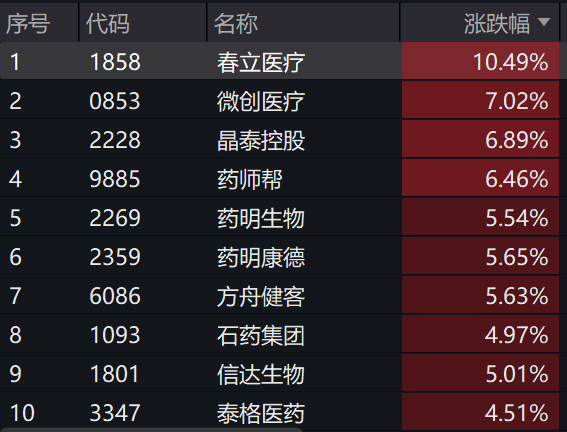
Group 1 - The China Securities Hong Kong Stock Connect Medical Theme Index (932069) has risen by 2.99%, with notable increases in constituent stocks such as Chunli Medical (01858) up 10.49%, MicroPort Medical (00853) up 7.02%, and Crystal Technology Holdings (02228) up 6.89% [1] - The Hong Kong Medical ETF (159366) has also seen an increase of 2.44% [1] - The China Securities All Index Medical Device Index (H30217) has increased by 1.46%, with significant gains from Ji Min Health (603222) up 9.98%, Hualan Biological Engineering (301093) up 7.81%, and Huatai Medical (688617) up 6.93% [2][3] Group 2 - The FDA has accepted Vibration-Controlled Transient Elastography (VCTE) as an alternative endpoint for assessing liver fibrosis in patients with Metabolic Associated Steatotic Liver Disease (MASH), marking a significant breakthrough in non-invasive diagnostic technology [4] - This advancement is expected to enhance drug development efficiency for MASH and provide growth opportunities for domestic companies in the non-invasive companion diagnostics field [4] - The pharmaceutical and biotechnology sector showed marginal improvement in Q2 2025, with the innovative drug and CXO sectors performing particularly well, as the CXO industry rebounded with a 14% year-on-year revenue increase and a 54% increase in net profit [4] Group 3 - The domestic medical device industry is gradually recovering from an adjustment period, with market demand showing signs of recovery [5] - In Q2 2025, the medical equipment sector experienced a 5.26% year-on-year revenue growth, and the medical consumables sector maintained stable growth [5] - The Hong Kong Medical ETF (159366) focuses on rare medical segment leaders and has a high CXO content, while the Medical Device ETF (159883) is the largest in A-shares, covering various sub-sectors of the medical device industry [5]


港股创新药ETF(159567)涨3.62%,成交额20.04亿元
Xin Lang Cai Jing· 2025-08-29 10:37
Group 1 - The Hong Kong Innovative Drug ETF (159567) closed with a gain of 3.62% on August 29, with a trading volume of 2.004 billion yuan [1] - The fund was established on January 3, 2024, with an annual management fee of 0.50% and a custody fee of 0.10% [1] - As of August 28, 2024, the fund's latest share count was 6.619 billion, with a total size of 6.126 billion yuan, reflecting an increase of 1574.08% in shares and 1521.35% in size year-to-date [1] Group 2 - The current fund manager is Ma Jun, who has managed the fund since its inception, achieving a return of 85.10% during the tenure [2] - The top holdings of the fund include Innovent Biologics, WuXi Biologics, BeiGene, and others, with significant weightings such as 9.52% for Innovent Biologics and 9.47% for WuXi Biologics [2] - The fund's recent trading activity shows a cumulative trading amount of 34.226 billion yuan over the last 20 trading days, averaging 1.711 billion yuan per day [1]
港股收评:恒生科技指数涨0.54%。比亚迪电子涨超7%


Zheng Quan Shi Bao Wang· 2025-08-29 09:29
Group 1 - The Hang Seng Index closed up by 0.32% [1] - The Hang Seng Tech Index increased by 0.54% [1] - BYD Electronics rose over 7% [1] - WuXi Biologics and CSPC Pharmaceutical Group both increased by over 6% [1]