PING AN OF CHINA(02318)

Search documents
专访平安集团王晓航:AI超级客服“不是超级酷炫,是超级好用”
2 1 Shi Ji Jing Ji Bao Dao· 2025-11-21 07:36
Core Insights - Ping An Group is developing a unified AI entry point called "AI Super Customer Service," which aims to connect various services in finance, healthcare, elderly care, and daily life, facilitating direct access to consultation, service handling, and emergency rescue. This service is currently in the internal testing phase [1][3]. Group 1 - The "AI Super Customer Service" is part of Ping An Group's broader strategy to enhance service integration and accessibility [1][3]. - In addition to "AI Super Customer Service," Ping An Group is also launching "AI Family Doctor" and "AI Elderly Care Butler," which are the three major AI services being introduced [1].


中国平安跌2.14%,成交额40.67亿元,近3日主力净流入-7.53亿
Xin Lang Cai Jing· 2025-11-21 07:16
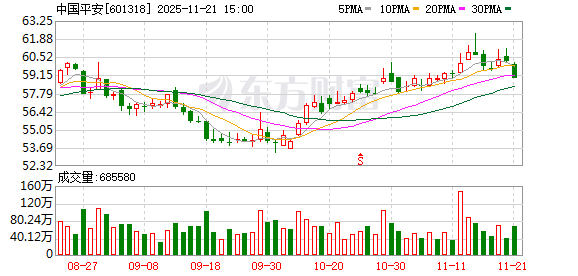
Core Viewpoint - China Ping An's stock experienced a decline of 2.14% on November 21, with a trading volume of 4.067 billion yuan and a market capitalization of 1,066.721 billion yuan [1] Group 1: Dividend and Shareholding - The dividend yields for China Ping An over the past three years were 5.15%, 6.03%, and 4.84% respectively [2] - Among the top ten circulating shareholders, Central Huijin Asset Management Co., Ltd. and China Securities Finance Corporation Limited are included [2] - As of September 30, 2025, the total cash dividends distributed by China Ping An since its A-share listing amounted to 391.904 billion yuan, with 134.54 billion yuan distributed over the last three years [7] Group 2: Business Overview - China Ping An Insurance (Group) Co., Ltd. was established on March 21, 1988, and listed on March 1, 2007, providing diversified financial services including insurance, banking, securities, and trust [6] - The revenue composition of the company includes life and health insurance (45.76%), property insurance (34.46%), banking (13.87%), asset management (5.27%), and financial empowerment (3.85%) [6] - The company has a presence in various sectors, including internet insurance and unicorn concepts, with subsidiaries like Lufax, Ping An Good Doctor, and Ping An Health Insurance [2] Group 3: Financial Performance - For the period from January to September 2025, China Ping An reported a net profit attributable to shareholders of 132.856 billion yuan, reflecting a year-on-year growth of 11.47% [6] - The average trading cost of the stock is 52.40 yuan, with the stock price approaching a resistance level of 58.95 yuan, indicating potential for upward movement if the resistance is broken [5] Group 4: Market Activity - The net inflow of funds for the stock today was -388 million yuan, with a market ranking of 5 out of 5 in its industry, indicating no significant trend in major shareholder activity [3][4] - The main shareholders have a light control over the stock, with a relatively dispersed distribution of shares [4]
70家人身险企三季度退保率盘点:近八成同比下降,德华安顾人寿退保率居首
Xin Lang Cai Jing· 2025-11-21 05:33
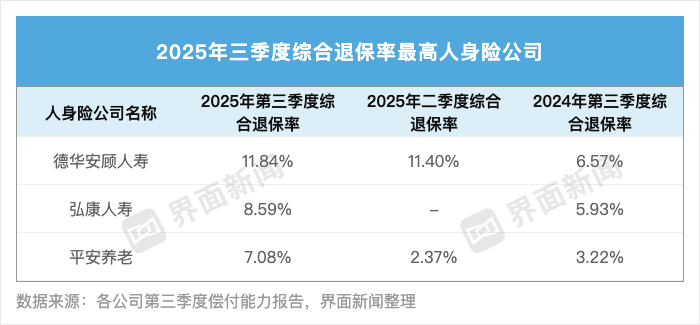
Core Insights - The overall trend in the third quarter shows a decline in the comprehensive surrender rate among life insurance companies, with nearly 80% of the 70 companies reporting a decrease compared to the first three quarters of 2024, while 15 companies experienced an increase [1][4]. Group 1: Surrender Rate Trends - The highest comprehensive surrender rate in Q3 2025 was reported by Deutsche Bank Life at 11.84%, followed by Hongkang Life at 8.59% and Ping An Pension at 7.08%. The lowest rates were reported by National Pension, Xinhua Pension, and Aixin Life, all below 0.5% [2][3]. - Among the 70 life insurance companies, 55 reported a decrease in surrender rates year-on-year, with Dajia Pension showing the largest decline from 6.5% in Q3 2024 to 1.16% in Q3 2025 [4][9]. Group 2: Product and Channel Analysis - Surrender rates are primarily concentrated in investment-linked and universal life insurance products, with significant rates exceeding 60% or even 100% for some products [11][12]. - The silver insurance channel remains a major source of high surrender rates, attributed to the nature of products sold, which are often short-term savings products that lead to concentrated surrenders once they reach their maturity [17][18]. Group 3: Factors Influencing Surrender Rates - The decline in surrender rates reflects improvements in product structure, enhanced customer management capabilities, and stabilized market interest rate expectations [1][10]. - The shift towards more flexible, short-term products has reduced early surrender pressures compared to traditional long-term savings products [10][16]. - The impact of market interest rates on surrender behavior is significant, with lower rates leading to higher surrender rates in products with strong financial attributes, such as universal and investment-linked insurance [16][17].

中国中车(01766.HK)获中国平安增持858万股
Ge Long Hui· 2025-11-20 23:33
Group 1 - China Pacific Insurance (Group) Co., Ltd. increased its stake in CRRC Corporation Limited by acquiring 8.58 million shares at an average price of HKD 6.3429 per share, totaling approximately HKD 54.42 million [1][2] - Following this transaction, China Pacific Insurance's total shareholding in CRRC has risen to 265,816,000 shares, increasing its ownership percentage from 5.88% to 6.08% [1][2]


中国中车获中国平安增持858万股
Ge Long Hui· 2025-11-20 23:33
Group 1 - The core point of the article is that China Ping An Insurance (Group) Co., Ltd. has increased its stake in CRRC Corporation Limited by purchasing 8.58 million shares at an average price of HKD 6.3429 per share, raising its ownership percentage from 5.88% to 6.08% [1][2]. Group 2 - The total investment made by China Ping An for this acquisition amounts to approximately HKD 54.42 million [1]. - Following the purchase, China Ping An's total shareholding in CRRC Corporation is now 265,816,000 shares [1][2].
险企今年以来发债超700亿元 永续债成资本补充主力
Zhong Guo Zheng Quan Bao· 2025-11-20 20:09
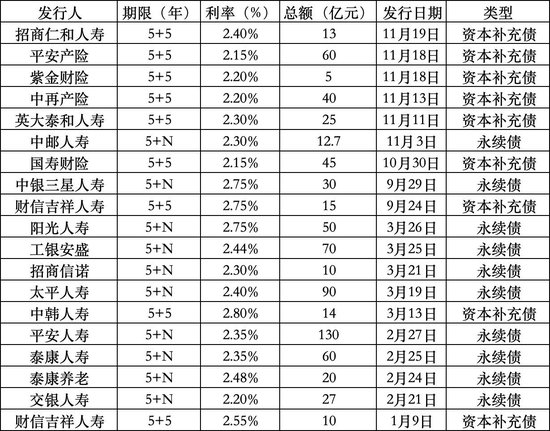
Core Viewpoint - Insurance companies are accelerating capital replenishment as the transition period for the second phase of the solvency regulation approaches its end, with 19 companies issuing capital supplementary bonds or perpetual bonds totaling over 70 billion yuan this year, with nearly 70% being perpetual bonds [1][2] Group 1: Capital Supplementation Trends - As of November 20, 2023, 19 insurance companies have issued capital supplementary bonds or perpetual bonds, with a total issuance scale of 741.7 billion yuan, slightly down from the previous year but still at a high level [1][2] - Half of the issuing companies opted for perpetual bonds, with a total issuance close to 500 billion yuan, representing nearly 70% of the total [2] - Major issuers of perpetual bonds include Ping An Life (13 billion yuan), Taiping Life (9 billion yuan), ICBC-AXA Life (7 billion yuan), Taikang Life (6 billion yuan), and Sunshine Life (5 billion yuan) [2] Group 2: Cost of Issuance and Debt Management - The average coupon rate for the bonds issued this year is below 3%, with the highest at 2.8% and the lowest at 2.15% [2][3] - Some insurance companies are redeeming old bonds while issuing new ones to lower financing costs, as seen with China Merchants Jinhe Life redeeming an 8 billion yuan bond with a higher interest rate [3] Group 3: Regulatory Context and Future Outlook - The issuance of bonds is primarily driven by the need to enhance solvency and meet stricter regulatory requirements under the second phase of solvency regulations, which has seen a decline in solvency ratios [3] - The transition period for these regulations has been extended to the end of 2025, prompting insurance companies to expedite capital replenishment efforts [3] - Industry experts suggest that insurance companies should diversify their capital replenishment channels and improve their profitability and capital management efficiency for sustainable development [3]

月内超150亿元!险企发债“补血”迎小高潮
Guo Ji Jin Rong Bao· 2025-11-20 15:48
Core Viewpoint - Insurance companies are increasingly issuing perpetual bonds and capital supplementary bonds to enhance their capital and solvency, with a total issuance exceeding 15 billion yuan since November [1][2]. Group 1: Bond Issuance Trends - The total bond issuance by insurance companies has decreased compared to last year but remains at a high level, with a notable preference for perpetual bonds [1][2]. - In November, several insurance companies accelerated their bond issuance, including Zhongyou Life (1.27 billion yuan), Yingda Taihe Life (2.5 billion yuan), Zhongzheng Property Insurance (4 billion yuan), Ping An Property Insurance (6 billion yuan), and others [2]. - The primary purpose of these bond issuances is to supplement capital and enhance the companies' solvency to support sustainable business development [2]. Group 2: Factors Influencing Bond Issuance - The surge in bond issuance is attributed to multiple factors, including a favorable regulatory approval timeline and the need to address the impact of new accounting standards on solvency ratios [3]. - The relatively low financing costs have also encouraged insurance companies to issue bonds, with coupon rates ranging from 2.15% to 2.40%, significantly lower than the previous years' rates around 3.5% [3][4]. Group 3: Perpetual Bonds as a Financing Tool - Perpetual bonds have emerged as a new tool for capital supplementation, allowing insurance companies to meet regulatory capital requirements without a fixed maturity [5]. - The issuance of perpetual bonds has gained momentum since the regulatory framework was established in 2022, with major companies like Taikang Life leading the way [5][6]. - The total issuance of perpetual bonds in 2023 reached 35.77 billion yuan, with projections for 2024 indicating further growth [6]. Group 4: Long-term Capital Strategies - While bond issuance provides short-term capital relief, the long-term solution lies in enhancing the insurance companies' internal capital generation capabilities [7]. - Companies are encouraged to focus on high-quality development, optimize business structures, and improve operational efficiency to reduce reliance on external capital [7]. - Strengthening asset-liability management and leveraging technology for operational efficiency are essential for sustainable growth in the insurance sector [7].



第一大股东平安公开质疑,曾经的环京“地产一哥”司法重整生变
Di Yi Cai Jing· 2025-11-20 14:32
Core Viewpoint - The company Huaxia Happiness is facing a pre-restructuring process initiated by a creditor due to an unpaid engineering fee of 4.1716 million yuan, which has led to internal disputes regarding the legitimacy of the restructuring process and governance issues within the board [2][3][4]. Group 1: Restructuring Process - Huaxia Happiness has been subjected to a pre-restructuring application by Longcheng Construction, which is owed 4.1716 million yuan for municipal engineering work [3][4]. - The court has accepted the pre-restructuring application, and a temporary management team has been appointed to oversee the process [4]. - The deadline for creditors to submit their claims is set for December 18, and the court's decision on the restructuring will depend on the company's financial assessments within 3 to 4 months [4][5]. Group 2: Internal Disputes - Board member Wang Wei has publicly expressed his lack of knowledge regarding the pre-restructuring announcement and has filed a complaint with regulatory authorities, citing violations of corporate governance procedures [3][6]. - Wang Wei has previously opposed significant asset impairment measures, indicating ongoing disagreements within the board regarding financial management and decision-making [7][10]. Group 3: Financial Context - Huaxia Happiness has been struggling with significant financial issues, including a reported loss of 39 billion yuan in 2021, leading to a complex debt restructuring plan involving 219.2 billion yuan in financial debts [11]. - The company has already signed restructuring agreements for 192.669 billion yuan of its debts, but the recent pre-restructuring application by a small creditor highlights potential vulnerabilities in its debt management strategy [11][12]. - The asset replacement plan, which involved transferring significant assets to a related entity for a nominal fee, has raised concerns among creditors about the fairness and implications for debt recovery [8][9].


第一大股东平安公开质疑,曾经的环京“地产一哥”司法重整生变
第一财经· 2025-11-20 14:21
Core Viewpoint - The article discusses the recent pre-restructuring application of Huaxia Happiness due to a debt of 4.1716 million yuan, highlighting internal disagreements and potential risks associated with the restructuring process [3][5][14]. Group 1: Pre-restructuring Events - Huaxia Happiness was recently subjected to a pre-restructuring application initiated by Longcheng Construction, which is owed 4.1716 million yuan for municipal engineering work [5][6]. - The court has accepted the pre-restructuring application, indicating that the company is unable to meet its debt obligations and lacks the ability to repay [6][14]. - The company’s board has stated that it will cooperate with the court during the pre-restructuring process, which includes notifying creditors to declare their claims by December 18 [6][14]. Group 2: Internal Disagreements - Wang Wei, a current director and representative of the "Ping An system," publicly expressed his lack of knowledge regarding the pre-restructuring announcement and has filed a complaint with regulatory authorities about procedural compliance [5][7]. - Wang Wei has previously voted against significant asset impairment measures in the company's mid-2025 financial report, citing concerns over the prudence of asset handling [9][10]. - The disagreement reflects a broader conflict between the "Ping An system" and Huaxia Happiness regarding debt restructuring strategies and asset management [10][11]. Group 3: Financial Implications - Huaxia Happiness has previously disclosed a debt restructuring plan involving 219.2 billion yuan in financial debt, with 192.669 billion yuan already signed for restructuring [14]. - The company has faced significant financial challenges, including a reported loss of 39 billion yuan in 2021, leading to a decline in its stock and management control issues [13][14]. - The restructuring process may lead to extended repayment periods for creditors and increased uncertainty regarding the recovery rate of debts [6][14].

2025年险企发债观察:发行规模仍处历史高位,永续债占比近七成
Mei Ri Jing Ji Xin Wen· 2025-11-20 12:04
Core Viewpoint - The issuance of bonds by insurance companies remains at historically high levels, with perpetual bonds accounting for nearly 70% of the total issuance in 2025, driven by the need for capital supplementation to meet regulatory requirements and enhance risk resilience [1][2][6]. Group 1: Bond Issuance Trends - As of November 2025, 19 insurance companies have successfully issued capital supplementary bonds or perpetual bonds, totaling 741.7 billion yuan, which is a decrease compared to the previous two years but still at a historical high [1][6]. - The trend shows a preference for perpetual bonds, with 10 issued totaling approximately 500 billion yuan, representing nearly 70% of the total issuance [1][3]. - Major issuers of perpetual bonds include large life insurance companies and bank-affiliated insurers, as these bonds are more favorable for long-term capital needs [4][5]. Group 2: Capital Supplementation Needs - The need for continuous capital supplementation is a common requirement in the industry, as increasing shareholder contributions is challenging, leading to a reliance on various channels for capital [2][6]. - The overall trend in bond issuance is characterized by a decrease in total volume but a high level of issuance, with a structural shift towards perpetual bonds [2][6]. Group 3: Financial Performance and Regulatory Compliance - The solvency pressure has eased in 2025, resulting in a decrease in large bond issuances compared to 2024, where several companies issued bonds exceeding 100 billion yuan [6][7]. - As of the end of Q3 2025, the comprehensive solvency adequacy ratio for the insurance industry was 186.3%, with a core solvency adequacy ratio of 134.3%, indicating a decline from the end of 2024 [7]. - The issuance of bonds has been beneficial in alleviating short-term capital pressures and providing necessary financial buffers for strategic adjustments and business upgrades [5][6]. Group 4: Financing Costs and Market Conditions - The current relatively loose interest rate environment has led to a decrease in financing costs for insurance companies, with bond issuance rates ranging from 2.15% to 2.8% [8][9]. - The trend of declining issuance rates indicates a favorable market liquidity and high investor confidence in the credit quality of insurance companies, facilitating low-cost financing [8][9]. - Companies are adopting a strategy of issuing low-cost new bonds to replace or repay existing higher-rate debts, thereby optimizing their financial structure [8][9].