
PICC P&C(02328)

Search documents
中国财险(02328):综合成本率大幅改善,承保利润与投资收益均向好
Soochow Securities· 2025-08-28 07:54
Investment Rating - The report maintains a "Buy" rating for the company [1] Core Views - The company has shown significant improvement in its comprehensive cost ratio, with both underwriting profit and investment income trending positively [1][8] - The report projects an increase in net profit for the years 2025 to 2027, with expected figures of 449 billion, 467 billion, and 503 billion respectively [1][8] Financial Performance Summary - Total revenue for 2023 is projected at 478.826 billion, with a year-on-year growth of 7.02% [1] - The net profit attributable to shareholders for 2023 is estimated at 24.585 billion, reflecting a decrease of 15.70% compared to the previous year [1] - The latest diluted book value per share is 10.40, with a price-to-book ratio of 1.60 [1] Underwriting and Investment Performance - The company reported a net profit of 245 billion for the first half of 2025, a year-on-year increase of 32.3% [8] - The underwriting profit for the same period was 130 billion, up 44.6% year-on-year [8] - The total investment asset scale reached 711.5 billion, with a 5.2% increase from the beginning of the year [8][16] Premium Growth and Market Share - The company's original premium income grew by 3.6% in the first half of 2025, with a market share of 33.5%, an increase of 1.7 percentage points from the beginning of the year [8] - The premium income from auto insurance increased by 3.4%, with the proportion of personal auto insurance rising to 73.4% [8] Cost and Profitability Metrics - The comprehensive cost ratio improved to 94.8%, a decrease of 1.4 percentage points year-on-year [8] - The expense ratio decreased to 23.0%, benefiting from strict cost control measures [8][15] Investment Strategy - The company has adjusted its investment strategy, increasing allocations to bonds and stocks while reducing the proportion of OCI stocks [8][16] - The total investment income for the first half of 2025 was 173 billion, reflecting a year-on-year increase of 26.6% [8]
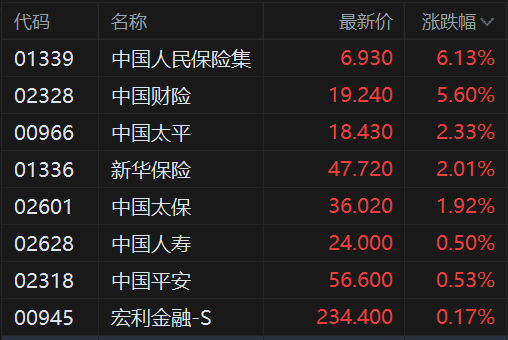
内险股拉升 中国人民保险、中国财险齐创新高 中国平安跟涨
Ge Long Hui· 2025-08-28 03:39
Group 1 - The core viewpoint is that the Chinese insurance industry is emerging from a low point, with several positive factors driving it towards a new phase of higher quality and sustainable development [1] - China People's Insurance Group reported a mid-year revenue of 324.12 billion yuan, up from 292.34 billion yuan in the same period last year, and a net profit of 26.7 billion yuan, compared to 23.4 billion yuan year-on-year [1] - China Pacific Insurance and New China Life Insurance both saw stock price increases of 2%, while China Life and Ping An rose by 0.5% [2] Group 2 - China Property & Casualty Insurance reported a net profit of 24.455 billion yuan for the first half of the year, representing a year-on-year growth of 32.3% [1] - Prudential announced a mid-year profit attributable to shareholders of 1.284 billion USD, a year-on-year increase of 9.7 times [1] - Ping An's operating profit attributable to shareholders grew by 3.7% in the first half of the year, with a strong growth of 39.8% in new business value for life insurance [1]


中国财险(02328):投资与承保共同推动盈利增长32%
EBSCN· 2025-08-28 03:08
2025 年 8 月 28 日 公司研究 投资与承保共同推动盈利增长 32% ——中国财险(2328.HK)2025 年半年报点评 买入(维持) 当前价:18.22 港元 作者 分析师:王一峰 执业证书编号:S0930519050002 010-57378038 wangyf@ebscn.com 分析师:黄怡婷 执业证书编号:S0930524070003 010-57378023 huangyiting@ebscn.com 市场数据 盈利增速承压,COR 优于同业——中国财险 ( 2328.HK ) 2024 年 一 季 报 点 评 (2024-04-30) 要点 事件: 2025 年上半年,中国财险原保险保费收入 3232.8 亿元,同比+3.6%;保险服务收 入 2490.4 亿元,同比+5.6%;归母净利润 244.5 亿元,同比+32.3%;承保综合成 本率 94.8%,同比-1.4pct;总投资收益率(非年化)2.6%,同比+0.4pct;拟派发 中期股息每股 0.24 元,同比+15.4%。 | 总股本(亿股) | 222.43 | | --- | --- | | 总市值(亿元港币): | 405 ...
大行评级|瑞银:中国财险上半年业绩超预期 目标价上调至20.7港元
Ge Long Hui· 2025-08-28 03:08
Core Viewpoint - UBS reports that China's property insurance performance in the first half of the year exceeded market expectations, driven by a 45% year-on-year surge in underwriting profit and a 27% year-on-year increase in total investment income [1] Summary by Relevant Categories Financial Performance - The net profit after tax (NPAT) growth is attributed to significant increases in underwriting profit and total investment income [1] - Underwriting profit increased by 45% year-on-year [1] - Total investment income grew by 27% year-on-year [1] Future Projections - UBS forecasts total premium growth of 4.5%, automotive insurance premium growth of 3.5%, and non-automotive insurance premium growth of 5.8% by 2025 [1] - The net asset value and NPAT forecasts have been raised by 4% and 6% respectively, reflecting better-than-expected combined cost ratios and improved market sentiment [1] Valuation Adjustments - UBS has adjusted the valuation multiples to reflect a more favorable macroeconomic environment and supportive policy conditions [1] - The target price has been raised from HKD 18.7 to HKD 20.7, maintaining a "Buy" rating [1]
港股异动丨内险股拉升 中国人民保险、中国财险齐创新高 中国平安跟涨
Ge Long Hui· 2025-08-28 03:01
Group 1 - The core viewpoint of the article highlights a significant rally in Hong Kong's insurance stocks, with China People's Insurance Group and China Pacific Insurance reaching historical highs [1] - China People's Insurance Group reported a mid-year revenue of 324.12 billion yuan, up from 292.34 billion yuan in the same period last year, and a net profit of 26.7 billion yuan, compared to 23.4 billion yuan previously [1] - China Pacific Insurance's net profit for the first half of the year was 24.455 billion yuan, reflecting a year-on-year growth of 32.3% [1] Group 2 - Prudential reported a shareholder profit of 1.284 billion USD for the mid-year period, marking a year-on-year increase of 9.7 times [1] - China Ping An's operating profit attributable to shareholders grew by 3.7% in the first half of the year, with a strong increase of 39.8% in new business value for life insurance [1] - Analysts suggest that the Chinese insurance industry is emerging from a low point, driven by multiple favorable factors, indicating a shift towards a higher quality and more sustainable development phase [1]
国信证券晨会纪要-20250828
Guoxin Securities· 2025-08-28 02:57
Group 1: Automotive Industry Insights - The automotive industry is experiencing a significant shift towards intelligent driving technologies, with companies like HUAWEI and Horizon leading the way in advanced driver assistance systems [13][14]. - The penetration rate of L2 and above autonomous driving features in passenger vehicles reached 29.7% as of June 2025, reflecting a year-on-year increase of 13 percentage points [14]. - Investment recommendations include companies such as Xpeng Motors, Leap Motor, and Geely for complete vehicles, and suppliers like Suoteng Technology and Hesai Technology for components [15]. Group 2: Pharmaceutical Sector Developments - The pharmaceutical sector showed weaker performance compared to the overall market, with the biopharmaceutical segment rising only 1.05% [16]. - The World Lung Cancer Conference (WCLC) in September 2025 will showcase innovative research from Chinese pharmaceutical companies, highlighting the growing competitiveness of domestic products [16][17]. - Investment focus is recommended on companies presenting at major conferences like ESMO and WCLC, particularly those with promising clinical data [17]. Group 3: Mining and Metals Performance - Luoyang Molybdenum's net profit for H1 2025 increased by 60% to CNY 8.67 billion, driven by rising copper and cobalt prices alongside increased production [18][19]. - Zijin Mining reported a 54.41% year-on-year increase in net profit for H1 2025, attributed to a significant rise in gold production and prices [22][23]. - Cloud Aluminum's net profit for H1 2025 grew by 10%, with a strong performance in aluminum production and a proposed cash dividend of CNY 3.2 per share [20][21]. Group 4: Real Estate and Property Management - Poly Property's revenue for H1 2025 reached CNY 8.4 billion, with a net profit increase of 5%, indicating steady growth in property management services [31][32]. - Greentown China reported a significant decline in net profit by 89.7% for H1 2025, primarily due to uneven revenue recognition and asset impairment provisions [33][34]. - The company maintained a strong sales performance, with total sales area down only 10% compared to the industry average, reflecting resilience in a challenging market [34].



中国财险绩后涨超6% 上半年净利同比增加32.3% 实现原保险保费收入3232.82亿元
Zhi Tong Cai Jing· 2025-08-28 01:42
中国财险(02328)绩后涨超6%,截至发稿,涨6.37%,报19.38港元,成交额4804.82万港元。 消息面上,8月27日,中国财险发布截至2025年6月30日止6个月中期业绩,该集团取得原保险保费收入 人民币3232.82亿元(单位下同),同比增加3.6%;保险服务收入2490.4亿元,同比增加5.6%;承保利润 130.15亿元,同比增加44.6%;净利润244.55亿元,同比增加32.3%。 2025年上半年实现承保利润130.15亿元,同比增长44.6%;综合成本率94.8%,同比下降1.4个百分点, 其中车险综合成本率94.2%,同比下降2.2个百分点,非车险综合成本率95.7%,同比下降0.1个百分点; 本公司及子公司坚持保险与投资双轮驱动,调整资产配置结构,提高资金长期运作能力,优化投资组合 风险收益特征,实现总投资收益172.60亿元,同比增长26.6%;净利润244.55亿元,同比增长32.3%;净 资产收益率(未年化)9.0%,同比上升1.3个百分点。 公告称,2025年上半年,本公司及子公司始终坚守保险保障本源,持续发挥核心主业作用,坚持把体制 机制创新作为重要驱动,有力塑造发展优 ...
港股异动 | 中国财险(02328)绩后涨超6% 上半年净利同比增加32.3% 实现原保险保费收入3232.82亿元
Zhi Tong Cai Jing· 2025-08-28 01:41
Core Viewpoint - China Pacific Insurance (02328) reported a strong performance for the first half of 2025, with significant increases in key financial metrics, leading to a stock price increase of over 6% following the earnings announcement [1][2]. Financial Performance - The company achieved original insurance premium income of RMB 323.28 billion, a year-on-year increase of 3.6% [1]. - Insurance service income reached RMB 249.04 billion, reflecting a year-on-year growth of 5.6% [1]. - Underwriting profit was RMB 13.015 billion, marking a substantial year-on-year increase of 44.6% [2]. - Net profit for the period was RMB 24.455 billion, which is a 32.3% increase compared to the previous year [2]. Market Position - The company maintained a market share of 33.5% in the Chinese property insurance market, reinforcing its leading position in the industry [1]. Cost and Efficiency - The comprehensive cost ratio improved to 94.8%, a decrease of 1.4 percentage points year-on-year [2]. - The comprehensive cost ratio for auto insurance was 94.2%, down 2.2 percentage points, while the non-auto insurance comprehensive cost ratio was 95.7%, a slight decrease of 0.1 percentage points [2]. Investment Strategy - The company and its subsidiaries adopted a dual-driven strategy of insurance and investment, optimizing asset allocation to enhance long-term operational capabilities [2]. - Total investment income reached RMB 17.26 billion, representing a year-on-year growth of 26.6% [2]. - The return on equity (annualized) was 9.0%, an increase of 1.3 percentage points year-on-year [2].
【西安】首单知识产权执行保险生效
Shan Xi Ri Bao· 2025-08-27 22:37
Core Viewpoint - The signing of the first intellectual property enforcement insurance policy in Xi'an marks a significant step in protecting local businesses from infringement risks, enhancing their confidence in innovation and investment [1][2]. Group 1: Intellectual Property Insurance - Xi'an's first intellectual property enforcement insurance policy was signed between China People's Property Insurance Co., Ltd. and Shaanxi Tangchao Brand Management Co., Ltd. [1] - The policy was tailored to address the specific infringement risks faced by Shaanxi Tangchao in patent protection and brand market development [1]. Group 2: Innovation and Risk Management - The Xi'an Market Supervision Administration's Qujiang New District branch has established an innovative "problem discovery - demand matching - service customization" model to support businesses [2]. - This model focuses on a comprehensive mechanism of "insurance + rights protection + services" to safeguard the innovative development of enterprises [2]. - The successful implementation of the first intellectual property enforcement insurance enhances the confidence of enterprises in innovation investment and risk prevention [2]. Group 3: Government and Insurance Collaboration - The Qujiang New District branch systematically identified enterprises with urgent risk protection needs related to intellectual property infringement disputes [2]. - Collaboration with insurance institutions includes policy interpretation and case analysis to inform businesses about the functions of intellectual property insurance and related government subsidies [2]. - The branch acts as a bridge between enterprises and insurance institutions, providing personalized services to improve the precision of policy benefits [2].
中国财险(02328):承保盈利提升,龙头优势夯实
Guoxin Securities· 2025-08-27 15:16
Investment Rating - The investment rating for the company is "Outperform the Market" [6] Core Views - The company achieved a significant net profit growth of 32.3% year-on-year, reaching 24.455 billion yuan in the first half of 2025, driven by improved underwriting profits and investment returns [1][2] - The company maintained its leading market share in the insurance industry at 33.5%, with original insurance premium income of 323.282 billion yuan, reflecting a year-on-year increase of 3.6% [1] - The underwriting profit increased by 44.6% year-on-year to 13.015 billion yuan, supported by the expansion of auto insurance, health insurance, and corporate property insurance [2] - The company is focusing on expanding its non-auto insurance business, particularly in policy-based health insurance, and enhancing its service to small and micro enterprises [2] Summary by Sections Financial Performance - The company reported a total investment income of 17.260 billion yuan, a year-on-year increase of 26.6% [3] - The comprehensive cost ratio (COR) improved by 1.4 percentage points to 94.8%, with the claims ratio and expense ratio decreasing to 71.8% and 23.0%, respectively [3] - The company’s equity asset proportion increased to 26.1%, contributing significantly to investment returns [3] Future Outlook - The company plans to deepen its engagement in technology finance, green insurance, and inclusive finance while advancing digital transformation and AI applications [4] - Earnings per share (EPS) forecasts for 2025 to 2027 are projected at 1.55, 1.67, and 1.77 yuan per share, respectively, with a current price-to-book (P/B) ratio of 1.33, 1.28, and 1.23 for the same period [4][5]