
CHINA POWER(02380)

Search documents
全球储能领域:中国电力行业分析 =若电力是人工智能的瓶颈,中国是否正胜出?
2025-10-09 02:00
Summary of Key Points from the Conference Call Industry Overview - The conference call focuses on the **Global Energy Storage** industry, particularly the **electricity demand and supply dynamics in China**. [1][10] Key Insights and Arguments 1. **Electricity Demand Growth**: - China's power demand surpassed **1,000 TWh** last month, with annual demand reaching approximately **10,000 TWh** last year, projected to grow to **13,500 TWh by 2030** and **25,000 TWh by 2050**. This growth is driven by sectors such as AI, EVs, air conditioning, and high-tech manufacturing automation. [1][10] - Expected **CAGR** for electricity demand is **5.6%** through 2030 and **3.2%** through 2050, outpacing GDP growth. By 2050, electricity will account for over **50%** of final energy consumption. [1][10] 2. **Renewable Energy Capacity**: - China is positioned to add over **500 GW** of power capacity annually, having added over **400 GW** last year, which accounted for **70%** of global power capacity additions. [1][10] - Solar and wind power generation could increase **10x** to **18,000 TWh** by 2050 at current installation rates, with expectations for solar and wind to account for **70%** of power generation by 2050. [2] 3. **Energy Storage Needs**: - With rising renewable penetration, China will require **3,300 GW** or approximately **12,000 GWh (12 TWh)** of installed energy storage capacity, representing a **30x** increase from current levels. [3] 4. **Grid Infrastructure Investment**: - Significant investment in grid infrastructure is necessary to match demand with renewable power supply, particularly in central and western China. Investment in grid infrastructure reached **RMB 600 billion** last year, growing by **15%** year-over-year. [4] 5. **Nuclear Power's Role**: - Nuclear power is expected to play a significant role as a baseload alternative to coal, with investment growing by **42%** last year to **RMB 142 billion**. However, it is projected to remain less than **10%** of the power generation mix. [5] 6. **Fossil Fuels Outlook**: - Coal and oil are expected to decline as China electrifies its economy, with coal-fired power generation declining by **2.5%** in the first half of 2025. Oil consumption is likely to peak before 2030 due to the growth of EVs. [6] Additional Important Insights - The rise of AI and EVs is significantly increasing power demand, with electricity consumption growth expected to continue outpacing GDP growth. [10] - The electrification ratio in China is projected to rise to **35%** by 2030 and **55%** by 2050, driven by new sources of power demand such as data centers and EV charging. [18] - The power multiplier, which indicates the ratio of electricity consumption growth to GDP growth, is expected to increase from **1.3** to **1.4** over the next five years. [32] Investment Implications - Companies like **CATL** are highlighted as top picks due to their strategic positioning in the energy storage market, which is critical for supporting the growth of solar and wind energy. [10]


电力行业2025年三季报前瞻:火电经营持续改善,清洁能源延续分化
Changjiang Securities· 2025-10-08 23:30
Investment Rating - The industry investment rating is "Positive" and is maintained [11] Core Viewpoints - The report indicates that while electricity prices and volumes continued to decline in the third quarter, the significant drop in coal prices is expected to lead to positive performance for thermal power operators in northern and parts of eastern and central China [2][6] - Hydropower performance is anticipated to be limited due to weak electricity generation during the main flood season, with a year-on-year decrease of 9.95% in hydropower generation from July to August [7][35] - Nuclear power generation is expected to grow steadily, but performance may vary by province due to differing impacts from declining electricity prices [7][36] - Clean energy utilization hours have decreased nationally, but regions like Fujian, Shanghai, and Guangdong have shown recovery in wind energy utilization hours, leading to strong performance from certain regional new energy operators [8][43] Summary by Sections Thermal Power - The three core factors affecting thermal power profitability are coal prices, electricity prices, and utilization hours. Despite a general decline in electricity prices across provinces, coal prices have significantly decreased, with the average coal price in Qinhuangdao dropping by 175.63 yuan/ton year-on-year [6][20] - The comprehensive coal price drop is expected to reduce thermal power fuel costs by approximately 0.035 yuan/kWh year-on-year, supporting continued improvement in thermal power operations, especially in northern and eastern provinces [6][32] Hydropower - Hydropower generation faced a year-on-year decline of 9.95% due to high base effects and uneven rainfall distribution. However, improved water inflow in September is expected to alleviate some pressure on hydropower performance [7][35] - Major hydropower companies are expected to manage water reservoir operations effectively to mitigate fluctuations in water inflow [35] Nuclear Power - Nuclear power generation is projected to grow by 7.09% year-on-year, supported by increased installed capacity and stable maintenance schedules. However, market price fluctuations may impact performance differently across operators [36][7] Clean Energy - Wind and solar power generation saw significant year-on-year growth of 11.85% and 22.09%, respectively, but utilization hours have decreased. Regional disparities exist, with eastern coastal provinces showing improved wind energy utilization [8][43] - Despite high growth in installed capacity, the overall performance of new energy operators may face pressure due to rising costs and weak electricity prices, although some regional operators are expected to perform well [8][43] Investment Recommendations - The report recommends focusing on quality thermal power operators such as Huaneng International, Datang Power, and Guodian Power, as well as major hydropower companies like Yangtze Power and State Power Investment Corporation. For new energy, it suggests companies like Longyuan Power and China Nuclear Power [9][54]



国内首台、国际首创!苏蒙首个重大能源合作项目投运【附中国电力行业现状】
Sou Hu Cai Jing· 2025-10-06 10:25
Group 1 - The first major energy cooperation project in Su Mong provinces, the Ulagai 2×1000MW ultra-supercritical coal-fired power generation project, has successfully completed a 168-hour full-load trial operation, marking the official transition to commercial operation of China's first and the world's first million-level lignite power generation unit [2][3] - The project, with a total investment of 7.26 billion yuan, is a key power support project for the "Ximeng-Taizhou ±800kV" UHV transmission line, which plays a significant role in ensuring energy security supply for Jiangsu Province [2][3] - The project has achieved over 20 domestic firsts in design, manufacturing, and construction, and has successfully addressed the challenges of stable and efficient clean combustion of high-moisture, low-heat-value lignite [3] Group 2 - The "Ximeng-Taizhou ±800kV" UHV transmission line, which is part of a key national project, connects the coal power bases in western China with the load centers in the east, with a total length of 1,620 kilometers [3] - Once both units of the project are fully operational, they are expected to deliver approximately 8 billion kilowatt-hours of electricity to Jiangsu annually, equivalent to the annual electricity consumption of over 3 million average households [3] - The electricity industry is a crucial sector in the national economy, reflecting economic development and closely related to social development and people's livelihoods [3] Group 3 - Recent data from the National Energy Administration indicates that China's total electricity consumption reached 1.02 trillion kilowatt-hours in July, marking an 8.6% year-on-year increase and breaking the 1 trillion kilowatt-hours mark for the first time in a single month [6] - According to Ember Energy's "2025 Global Power Review," global electricity generation is expected to continue growing, reaching 30,853.34 terawatt-hours in 2024, a year-on-year increase of 3.94% [4] Group 4 - The chairman and CEO of Shanghai Quanying Technology Co., Ltd. believes that coal-fired thermal power will continue to play a fundamental role in energy supply, despite the increasing conflict between energy supply and carbon reduction goals [8] - The application of artificial intelligence technology is expected to bring revolutionary changes to the thermal power industry, promoting a transition towards smarter, more efficient, and greener production capabilities [8]


一边电力过剩,一边新能源发电不够用?一口气了解中国电力体制
Sou Hu Cai Jing· 2025-10-05 17:06
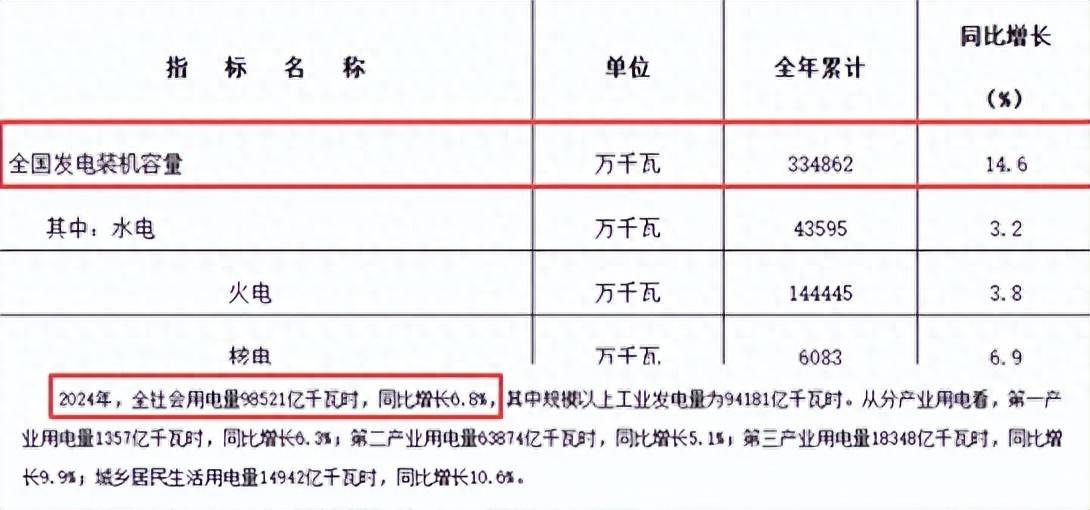
Core Viewpoint - The current situation in China's electricity supply cannot be simply characterized as "overcapacity," as the core issue lies in the mismatch between advanced 21st-century generation capabilities and a 20th-century dispatch system [1] Group 1: Electricity Generation Capacity - China's total installed power generation capacity reached 334,862 MW, with a year-on-year growth of 14.6% [2] - The installed capacity for hydropower was 43,282 MW (3.2% growth), and for thermal power, it was 144,445 MW (3.8% growth) [2] - In 2024, the total electricity consumption is projected to be 98,521 billion kWh, with a growth of 0.8% year-on-year [2] Group 2: Energy Supply and Demand Dynamics - The contradiction arises from the difference between installed capacity and actual generation, with renewable energy sources like wind and solar being less reliable [5] - Despite the apparent overcapacity, there is still a shortage of renewable energy to meet demand, leading to the approval of new large coal power projects [3][9] - The rapid growth of electricity consumption, particularly in new economic sectors like AI data centers and electric vehicles, necessitates the retention of thermal power to fill the gap [9] Group 3: Renewable Energy Challenges - The phenomenon of "abandoned electricity" results in the waste of clean power worth over a thousand billion annually, highlighting the inefficiencies in the current system [3] - The actual operating time of wind and solar power is significantly lower than that of thermal power, leading to localized overcapacity during favorable weather conditions [5] Group 4: Policy and Market Dynamics - The investment in thermal power increased by 38% in 2023, with the highest number of new projects since 2015, indicating a strategic move to ensure grid stability [9] - The current electricity market lacks real-time pricing mechanisms, which amplifies risks in the spot market and hinders the ability of renewable energy producers to respond effectively [12] Group 5: Structural and Systemic Issues - The electricity system's challenges have shifted from supply assurance to consumption and balance, necessitating systemic reforms in dispatch, trading, and pricing [14] - There are significant barriers to cross-province electricity trading, as local governments prioritize domestic consumption to protect jobs and tax revenues [12][14] - The integration of advanced transmission technologies and large-scale storage solutions is essential to address the spatial and temporal mismatches in energy supply [12]
特朗普“大而美”法案弄巧成拙,中国电力实力碾压欧美
Sou Hu Cai Jing· 2025-10-03 05:13
Group 1 - The "Big and Beautiful" bill, pushed by Trump, passed the US House of Representatives with a narrow margin of 218 to 214, unexpectedly strengthening China's position in the global energy sector [1] - The bill includes significant measures such as eliminating tax credits for electric vehicles seven years early, tightening wind and solar subsidies, and prohibiting companies using Chinese technology from receiving subsidies, which ultimately undermines the US energy industry [5] - In 2024, 81% of new power generation capacity in the US is expected to come from solar and energy storage systems, but the implementation of this bill has cut off the development momentum of this sector [5] Group 2 - In 2000, China's annual electricity generation was 1,300 TWh, less than one-third of the US; by 2025, it is projected to exceed 10,000 TWh, surpassing the US's 5,000 TWh [7] - China's hydropower, wind power, and solar power installed capacity all rank first globally, with the cost of electricity in China being 40% lower than in the US [7] - The ecological project in Xinjiang has led to a significant increase in green areas, with 479 million mu of new greening area added in the past year, and the economic output from desert agriculture exceeding 30 billion yuan [9] Group 3 - Companies are making practical choices in response to the impact of Trump's bill, with Tesla criticizing the bill while expanding its Shanghai factory capacity, and Apple relocating 30% of its iPhone production to Mexico but paying for Chinese components in RMB [11] - The transformation of the Tohun River in Changji City has become a symbol of high-quality development, earning multiple national honors and significantly improving air quality [11][14] - The contrasting energy and ecological policies between China and the US are shaping distinctly different futures, with China's clean technology rise providing a strategic buffer in global geopolitical conflicts [14]
上市公司能源消耗数据(2025年更新)
Sou Hu Cai Jing· 2025-10-03 03:32
Core Insights - The energy consumption data of listed companies has evolved from a compliance disclosure item to a strategic asset, reflecting resource utilization efficiency and serving as a basis for investors to assess sustainable development capabilities and for regulators to formulate policies [2] Group 1: Energy Consumption Data Overview - Traditional energy consumption analysis focused on single indicators like electricity consumption and coal usage, while a new analytical framework constructs a "energy structure-efficiency-emission" three-dimensional model for in-depth dissection of energy consumption quality [2] Group 2: Energy Structure Transformation Index - In 2024, the share of clean energy in China's electricity sector reached 80.12%, an increase of 47 percentage points from 2019, with carbon emissions intensity per unit of electricity generation at 0.28 kgCO₂/kWh, which is 42% lower than the industry average [3] Group 3: Dynamic Efficiency Assessment System - In 2024, Datang Power led the industry with a coal consumption rate of 288.47 g/kWh, a 12% decrease from 2019, while Huaneng International's coal consumption reached 293.90 g/kWh, indicating room for technological upgrades [4] Group 4: Emission Intensity Visualization - In 2024, Guodian Power's scope 1 emissions reached 31,460.65 million tons of CO₂ equivalent, while China's scope 2 emissions surged by 142.8%, a year-on-year increase of 43%, providing investors with risk warning signals [5] Group 5: Innovative Applications of Energy Consumption Data - China Power generated revenue of 2.33 billion yuan from selling carbon quotas of 233.3 million tons of CO₂ equivalent, a 60% year-on-year increase, indicating that energy companies are transforming carbon emissions rights into new profit growth points [6] Group 6: Technological Breakthroughs - Jerry Holdings achieved breakthroughs in lithium battery resource recycling, with recovery purity and rate reaching 98%, addressing low recovery rates in the industry [7] Group 7: Industry Chain Collaboration - Huaming Equipment established two production bases, enhancing product reliability by 20% and reducing production costs by 15% through vertical integration, setting a demonstration effect in the energy sector [8] Group 8: Governance Challenges of Energy Consumption Data - In 2024, only 30% of A-share listed companies directly disclosed greenhouse gas emissions, with less than 5% disclosing scope 3 emissions, leading to discrepancies exceeding 30% in carbon emissions reporting [9] Group 9: Future Trends in Energy Consumption Data - AI-powered energy consumption prediction models are becoming prevalent, with Guodian Power achieving a 95% accuracy rate in short-term load forecasting, supporting carbon trading strategies [11] - Blockchain technology is being piloted to trace the carbon footprint of photovoltaic components throughout their lifecycle, potentially reshaping global trade rules under carbon tariffs [12] - Leading energy companies are building ESG data platforms to integrate diverse data, with Yangtze Power reducing greenhouse gas emissions intensity from 5.21 kg to 4.47 kg per ten thousand yuan in revenue from 2024 to 2025 [12] Conclusion - Energy consumption data has transcended simple compliance requirements to become a core input for strategic decision-making, with companies demonstrating that effective data governance capabilities are crucial for survival and development in the carbon-neutral era [12]


中国电力(02380) - 股份发行人的证券变动月报表
2025-09-30 08:53
股份發行人及根據《上市規則》第十九B章上市的香港預託證券發行人的證券變動月報表 截至月份: 2025年9月30日 狀態: 新提交 致:香港交易及結算所有限公司 公司名稱: 中國電力國際發展有限公司 呈交日期: 2025年9月30日 I. 法定/註冊股本變動 不適用 FF301 第 1 頁 共 10 頁 v 1.1.1 FF301 II. 已發行股份及/或庫存股份變動 | 1. 股份分類 | 普通股 | 股份類別 | 不適用 | | 於香港聯交所上市 (註1) | 是 | | | --- | --- | --- | --- | --- | --- | --- | --- | | 證券代號 (如上市) | 02380 | 說明 | | | | | | | | | 已發行股份(不包括庫存股份)數目 | | 庫存股份數目 | | 已發行股份總數 | | | 上月底結存 | | | 12,370,150,983 | | 0 | | 12,370,150,983 | | 增加 / 減少 (-) | | | 0 | | 0 | | | | 本月底結存 | | | 12,370,150,983 | | 0 | | 12,37 ...
2025国际能源电力工程创新与合作发展大会暨中国电力规划设计75周年成果展示在京举办
Zheng Quan Ri Bao Zhi Sheng· 2025-09-27 04:13
Core Insights - The conference aims to create a global dialogue platform for energy and power engineering, showcasing China's achievements and discussing opportunities and challenges in global energy transformation [1][2]. Group 1: Conference Overview - The 2025 International Energy Power Engineering Innovation and Cooperation Development Conference was held in Beijing, marking the 75th anniversary of China's power planning and design [1]. - The event was co-hosted by several organizations, including China Energy Construction and North China Electric Power University, focusing on sharing cutting-edge technology and addressing climate change [1]. Group 2: Key Statements from Industry Leaders - China Energy Construction's Vice President Ni Zhen emphasized the company's commitment to green development and international cooperation in energy and power sectors, proposing four initiatives for collaboration [2]. - The initiatives include promoting green development, expanding cooperative spaces under the "dual carbon" goals, building a shared technology ecosystem, and nurturing talent for sustainable development [2]. Group 3: Future Directions and Innovations - The Chairman of China Electric Power Engineering Consulting Group, Luo Bixiong, highlighted the evolution of China's power planning from supporting industrialization to leading green transformation, advocating for a new energy system [3]. - Future strategies involve multi-energy complementarity, unified scheduling of various energy storage methods, and deep integration of electricity with transportation, construction, and industry [3]. - The conference featured discussions on energy security, clean coal utilization, and technological innovations in energy systems, with publications on new energy systems and wind power technology released [3][4].
中国电力8月合并总售电量约1172.15万兆瓦时 同比增加4.78%
Zhi Tong Cai Jing· 2025-09-26 09:48
中国电力(02380)发布公告,该集团于2025年8月的合并总售电量为约1172.15万兆瓦时,较去年同月增加 4.78%,而2025年首8个月的合并总售电量为约8680.13万兆瓦时。 ...
中国电力(02380)8月合并总售电量约1172.15万兆瓦时 同比增加4.78%
智通财经网· 2025-09-26 09:41
智通财经APP讯,中国电力(02380)发布公告,该集团于2025年8月的合并总售电量为约1172.15万兆瓦 时,较去年同月增加4.78%,而2025年首8个月的合并总售电量为约8680.13万兆瓦时。 ...