CPIC(02601)

Search documents
中国太保今日大宗交易折价成交97.87万股,成交额3655.4万元
Xin Lang Cai Jing· 2025-12-25 09:38
12月25日,中国太保大宗交易成交97.87万股,成交额3655.4万元,占当日总成交额的2.46%,成交价 37.35元,较市场收盘价42.64元折价12.41%。 | Par 13-2 man week 1 kr 1 1 27% 1 | | | | | | | | --- | --- | --- | --- | --- | --- | --- | | 交易日期 | 证券简称 | 证券代码 | 成交价(元) 成交金额(万元) 成交量( *) 买入营业部 | | | 卖出营业部 是否为专场 | | 025-12-25 | 中国太保 | 601601 | 37.35 3655.4 | 97.87 | 更新增量 | 製糖酸 190 | ...



保险板块12月25日涨1.97%,中国太保领涨,主力资金净流入2.87亿元
Zheng Xing Xing Ye Ri Bao· 2025-12-25 09:03
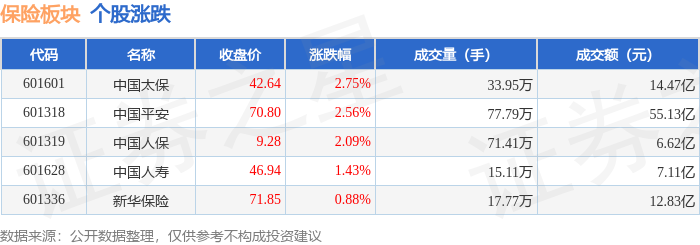
Core Viewpoint - The insurance sector experienced a rise of 1.97% on December 25, with China Pacific Insurance leading the gains, while the Shanghai Composite Index and Shenzhen Component Index also saw increases of 0.47% and 0.33% respectively [1] Group 1: Market Performance - The closing price of China Pacific Insurance was 42.64, reflecting a gain of 2.75% with a trading volume of 339,500 shares [1] - China Ping An closed at 70.80, up by 2.56% with a trading volume of 777,900 shares [1] - China Life Insurance closed at 46.94, showing an increase of 1.43% with a trading volume of 151,100 shares [1] Group 2: Fund Flow Analysis - The insurance sector saw a net inflow of 287 million yuan from institutional investors, while retail investors experienced a net outflow of 258 million yuan [1] - China Ping An had a net inflow of 279 million yuan from institutional investors, but a net outflow of 345 million yuan from retail investors [2] - China Pacific Insurance experienced a net inflow of 65.44 million yuan from institutional investors, with retail investors seeing a net outflow of 53.36 million yuan [2]




固定收益点评:分红险复兴,如何影响保险配置偏好?
Guohai Securities· 2025-12-25 08:05
1. Report Industry Investment Rating No relevant content provided. 2. Core Viewpoints of the Report - The report addresses the asset allocation characteristics of dividend - paying insurance and the impact of its transformation on the bond market [4][10] - In 2025, the transformation of dividend - paying insurance became an industry trend, with significant growth in scale. The income of ordinary dividend - paying insurance of six listed insurance companies in the first half of 2025 reached 157.7 billion yuan, a year - on - year increase of 12%, and its proportion in total life insurance income rose from 15% at the end of 2024 to 16.3% [5][11] - The rapid expansion of dividend - paying insurance meets the needs of both clients and insurance companies. For clients, it offers "certainty of guaranteed return + elastic dividend expectation"; for insurance companies, it helps prevent interest spread losses and reduces the impact of investment asset prices on financial statements [5][14][15] - Compared with ordinary life insurance, the asset allocation logic of dividend - paying insurance is more return - oriented, increasing the allocation of high - volatility assets [5] - The growth rate of insurance companies' bond allocation scale may slow down marginally, and their preference for equities will continue. In terms of specific bond types, insurance companies may increase trading demand for ultra - long - term treasury bonds and allocation demand for secondary perpetual bonds while maintaining the allocation of ultra - long - term local government bonds [5][20][22] 3. Summary by Directory 3.1 Dividend - paying Insurance Transformation Initiation - In 2025, major listed insurance companies placed dividend - paying insurance at the core of their products, driving it to dominate new business. The income of dividend - paying insurance of six listed insurance companies in the first half of the year increased significantly [11] - Each major insurance company has taken measures to promote dividend - paying insurance. For example, China Ping An focused on dividend - paying products, and China Pacific Insurance optimized its product structure with increased dividend - paying insurance new - policy premium [12] 3.2 Reasons for the Rapid Increase in Dividend - paying Insurance Scale - Client side: In the context of low - interest rates and expected stock market improvement, the "certainty of guaranteed return + elastic dividend expectation" of dividend - paying insurance meets clients' demand for more elastic returns [5][14] - Insurance company side: It can prevent interest spread losses and reduce the impact of investment asset price fluctuations on financial statements [5][15] 3.3 Differences in the Asset Allocation Logic of Dividend - paying Insurance - Accounting mechanism: Dividend - paying insurance uses the "floating fee method" for measurement, allowing its liability - side price to be linked to the asset - side. It has a return smoothing mechanism, giving its account a higher risk tolerance [5][16][17] - Business transformation: Higher and stable investment returns are crucial for attracting customers, fulfilling dividend promises, and promoting successful transformation [17] 3.4 Impact on the Bond Market - Overall bond demand: The growth rate of insurance companies' bond allocation scale may slow down marginally, and their preference for equities will continue. In the first three quarters of 2025, the proportion of equity assets in insurance companies' new investments increased from 10.4% in 2024 to 39.9%, while the proportion of bonds decreased from 72.2% to 57.1% [20] - Specific bond types: Insurance companies may increase trading demand for ultra - long - term treasury bonds and allocation demand for secondary perpetual bonds while maintaining the allocation of ultra - long - term local government bonds [22]
保险股上涨,证券保险ETF年内涨超15%,保险证券ETF年内涨超11%
Ge Long Hui· 2025-12-25 06:26
Core Viewpoint - The insurance and securities sectors are experiencing significant growth, with the Securities Insurance ETF up over 15% and the Insurance Securities ETF up over 11% year-to-date, driven by strong performances from major companies in the industry [1][2]. Group 1: ETF Performance - The Securities Insurance ETF tracks the CSI 300 Non-Bank Financial Index, with 61.4% of its components being securities and 37.7% being insurance [3]. - The Insurance Securities ETF follows the CSI 800 Securities Insurance Index, with 73.8% of its components in securities and 25.6% in insurance [4]. Group 2: Industry Outlook - According to a recent report by CICC, the life insurance industry is expected to enter a golden development period by 2026, with a more positive trend in liabilities, shifting the investment logic from "seeking revaluation of existing businesses" to "valuing growth capabilities" [4]. - The current surge in the insurance sector is attributed to the expansion of asset under management (AUM) and the recovery of interest rate spreads, enhancing the certainty of investment returns [4]. - The insurance sector is seen as being in a critical window for performance and valuation recovery, supported by favorable policy and market conditions, with leading companies strengthening their advantages [4]. Group 3: Securities Firms - West Securities believes that there is a mismatch between profitability and valuation in the brokerage sector, indicating potential for future recovery [4]. - Guojin Securities highlights four themes for 2026: increased market activity from resident deposit migration, enhanced resilience and reduced volatility in capital markets, opportunities in direct financing for innovative enterprises, and ongoing mergers and acquisitions in the brokerage industry [5]. - Huatai Securities notes that the market remains active with daily trading volumes around 1.7 trillion yuan and financing balances stabilizing at 2.48 trillion yuan, indicating a favorable environment for brokerage value recovery [6].

低利率之下!人身险公司“资负棋局”防利差损,政策新规引航向
Huan Qiu Wang· 2025-12-25 06:02
Core Viewpoint - The insurance industry is facing unprecedented challenges in asset-liability management due to a prolonged low interest rate environment, which has significantly altered the operational landscape for life insurance companies [2][3]. Group 1: Asset-Liability Management Challenges - Asset-liability management is crucial for balancing long-term liabilities and asset returns, serving as a defense against systemic risks [1]. - The current low interest rate environment has intensified the risk of interest spread losses for existing high guaranteed interest rate policies, prompting a shift in product strategy from traditional fixed income to guaranteed returns plus floating dividends [2][3]. - The majority of insurance funds come from policy liabilities, which have long durations, necessitating long-term asset allocation [2]. Group 2: Regulatory Developments - The new "National Ten Articles" and the draft "Insurance Company Asset-Liability Management Measures" emphasize the need for enhanced asset-liability linkage regulation [6][7]. - The draft measures establish regulatory indicators for life insurance companies, including effective duration gap and net investment income coverage ratio, with minimum standards set to ensure financial stability [7][8]. Group 3: International Responses to Low Interest Rates - Internationally, life insurance markets have adapted to low interest rates by adjusting investment strategies, such as increasing allocations to low liquidity assets for higher liquidity premiums [4][5]. - In the UK, companies have reduced guaranteed dividend levels and shifted towards investment-linked products to share investment risks with policyholders [4]. Group 4: Strategic Recommendations for Insurers - Insurers are advised to construct a robust asset-liability management system to effectively mitigate interest spread loss risks, moving away from reliance on high guaranteed yield products [3][9]. - Companies should focus on enhancing their asset allocation strategies by increasing investments in high-quality long-term bonds and high-dividend equities, while also exploring alternative investments to match liabilities and improve liquidity [9][10]. - Smaller insurers face greater challenges compared to larger firms due to limited capital and investment channels, necessitating a strategic focus on stable cash flows and diversified asset portfolios to survive in a low interest rate environment [9][10].

中国太保:公司不再设立监事会
Xin Lang Cai Jing· 2025-12-25 03:30
中国太保12月24日公告称,本公司于近日收到金融监管总局《关于中国太平洋保险(集团)股份有限公 司修改公司章程的批复》(金复〔2025〕739号),金融监管总局已经核准本公司修订后的《公司章 程》。自本次修订后的《公司章程》核准生效之日起,本公司监事会正式撤销,由董事会审计与关联交 易控制委员会行使《中华人民共和国公司法》和监管制度规定的监事会职权。本公司现任监事不再担任 监事职务。 ...
中国太保盘中股价创历史新高
Mei Ri Jing Ji Xin Wen· 2025-12-25 02:27
(文章来源:每日经济新闻) 每经AI快讯,12月25日,中国太保盘中股价创历史新高,现涨2.89%,报42.70元,总市值为3767.50亿 元。 ...

保险股走强,中国太保创新高
Di Yi Cai Jing Zi Xun· 2025-12-25 02:26
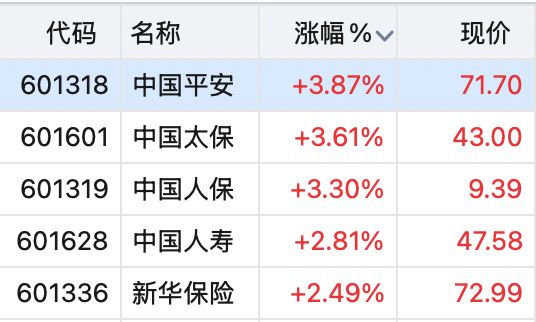
Core Viewpoint - The insurance sector experienced a strong upward trend on December 25, with major companies reaching new highs in stock prices, indicating positive market sentiment towards the industry. Group 1: Stock Performance - China Pacific Insurance (中国太保) rose by 3.61%, reaching a price of 43.00 yuan per share, marking a historical high [1] - Ping An Insurance (中国平安) increased by 3.87%, with a current price of 71.70 yuan per share, the highest since March 2021 [2] - China Life Insurance (中国人寿) and New China Life Insurance (新华保险) both saw increases of over 2%, with prices at 47.58 yuan and 72.99 yuan per share respectively [1][2] - China Insurance (中国人保) also rose by 3.30%, currently priced at 9.39 yuan per share [2]
保险板块震荡走强 中国太保涨近3%创历史新高
Xin Lang Cai Jing· 2025-12-25 02:23
【保险板块震荡走强 中国太保涨近3%创历史新高】智通财经12月25日电,早盘保险板块震荡走强,中 国太保涨近3%,创历史新高,中国平安涨超3%,创2021年3月以来新高,新华保险、中国人保涨超 2%。 转自:智通财经 ...
2025年三季度寿险公司资本要求结构分析:权益价格风险显著提升,利率风险略有下降
13个精算师· 2025-12-24 11:02
Core Viewpoint - The comprehensive solvency adequacy ratio of the life insurance industry in Q3 2025 is 204%, showing a decrease of 26 percentage points quarter-on-quarter and 18 percentage points year-on-year. This decline is attributed to several factors, including the increase in minimum capital requirements and the dynamics of asset and liability growth [1][10]. Group 1: Solvency Analysis - The solvency adequacy ratio decreased due to a 3.2% increase in recognized assets and a 4.1% increase in recognized liabilities, leading to a 1.6% decline in actual capital. Meanwhile, the minimum capital requirement increased by 10.8% [3][13]. - The minimum capital scale reached 2.3 trillion yuan, up 10.8% quarter-on-quarter and 18.7% year-on-year, while actual capital stood at 4.7 trillion yuan, down 1.6% quarter-on-quarter but up 8.1% year-on-year [11][12]. Group 2: Risk Structure - The composition of the quantitative risk minimum capital shows that insurance risk accounts for 24%, market risk for 62%, and credit risk for 14%. The market risk proportion has significantly increased compared to the past three years [16][18]. - The increase in market risk minimum capital is primarily due to the shift towards dividend-type insurance products and the corresponding rise in equity asset allocation, which has heightened the minimum capital requirements and increased solvency pressure on insurance companies [18][26]. Group 3: Regulatory Response - In response to the solvency pressure, regulatory authorities introduced policies to guide the industry in optimizing investment structures and promoting long-term investment. For instance, the risk factor for long-term investments in stocks from the CSI 300 index held for over three years can be reduced by 10% [18][26]. - These adjustments aim to support stable investment behaviors and alleviate the capital burden faced by insurance companies in the current market environment [18][26]. Group 4: Company-Specific Risk Indicators - Among the top three life insurance companies, China Life has a market risk minimum capital proportion of 68.6%, which is above the industry average [18][27]. - The risk structures of leading companies differ significantly, influenced by their business structures, product term structures, and asset allocation strategies [20][28].