
China Life(02628)

Search documents
【华创金融 徐康团队】平安再度增持国寿H,全年行业保费6.12万亿
Xin Lang Cai Jing· 2026-02-02 13:42
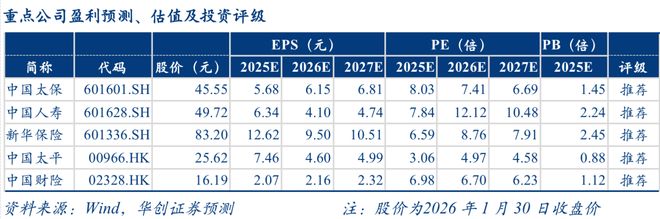
Market Performance - The insurance index increased by 5.55%, outperforming the market by 5.47 percentage points [1] - Individual insurance stocks showed mixed performance, with notable gains from Taiping (+9.96%), AIA (+8.79%), China Life (+8.73%), and others, while ZhongAn experienced a decline of -1.54% [1] Recent Developments - Ping An Life increased its stake in China Life by acquiring 11.891 million H-shares at an average price of HKD 32.0553 per share, totaling approximately HKD 381 million, raising its ownership from 8.98% to 9.14% [2] - Sunshine Life reduced its holdings in Huishang Bank by selling 11.694 million H-shares at an average price of HKD 3.2896 per share, involving funds of approximately HKD 38.4686 million, decreasing its stake from 7.92% to 6.93% [2] - China Life announced plans to establish a pension industry equity investment fund and a private fund in the Yangtze River Delta, with a total commitment of nearly CNY 12.5 billion [2] - The China Securities Regulatory Commission modified regulations to expand the types of strategic investors, including social security funds and commercial insurance funds, with a minimum shareholding requirement of 5% [2] Industry Projections - The insurance industry is projected to achieve a total premium income of CNY 6.12 trillion by 2025, with life insurance accounting for CNY 4.65 trillion and property insurance for CNY 1.47 trillion [3] Investment Recommendations - The report includes investment recommendations for several insurance companies, highlighting their expected earnings per share (EPS) and price-to-earnings (PE) ratios for 2025, with China Life and New China Life receiving a "recommended" rating [6]


智通港股通活跃成交|2月2日
智通财经网· 2026-02-02 11:01
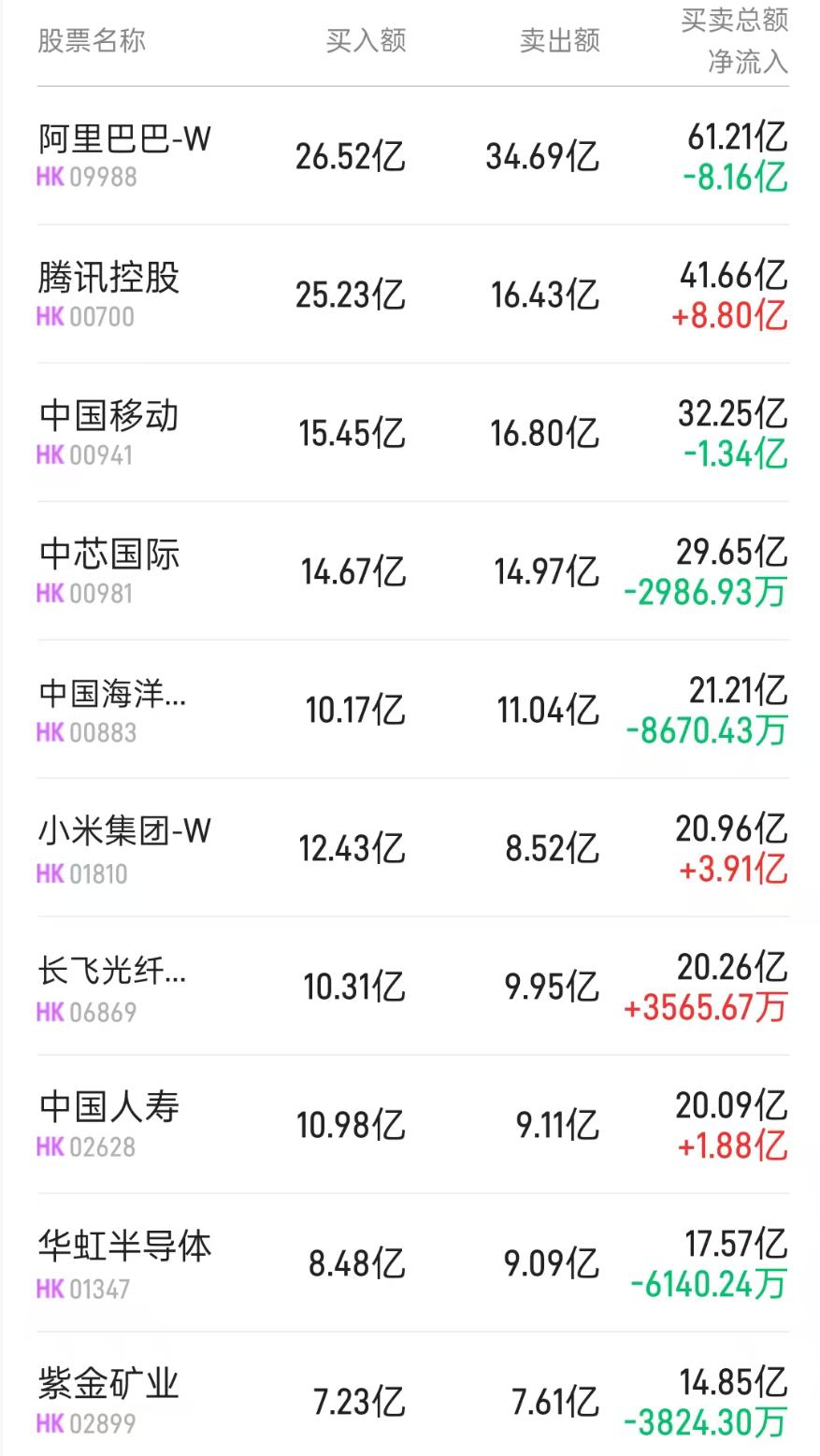
Core Insights - On February 2, 2026, Alibaba-W (09988), Tencent Holdings (00700), and China Mobile (00941) were the top three companies by trading volume in the Southbound Stock Connect, with transaction amounts of 6.121 billion, 4.166 billion, and 3.225 billion respectively [1] - In the Shenzhen-Hong Kong Stock Connect, Alibaba-W (09988), Tencent Holdings (00700), and SMIC (00981) also led the trading volume, with transaction amounts of 3.730 billion, 2.511 billion, and 2.012 billion respectively [1] Southbound Stock Connect Top Active Companies - Alibaba-W (09988) had a trading amount of 6.121 billion with a net buy of -0.816 billion [2] - Tencent Holdings (00700) recorded a trading amount of 4.166 billion with a net buy of +0.880 billion [2] - China Mobile (00941) had a trading amount of 3.225 billion with a net buy of -0.134 billion [2] - SMIC (00981) had a trading amount of 2.965 billion with a net buy of -29.8693 million [2] - Other notable companies included Xiaomi Group-W (01810) with a trading amount of 2.096 billion and a net buy of +0.391 billion [2] Shenzhen-Hong Kong Stock Connect Top Active Companies - Alibaba-W (09988) had a trading amount of 3.730 billion with a net buy of +0.488 billion [2] - Tencent Holdings (00700) recorded a trading amount of 2.511 billion with a net buy of +0.424 billion [2] - SMIC (00981) had a trading amount of 2.012 billion with a net buy of -1.32 billion [2] - Other significant companies included China Mobile (00941) with a trading amount of 1.401 billion and a net buy of +0.0651447 billion [2]





张家口监管分局同意中国人寿财险沽源县支公司变更营业场所
Jin Tou Wang· 2026-02-02 10:56
二、中国人寿财产保险股份有限公司应按照有关规定及时办理变更及许可证换领事宜。 一、同意中国人寿财产保险股份有限公司沽源县支公司将营业场所变更为:河北省张家口市沽源县中环 西路与平定街交叉口东60米路南。 2026年1月28日,国家金融监督管理总局张家口监管分局发布批复称,《中国人寿财产保险股份有限公 司河北省分公司关于中国人寿财产保险股份有限公司沽源县支公司变更营业场所的请示》(国寿财险冀 发〔2025〕178号)收悉。经审核,现批复如下: ...
北水动向|北水成交净买入19.07亿 元宝春节红包活动启动 北水抢筹腾讯(00700)超13亿港元
智通财经网· 2026-02-02 10:01
Summary of Key Points Core Viewpoint - The Hong Kong stock market experienced significant net inflows from northbound capital, with a total net buy of HKD 19.07 billion on February 2, 2023, indicating strong investor interest in certain stocks while others faced net sell-offs [1]. Group 1: Northbound Capital Activity - Northbound capital recorded a net buy of HKD 27.38 billion through the Shanghai Stock Connect and a net sell of HKD 8.3 billion through the Shenzhen Stock Connect [1]. - The most bought stocks included Tencent (00700), Xiaomi Group-W (01810), and China Life (02628) [1]. - The most sold stocks were Hua Hong Semiconductor (01347), Zijin Mining (02899), and CSPC Pharmaceutical Group (01093) [1]. Group 2: Individual Stock Performance - Alibaba-W (09988) had a net sell of HKD 3.28 billion, with plans to invest HKD 30 billion in a "Spring Festival Treat Plan" [6][7]. - Tencent (00700) saw a net buy of HKD 13.03 billion, boosted by the launch of its "Yuanbao" Spring Festival red envelope activity, which is expected to increase downloads and user engagement [4]. - China Life (02628) received a net buy of HKD 1.87 billion, supported by positive forecasts for its individual insurance sales [5]. - Hua Hong Semiconductor (01347) faced a net sell of HKD 6.15 billion, amid tightening order reviews from major chip manufacturers [6]. - Zijin Mining (02899) experienced a net sell of HKD 4.64 billion, as it announced plans to issue USD 1.5 billion zero-coupon convertible bonds for project financing [7].


中国人寿举办第四届“感动国寿”人物事迹展示活动
Zheng Quan Ri Bao Wang· 2026-02-02 09:51
据了解,"感动国寿"人物事迹展示活动已成功举办四届,已成为中国人寿弘扬社会主义核心价值观、践行新时代奋斗精神 的重要平台。活动立足金融央企使命担当,聚焦基层一线奋斗榜样,深挖平凡岗位上的责任坚守与价值奉献,讲述他们的不平 凡人生和故事,向更多的人和全社会传递正能量,生动诠释了寿险头雁服务国家战略、守护民生福祉的初心使命,为"十五 五"开局之年注入温暖而坚定的奋进力量。 过去一年,中国人寿勇立潮头、奋勇争先,总保费规模历史性跨越7000亿元大关,总资产、投资资产双双突破7万亿元, 以超过7980亿美元的准备金成为全球最大寿险公司。亮眼成绩单的背后,是万千国寿人扎根岗位的默默耕耘,是国有金融保险 企业坚守"金融报国、保险为民"底色的生动实践。 本报讯 (记者冷翠华)1月30日,中国人寿保险股份有限公司(以下简称"中国人寿")在京举办以"守护初心 致敬不凡"为 主题的"感动国寿"人物事迹展示活动。 此次活动以"守护初心·使命传承""守护民生·温暖相伴""守护美好·同心同行"三个篇章徐徐展开,讲述了本届"感动国寿"十 大人物的动人故事。活动通过短片展播、人物分享等多元形式,立体呈现先进人物在不同领域的坚守与奉献,让榜 ...
中国人寿财产保险公司增资至278亿,增幅约48%
Xin Lang Cai Jing· 2026-02-02 07:06
Core Viewpoint - China Life Property & Casualty Insurance Co., Ltd. has increased its registered capital from 18.8 billion RMB to 27.8 billion RMB, representing an increase of approximately 48% [1] Group 1: Company Changes - The registered capital of China Life Property & Casualty Insurance Co., Ltd. has been raised significantly [1] - Several key personnel changes have occurred within the company [1] Group 2: Company Background - China Life Property & Casualty Insurance Co., Ltd. was established in December 2006 and is represented legally by Huang Xiumei [1] - The company's business scope includes property damage insurance, liability insurance, credit insurance, and guarantee insurance [1] - The shareholders of the company include China Life Insurance (Group) Company and China Life Insurance Co., Ltd. [1]
多家上市公司出资参设具身智能机器人基金;中国人寿拟出资40亿元参与设立长三角科创私募基金丨01.26-02.01
Sou Hu Cai Jing· 2026-02-02 07:01
Group 1: AI and Robotics Investment Funds - Kunshan established a 5 billion RMB AI industry fund, focusing on core hardware, computing infrastructure, and AI+ manufacturing [2] - Luoyang's industrial development fund plans to set up a 2 billion RMB humanoid robot fund, targeting investments in the entire humanoid robot industry chain [2] - A 6.6 billion RMB intelligent robot industry fund was jointly established by UBTECH and the Liuzhou government, focusing on the entire industry chain [12] Group 2: Aerospace and Space Technology Funds - Sichuan Liangshan plans to establish a commercial aerospace special fund of no less than 4 billion RMB, supporting rocket and satellite development [2] - Beijing Yizhuang Star Arrow Technology established a 1 billion RMB aerospace industry fund, focusing on reusable rockets and satellite applications [3] Group 3: Regional and Sector-Specific Funds - Urumqi's Midong District set up a 200 million RMB industrial fund to boost five key industries, including petrochemicals and new energy [3] - Jiangsu's Wuxi Huishan District launched its first S fund with a total scale of 500 million RMB, focusing on private equity secondary markets [8] - The Jiangsu province's guiding fund successfully established a 500 million RMB results transformation fund to promote technology transfer [5] Group 4: Renewable Energy and New Materials Funds - Zhejiang Zhengtai Electric plans to invest 150 million RMB in a 1 billion RMB household photovoltaic investment fund [11] - Hunan Keli Yuan plans to lead a 2 billion RMB energy storage industry fund, focusing on new energy storage projects [17] Group 5: Healthcare and Biomedicine Funds - The first CVC biomedicine sub-fund in Yangzhou was established with a total scale of 500 million RMB, focusing on medical technology [13] - Liaoning He’s Eye Hospital Group plans to invest 80 million RMB in a biomedicine fund, targeting biotechnology and healthcare projects [15] Group 6: Government and Policy Initiatives - Hangzhou Yuhang District released a new investment fund management method to enhance investment efficiency and support emerging industries [18]

非银金融行业周报:行业周报:战略投资者类型拟扩大,推动耐心资本与上市公司深度对接-20260202
GOLDEN SUN SECURITIES· 2026-02-02 06:36
Investment Rating - The report maintains an "Increase" rating for the non-bank financial sector [5] Core Insights - The China Securities Regulatory Commission (CSRC) is expanding the types of strategic investors to enhance long-term capital engagement with listed companies, including pension funds, insurance funds, and public funds [1][2] - The report highlights a stable regulatory environment for the insurance sector, with long-term benefits expected from trends in deposit migration and increasing demand for healthcare and retirement security [3] - The securities sector is experiencing heightened market risk appetite and active trading, benefiting both IT companies and brokerages [3] Summary by Sections Industry Dynamics - Non-bank financial, securities II, insurance II, and fintech indices experienced fluctuations of +1.04%, -0.69%, +5.50%, and -5.78% respectively, while the Shanghai Composite Index decreased by -0.44% [10] - China Life Insurance led the insurance sector with an increase of +8.73% [10] Insurance - Ping An Life increased its stake in China Life H shares by purchasing 11.891 million shares at an average price of 32.0553 HKD, raising its holding to 9.14% [14] - The registered capital of China Life Property Insurance has increased from 18.8 billion RMB to 27.8 billion RMB, a growth of approximately 48% [14] - As of December, the original premium income for property insurance reached 1,470.3 billion RMB, a year-on-year increase of 2.60%, while life insurance premiums reached 4,649.1 billion RMB, up 9.05% [15] Securities - The A-share market was active in 2025, with daily average trading volume of 2.08 trillion RMB, a year-on-year increase of 70.36% [24] - The number of IPO approvals surged by 109.43% year-on-year, with fundraising amounts increasing by 208.01% [24] - Listed brokerages that have released earnings forecasts expect a net profit growth of 59%-66% year-on-year [24] Investment Recommendations - The report suggests a positive outlook for the insurance sector, despite short-term pressures on capital and sentiment, due to long-term trends in liabilities and stable interest rates [3][37] - In the securities sector, the report recommends focusing on companies like China Ping An A/H, China Life H, Guotai Junan, and Huatai Securities [3][37]
鸿鹄基金1100亿元扛起险资试点“半壁江山”,中国人寿引领险资“长钱长投”
Cai Jing Wang· 2026-02-02 03:58
Core Viewpoint - Long-term capital is essential for maintaining the stability and healthy operation of capital markets, with insurance funds playing a crucial role in optimizing financing structures and supporting economic development [1][2]. Group 1: Long-term Investment Strategy - China Life Group emphasizes the importance of long-term capital, highlighting its significant scale and stable sources, which are vital for supporting the real economy [1]. - The company reported total assets of 8.56 trillion yuan and managed assets of 17.5 trillion yuan, showcasing its capacity to leverage insurance capital for long-term investments [1]. - In 2025, China Life's net purchases of domestic equity investments exceeded 200 billion yuan, demonstrating its commitment to long-term investment even during market fluctuations [2]. Group 2: Innovative Investment Vehicles - The establishment of the Honghu Fund, the first private equity fund led by insurance capital, aims to hold high-quality listed company stocks for the long term, enhancing market stability [2][3]. - The Honghu Fund has a total scale of 110 billion yuan, with China Life contributing nearly half, showcasing its leadership in long-term capital investment [2]. Group 3: Support for Technological Innovation - China Life actively invests in technology companies, supporting their growth from inception to maturity, thereby fostering new productive forces [4]. - The company has invested in key sectors such as semiconductors and artificial intelligence, with funds like the Guoshou Science and Technology Fund and the Guoshou Dual Carbon Fund focusing on high-tech industries [5]. Group 4: Social Responsibility and Welfare - China Life's investments also focus on enhancing public welfare, with initiatives in elderly care and rural revitalization, reflecting its commitment to social responsibility [9][10]. - The company has established a 20 billion yuan elderly care fund and a 10 billion yuan silver industry fund to support the aging population and improve healthcare services [10]. Group 5: Long-term Vision and Strategy - China Life's approach to "long" is not merely about timeframes but involves a deep integration with the pulse of the economy and a commitment to sustainable development [12]. - The company aims to align its financial services with the needs of the real economy, ensuring that its investments contribute to long-term growth and stability [12].

中国人寿(02628) - 截至2026年1月31日止股份发行人的证券变动月报表
2026-02-02 03:01
股份發行人及根據《上市規則》第十九B章上市的香港預託證券發行人的證券變動月報表 截至月份: 2026年1月31日 狀態: 新提交 致:香港交易及結算所有限公司 公司名稱: 中國人壽保險股份有限公司 呈交日期: 2026年2月2日 I. 法定/註冊股本變動 | 1. 股份分類 | 普通股 | 股份類別 | H | | | 於香港聯交所上市 (註1) | | 是 | | | --- | --- | --- | --- | --- | --- | --- | --- | --- | --- | | 證券代號 (如上市) | 02628 | 說明 | | | | | | | | | | | 法定/註冊股份數目 | | | 面值 | | | 法定/註冊股本 | | | 上月底結存 | | | 7,441,175,000 | RMB | | 1 | RMB | | 7,441,175,000 | | 增加 / 減少 (-) | | | | | | | RMB | | | | 本月底結存 | | | 7,441,175,000 | RMB | | 1 | RMB | | 7,441,175,000 | FF301 第 1 ...