BANK COMM(03328)

Search documents
交通银行辽宁省分行落地首笔高标准农田建设贷款
Zhong Guo Jin Rong Xin Xi Wang· 2025-12-09 11:54
Core Viewpoint - The successful issuance of the first high-standard farmland construction loan by Bank of Communications Liaoning Branch demonstrates the effectiveness of deepening cooperation among government, banks, and enterprises, facilitating the flow of financial resources into key areas of rural revitalization [2]. Group 1: Loan Details - Bank of Communications Liaoning Branch issued its first high-standard farmland construction loan of 5 million yuan to support agricultural micro-enterprises facing financing bottlenecks [1]. - The loan aims to enhance the construction of high-standard farmland, which is crucial for ensuring national food security and promoting rural revitalization [1]. Group 2: Project Impact - The timely injection of loan funds will ensure the smooth implementation of key projects such as water-saving irrigation and field roads across thousands of acres of high-standard farmland [1]. - Upon project completion, the water utilization coefficient of the canal system in the project area is expected to increase to 0.8, and the level of agricultural mechanization is projected to improve by 10%-20%, enhancing irrigation security and disaster resistance of the farmland [1].
融入民营经济发展脉络,解构交通银行的四重角色
券商中国· 2025-12-09 11:13
Core Viewpoint - The article emphasizes the importance of the private economy as a vital source of vitality for China's economic development, highlighting the role of financial institutions like Bank of Communications in supporting and nurturing this sector through innovative financial services and products [1]. Group 1: Support for Private Enterprises - Bank of Communications addresses the funding challenges faced by private small and micro enterprises by optimizing services like "no repayment renewal" loans, enhancing approval processes, and upgrading risk control models, significantly improving service coverage [2]. - The bank has developed a dynamic assessment system powered by big data, allowing credit limits for stable and promising private small and micro enterprises to be raised to 20 million yuan, injecting more growth potential into these businesses [2]. Group 2: Online Financing Solutions - The bank has established an efficient online comprehensive credit service system, enabling enterprises to complete financing operations from application to withdrawal online, with nearly 50% coverage of online loans for private small and micro enterprises [3]. - By collaborating with core enterprises in various industries, the bank extends financial services along the supply chain, effectively activating the "capillary" of the real economy [3]. Group 3: Focus on Technological Innovation - The private economy hosts over 80% of specialized "little giant" enterprises and more than 92% of national high-tech enterprises, making it a fertile ground for technological innovation [4]. - The bank has developed a "1+N" evaluation model for technology enterprises, transforming innovation capabilities into financing capabilities [4]. Group 4: Diverse Financial Products - The bank offers a wide range of financial products, including "Talent Loan" providing up to 10 million yuan in unsecured loans and "Science and Technology Quick Loan" that utilizes multiple data dimensions for efficient financing support [5]. - The bank has established a comprehensive financing support system integrating equity, debt, and leasing, serving the diverse needs of private enterprises [5]. Group 5: Cross-Border Financing Support - In the context of global supply chain restructuring, the bank provides comprehensive cross-border financial services, including cross-border fund transfers, trade financing, and foreign exchange risk management, to support private enterprises in their global expansion [7]. - The bank has developed an account service system that simplifies cross-border financing issues for enterprises, enhancing the efficiency of cross-border fund allocation [8]. Group 6: Collaborative Growth with Private Enterprises - The bank has shifted its role from merely providing funds to becoming a partner in the growth of private enterprises, offering customized growth plans and engaging in regular communication with various stakeholders [9]. - The bank has conducted numerous activities to connect with private enterprises, providing policy guidance, project promotion, and financing matchmaking services, significantly increasing its support for high-tech private enterprises [10].


上市银行超2600亿元分红要来了
21世纪经济报道· 2025-12-09 10:53
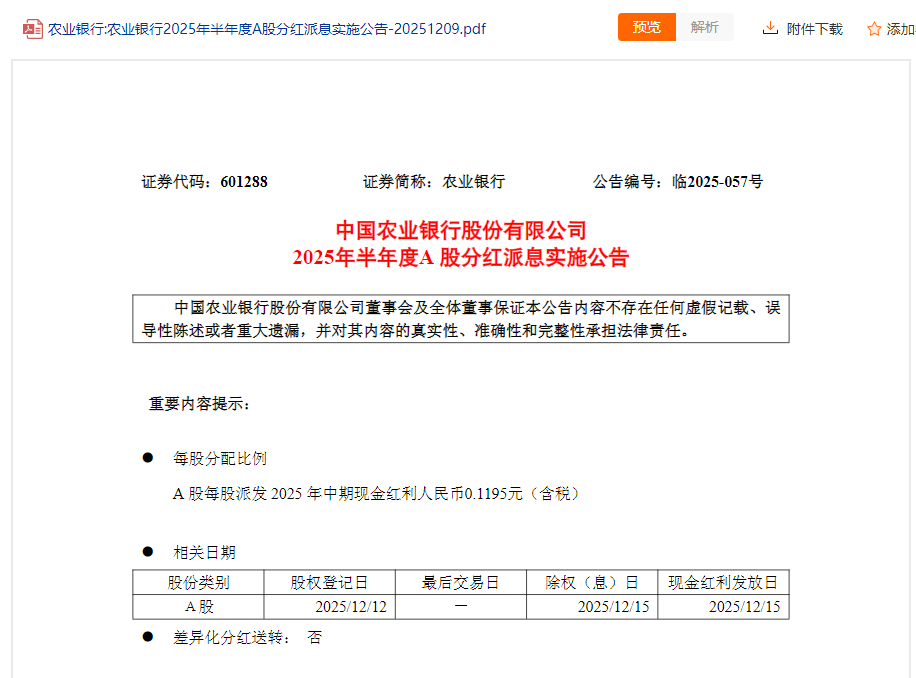
Core Viewpoint - The article highlights the upcoming cash dividend distributions by major Chinese banks, indicating a trend of increased mid-term dividends and a positive outlook for the banking sector's investment value [1][3][6]. Group 1: Dividend Announcements - Industrial and Commercial Bank of China (ICBC) and Agricultural Bank of China (ABC) will distribute approximately 762 billion yuan in cash dividends to A-share shareholders on December 15 [1][3]. - A total of 32 listed banks have announced plans for mid-term dividends this year, an increase of 8 banks compared to 2024, with 9 banks planning to distribute dividends for the first time [6][8]. - The average dividend payout ratio among the 26 banks that have announced specific profit distribution plans is 24.9%, with a total dividend amount of 264.57 billion yuan, reflecting a 2.55% increase from last year [6][7]. Group 2: Specific Bank Dividends - ICBC's mid-term profit distribution plan includes a cash dividend of 0.1414 yuan per share, totaling approximately 50.396 billion yuan, with 38.123 billion yuan allocated for A-shares [3][6]. - ABC will distribute a cash dividend of 0.1195 yuan per share, amounting to about 41.823 billion yuan, with 38.15 billion yuan for A-shares [3][6]. - Other major banks like China Bank and China Construction Bank have also announced their mid-term dividends, with China Bank distributing 0.1094 yuan per share and China Construction Bank distributing 0.1858 yuan per share [3][6]. Group 3: Market Trends and Investor Sentiment - The trend of increased mid-term dividends and earlier distribution dates reflects a robust dividend value in the banking sector, attracting long-term capital [6][10]. - The average dividend yield for listed banks is currently 4.48%, with 12 banks yielding over 5% [7][10]. - There has been a notable increase in share buyback plans by bank executives and major shareholders, indicating confidence in the banks' strategic planning and long-term investment value [10][12].




交通银行(601328) - 交通银行关于2025年第四次临时股东会召开时间变更的公告
2025-12-09 09:15
关于2025年第四次临时股东会召开时间变更的公告 交通银行股份有限公司(以下简称"交通银行"或"本行")董事会及全体董事保证本 公告内容不存在任何虚假记载、误导性陈述或者重大遗漏,并对其内容的真实性、准确性和 完整性承担法律责任。 股票代码:601328 股票简称:交通银行 编号:临2025- 075 交通银行股份有限公司 (一)原股东会的类型和届次:2025年第四次临时股东会 (二)原股东会召开日期时间:2025 年 12 月 12 日9 点 30 分 (三)原股东会股权登记日: | 股份类别 | 股票代码 | 股票简称 | 股权登记日 | | --- | --- | --- | --- | | A股 | 601328 | 交通银行 | 2025/12/4 | 二、股东会时间变更原因 本行于 2025 年 11 月 20 日在上海证券交易所网站(www.sse.com.cn)披露 了《交通银行股份有限公司关于召开 2025 年第四次临时股东会的通知》(公告编 号:临 2025-073。现因工作安排原因,调整股东会召开时间,变更情况说明如 下: 重要内容提示: 会议延期后的召开日期时间:2025 年 12 月 ...
“产品+科技”双轮驱动,交通银行助力残障群体解锁更多可能
Nan Fang Du Shi Bao· 2025-12-09 09:03
Core Viewpoint - The article emphasizes the role of financial institutions, particularly Bank of Communications, in promoting inclusive finance and supporting the development of the disabled community in the Guangdong-Hong Kong-Macao Greater Bay Area through innovative financial services and products [1][6]. Group 1: Financial Services for the Disabled - Bank of Communications launched the "Comprehensive Financial Service Plan for Assisting the Disabled," which includes accessible services, inclusive finance, cross-border finance, and digital RMB wallets to provide practical financial support for the disabled and related organizations [2]. - The bank introduced a "No Barriers Love Loan" offering credit limits up to 1 million yuan with exclusive preferential interest rates, facilitating quick online applications and approvals [2]. - A series of specialized loans, such as entrepreneurial guarantee loans and assistive business loans, are designed to support businesses that assist the disabled, providing tailored financial backing and policies [2][3]. Group 2: Technological Empowerment - The bank focuses on technology to enhance financial services, creating a customized intelligent fund management system for disability associations to improve fund management efficiency [4]. - The "Cloud Cross-Bank" fund management service platform has served over 1,500 government and enterprise units, ensuring that donations are effectively utilized for the benefit of the disabled community [4]. - Innovative services like "Credit Medical Care" allow patients to receive treatment before payment, addressing healthcare payment challenges, while the "Smart Campus" program offers comprehensive services for special education institutions [4]. Group 3: Regional Financial Innovation - The bank integrates regional financial innovation into its services, offering fee waivers for cross-border remittances and a suite of one-stop cross-border financial services for businesses assisting the disabled [6]. - The bank has established 64 "Social Security and Banking Cooperation Points" across Guangdong to provide comprehensive financial support for the disabled, enhancing accessibility and service quality [6]. - Exclusive products such as a digital RMB wallet and commemorative coins for the 2025 National Special Olympics are designed to enhance the payment and investment experience for event participants [6]. Group 4: Commitment to Social Responsibility - The bank's initiatives reflect a commitment to "finance for good," focusing on inclusive product design, technology-driven services, and regional financial innovations to benefit the disabled community [7]. - The bank aims to ensure that the benefits of financial development reach all members of society, including the disabled, contributing to the overall advancement of the disabled community [7].
交通银行(03328) - 关於2025年第四次临时股东会召开时间变更的公告
2025-12-09 08:39
香港交易及結算所有限公司及香港聯合交易所有限公司對本公告之內容概不負責,對其準確性 或完整性亦不發表任何聲明,並明確表示,概不就因本公告全部或任何部分內容而產生或因倚 賴該等內容而引致之任何損失承擔任何責任。 (於中華人民共和國註冊成立的股份有限公司) 變更臨時股東會召開時間 因工作安排的原因,原定於2025年12月12日九時三十分舉行的臨時股東會變更至 2025年12月12日十四時舉行。 委任代表表格 除上述變更外,臨時股東會的委任代表表格維持不變,對延期的臨時股東會而言 仍然有效。尚未交回委任代表表格但有意出席及於臨時股東會投票的股東須依據 其上列印的指示填妥並於延期後的臨時股東會指定舉行時間24小時前(即2025年 12月11日(星期四)下午十四時前)送達本行H股股份過戶登記處香港中央證券登 記有限公司,地址為香港灣仔皇后大道東183號合和中心17M樓。為免疑慮,若 股東已經依據委任代表表格上列印的指示填妥並交回,該等委任代表表格對延期 的臨時股東會而言,仍然有效,該股東無須再次遞交委任代表表格。 1 (股份代號:03328) 關於2025年第四次臨時股東會召開時間變更的公告 茲提述交通銀行股份有限公司 ...
2025企业家博鳌论坛丨数字金融安全发展大会暨数字金融联合宣传年年度活动成功举行
Sou Hu Cai Jing· 2025-12-09 06:18
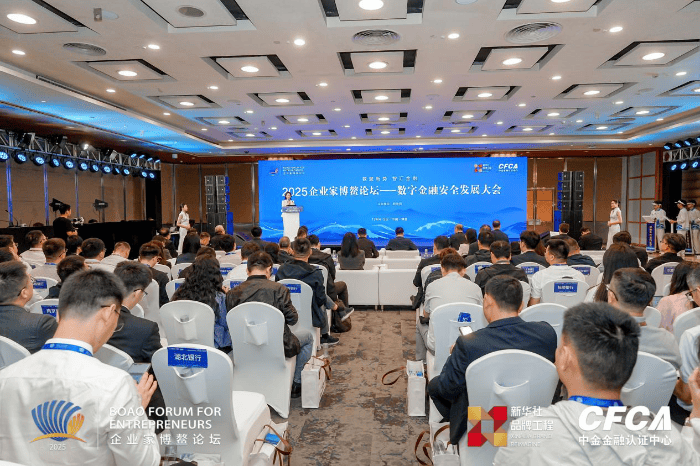
Core Insights - The conference focused on the theme "Digital Financial Security Development" and aimed to explore breakthroughs in financial technology, digital security, and high-quality financial development [2][10] - A memorandum for cooperation on key technologies and standards in intelligent communication within the financial industry was signed by multiple parties, marking the start of strategic collaboration [19] Group 1: Industry Perspectives - The importance of an open, collaborative, and secure digital financial ecosystem was emphasized as a consensus among industry leaders [4] - The prosperity of digital finance relies on an open and collaborative industrial ecosystem, as highlighted by the President of China UnionPay [6] - The need for high-level security to ensure high-quality development in digital finance was stressed by the Director of the Technology Department of the People's Bank of China [8] Group 2: Technological Innovations - CFCA's General Manager discussed the establishment of a trusted digital identity system to enhance digital financial security and support the digital transformation of finance [12] - The Deputy General Manager of the Beijing National Financial Standardization Research Institute outlined the seven roles of financial standards in enhancing data quality and risk prevention in digital finance [14] - The Chief Engineer of China Postal Savings Bank emphasized the need for financial institutions to build efficient and stable fintech platforms to enhance service capabilities [16] Group 3: Collaborative Efforts - A strategic cooperation memorandum was signed among China UnionPay, Huawei, Shanghai Pudong Development Bank, and CFCA to focus on key technology research and standard formulation in intelligent communication [19] - Industry experts shared innovative solutions for digital financial security, highlighting the importance of collaboration among banks, regulatory bodies, and technology companies [21][22] Group 4: Future Outlook - The conference included discussions on how digital technology can reshape financial services and improve service quality [24] - The release of the "2025 Digital Banking Survey Report" provided insights into the evolving landscape of digital banking, utilizing a large data sample of over 70 million active users [27] - The successful hosting of the conference established a platform for collaboration and consensus on digital financial security development [28]


邯郸金融监管分局核准吴少杰交通银行邯郸分行行长任职资格
Jin Tou Wang· 2025-12-09 03:24
三、交通银行应督促上述核准任职资格人员持续学习和掌握经济金融相关法律法规,牢固树立风险合规 意识,熟悉任职岗位职责,忠实勤勉履职。 2025年12月4日,邯郸金融监管分局发布批复称,《交通银行股份有限公司河北省分行关于核准吴少杰 同志任职资格的请示》(交银冀〔2025〕63号)收悉。经审核,现批复如下: 二、交通银行应要求上述核准任职资格人员严格遵守金融监管总局有关监管规定,自交通银行政许可决 定作出之日起3个月内到任,并按要求及时报告到任情况。未在上述规定期限内到任的,本批复文件失 效,由决定机关办理行政许可注销手续。 一、核准吴少杰交通银行邯郸分行行长的任职资格。 ...
交通银行河南省分行多措并举提升资产质量
Zheng Quan Ri Bao Zhi Sheng· 2025-12-08 17:08
Core Viewpoint - The Bank of Communications Henan Branch emphasizes integrating development and safety into its operations, continuously enhancing credit risk management and asset quality [1] Group 1: Risk Management Enhancements - The bank strengthens risk prevention capabilities by enforcing management responsibilities and establishing a mechanism for regular customer risk assessments [1] - It focuses on dynamic risk management in key areas such as real estate and local debts, utilizing a proactive approach to risk control [1] - The bank implements a tailored strategy for key corporate projects, accelerating asset disposal through resource integration and enhancing the effectiveness of bad debt management [1] Group 2: Bad Debt Disposal Strategies - The bank adopts a targeted approach for retail sectors based on asset quality characteristics, employing traditional tools like litigation and write-offs while promoting the securitization of individual loan bad debts [1] - Collaboration with external institutions such as courts and law firms is emphasized to optimize pre-litigation mediation processes [1] Group 3: Commitment to Economic Stability - The Bank of Communications Henan Branch aims to consolidate existing achievements and continuously improve risk management precision, positioning itself as a key player in supporting the real economy and maintaining financial stability [1]
2000亿“红包雨”即将来袭,国有大行今年中期分红提前近一个月落地
Feng Huang Wang· 2025-12-08 14:54
Core Viewpoint - The pace of interim dividends for state-owned banks has significantly accelerated this year, with major announcements made by Agricultural Bank of China and Industrial and Commercial Bank of China for the 2025 interim dividend distribution [1][4]. Group 1: Dividend Announcement Details - Agricultural Bank of China and Industrial and Commercial Bank of China announced their interim dividend distribution dates, with the record date set for December 12, 2025, and the ex-dividend date and cash dividend payment date both on December 15, 2025 [2]. - Industrial and Commercial Bank of China will distribute a cash dividend of RMB 0.1414 per share, totaling approximately RMB 503.96 billion, with about RMB 381.23 billion allocated for A-shares [4]. - Agricultural Bank of China will distribute a cash dividend of RMB 0.1195 per share, totaling approximately RMB 418.23 billion, with about RMB 381.50 billion for A-shares [4]. Group 2: Comparison with Previous Year - As of now, four state-owned banks have announced their interim dividend plans, which is nearly a month earlier than the same period last year [3]. - The total cash dividend for the six major state-owned banks is expected to reach RMB 2046.57 billion, remaining stable compared to the same period last year, with a dividend payout ratio of around 30% [3][7]. - The interim dividend amounts for the other two banks, Bank of Communications and Postal Savings Bank, are expected to be RMB 138.11 billion and RMB 147.72 billion, respectively [7]. Group 3: Regulatory Influence - The acceleration in dividend announcements aligns with the new "National Nine Articles" issued by the State Council in April 2024, which aims to strengthen cash dividend regulations for listed companies [5]. - The industry has become more adept at implementing these policies, leading to a quicker realization of dividend distributions this year compared to last year [6].