
LOGAN GROUP(03380)

Search documents
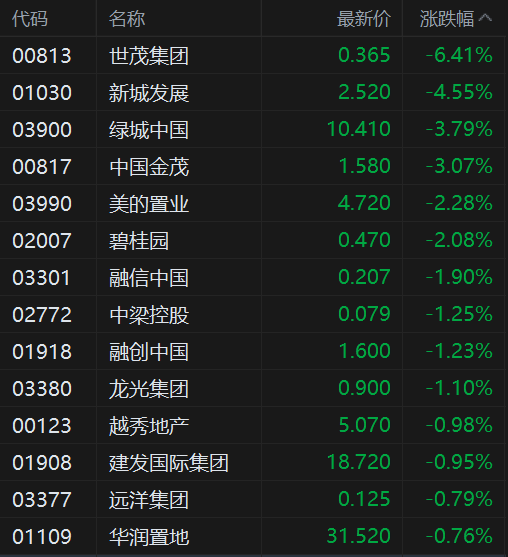
港股异动丨内房股普跌 昨日上海调整限购 分析指市场更需要的是“持续添柴”
Ge Long Hui· 2025-08-26 03:41
Core Viewpoint - The Hong Kong property stocks experienced a collective decline after a brief rise, indicating market skepticism about the sustainability of recent policy changes aimed at boosting the real estate sector [1] Group 1: Market Performance - Major property stocks such as Shimao Group, New World Development, and Greentown China saw significant declines, with Shimao Group dropping by 6.4% and New World Development by 4.55% [1] - Other companies like China Jinmao, Midea Real Estate, and Country Garden also faced losses, with declines exceeding 2% [1] Group 2: Policy Impact - The recent policy adjustment in Shanghai, known as "Six Measures," allows unlimited purchases for eligible buyers outside the outer ring and treats single buyers as families, which initially boosted market confidence [1] - Despite the short-term positive impact, there are ongoing doubts about the long-term effectiveness of these policies and the actual improvement in the market fundamentals [1] Group 3: Future Outlook - The market requires continuous support beyond initial policy changes, with a focus on whether more cities will follow suit and how existing policies will be implemented, particularly regarding credit support [1]



龙光集团(03380)上涨5.62%,报0.94元/股
Jin Rong Jie· 2025-08-25 02:17
截至2024年年报,龙光集团营业总收入232.65亿元、净利润-62.98亿元。 作者:行情君 8月25日,龙光集团(03380)盘中上涨5.62%,截至09:52,报0.94元/股,成交2364.38万元。 8月27日,龙光集团将披露2025财年中报。 龙光集团专注于地产综合开发,拥有房地产开发一级资质、建筑工程施工总承包一级资质和工程设计甲 级资质,业务包括住宅开发、城市更新、资产经营、产业链服务,并广泛布局粤港澳大湾区、长三角核 心都市圈及中西部城市群。截至2021年12月31日,集团中短期可供开发土地超过3430万平方米,一二线 城市土地占比超过70%,建立了四大产品线,已开发逾150个住宅项目,为超过百万人口提供人居服 务。 本文源自:金融界 ...
港股异动丨内房股走高 美的置业发盈喜一度涨近15% 龙光集团等多股涨超3%
Ge Long Hui· 2025-08-19 02:03
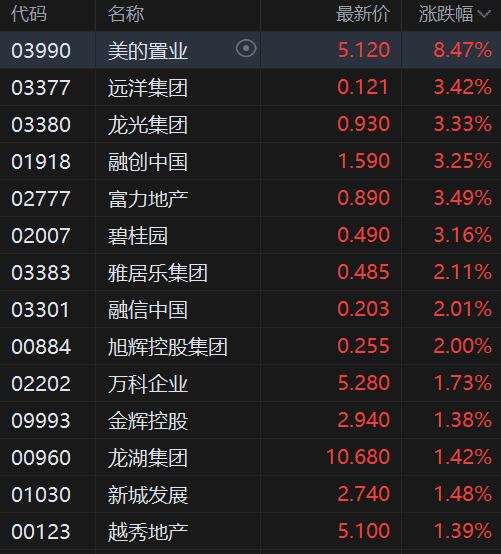
Group 1 - The Hong Kong real estate stocks saw an initial rise, with Midea Real Estate experiencing a notable increase of 15%, while other companies like Oceanwide Group, Sunac China, Longfor Group, Country Garden, and R&F Properties rose over 3% [1] - On August 18, Premier Li Qiang emphasized the need for strong measures to stabilize the real estate market and promote urban renewal, including the renovation of urban villages and dilapidated houses to release improvement demand [1] - Midea Real Estate announced a profit upgrade, expecting a profit attributable to shareholders from continuing operations to be between 250 million to 350 million yuan for the first half of 2025, compared to 140 million and 142 million yuan in the same period last year [1] Group 2 - Oceanwide Group's subsidiary, Beijing Oceanwide Holdings Group Co., Ltd., announced a domestic debt restructuring plan, with a creditor meeting scheduled from September 9 to September 12, involving 7 company bonds and 3 PPNs, totaling 18.05 billion yuan [1] - Country Garden announced that it is seeking strong support from creditors holding a significant amount of existing debt for its restructuring plan [1] - The stock performance of various real estate companies included Midea Real Estate at 5.120 yuan with an increase of 8.47%, Oceanwide Group at 0.121 yuan with a rise of 3.42%, and Longfor Group at 0.930 yuan with a gain of 3.33% [1]

房企债务重组加速破局 年内8家方案落地、削债成主流
Xin Lang Cai Jing· 2025-08-18 03:58
Group 1 - As of early August, 42 out of 60 distressed real estate companies have disclosed debt restructuring progress, with 16 completing full or partial debt restructuring [1] - The current restructuring trend has shifted from "extension" to "debt reduction," with companies like Sunac China reducing over 50% of their 154 billion yuan debt [1] - Longguang Group's 219 billion yuan debt restructuring plan was approved by creditors within 20 days, utilizing asset swaps and cash buybacks [1] Group 2 - Major real estate companies are achieving breakthroughs in risk resolution through judicial reorganization, with Jinke Properties being the first nationwide listed company to complete this process, involving 147 billion yuan in debt and over 8,400 creditors [1] - The "judicial reorganization + strategic investment" model adopted by Jinke Properties has attracted strategic capital, facilitating its transformation into a comprehensive real estate operator [1] - Despite the acceleration of restructuring, companies like R&F Properties and Contemporary Land still face challenges, highlighting the importance of sales recovery and operational capability [2] Group 3 - By 2025, real estate companies will face 525.7 billion yuan in maturing debt, with a peak repayment of 157.4 billion yuan in the third quarter, indicating that market recovery will influence the effectiveness of restructuring [2] - The industry is transitioning from "effective resolution" to "systematic recovery," emphasizing the need for companies to improve both internally and externally for true revitalization [2]

龙光集团(03380.HK)将于8月27日召开董事会会议以审批中期业绩
Ge Long Hui· 2025-08-15 09:03
龙光集团(03380.HK)将于8月27日召开董事会会议以审批中期业绩 港股内房股集体飙升!龙光集团涨 42%,远洋集团涨28% 格隆汇8月15日丨龙光集团(03380.HK)公布,公司将于2025年8月27日召开董事会会议,以(其中包括)审 议及通过集团截至2025年6月30日止六个月的中期业绩及其发布,以及审议派发中期股息的建议(如 有)。 相关事件 ...
龙光集团(03380) - 董事会会议召开日期
2025-08-15 08:31
董事會會議召開日期 龍光集團有限公司(「本公司」)董事會(「董事會」)宣佈,本公司將於二零二五年八月 二十七日(星期三)舉行董事會會議,藉以(其中包括)考慮及批准本公司及其附屬公 司截至二零二五年六月三十日止六個月之中期業績以及考慮派發中期股息(如有)。 香港交易及結算所有限公司及香港聯合交易所有限公司對本公告的內容概不負責, 對其準確性或完整性亦不發表任何聲明,並明確表示,概不對因本公告全部或任何 部份內容而產生或因倚賴該等內容而引致的任何損失承擔任何責任。 Logan Group Company Limited 龍光集團有限公司 (於開曼群島註冊成立之有限公司) 主席 紀海鵬 香港,二零二五年八月十五日 於本公告日期,本公司執行董事為紀海鵬先生、賴卓斌先生、黃湘玲女士、陳勇先 生及周吉先生;及本公司獨立非執行董事為張化橋先生、廖家瑩女士、蔡穗聲先生 及劉勇平博士。 承董事會命 龍光集團有限公司 ...
港股异动丨内房股拉升 美的置业大涨超13%领衔 业界期待政策放松节奏提速
Ge Long Hui· 2025-08-14 02:08
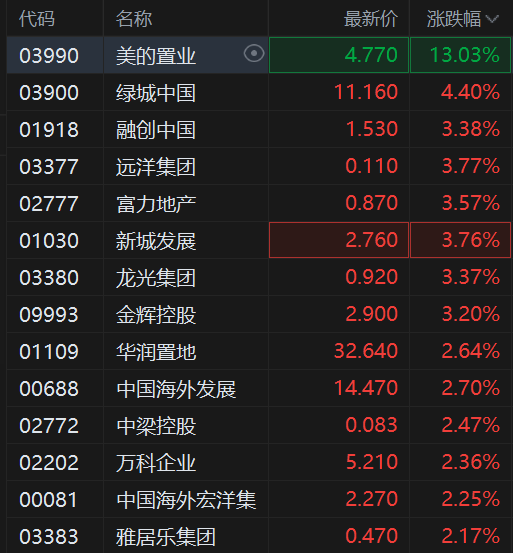
Group 1 - The core viewpoint of the article highlights a significant rise in Hong Kong's real estate stocks, driven by positive industry policies and market sentiment [1] - Midea Real Estate led the gains with an increase of over 13%, while other companies like Greentown China and Sunac China also saw notable rises [1][1] - Recent supportive policies include housing provident fund support for down payments in cities like Tianjin, and new regulations in Changsha and Fuzhou aimed at easing pressure on developers [1][1] Group 2 - The article notes that in the context of a deep adjustment in the real estate industry, some small to medium-sized listed real estate companies are turning their focus to the technology sector through mergers and acquisitions [1] - Industry insiders believe that cross-industry mergers and acquisitions could provide a second growth curve for these companies during the industry adjustment period, enhancing their cyclical resilience [1][1]

专题 | 2025上半年房企债务重组进展解析
克而瑞地产研究· 2025-08-08 10:16
Core Viewpoint - The restructuring of real estate companies has entered a critical phase, with an increasing focus on debt reduction and debt-to-equity swaps becoming mainstream, facilitating risk clearance in the industry [1][3]. Group 1: Debt Restructuring Trends - As of August 4, 2025, 60 distressed real estate companies have disclosed progress in debt restructuring or bankruptcy reorganization, with 42 companies reporting restructuring, and 16 completing all or part of their debt restructuring [5][19]. - Among the 16 companies that completed restructuring, 8 received approval for their plans in 2025, indicating a significant acceleration in the pace of debt restructuring [5][19]. - Four companies have initiated bankruptcy reorganization, while five H-share companies have been ordered to liquidate [6][19]. Group 2: Debt-to-Equity Swaps - Debt-to-equity swaps are becoming a standard feature in restructuring plans, with cash buybacks, debt extensions, and debt-to-equity swaps being the primary methods employed [9][19]. - Most companies are targeting a debt reduction ratio of around 70%, and the time taken for plan approvals has decreased [9][19]. Group 3: Characteristics of Restructuring Plans - Each company's restructuring plan has unique features, with the core objective being debt reduction [15][19]. - Notable examples include Longguang's successful restructuring of 22 billion yuan in domestic debt within 20 days, and Sunac's full debt-to-equity swap for its offshore debt, aiming for a win-win situation [15][19]. - Jinke's bankruptcy reorganization is nearing completion, with 2.6 billion yuan in investment funds fully received [15][19]. Group 4: Industry Risk Clearance - The progress in debt restructuring reflects the ongoing negotiation and balance between real estate companies and their creditors, with the goal of achieving a stable market [16][18]. - The central government has introduced measures to stabilize the real estate market, which is expected to support companies in returning to normal operations post-restructuring [18].

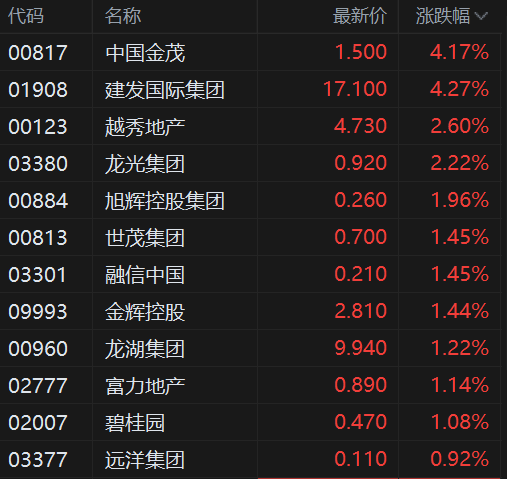
港股异动丨内房股普涨 中国金茂、建发国际涨超4%
Ge Long Hui A P P· 2025-08-07 02:33
Core Viewpoint - The Hong Kong real estate stocks have generally risen, with notable increases in companies such as China Jinmao and Jianfa International Group, indicating a potential recovery in the market [1] Group 1: Market Performance - Hong Kong real estate stocks saw significant gains, with China Jinmao and Jianfa International Group rising over 4%, and Yuexiu Property increasing by 2.6% [1] - Other companies like Longfor Group, CIFI Holdings, Shimao Group, and R&F Properties also experienced gains exceeding 1% [1] Group 2: Market Outlook - Huatai Securities' research report suggests that the foundation for a medium to long-term stabilization in the real estate market is being established, although full recovery will take time [1] - The report outlines potential policy directions for the second half of the year, including stabilizing housing price expectations, effectively stimulating home-buying demand, optimizing land acquisition to reduce inventory, and focusing on funding sources for urban renewal [1] Group 3: Investment Recommendations - Huatai Securities favors the recovery pace in core cities, particularly first-tier cities, and continues to recommend developers with "good credit, good cities, and good products" [1] - The report also highlights the attractiveness of leading property management companies with stable dividends and performance, as well as local Hong Kong real estate stocks benefiting from asset revaluation [1]

龙光集团(03380) - 截至二零二五年七月三十一日止之股份发行人的证券变动月报表
2025-08-04 07:05
FF301 股份發行人及根據《上市規則》第十九B章上市的香港預託證券發行人的證券變動月報表 本月底法定/註冊股本總額: HKD 10,000,000,000 第 1 頁 共 11 頁 v 1.1.1 FF301 截至月份: 2025年7月31日 狀態: 新提交 致:香港交易及結算所有限公司 公司名稱: 龍光集團有限公司 (於開曼群島註冊成立之有限公司) 呈交日期: 2025年8月4日 I. 法定/註冊股本變動 | 1. 股份分類 | 普通股 | 股份類別 不適用 | | | 於香港聯交所上市 (註1) | 是 | | | --- | --- | --- | --- | --- | --- | --- | --- | | 證券代號 (如上市) | 03380 | 說明 | | | | | | | | | 法定/註冊股份數目 | | 面值 | | 法定/註冊股本 | | | 上月底結存 | | 100,000,000,000 | HKD | | 0.1 HKD | | 10,000,000,000 | | 增加 / 減少 (-) | | | 0 | | HKD | | 0 | | 本月底結存 | | 100,00 ...