BANK OF CHINA(03988)

Search documents
中国银行(601988) - H股公告-中国银行股份有限公司400亿美元中期票据计划下通过香港分行发行的票据在香港联合交易所上市之通告
2025-12-11 09:15
香港交易及結算所有限公司及香港聯合交易所有限公司對本公告之內容概不負責,對其準確性 或完整性亦不發表任何聲明,並明確表示,概不對因本公告全部或任何部分內容而產生或因倚 賴該等內容而引致之任何損失承擔任何責任。 本公告僅供參考之用,並不構成收購、購買或認購證券的邀請或要約。根據計劃將予發行的票 據(定義如下)將不會根據經修訂的1933年美國聯邦證券法登記。受制於某些例外情形,根據計 劃將予發行的票據有可能不得在美國境內或向任何美國人士(如證券法S規例定義)或為美國人 士的利益提出要約出售或者進行出售。本公告不得直接或間接於或向美國境內進行分發。 於香港聯合交易所有限公司 上市之通告 中 國 銀 行 股 份 有 限 公 司 香 港 分 行(「 發 行 人 」) 在中國銀行股份有限公司建立的 40,000,000,000 美 元 中 期 票 據 計 劃(「 計 劃 」)下 發 行 | 中國銀行 | 中國農業銀行 | 交通銀行 | 法國巴黎銀行 | | --- | --- | --- | --- | | 中國建設銀行 | 中信銀行 | 中國光大銀行 | 中金公司 | | | | 香港分行 | | | 中信建投國際 | ...
中国银行:公司400亿美元中期票据计划中部分票据将在港交所上市
Xin Lang Cai Jing· 2025-12-11 09:14
中国银行(03988.HK)股份有限公司香港分行(发行人),在中国银行股份有限公司建立的400亿美元中 期票据计划下发行于2028年到期的300亿美元浮动利率票据,于2027年到期的15亿元港币2.85厘利率票 据。在计划下发行的票据已向香港联合交易所有限公司申请票据仅以向专业投资者(定义于《香港联合 交易所有限公司证券上市规则》第37章)发行债务证券的方式上市及买卖。预计票据上市及买卖的批准 将于二零二五年十二月十二日开始生效。 ...
中国银行(03988) - 中国银行股份有限公司400亿美元中期票据计划下通过香港分行发行的票据在香...
2025-12-11 08:57
於香港聯合交易所有限公司 上市之通告 中 國 銀 行 股 份 有 限 公 司 香 港 分 行(「 發 行 人 」) 在中國銀行股份有限公司建立的 40,000,000,000 美 元 中 期 票 據 計 劃(「 計 劃 」)下 發 行 於 2028 年到期的 300,000,000 美元浮動利率票據 (代號: 40024 ) 於 2027 年到期的 1,500,000,000 港 幣 2.85 釐利率票據 (代號: 40025 ) ( 統 稱 為「 票 據 」) 中國銀行股份有限公司 BANK OF CHINA LIMITED 香港交易及結算所有限公司及香港聯合交易所有限公司對本公告之內容概不負責,對其準確性 或完整性亦不發表任何聲明,並明確表示,概不對因本公告全部或任何部分內容而產生或因倚 賴該等內容而引致之任何損失承擔任何責任。 本公告僅供參考之用,並不構成收購、購買或認購證券的邀請或要約。根據計劃將予發行的票 據(定義如下)將不會根據經修訂的1933年美國聯邦證券法登記。受制於某些例外情形,根據計 劃將予發行的票據有可能不得在美國境內或向任何美國人士(如證券法S規例定義)或為美國人 士的利益提出要約出售 ...
A股大额分红,来了!
Zhong Guo Zheng Quan Bao· 2025-12-11 08:37
Core Viewpoint - A-share listed companies in China have significantly increased cash dividends in 2023, surpassing the total amount distributed in the previous year, marking a historical high [1][3]. Group 1: Bank Dividends - On December 11, China Bank and Construction Bank distributed cash dividends, with China Bank paying approximately 35.25 billion yuan (tax excluded) and Construction Bank distributing around 48.61 billion yuan [3]. - Industrial and Agricultural Banks are set to distribute over 76 billion yuan in cash dividends on December 15, 2025, indicating a growing trend in mid-term dividend distributions among banks [3][4]. - Analysts note that the number of banks implementing mid-term dividends is increasing, with many maintaining stable dividend rates and some even raising them, reflecting the banking sector's robust dividend value [3][4]. Group 2: Other Companies' Dividends - Kweichow Moutai announced a cash dividend of 23.957 yuan per share, totaling approximately 30 billion yuan (tax included), with the ex-dividend date set for December 19, 2025 [6]. - Wuliangye announced a cash dividend of 25.78 yuan for every 10 shares, amounting to about 10 billion yuan (tax included), with the ex-dividend date on December 18, 2025 [6]. - Regulatory measures are increasingly supporting dividend distributions, with proposed regulations aimed at enhancing investor returns and promoting cash dividends among listed companies [6][7].


中期分红潮来了,上市公司年内分红有望首破2.6万亿元!红利主题ETF同步官宣分红
Sou Hu Cai Jing· 2025-12-11 03:43
Group 1 - A total of 3,762 A-share listed companies in China have distributed dividends amounting to 2.46 trillion yuan this year, setting a new historical record [1] - 36 companies have announced real-time dividend distributions, with a total proposed dividend amount of 151.8 billion yuan, indicating that the total annual dividend is expected to exceed 2.6 trillion yuan for the first time [1] - Major companies such as China Mobile and Industrial and Commercial Bank of China have distributed over 50 billion yuan in mid-term dividends, while several others, including China Construction Bank and Kweichow Moutai, have distributed over 30 billion yuan [1] Group 2 - The Hong Kong Dividend Low Volatility ETF (520550) has announced a dividend of 0.04 yuan per ten shares, with a distribution ratio of 0.32%, marking its eighth dividend distribution since inception [2] - The China Securities Dividend Quality ETF (159209) has a distribution ratio of 0.26% for its sixth dividend distribution, with both ETFs having a dividend rights registration date of December 12 [1][2] - Recent data shows that the Hong Kong Dividend Low Volatility ETF has seen a net subscription of 119 million yuan in the last ten days and 186 million yuan in the last twenty days, while the China Securities Dividend Quality ETF has experienced a net inflow of 64 million yuan in the last twenty days [2] Group 3 - Huachuang Securities anticipates a rebound in industry rotation strength, with a shift from technology to dividend and anti-involution assets, indicating a recovery in rotation intensity to the 52nd percentile since 2021 [3] - The Producer Price Index (PPI) has shown a narrowing of inflation levels from -3.6% to -2.1% in October, suggesting that cyclical assets with high weight in dividend stocks may benefit from this trend [3] - Recent policies have focused on capital market and consumption, with an emphasis on domestic demand and new industries, indicating a favorable environment for dividend sectors as traditional investment windows for insurance funds approach [3]



信用债异常成交跟踪:12月10日信用债异常成交跟踪
SINOLINK SECURITIES· 2025-12-10 15:27
Report Summary 1. Industry Investment Rating No information about the industry investment rating is provided in the report. 2. Core Viewpoints - Among the bonds with discounted transactions, "25 Yungang Y4" had a large deviation in the valuation price. Among the bonds with rising net prices, "25 Datong C3" had a relatively high deviation in the valuation price. Among the Tier 2 and perpetual bonds with rising net prices, "22 Bank of Communications Tier 2 Capital Bond 02B" had a large deviation in the valuation price; among the commercial financial bonds with rising net prices, "25 Agricultural Bank of China TLAC Non - capital Bond 02C(BC)" had a relatively high deviation in the valuation price. Among the bonds with a transaction yield higher than 5%, real - estate bonds ranked high [2]. - The changes in the valuation yield of credit bonds were mainly distributed in the [-5,0) interval. The transaction terms of non - financial credit bonds were mainly distributed between 2 and 3 years, with the highest proportion of discounted transactions for varieties within 0.5 years. The transaction terms of Tier 2 and perpetual bonds were mainly distributed between 4 and 5 years, with the highest proportion of discounted transactions for varieties within 1 year. In terms of industries, bonds in the national defense and military industry had the largest average deviation in valuation prices [2]. 3. Summary by Relevant Charts Chart 1: Discounted Transaction Tracking - The table listed 30 bonds with large discounts, including "25 Yungang Y4", "25 Dongfang K1", etc., with information on the remaining term, valuation price deviation, valuation net price, valuation yield deviation, and transaction scale. The industries involved included transportation, non - financial finance, and urban investment [4]. Chart 2: Tracking of Bonds with Rising Net Prices - The table showed 43 bonds with large positive deviations, such as "25 Datong C3", "25 Raofa 02", etc. It provided details on the remaining term, valuation price deviation, valuation net price, valuation yield deviation, and transaction scale. The industries included non - financial finance, comprehensive, and public utilities [6]. Chart 3: Tracking of Tier 2 and Perpetual Bond Transactions - The table presented 40 Tier 2 and perpetual bonds, including "22 Bank of Communications Tier 2 Capital Bond 02B", "22 Industrial and Commercial Bank of China Tier 2 Capital Bond 04B", etc., with information on the remaining term, valuation price deviation, valuation net price, valuation yield deviation, bank classification, and transaction scale [7]. Chart 4: Tracking of Commercial Financial Bond Transactions - The table listed 29 commercial financial bonds, such as "25 Agricultural Bank of China TLAC Non - capital Bond 02C(BC)", "24 Agricultural Bank of China TLAC Non - capital Bond 01B(BC)", etc., providing details on the remaining term, valuation price deviation, valuation net price, valuation yield deviation, bank classification, and transaction scale [8]. Chart 5: Bonds with a Transaction Yield Higher than 5% - The table showed 20 bonds with a high - yield transaction, including "21 Vanke 06", "23 Vanke 01", etc., with information on the remaining term, valuation price deviation, valuation net price, valuation yield deviation, and transaction scale. The industries involved included real estate, steel, and non - financial finance [10]. Chart 6: Distribution of Valuation Deviations in Credit Bond Transactions on the Day - The chart showed the distribution of changes in the valuation yield of credit bonds on the day, with the intervals [-10,-5), [-5,0), (0,5], and (5,10], and the number of bonds and transaction scale in each interval [13]. Chart 7: Distribution of Transaction Terms of Non - financial Credit Bonds on the Day - The chart presented the distribution of transaction terms of non - financial credit bonds on the day, including intervals such as within 0.5 years, 0.5 - 1 year, etc., and the corresponding transaction scale [15]. Chart 8: Distribution of Transaction Terms of Tier 2 and Perpetual Bonds on the Day - The chart showed the distribution of transaction terms of Tier 2 and perpetual bonds on the day, including intervals such as within 1 year, 1 - 1.5 years, etc., and the corresponding transaction scale [18]. Chart 9: Discounted Transaction Ratio and Transaction Scale of Non - financial Credit Bonds in Each Industry - The chart displayed the average valuation price deviation and transaction scale of non - financial credit bonds in various industries, including petroleum and petrochemicals, real estate, etc. The national defense and military industry had the largest average valuation price deviation [20].


大连文体旅产业“烟火升腾”!“金融+体育”深度融合释放乘数效应
Xin Lang Cai Jing· 2025-12-10 13:56
Core Viewpoint - The opening of the first football-themed branch of SPD Bank in Dalian signifies the deep integration of finance and sports, promoting high-quality development of the sports economy and the integration of culture, sports, and tourism in the city [3][30]. Group 1: Financial Support for Sports - SPD Bank's Dalian branch aims to break traditional banking service boundaries by creating a unique service system that integrates financial services, fan experiences, and industry support [6][32]. - The strategic partnership between SPD Bank and Dalian Yingbo Football Club will provide comprehensive financial services, including credit, fund management, and payroll services, while enhancing fan engagement through digital platforms [6][32]. - Postal Savings Bank of Dalian is also collaborating with Dalian Yingbo Football Club to offer personalized financial services and themed credit cards, enhancing the "finance + football" ecosystem [8][35]. Group 2: Youth Development in Football - The "You Are On Stage" public football training camp, organized by Ping An Life and Dalian Football Association, aims to provide a professional growth platform for young football talents while integrating financial services into the training system [9][36]. Group 3: Promoting Sports Events - Dalian International Walking Festival and Dalian Marathon are key sports events that showcase the city's charm and spirit, with significant participation from the financial sector enhancing their impact [11][39]. - Financial institutions like Ping An Life and Huaxia Bank have been actively involved in supporting these events, providing services and resources to ensure a positive experience for participants [11][39]. Group 4: International Event Support - Dalian is becoming a significant venue for international sports events, with financial institutions like Bank of China providing comprehensive financial support for events such as the International Football World Cup [13][40]. - The successful hosting of international events relies on a robust safety and insurance framework, with companies like MetLife providing tailored insurance solutions for participants and staff [14][41]. Group 5: Integration of Sports and Tourism - Dalian is leveraging sports events to drive the integration of tourism, culture, and consumption, promoting the "Follow the Event to Tour Dalian" brand [16][43]. - Financial institutions are innovating products to support tourism-related businesses, such as "宿易贷" and "餐易贷," which provide significant funding to enhance the tourism economy [18][44]. Group 6: Future Prospects - Dalian has been recognized as a national pilot city for sports consumption, with tourism revenue reaching 99.15 billion yuan in the first half of 2025, a 300.72% increase from 2022 [20][47]. - The financial sector is expected to continue deepening its integration with the sports industry, contributing to the city's economic growth and the development of a vibrant sports economy [20][47].




五年新坐标|多措并举 助力打造科技创新 “硬实力”
Zhong Guo Xin Wen Wang· 2025-12-10 13:53
Core Insights - The article emphasizes the commitment of the Bank of China to enhance financial support for technological innovation during the 14th Five-Year Plan period, aiming to foster new momentum and advantages in the economy [1] Group 1: Financial Support for Technology Innovation - As of September 2025, the Bank of China's technology loan balance reached 4.7 trillion yuan, with 166,000 credit accounts established, and a cumulative supply of comprehensive services exceeding 830 billion yuan [1] - The establishment of a multi-level organizational system for technology finance, including a central technology finance center and 317 specialized outlets, aims to respond quickly to market demands [2] Group 2: Focus on Emerging Industries - The Bank of China has launched an action plan to support the development of the artificial intelligence industry chain, collaborating with over 2,300 core enterprises in this sector and providing a credit balance of approximately 410 billion yuan [2] - The introduction of the "bond-loan linkage" model and the "Zhongyin Sci-Tech Computing Loan" service in major innovation hubs like Beijing, Shanghai, and Shenzhen has facilitated connections with 773 supply-demand enterprises in the computing sector [2] Group 3: Product and Service Innovation - The Bank of China has innovated financial products to meet the diverse needs of technology enterprises, achieving multiple market firsts, including the launch of a stock repurchase loan policy and the issuance of 200 billion yuan in technology innovation bonds [3] - The "Innovation Credit Loan" has been developed to assess enterprise credit levels and growth potential, enhancing the credit service experience for small and micro technology enterprises [3] Group 4: Building a Financial Ecosystem - The "Zhongyin Sci-Tech Ecological Partner Program" aims to create a collaborative platform for technology innovation, injecting "patient capital" into the primary market for technology [4] - The establishment of 16 AIC equity investment funds, with a total subscription of 11.76 billion yuan, has facilitated investments in sectors such as commercial aerospace and artificial intelligence [4] - The Bank of China plans to continue enhancing its financial services for technology innovation, utilizing various financial tools to support major national technology tasks and small and medium-sized technology enterprises [4]

探寻利率方向(4):从M2看2026年债市流动性
GF SECURITIES· 2025-12-10 11:48
Investment Rating - The report assigns a "Buy" rating for the banking sector, indicating an expectation that stock prices will outperform the market by more than 10% over the next 12 months [40]. Core Insights - The growth of M2 is primarily driven by government and corporate leverage, with government leverage's contribution increasing from 23.9% in 2015 to 45.5% in 2025, while corporate leverage is expected to contribute 63.6% to M2 growth in 2025 [5][14]. - The report highlights a divergence between the social financing (社融) and M2 growth rates, indicating a liquidity accumulation in the financial system when the demand for financing from the real economy is insufficient, which can lead to a decline in bond yields [5][19]. - The expected social financing-M2 differential for 2026 is projected to be 0.56%, with a quarter-on-quarter increase of 33 basis points [32]. Summary by Sections M2 and Liquidity Analysis - M2 includes cash, personal deposits, corporate deposits, non-bank deposits, and deposits from non-deposit financial institutions. The main contributors to M2 growth are government and corporate leverage [5][13]. - The report discusses the relationship between the social financing-M2 differential and bond market performance, noting a shift in correlation since the second half of 2022 [5][19]. Social Financing Projections - For 2026, the report forecasts a total of 16.3 trillion yuan in new loans under the social financing framework, with a growth rate of 8.11% [32][34]. - The report anticipates that the net issuance of government bonds will reach 14.8 trillion yuan in 2026, with a focus on maintaining a proactive fiscal policy [34]. M2 Growth Forecast - The M2 growth rate for 2026 is projected at 7.55%, influenced by factors such as net fiscal deposits, the strengthening of the equity market, and cross-border capital flows [32][36].


中行、建行相继公告!资本补充工作迎来关键进展
Xin Lang Cai Jing· 2025-12-10 10:55
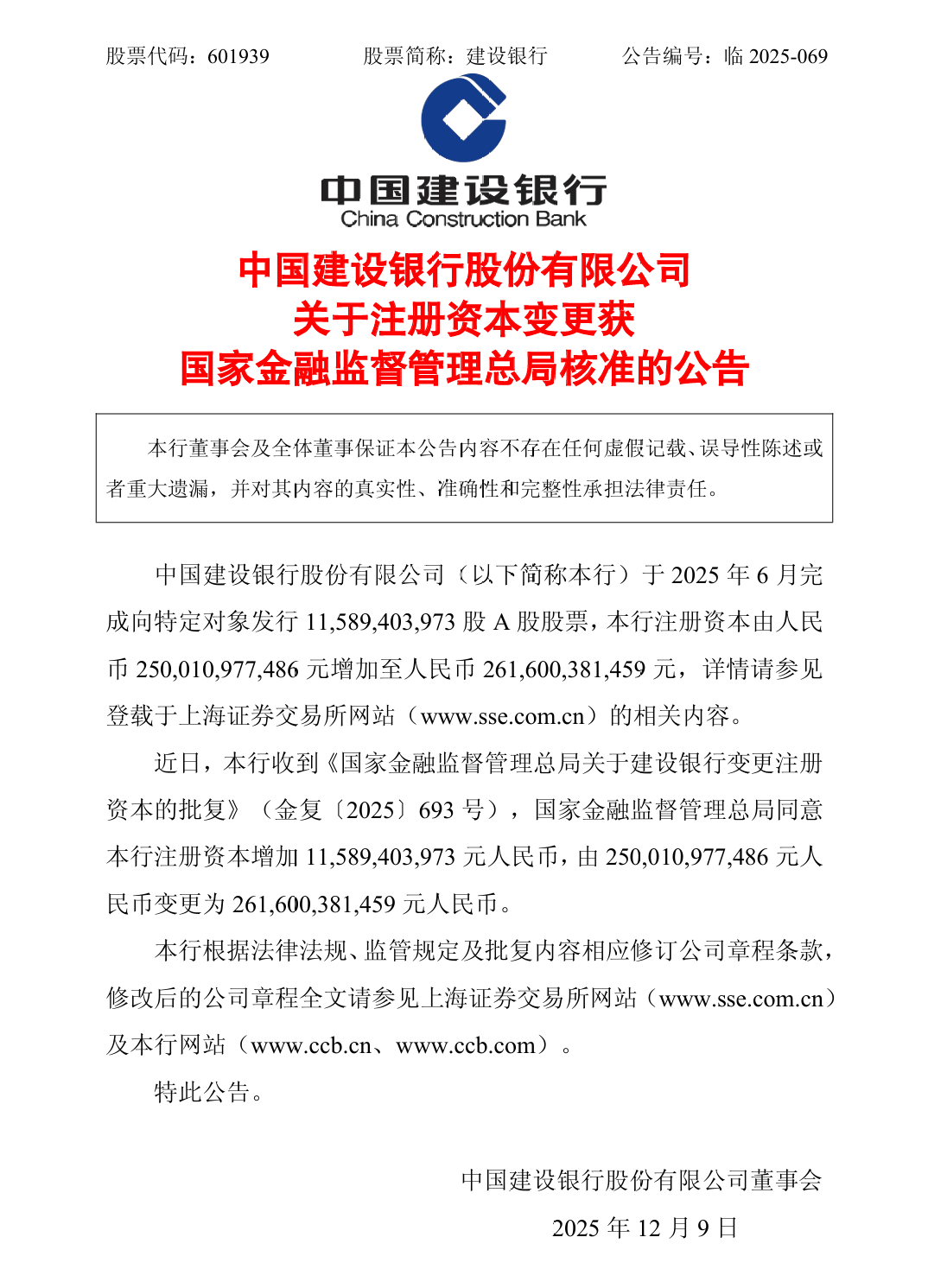
Core Viewpoint - The recent announcements from major state-owned banks regarding capital replenishment reflect a broader trend of capital enhancement among these institutions, with China Construction Bank (CCB) completing a significant issuance of A-shares to increase its registered capital [1][7]. Group 1: Capital Increase Details - China Construction Bank announced on December 9 that it completed the issuance of approximately 11.589 billion A-shares, raising its registered capital from RMB 2500.11 billion to RMB 2616.00 billion [1][4][7]. - The issuance was approved by the National Financial Regulatory Administration, allowing CCB to increase its registered capital by RMB 115.89 billion [4][7]. Group 2: Context of Capital Replenishment - The capital increase is part of a collective effort by major state-owned banks to enhance their capital bases, as highlighted in the government's work report which proposed issuing special government bonds worth RMB 500 billion to support these banks [7][15]. - In March, four major banks, including CCB, announced plans to issue A-shares to raise a total of RMB 4.1 trillion, with CCB aiming to raise up to RMB 1650 billion [7][15]. Group 3: Implications for Capital Adequacy - The capital increase is expected to directly improve the core Tier 1 capital adequacy ratio of CCB and other banks, which is crucial for risk management and supporting the real economy [7][16]. - While the increase in share capital may dilute earnings per share in the short term, it is anticipated to enhance the banks' competitive edge and long-term return expectations for investors [8][16].