BANK OF CHINA(03988)

Search documents
建信恒指港股通交易型开放式指数证券投资基金基金份额发售公告
Shang Hai Zheng Quan Bao· 2025-11-30 18:55
Fund Overview - The fund is named "Jianxin Hangzhi Hong Kong Stock Connect Exchange-Traded Open-Ended Index Securities Investment Fund" and is referred to as "Jianxin Hangzhi Hong Kong Stock Connect ETF" [52] - The fund operates as an exchange-traded open-ended index fund and is categorized as a stock-type fund [52] - The initial offering price for each fund share is set at RMB 1.00 [52] Fund Raising Details - The maximum initial fundraising limit for the fund is RMB 2 billion, excluding interest and subscription fees [53] - The fundraising period is from December 4, 2025, to December 19, 2025, with both online and offline cash subscription options available [56] - Investors can subscribe multiple times, with no upper limit on the total subscription amount for individual investors [2][53] Subscription Methods - Investors can choose between online cash subscription and offline cash subscription [59] - For online subscriptions, a minimum of 1,000 shares or its multiples is required per transaction, while offline subscriptions through the fund management company require a minimum of 50,000 shares [2][63] - Subscription fees will be calculated based on the number of shares subscribed and the applicable commission rate [60][64] Fund Management and Custody - The fund is managed by Jianxin Fund Management Co., Ltd., and the custodian is Bank of China Co., Ltd. [1] - The fund's share registration agency is China Securities Registration and Settlement Co., Ltd. [1] Investor Eligibility - The fund is available for individual investors, institutional investors, qualified foreign investors, and other investors permitted by laws and regulations [54] Fund Operation and Adjustments - The fund management company reserves the right to adjust the fundraising arrangements based on various circumstances [18] - After the fundraising period, the fund management will determine the list of brokers for subscription and redemption, which will be announced after approval from the Shanghai Stock Exchange [5]

2025年全球系统重要性银行名单出炉
Zheng Quan Ri Bao Zhi Sheng· 2025-11-30 16:06
Core Insights - The Financial Stability Board (FSB) has released the 2025 list of Global Systemically Important Banks (G-SIBs), maintaining the number of banks at 29, with five Chinese state-owned banks included [1][2] - The grouping of banks has changed, reflecting shifts in their core business activities, with the Industrial and Commercial Bank of China (ICBC) moving from the second to the third group, marking it as the first Chinese bank in that category [1][2] Group Changes - The highest group (fifth group) remains vacant, while the fourth group includes only JPMorgan Chase [1] - The Agricultural Bank of China, Bank of China, and China Construction Bank remain in the second group, while the Bank of Communications is in the first group [1] Score Changes - The scores of Chinese G-SIBs have changed significantly, with ICBC and Bank of China increasing by 33 and 32 points respectively, driven by multiple factors rather than just size [2] - Currency effects have also positively influenced the scores of Chinese G-SIBs [2] Capital Requirements - Following the group adjustment, ICBC's additional capital requirement will increase from 1.5% to 2.0%, necessitating compliance with Total Loss-Absorbing Capacity (TLAC) requirements within a specified timeframe [2] Importance in Global Financial System - The adjustment confirms ICBC's significant position in the global financial system, raising expectations for its compliance and risk management [2] - The five Chinese banks are encouraged to enhance their ESG management and global strategy, leveraging financial technology for new service models [3] Recommendations for Future Strategy - The banks should improve their compliance and risk management systems by learning from global experiences and actively participating in discussions on international financial management standards [3] - They are advised to innovate in business practices to enhance their narrative in the global financial system and increase their influence [3]


四川中行联动多家金融机构为成都民营企业发展注入金融动能
Zhong Guo Jin Rong Xin Xi Wang· 2025-11-30 12:39
Core Insights - The "Chengdu Financial Service Relay Plan" aims to enhance financial support for private enterprises in Chengdu by creating a collaborative platform among various financial institutions [1] Group 1: Initiative Overview - The initiative is launched by the Chengdu Municipal Committee Financial Office and the Municipal Private Economic Development Promotion Center to break the traditional "individual service" model of financial institutions [1] - It establishes an innovative service mechanism of "main bank recommendation and multi-institution relay" to facilitate the integration of finance and industry [1] Group 2: Event Details - The recent event featured four companies from the biotechnology, agricultural development, and education sectors for live presentations and Q&A sessions [1] - The Sichuan Bank aims to collaborate with multiple financial institutions to provide comprehensive financial services tailored to the different financing needs of enterprises at various development stages [1] Group 3: Financial Institution Role - Sichuan Bank is one of the first financial institutions to cooperate with the Chengdu Municipal Private Economic Development Promotion Center, continuously promoting effective supply of financial resources to the real economy [1] - The bank's efforts are focused on providing effective financial support to drive the high-quality development of Chengdu's private economy [1]
6400亿元!绿色金融债发行翻倍,中小银行加速入场
券商中国· 2025-11-30 07:29
Core Viewpoint - The issuance of green financial bonds in China has significantly increased in 2023, driven by supportive policies and a diverse range of issuing institutions, including small and medium-sized banks, which have become new growth points in the market [2][3][9]. Group 1: Green Bond Issuance - On November 27, the National Development Bank successfully issued 9 billion yuan of 3-year green financial bonds with an interest rate of 1.52%, achieving a subscription multiple of 2.46 times [1]. - Since the implementation of the "Green Bond Support Project Directory (2025 Edition)" in October, financial institutions have entered a "fast track" for green bond issuance, with 14 bank green bonds issued in November alone, marking the highest issuance density of the year [2]. - In November, various banks issued a total of 110.7 billion yuan in green financial bonds, setting a new monthly record for 2023 [3]. Group 2: Diverse Issuers - The issuance of green bonds has expanded beyond state-owned banks to include small and medium-sized banks and non-bank financial institutions, indicating a diversification of issuers [4][9]. - In November, several small banks issued green bonds ranging from 700 million yuan to 3.5 billion yuan, with specific examples including Tangshan Bank and Chongqing Three Gorges Bank [5][6][7]. Group 3: Policy Support and Market Growth - The explosive growth in green bond issuance is attributed to continuous policy support, particularly following the launch of the new project directory, which has unified various green financial products and reduced identification costs for financial institutions [9]. - As of November 28, over 240 green bonds have been issued by financial institutions, with a total issuance scale exceeding 640 billion yuan, doubling the issuance scale from 2024 [9]. Group 4: Cost Optimization and Innovation - The average issuance cost of bank green bonds has improved, decreasing from 1.94% in 2024 to 1.74% in 2023, enhancing the financing cost-effectiveness [3]. - There has been a notable increase in product innovation within the green bond market, with various financial institutions exploring new mechanisms, including floating rate bonds and thematic bonds focused on specific sectors like green manufacturing [11][13].




固收点评20251129:二级资本债周度数据跟踪-20251129
Soochow Securities· 2025-11-29 08:46
1. Report Industry Investment Rating No information provided in the report. 2. Core View of the Report The report provides a weekly data tracking of secondary capital bonds from November 24 to November 28, 2025, covering primary market issuance, secondary market trading, and valuation deviation of individual bonds [1]. 3. Summary by Relevant Catalogs 3.1 Primary Market Issuance - Three new secondary capital bonds were issued in the inter - bank and exchange markets this week, with a total issuance scale of 68.9 billion yuan. The issuance term is 10 years, the issuers include local state - owned enterprises and central financial enterprises, with subject ratings of AA+ and AAA, and the issuer regions are Zhejiang, Hunan, and Beijing [1]. 3.2 Secondary Market Trading - **Trading Volume**: The total weekly trading volume of secondary capital bonds was approximately 178.5 billion yuan, an increase of 13.2 billion yuan from last week. The top three bonds in terms of trading volume were 25 Bank of China Secondary Capital Bond 02BC (10.146 billion yuan), 25 Agricultural Bank of China Secondary Capital Bond 04A(BC) (9.421 billion yuan), and 25 Bank of China Secondary Capital Bond 01BC (6.028 billion yuan). By issuer region, the top three in trading volume were Beijing (141.6 billion yuan), Shanghai (12.6 billion yuan), and Fujian (4.7 billion yuan) [2]. - **Yield to Maturity**: As of November 28, for 5Y secondary capital bonds, the yield - to - maturity changes of AAA-, AA+, and AA - rated bonds compared to last week were 5.46BP, 7.44BP, and 8.44BP respectively; for 7Y bonds, the changes were 9.05BP, 10.90BP, and 10.90BP respectively; for 10Y bonds, the changes were 10.13BP, 9.50BP, and 9.50BP respectively [2]. 3.3 Valuation Deviation of Top 30 Individual Bonds - The overall valuation deviation of the weekly trading average price of secondary capital bonds was not significant this week. The proportion and amplitude of discount transactions were smaller than those of premium transactions. - **Discount Bonds**: The top three discount - rate bonds were 21 Jiutai Rural Commercial Secondary (-48.4374%), 21 Guiyang Rural Commercial Secondary (-1.0131%), and 23 China CITIC Bank Secondary Capital Bond 01B (-0.3428%). The remaining discount rates were within - 0.31%. The ChinaBond implicit ratings were mainly AAA-, AA+, and AA - rated, and the regional distribution was mainly in Beijing, Zhejiang, and Shanghai [3]. - **Premium Bonds**: The top three premium - rate bonds were 25 Shanghai Pufa Bank Secondary Capital Bond 01B (1.5031%), 25 Qujiang Rural Commercial Bank Secondary Capital Bond 01 (1.3216%), and 25 Agricultural Bank of China Secondary Capital Bond 04B(BC) (0.8022%). The remaining premium rates were within 0.78%. The ChinaBond implicit ratings were mainly AAA-, AA+, and AA - rated, and the regional distribution was mainly in Beijing, Shanghai, and Tianjin [3].
央行、工行、农行、中行、建行、交行等集体出手,全力支持救灾及灾后重建工作
2 1 Shi Ji Jing Ji Bao Dao· 2025-11-29 07:04
Core Viewpoint - Several major banks in China, including Industrial and Commercial Bank of China (ICBC), Agricultural Bank of China (ABC), Bank of China (BOC), China Construction Bank (CCB), and others, have collectively mobilized to provide financial support and aid for disaster relief following a significant fire incident in Hong Kong's Tai Po district, demonstrating a strong commitment to corporate social responsibility and community support [1][3][6][9][12][14][17][18]. Group 1: Donations and Financial Support - ICBC announced a donation of HKD 10 million to support disaster relief and reconstruction efforts, coordinating with its Hong Kong branches to provide emergency financial services and support for affected customers [3][12]. - ABC pledged HKD 10 million for fire rescue and post-disaster recovery, organizing volunteer teams and financial support for affected families [6][12]. - BOC committed HKD 20 million, establishing a dedicated donation account for public contributions and offering expedited banking services for affected clients [9][12]. - CCB also donated HKD 10 million, facilitating cross-border donations and providing emergency services for affected residents [12][14]. - Bank of Communications announced a donation of HKD 10 million, setting up emergency service stations and providing immediate cash support for affected customers [14][18]. Group 2: Collective Efforts from Other Banks - Other banks, including Shanghai Bank, Spdb Bank, and Minsheng Bank, collectively donated nearly HKD 100 million, with Spdb Bank and Minsheng Bank each contributing HKD 10 million and HKD 5 million respectively for emergency aid [17][18]. - Foreign banks such as HSBC and Hang Seng Bank jointly donated HKD 30 million, while Standard Chartered and DBS Bank each contributed HKD 10 million to support the affected residents [18].
央行、工行、农行、中行、建行、交行等集体出手
21世纪经济报道· 2025-11-29 06:51
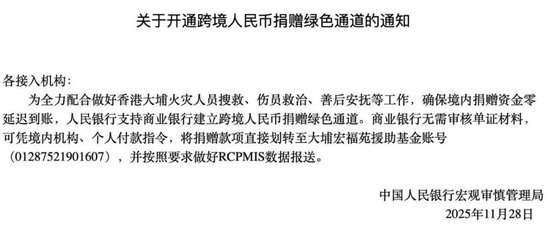
Core Viewpoint - The article discusses the response of various banks in Hong Kong to a significant fire incident in Tai Po, which resulted in major casualties and damage. Multiple banks have pledged financial support and emergency services to assist in disaster relief and recovery efforts. Group 1: Bank Contributions - Industrial and Commercial Bank of China (ICBC) donated HKD 10 million for disaster relief and recovery efforts, mobilizing resources and forming a volunteer team to assist local government [3][5]. - Agricultural Bank of China also pledged HKD 10 million, coordinating with local organizations for direct aid to affected families and offering financial support for insurance claims [6]. - Bank of China announced a donation of HKD 20 million, establishing a special fund for public contributions and providing expedited banking services for affected customers [10][12]. - China Construction Bank contributed HKD 10 million, facilitating cross-border donations and enhancing customer service for those impacted [15]. - Bank of Communications committed HKD 10 million, setting up emergency service stations and providing immediate cash support to affected clients [21][23]. - Other banks, including Shanghai Bank and various foreign banks, collectively donated nearly HKD 100 million to support the relief efforts [25][26]. Group 2: Emergency Services and Support - ICBC implemented an emergency financial service mechanism, offering services like cash withdrawals without cards and loan extensions for affected customers [3][5]. - Agricultural Bank of China organized volunteer teams and established a green channel for insurance claims to expedite support for disaster victims [6]. - Bank of China set up a 24-hour hotline for customer assistance and simplified procedures for affected clients needing banking services [10][12]. - China Construction Bank opened a dedicated service counter for residents of the affected area and extended service hours to accommodate urgent needs [15]. - Bank of Communications provided essential supplies and set up priority service channels for residents to access emergency banking services [21][24].

事关香港火灾!多家银行捐钱捐物、提供应急服务 支持灾后重建
Bei Ke Cai Jing· 2025-11-29 04:33
Core Viewpoint - Multiple banks in Hong Kong are actively providing financial support and donations to assist victims of the recent fire incident in Tai Po, aiming to help them recover and rebuild their lives. Group 1: Donations and Support - Industrial and Commercial Bank of China (ICBC) and its Hong Kong branches will donate HKD 10 million for disaster relief and reconstruction efforts, while also organizing a volunteer team to assist local government [2][3] - Agricultural Bank of China (ABC) will also donate HKD 10 million specifically for fire rescue and post-disaster recovery, coordinating with public welfare organizations for targeted donations [2][3] - China Bank will contribute HKD 20 million and has set up a special account for public donations, while other banks like Bank of Communications and Minsheng Bank are also making significant contributions [3][4] Group 2: Emergency Financial Services - ICBC is extending service hours and providing special service windows for affected customers, offering cash withdrawal without cards and loan extensions [4][5] - China Bank is expediting the reissuance of bank cards for customers without identification and is waiving related fees, while also providing flexible repayment options for loans [5][6] - Bank of Communications is increasing staff at affected branches and extending service hours to assist customers, offering emergency cash support and fee waivers for withdrawals [6][7] Group 3: Insurance Claims Support - Agricultural Bank of China is coordinating with insurance companies to simplify claims processes and provide rapid responses to affected customers [7] - China Bank's insurance division has established a service hotline and emergency claims green channel to expedite claims for affected clients [7] - Bank of Communications Insurance is also reaching out to clients to offer quick service solutions and simplify claims procedures [7]
今日水贝投资金、首饰金及各大银行报价【2025.11.29】
Xin Lang Cai Jing· 2025-11-29 03:38
Group 1 - The article provides the latest gold and silver prices from various banks and institutions as of November 28, 2025, indicating real-time fluctuations in precious metal prices [1][2][3] - The Shanghai Gold Exchange lists the gold price at 953 yuan per gram, while silver prices vary, with the benchmark silver price from 中钞国鼎 at 7.43 yuan per gram and from 斯尔沃银器 at 12.2 yuan per gram [2][3] - The prices are subject to change and are provided for reference, with the final settlement price being the authoritative figure [3]
工行、农行、中行、建行、交行、邮储 停售!
Zhong Guo Ji Jin Bao· 2025-11-29 03:28
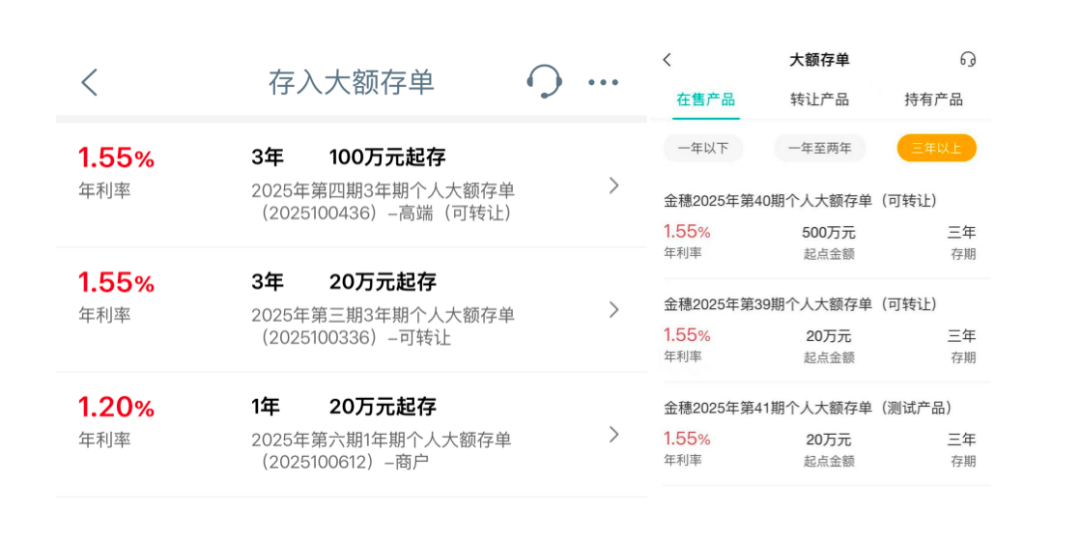
Core Viewpoint - The six major state-owned banks have collectively discontinued the 5-year large denomination certificates of deposit (CDs), reflecting a broader trend of adjustments in long-term deposit products among banks to reduce liability costs and stabilize net interest margins [1][3][8]. Group 1: Market Reactions and Adjustments - The discontinuation of 5-year large denomination CDs by major banks has drawn significant attention, as many smaller banks have also been adjusting their long-term deposit products [3][8]. - Some state-owned banks had already stopped offering 5-year CDs prior to this collective action, indicating a shift in the market [5][8]. - The adjustments in deposit products are primarily aimed at lowering high-cost liabilities and optimizing the banks' liability structures [9][10]. Group 2: Interest Rate Trends - Recent data shows that the net interest margin for commercial banks remains under pressure, with state-owned banks having the lowest net interest margin at 1.31% compared to 3.83% for private banks [8][10]. - The trend of lowering deposit rates is expected to continue, with banks likely to maintain a limited number of 5-year products at reduced rates [10][11]. - The adjustments reflect a significant transformation in the financial system under a low-interest-rate environment, with banks responding to declining asset yields by shortening deposit terms [9][10]. Group 3: Investor Guidance - Investors are advised to shift from a single deposit mindset to a diversified investment strategy, considering options like money market funds, cash management products, and government bonds to balance risk and return [11]. - The expectation of continued declines in deposit rates suggests that investors should lower their return expectations and adjust their investment strategies accordingly [11].