
MICROSOFT(04338)

Search documents
未来数月微软工程师将全力修复Windows 11核心问题
Jin Rong Jie· 2026-01-30 08:51
Core Viewpoint - Windows 11 is facing significant challenges, including performance issues, program vulnerabilities, and user dissatisfaction, prompting Microsoft to take urgent action to address these problems [1][2] Group 1: Current Issues - Windows 11 has been criticized for numerous program vulnerabilities and performance problems, which are eroding the core user experience [1] - Users are frustrated with forced pop-up notifications, advertising, and pre-installed bloatware, contributing to a decline in trust [1] - The initial system requirements set by Microsoft for Windows 11 have disappointed loyal users [1] Group 2: Company's Response - Microsoft plans to initiate a concentrated effort to fix the core issues of Windows 11 in the coming months [1] - The company is reallocating engineers to urgently address performance and reliability gaps in the system [1] - Microsoft aims to enhance system performance and reliability based on feedback from the user community [2] Group 3: Planned Improvements - Upcoming optimizations will focus on basic functionality improvements, such as fixing the dark mode issue and modernizing neglected system modules from the past decade [2] - The Windows and Devices division president emphasized the need to prioritize user needs in the optimization process [2]

英伟达、微软、亚马逊或联手向OpenAI注资600亿美元
Huan Qiu Wang Zi Xun· 2026-01-30 03:29
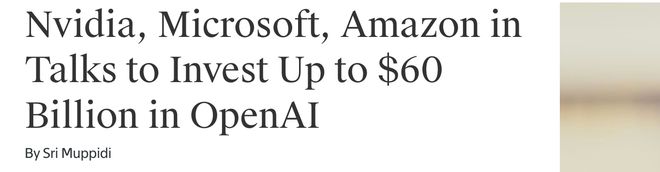
Group 1 - The core point of the article is that Nvidia, Microsoft, and Amazon are negotiating to invest up to $60 billion in OpenAI, which would be the largest single funding round in the AI sector to date [1][4] Group 2 - Nvidia plans to lead the investment with $30 billion, as it is a key chip supplier for OpenAI, providing GPUs for training models like ChatGPT [4] - Microsoft, as OpenAI's largest strategic partner and cloud service provider, intends to invest less than $10 billion, continuing its support since 2019 while avoiding excessive dilution of its equity [4] - Amazon is looking to invest over $10 billion, potentially exceeding $20 billion, marking its first direct investment in OpenAI, which is seen as a strategic move to strengthen its AI ecosystem against Microsoft Azure [4] Group 3 - The funding round is perceived as a response to competitive pressures, especially after Anthropic raised $7.3 billion and other tech giants like Google and Meta accelerated their AI investments [4] - OpenAI's CEO Sam Altman has indicated that future funding needs could reach trillions of dollars to achieve the goal of Artificial General Intelligence (AGI), making this financing round just the first step in a long-term plan [4]


微软:短期 Azure 增长回调,最终将推动长期 AI 战略布局升级
2026-01-30 03:14
28 January 2026 | 11:02PM EST Equity Research Microsoft Corp. (MSFT) Trading off short-term Azure growth ultimately drives more strategic AI positioning long term MSFT 12m Price Target: $600.00 Price: $481.63 Upside: 24.6% Selina Zhang +1(212)357-9979 | selina.zhang@gs.com Goldman Sachs & Co. LLC Key Data _____________________________________ Market cap: $3.6tr Enterprise value: $3.5tr 3m ADTV: $12.3bn United States Americas Software M&A Rank: 3 | GS Forecast __________________________________ | | | | | | - ...
大中华科技 - 半导体:从 Meta 与微软 2025 年第三季度财报看云与 PC 半导体的联动-Greater China Technology Semiconductors-Cloud and PC Semis Read-across from Meta's and Microsoft's 3Q25CY Earnings Calls
2026-01-30 03:14
Summary of Conference Call Notes Industry Overview - **Industry**: Greater China Technology Semiconductors - **Focus**: Cloud and PC Semiconductors - **Key Trends**: AI investments are a primary focus for hyperscalers in 2026, with memory pricing affecting capital expenditure (capex) and the overall PC and enterprise server market. Preference is given to cloud semiconductor companies over PC semiconductor companies [1][3]. Key Company Insights Meta (META.O) - **4Q25CY Capex**: US$22.1 billion, representing a 14% increase quarter-over-quarter (Q/Q) and a 48% increase year-over-year (Y/Y) [7]. - **2026 Capex Guidance**: Expected to be between US$115-135 billion, a 74% increase Y/Y at the mid-point, driven by investments in superintelligence labs and core business infrastructure [7]. - **AI Focus**: Continues to prioritize AI and collaborates with key partners while advancing its silicon program to diversify chip supply and enhance infrastructure flexibility [7]. Microsoft (MSFT.O) - **F2Q26 Capex**: Reported at US$37.5 billion, a 7.4% increase Q/Q and a 66% increase Y/Y, with two-thirds allocated to short-lived assets focusing on GPUs and CPUs [7]. - **Future Capex Expectations**: Anticipates a sequential decrease in capital expenditure due to normal variability from cloud infrastructure buildouts and timing of finance lease deliveries [7]. - **New Products**: Introduced the Maia 200 GPU and Cobalt 200 CPU, aimed at avoiding reliance on a single source for chip supply [7]. - **Impact of Memory Pricing**: Increasing memory prices are expected to affect capex and create volatility in on-premises server business transactions, with a negative outlook for the PC market [7]. Investment Outlook - **Cloud Semiconductor Providers**: Positive sentiment towards cloud semiconductor companies like Aspeed Technology (5274.TWO) due to ongoing investments in 2026 [3]. - **PC Market Caution**: A cautious view on PC semiconductors, particularly in the second half of 2026, due to rising memory prices impacting the market [3]. Valuation Methodology and Risks - **Aspeed Technology (5274.TWO)**: Valuation based on a residual income model with key assumptions including a cost of equity of 9.8%, medium-term growth rate of 18.5%, and terminal growth rate of 5.2% [9]. - **Risks**: Upside risks include stronger cloud demand and faster-than-expected specification migration, while downside risks involve softening cloud demand and intensified competition [9]. Additional Insights - **Industry View**: The overall industry view is considered attractive, indicating potential for growth and investment opportunities [5]. - **Analyst Team**: The report is prepared by a team of analysts including Daniel Yen, Charlie Chan, Daisy Dai, and Tiffany Yeh, who have certified their views on the companies discussed [14]. This summary encapsulates the key points from the conference call, focusing on the semiconductor industry, particularly the cloud and PC segments, and highlights the strategic directions of major players like Meta and Microsoft.
“烧钱”易挣钱难!微软(MSFT.US)AI回报大考折戟惨遭抛售,市值单日蒸发3570亿美元
Zhi Tong Cai Jing· 2026-01-30 02:05
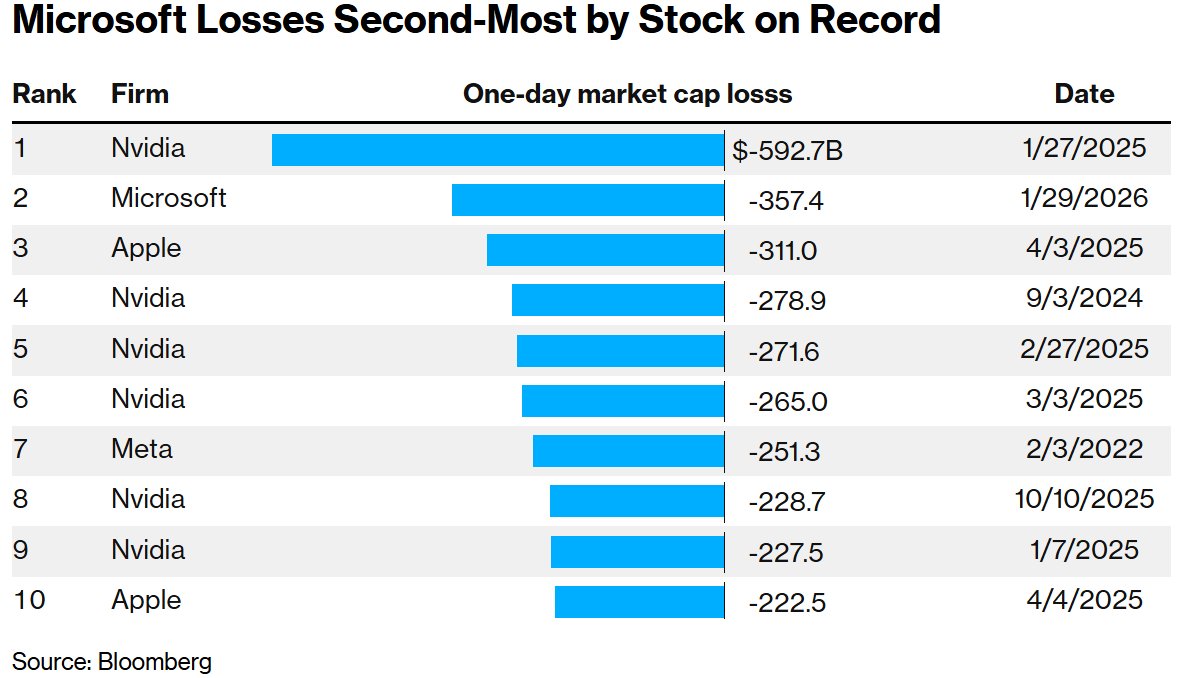
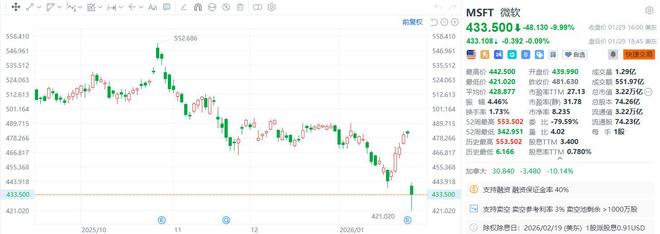
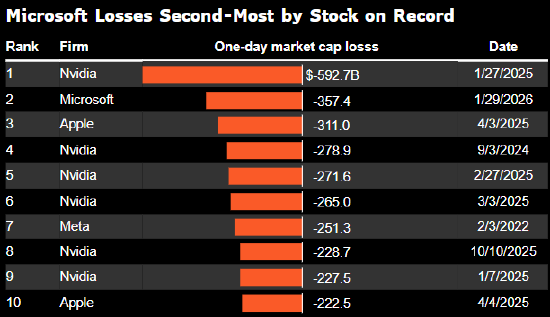
Core Viewpoint - Microsoft experienced a significant stock sell-off, resulting in a market cap loss of $357 billion, marking the second-largest single-day market cap loss in U.S. history [1][3]. Group 1: Market Performance - Microsoft's stock price plummeted by 10%, the largest single-day decline since March 2020 [1]. - The company's market cap loss exceeded the total market cap of over 90% of the S&P 500 index members [1]. - This event follows a historical precedent where Nvidia faced a $593 billion market cap loss in January 2022 [1][2]. Group 2: Financial Results and AI Investment - Microsoft's recent earnings report revealed record AI spending, with capital expenditures increasing by 66% to $37.5 billion [3]. - The growth rate of the Azure cloud computing business has slowed compared to the previous quarter [3]. - Microsoft faces capacity constraints in AI demand, with remaining performance obligations (RPO) totaling $625 billion, of which approximately 45% is linked to its partnership with OpenAI [3]. Group 3: Market Sentiment and Analyst Commentary - There is growing skepticism among investors regarding the return on investment (ROI) from Microsoft's substantial AI expenditures [3]. - Analysts suggest that Microsoft's stock may need to be revalued to align with its historical fair value due to the perceived lack of strong ROI from AI investments [3].
微软(MSFT.US)FY26Q2电话会:云业务收入首次突破500亿美元 Q3资本支出预计环比下降
Zhi Tong Cai Jing· 2026-01-30 01:22
Core Insights - Microsoft reported Q2 FY26 revenue of $81.3 billion, a 17% year-over-year increase, with operating income up 21% and adjusted EPS at $4.14, reflecting a 24% increase [1] - Cloud revenue surpassed $50 billion for the first time, reaching $51.5 billion, a 26% increase year-over-year [1] - The company’s commercial order volume grew by 230% year-over-year, driven by significant long-term commitments from clients like OpenAI [1] Financial Performance - Q2 revenue: $81.3 billion, up 17% YoY (15% at constant currency) [1] - Operating income: up 21% YoY (19% at constant currency) [1] - Adjusted EPS: $4.14, up 24% YoY (21% at constant currency) [1] - Cloud revenue: $51.5 billion, up 26% YoY (24% at constant currency) [1] - Gross margin: 67% [1] Business Outlook - Q3 revenue forecast: $80.65 billion to $81.75 billion, a 15%-17% YoY increase [1] - Expected cost of revenue: $26.65 billion to $26.85 billion, a 22% YoY increase [1] - Anticipated operating expenses: $17.8 billion to $17.9 billion, a 10%-11% YoY increase [1] - Capital expenditures expected to decrease quarter-over-quarter due to normal fluctuations in cloud infrastructure construction [1] Strategic Focus - The company’s strategy emphasizes three layers of technology stack: cloud and token factory, agent platform, and superior agent experience [2] - The impact of AI on GDP and Total Addressable Market (TAM) growth is just beginning [2] - The agent platform is seen as the next generation of application platforms, requiring various services for deployment and management [2] Capital Expenditure and ROI - CapEx growth is driven by long-term demand, with investments aimed at supporting applications like M365 Copilot and GitHub Copilot [3] - Azure's growth guidance is linked to capacity allocation rather than immediate revenue [3] - The average contract duration for RPO has increased from 2 years to 2.5 years, indicating a more stable revenue outlook [3] OpenAI Partnership - Approximately 45% of the unfulfilled orders (RPO) are related to OpenAI, with the remaining 55% reflecting a diverse business portfolio [4][5] - The partnership with OpenAI is viewed positively, contributing to Microsoft's leadership in technology and application innovation [5] Capacity Expansion - The company is focused on increasing capacity globally, with significant projects in Atlanta and Wisconsin [6] - Long-term infrastructure development is prioritized to ensure efficient deployment of GPU and CPU resources [6] Chip Development - The Maia 200 accelerator shows significant performance improvements, enhancing Microsoft's competitive edge in AI workloads [6] - Continuous innovation in chip design and system optimization is crucial for maintaining cost advantages [7] Client Transformation - Clients adopting Microsoft’s AI technology stack are experiencing transformative benefits, with potential for increased spending as they become "frontier firms" [8] - The deployment of agents is changing how companies coordinate work, leading to greater impact [8] Cloud Migration Trends - Ongoing cloud migration is evident, with services like SQL Server on Azure showing growth [9] - The need for a balanced approach between commercial cloud and AI cloud is emphasized as clients migrate workloads [9]
VSCode已死?从终端逆袭的Warp凭什么挑战微软和OpenAI
3 6 Ke· 2026-01-30 00:25
Core Insights - Warp is transforming the traditional terminal into a comprehensive AI development workbench, diverging from the trend of enhancing IDEs like VSCode with AI features [1][2][3] - The terminal is inherently suitable for AI agents due to its time-series interaction model, allowing for efficient parallel processing of tasks [2][3] - Warp aims to integrate the entire development workflow, not just code writing, by enabling AI to manage tasks such as deployment, debugging, and incident response [7][12] Development Trends - The boundaries between traditional IDEs and terminals are blurring, leading to a new interface centered around prompts and agent orchestration [4] - Warp's platform is designed to handle a wide range of development tasks, positioning itself as a unique solution compared to other tools that merely fork from IDEs [7][13] Technical Innovations - Warp emphasizes the importance of prompt engineering and context window management, which are critical for effective AI interaction in terminal environments [8][9] - The company employs a model routing strategy, dynamically switching between various AI models based on performance metrics like latency and cost [9] Practical Applications - Real-world examples include AI-generated code that successfully compiles and integrates into existing workflows, showcasing the practical utility of Warp's platform [12] - Future scenarios envision AI agents autonomously responding to system events and managing incidents, reducing the need for manual input from developers [12][16] Business Strategy - Warp has adapted its pricing model from a subscription-based system to a consumption-based approach, reflecting user preferences for transparent billing [12] - The company recognizes the competitive landscape with major players like OpenAI and Anthropic, focusing on differentiation through unique technical capabilities [13] Future Outlook - The perspective that AI will eventually "solve" programming challenges suggests a shift in developer roles towards intent expression and quality assurance rather than direct coding [14][16] - The terminal is positioned to become the central hub for future development processes, facilitating seamless collaboration between AI and human developers [16][17]

美股异动|微软市值单日缩水3570亿美元 金额仅次于英伟达创下的纪录
Ge Long Hui A P P· 2026-01-29 23:57
格隆汇1月30日|微软公司股价周四遭遇抛售,跌近10%报433.5美元,市值大减3570亿美元,单日缩水 金额在股市史上高居第二。财报显示,微软人工智能(AI)支出创纪录,而核心的云业务部门增长放缓。 历史上唯一一次市值单日缩水金额比这更大的,是英伟达去年在DeepSeek推出低成本AI模型后创下的 5930亿美元纪录。数据显示,微软市值变动金额超过了逾90%的标普500指数成分股的市值本身。其他 一些科技股也感受到了这股寒气。Alphabet和英伟达市值周四均一度蒸发超过1000亿美元。 ...
微软市值单日缩水3570亿美元 金额仅次于英伟达创下的纪录
Xin Lang Cai Jing· 2026-01-29 23:48
微软公司股价周四遭遇抛售,市值大减3570亿美元,单日缩水金额在股市史上高居第二。 受周三盘后公布的财报影响,这家软件巨头收盘下跌10%,创2020年3月以来最大跌幅。财报显示,微 软人工智能(AI)支出创纪录,而核心的云业务部门增长放缓。 | | | Microsoft Losses Second-Most by Stock on Record | | | --- | --- | --- | --- | | Rank | Firm | One-day market cap losss | Date | | 1 | Nvidia | $ 592.7B | 1/27/2025 | | 2 | Microsoft | -357.4 | 1/29/2026 | | 3 | Apple | -311.0 | 4/3/2025 | | 4 | Nvidia | -278.9 | 9/3/2024 | | 5 | Nvidia | -271.6 | 2/27/2025 | | 6 | Nvidia | -265.0 | 3/3/2025 | | 7 | Meta | -251.3 | 2/3/2022 | | 8 | N ...
微软市值一夜蒸发超2.4万亿
Jin Rong Jie· 2026-01-29 23:43
Core Viewpoint - Microsoft's stock price dropped by 10%, resulting in a market value loss of $357.7 billion, marking the second-largest single-day market value loss on record. This event reignited concerns in the market regarding the substantial investments in AI infrastructure in Silicon Valley, negatively impacting overall Wall Street performance [1]. Company Impact - Tesla's stock fell by over 3% following the news [1]. - Oracle's stock decreased by more than 2% in response to the market sentiment [1]. - Meta's stock experienced a rise of over 10%, indicating a potential divergence in market reactions [1]. - IBM's stock increased by over 5%, suggesting a positive market response compared to other tech companies [1].