
MICROSOFT(04338)

Search documents
云资本开支总结_META 与微软 2026 年资本开支将延续强劲势头,同比增幅有望轻松超过 60%_ Cloud Capex Wrap-Up_ META and MSFT Continue to Highlight Robust Capex Trajectory Heading into 2026 with Increases Set to Comfortably Exceed +60% Y_Y
2026-02-02 02:22
Summary of Key Points from the Conference Call Industry and Companies Involved - **Industry**: Hardware & Networking, specifically focusing on Cloud Capital Expenditures (Capex) - **Companies**: Meta Platforms Inc (META), Microsoft (MSFT) Core Insights and Arguments - **Capex Growth Trends**: - Meta and Microsoft reported strong capex trends for the December quarter, with aggregate capex increasing by +10% quarter-over-quarter and +60% year-over-year to $60 billion [1] - Both companies expect significant capex growth in their respective fiscal years, with guidance for increases exceeding +$50 billion year-over-year and growth rates above +60% [1] - **Meta's Capex Outlook**: - Meta's capex for Q4 2025 rose by +14% quarter-over-quarter and +49% year-over-year to $22 billion, driven by investments in data centers, servers, and network infrastructure [3] - For 2026, Meta is guiding a full-year capex outlook of $115-$135 billion, indicating a year-over-year growth of nearly +75% at the midpoint, translating to an increase of approximately +$55 billion compared to 2025 [3] - **Microsoft's Capex Outlook**: - Microsoft’s capex is projected to grow by more than +60% year-over-year in FY26, with Q2 FY26 capex rising +7% quarter-over-quarter and +66% year-over-year to $38 billion [3] - The majority of Microsoft's spending is focused on short-lived assets, including GPUs and CPUs, with significant investments in data center capacity, including nearly 1 gigawatt added in Q2 FY26 [3] - Microsoft anticipates a sequential decline in capex heading into Q3 FY26, but year-over-year growth is still expected to be +65%, equating to an increase of +$14 billion [3] Additional Important Information - **Positive Tailwinds for Related Companies**: The strong capex growth from Meta and Microsoft is expected to benefit companies in the coverage universe that are leveraged to AI infrastructure spending, including Amphenol, Arista, Celestica, Ciena, Coherent, Fabrinet, Flex, Jabil, and Lumentum [1] - **Analyst Coverage**: The report is produced by J.P. Morgan Securities LLC, with analysts Samik Chatterjee, Joseph Cardoso, Manmohanpreet Singh, and Marc Vitenzon involved in the analysis [2] This summary encapsulates the key points from the conference call, highlighting the robust capex growth expectations for Meta and Microsoft, along with the implications for related companies in the industry.


半导体_从 Meta 与微软看数据中心资本开支_AI 基础设施支出持续强劲,利好 AI 计算、网络、存储半导体企业
2026-02-02 02:22
Summary of Key Points from the Conference Call Transcript Industry Overview - The focus is on the **semiconductor industry**, particularly in relation to **datacenter capital expenditures** driven by AI infrastructure spending, as highlighted by earnings calls from **Meta** and **Microsoft** [1][1]. Core Insights 1. **Persistent Supply Constraints**: - Both Microsoft and Meta reported that demand continues to exceed supply, with Meta expecting to remain supply constrained through **2026**. This situation is anticipated to support strong investments in datacenters, servers, and network infrastructure through **2026** and into **2027** [1][1]. 2. **Capex Trends**: - Microsoft increased its capital expenditures (capex) for Q4 to **$37.5 billion**, exceeding consensus expectations of **$36.3 billion**. Meta's capex was reported at **$22.137 billion**, slightly above the consensus of **$22 billion**. - Meta also guided its **2026** capex to **$125 billion**, representing a **73%** increase year-over-year, compared to a consensus expectation of **57%** [1][1]. 3. **Custom Silicon and ASIC Development**: - Both companies are focusing on custom ASIC chip development alongside procuring more GPU supply from companies like **AMD** and **Nvidia**. Meta's MTIA program is expanding, with plans to support core ranking and recommendation training workloads in **Q1 2026**. Broadcom is identified as Meta's ASIC chip design partner, with expectations of Meta becoming a multi-billion dollar customer by **2026** [1][1]. 4. **Rising Compute Intensity**: - Compute intensity is increasing as models grow larger and more complex. Meta reported doubling the number of GPUs used for training its generative ads recommendation model and is scaling to larger clusters for training their GEM models in **2026**. The commentary on cloud capex emphasizes ongoing strong spending on AI infrastructure, networking, custom chip (ASIC), and GPU programs for compute and storage acceleration [1][1]. Additional Insights - Companies that are leveraged to AI/datacenter spending include **Broadcom (AVGO)**, **Marvell Technology (MRVL)**, **NVIDIA (NVDA)**, **Astera Labs (ALAB)**, **Micron Technology (MU)**, **Western Digital (WDC)**, **MACOM (MTSI)**, and **AMD** [1][1]. This summary encapsulates the critical points discussed in the conference call, focusing on the semiconductor industry's current trends and future outlook driven by AI infrastructure investments.


微软一夜蒸发2.4万亿,带来什么信号?
Xin Lang Cai Jing· 2026-02-01 15:32
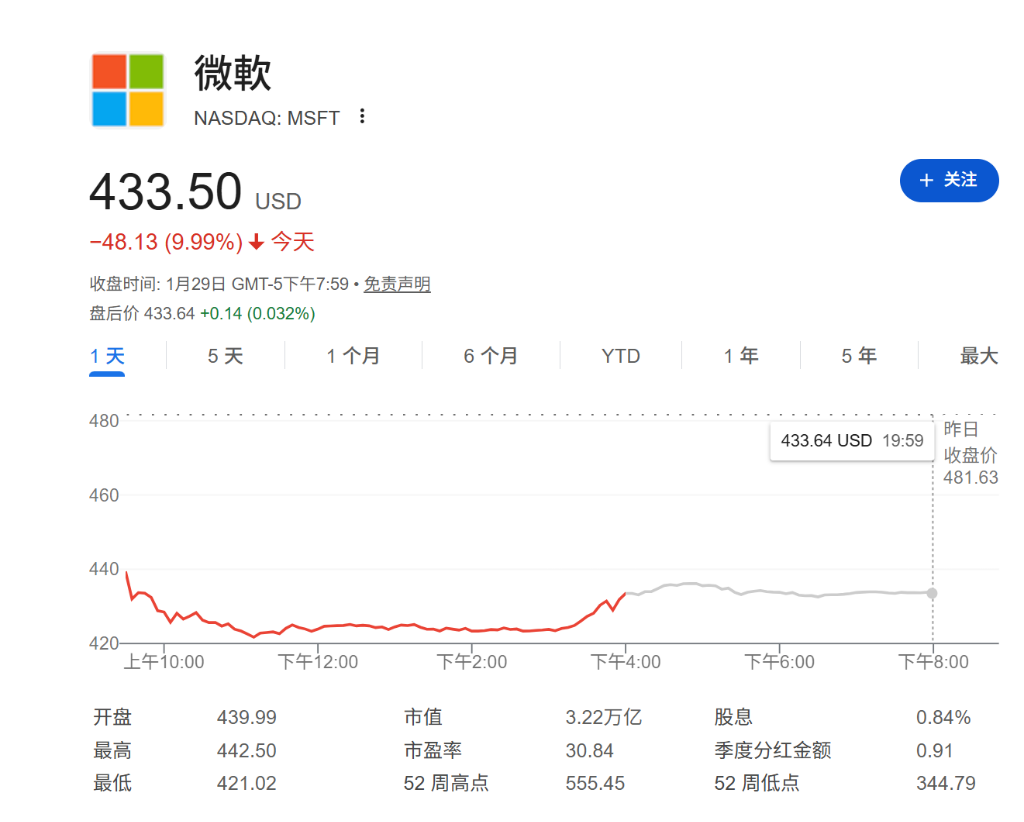
一夜之间,微软市值蒸发3500亿美元,折合人民币2.4万亿元,跻身美股历史上市值单日损失榜第二高 位。这数字什么概念呢?相当于中国2025年全年军费预算的1.3倍,一个中型省份全年GDP总量,或近 10家千亿级上市公司市值总和。 问题出在哪?微软刚交出的,明明是一份"亮眼财报",营收813亿美元同比增长17%,净利润385亿美元 飙升60%。挣得多反而跌得惨,为什么呢?因为市场对微软的预期,早已不是赚钱,而是"无限增长"。 微软的估值,建立在三个神话之上:Azure云业务持续高增长、AI商业化能快速变现与OpenAI的"铁 盟"牢不可破。可这一次,这三个神话,同时被戳破了。 首先,支撑微软万亿市值的关键是什么?是Azure云业务。这是微软的"现金奶牛",也是AI算力的基 石,但最新数据显示,Azure的增速从上季度的40%微降至39%。你没看错,只是降了1%,但在华尔街 眼里,这1%就是"原罪"。 可问题是,这些投入,能赚回来吗?目前,微软为OpenAI提供算力,基本是"免费赞助",OpenAI的API 收入,微软分不到多少,而AI产品的商业化路径,依然模糊。市场担忧,微软正从利润机器变成烧钱 包袱。 三是, ...

微软确认 Win11 新版开始菜单推送范围扩大,并解释为何重新设计
Xin Lang Cai Jing· 2026-02-01 06:25
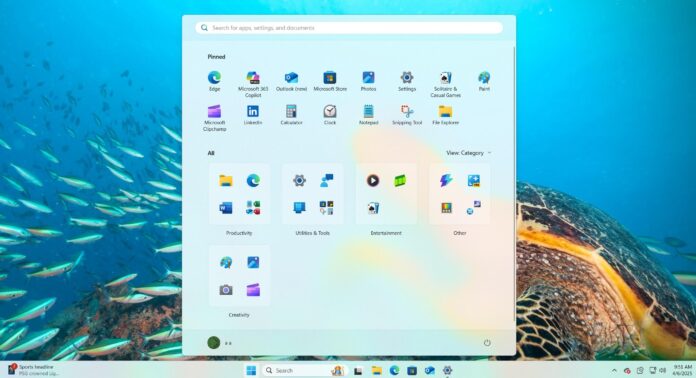
IT之家 2 月 1 日消息,微软向科技媒体《Windows Latest》透露,全新的 Windows 11 开始菜单已随 1 月系统更新全面推送。如果用户仍未看到该界面,可在 Windows 更新中开启"获取最新更新…"的开关,这能加快新功能的推送进度。其余未收到更新的设备,新开始菜单也会在未来几天至几周内陆续显示。 微软研发这款新开始菜单已近一年,在否决了数十个激进的设计方案后,最终确定了当前版本。新版开始菜单与现有版本并无天壤之别,但如果你本身就不 喜欢当前的开始菜单,大概率也不会青睐这个新界面。 微软表示:"经过重新设计的开始菜单现已向更多设备开放,会逐步推送给更多用户。"该更新的推送工作已于上周启动。 微软称,其初衷是保留开始菜单的核心定位,同时让它适配节奏更快、信息更繁杂的当下使用环境。 微软表示,团队仔细研读了反馈中心内所有用户的意见,并得出两大核心结论:第一,开始菜单是 Windows 11 的操作起点,运行和响应速度必须更快;第 二,界面需要更具个性化与静谧感,这也是推荐内容默认开启的原因。 同时新界面有着清晰的层级结构:顶部为搜索栏,其次是固定快捷方式,再往下是推荐内容,最后是全部应用列 ...
微软Copilot测试新提醒功能,面向所有移动端用户
Huan Qiu Wang Zi Xun· 2026-02-01 02:56
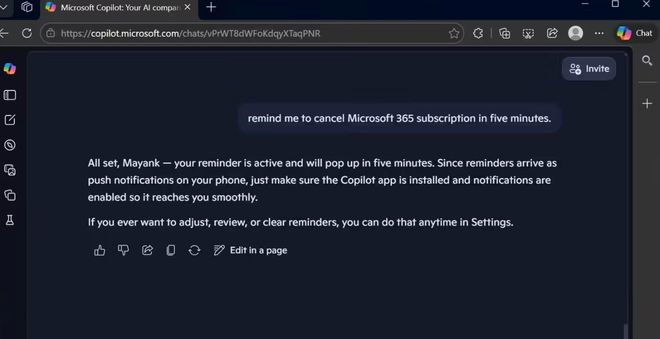
例如,用户可以让Copilot在五分钟后提醒自己取消Microsoft 365订阅,Copilot会向绑定了该应用的移动 设备发送提醒通知;也能让它提醒自己参加重要会议。Copilot能够精准获取用户设备的日期与时间信 息,甚至可以在一分钟内触发提醒。但需要留意的是,如果用户在安卓或iOS系统中关闭了Copilot的通 知权限,相关提醒弹窗将不会显示。 微软声明中透露,提醒功能具备跨设备同步的特性,不过提醒通知仅会发送至移动设备。目前,尚不清 楚后续版本的Windows 11内置Copilot是否会新增对提醒功能的支持。微软在相关说明中明确指出:"要 接收提醒,需安装Copilot应用,并开启应用的通知权限。"(青山) 来源:环球网 值得一提的是,微软此次在提醒功能的开放策略上十分友好。即便用户未订阅Copilot每月20美元的付费 服务,依然能够正常使用提醒功能,因为该功能同时向免费用户敞开了大门。不过,对于订阅了 Microsoft 365个人版的用户,将会解锁额外的提醒功能权益。 【环球网科技综合报道】2月1日消息,据科技媒体Windows Latest报道,微软Copilot正在测试一项名 为"提醒( ...
美股1月收官:道指月线9连涨!七巨头涨跌不一,甲骨文大跌逾15%,微软跌超11%
Jin Rong Jie· 2026-01-31 00:37
Core Insights - The U.S. stock market closed January with the Dow Jones Industrial Average rising 1.73%, the Nasdaq increasing by 0.95%, and the S&P 500 up by 1.37%, while the Nasdaq Golden Dragon China Index surged by 2.69% [1] - The Dow recorded a nine-month consecutive increase, setting a new historical high [1] Company Performance - Notable declines in January included Salesforce down 19.86%, Adobe down 16.21%, Oracle down 15.34%, Qualcomm down 11.38%, Microsoft down 11.03%, Netflix down 10.95%, Apple down 4.55%, Berkshire Hathaway B down 4.4%, Tesla down 4.29%, and Broadcom down 4.28% [1] - In contrast, AMD rose by 10.54%, TSMC increased by 8.78%, Meta grew by 8.55%, Google A was up by 7.99%, Amazon increased by 3.67%, and Nvidia rose by 2.48% [1] Market Capitalization - The top ten companies by market capitalization in the U.S. stock market currently include Nvidia, Apple, Google C, Google A, Microsoft, Amazon, Meta, TSMC, Broadcom, and Tesla [1]
1月收官战警报拉响!白银闪崩,微软暴跌,A股周期股行情要终结?
Sou Hu Cai Jing· 2026-01-30 17:00
Group 1 - The first "bomb" in the commodity market saw a dramatic drop in precious and non-ferrous metal prices, with silver experiencing a price swing of 12% in a single day, indicating a rapid exit of profit-seeking funds [3][4] - Multiple gold-related companies in the A-share market issued warnings about stock price volatility in relation to gold prices, suggesting regulatory guidance aimed at cooling overheated speculation in non-ferrous metals [3][4] - The second "bomb" came from the U.S. stock market, where Microsoft reported strong earnings but faced a sell-off due to concerns over slowing revenue growth in its Azure cloud service and high capital expenditures for AI infrastructure, leading to a 12% drop in its stock price [4][5] Group 2 - Meta's earnings report exceeded expectations, driven by strong advertising performance, resulting in a 9% increase in its stock price, highlighting a shift in market sentiment towards companies that can demonstrate AI's direct impact on profitability [5] - In the domestic market, the dye industry is experiencing a price increase, with disperse dye prices rising to 19 yuan per kilogram and reactive dye prices to 23 yuan per kilogram, indicating a potential turning point for the industry's fundamentals [7] - The commercial aerospace sector is set for significant growth, with projections estimating the market size to reach 2.5 to 2.8 trillion yuan by 2025 and potentially 8 to 10 trillion yuan by 2030, driven by advancements in technology and government support [8] Group 3 - In the AI application sector, there are numerous developments, including the release of new AI models and significant funding negotiations for OpenAI, indicating a strong long-term investment outlook for AI [9] - Trading data from January 29 shows a divergence between retail and institutional investors, with retail investors heavily buying into AI application stocks while institutions were reducing their positions in precious and non-ferrous metals [10] - Institutions are reallocating funds from overbought metal sectors to the chemical sector, particularly dye companies, suggesting a strategic shift in investment focus [10][12]

微软面临AI支出与订单积压风险
Xin Lang Cai Jing· 2026-01-30 15:51
Core Viewpoint - Microsoft (MSFT) experienced a significant drop of approximately 10% in its stock price following the announcement of its second-quarter earnings, despite exceeding expectations in earnings per share and revenue. The decline was attributed to slowing growth in Azure, a 66% increase in capital expenditures to $37.5 billion, and 45% of its $625 billion backlog being related to OpenAI [1][2]. Group 1 - Microsoft reported second-quarter earnings per share and revenue that surpassed expectations [1][2] - The stock price fell about 10% due to concerns over Azure's growth slowdown [1][2] - Capital expenditures surged by 66% to $37.5 billion [1][2] - 45% of the $625 billion commercial backlog is associated with OpenAI [1][2]
别只盯着Azure!大摩力挺微软:cRPO大增39%+Copilot临近爆发,公司长期增长逻辑未变
Hua Er Jie Jian Wen· 2026-01-30 10:35
Core Viewpoint - Despite a significant drop in Microsoft's stock price due to Azure's growth rate falling short of market expectations, Morgan Stanley maintains a bullish outlook, emphasizing the company's overall strong performance metrics and future growth potential [1][11]. Group 1: Financial Performance - Microsoft reported a revenue of over $240 billion with a constant currency growth of 15%, an operating margin expansion of 160 basis points to 47%, and a 21% increase in EPS [1][11]. - The second fiscal quarter of FY2026 showed Azure's constant currency growth at 38%, slightly above company guidance but below investor expectations [1][2]. - The total commercial remaining performance obligations (cRPO) grew by 39% year-over-year, indicating robust future demand, with total RPO reaching $625 billion, a 110% increase [1][4]. Group 2: Azure Growth Constraints - CFO Amy Hood highlighted that Azure's growth is constrained by supply issues rather than demand, stating that customer demand exceeds supply capabilities [2]. - The management is balancing Azure growth with investments in first-party applications like M365 Copilot, which is seen as a long-term strategic decision [2]. Group 3: M365 Copilot and User Growth - M365 Commercial Cloud showed a constant currency growth of 14%, with 15 million paid M365 Copilot seats and a tenfold increase in daily active users [3]. - The growth in average revenue per user (ARPU) is becoming a key contributor, with E5 upgrades previously driving growth now being overtaken by Copilot as the primary growth driver [3]. Group 4: Profitability and Guidance - Microsoft achieved a gross margin of 68.0%, exceeding market expectations, and an operating margin of 45.6%, also above expectations [4]. - The company raised its full-year operating margin guidance from "essentially flat" to "slightly up," reflecting strong cost control and operational efficiency [4]. Group 5: Valuation and Price Target - Morgan Stanley maintains a price target of $650 for Microsoft, based on a 31x CY27 EPS of $21.17, slightly down from a previous 32x valuation [5]. - The firm believes that Microsoft's strong positioning and execution justify its premium valuation compared to peers [5].
比特币下跌,微软在发布业绩后引领科技股遭抛售
Ge Long Hui· 2026-01-30 08:51
Kumar称,沃什不太可能寻求超出经济基本面所暗示的激进降息。受美伊紧张局势影响,风险偏好也受 到打压。伦敦证券交易所集团(LSEG)的数据显示,比特币下跌2.2%,至82,585美元,此前隔夜曾触及 81,103美元的低点。以太币下跌3.2%,至2,727美元,此前隔夜曾触及2,696美元的两个月低点。 责任编辑:山上 美股频道更多独家策划、专家专栏,免费查阅>> 1月30日,在微软令人失望的业绩引发科技股更广泛抛售之际,比特币在隔夜触及两个月低点后继续承 压。Jefferies经济学家Mohit Kumar在一份报告中称:"我们不属于AI泡沫阵营,但我们确实认为,市场 将质疑科技公司的资本支出回报。"与此同时,有报道称美国总统特朗普可能提名凯文·沃什(Kevin Warsh)担任美联储主席。 ...