
MICROSOFT(04338)

Search documents
云计算业务推动微软公司营收利润同比增长
Xin Hua Wang· 2025-10-30 06:24
Core Insights - Microsoft reported a quarterly revenue of approximately $77.7 billion, representing an 18% year-over-year growth [1] - The company's net profit for the quarter reached $27.7 billion, a 12% increase compared to the previous year [1] - Revenue from Microsoft's cloud computing business amounted to $49.1 billion, showing a 26% year-over-year growth, with intelligent cloud revenue at $30.9 billion, up 28% [1] - CEO Satya Nadella emphasized the company's commitment to advancing artificial intelligence applications and increasing investments in AI talent and capital to seize future opportunities [1]

微软第一财季营收777亿美元同比增18%,349亿美元AI基建投入创新高
3 6 Ke· 2025-10-30 03:32
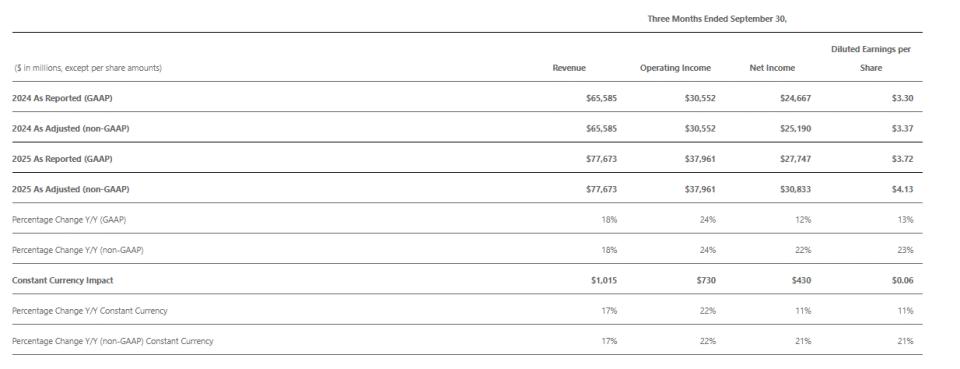
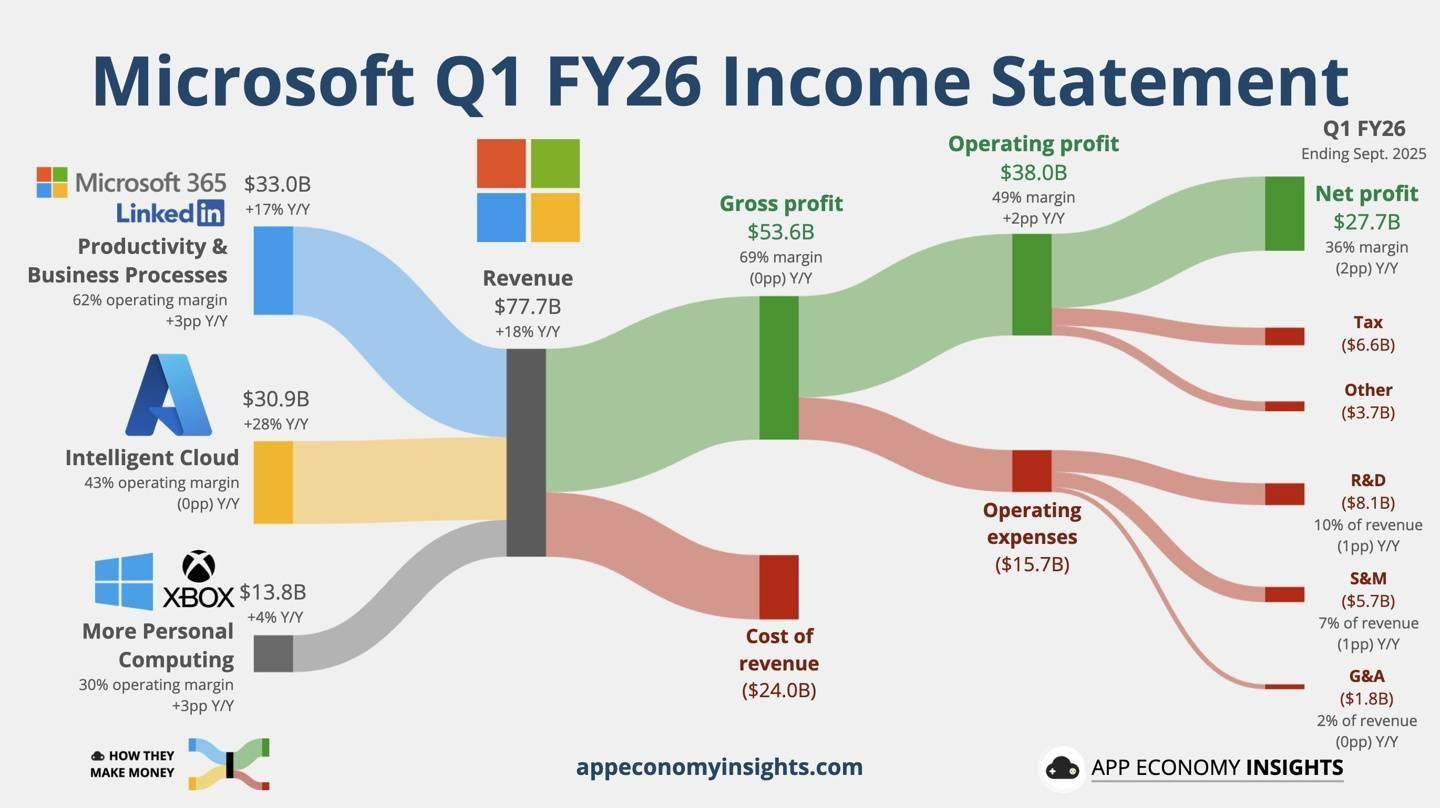
Core Viewpoint - Microsoft reported strong financial results for Q1 FY2026, with significant year-over-year growth in revenue and net income, despite concerns over increased capital expenditures impacting stock performance [1][2]. Financial Performance - Total revenue for Q1 was $77.673 billion, an 18% increase year-over-year [1][4]. - Net income reached $27.747 billion, up 12% year-over-year, with a non-GAAP net income of $30.833 billion, reflecting a 22% increase [1][3]. - Diluted earnings per share were $3.72, a 13% increase year-over-year, with a non-GAAP EPS of $4.13, up 23% [1][3]. Segment Revenue Breakdown - Revenue from the Productivity and Business Processes segment was $33.020 billion, a 17% increase year-over-year [5][6]. - Intelligent Cloud segment revenue was $30.897 billion, growing 28% year-over-year [7]. - More Personal Computing segment revenue was $13.756 billion, a 4% increase year-over-year [5][7]. Cost and Expenditure - Total cost of revenue for Q1 was $24.043 billion, up from $20.099 billion year-over-year [8]. - Research and development expenses were $8.146 billion, compared to $7.544 billion in the previous year [8]. - Capital expenditures increased by 74% year-over-year, with significant investments in AI infrastructure and high-performance chips [12]. Future Outlook - Microsoft expects Q2 revenue to be between $79.5 billion and $80.6 billion, representing a year-over-year growth of 14% to 16% [9][10]. - The company plans to continue increasing investments in AI and cloud services, with a focus on meeting strong market demand [11][12]. Strategic Partnerships - Microsoft has deepened its partnership with OpenAI, securing technology agreements and committing to significant resource procurement [13]. - The restructuring of OpenAI's ownership has positioned Microsoft to benefit from ongoing advancements in AI technology [13].

微软投资OpenAI已获10倍回报,微软押注AI资本支出超预期
Di Yi Cai Jing· 2025-10-30 03:10
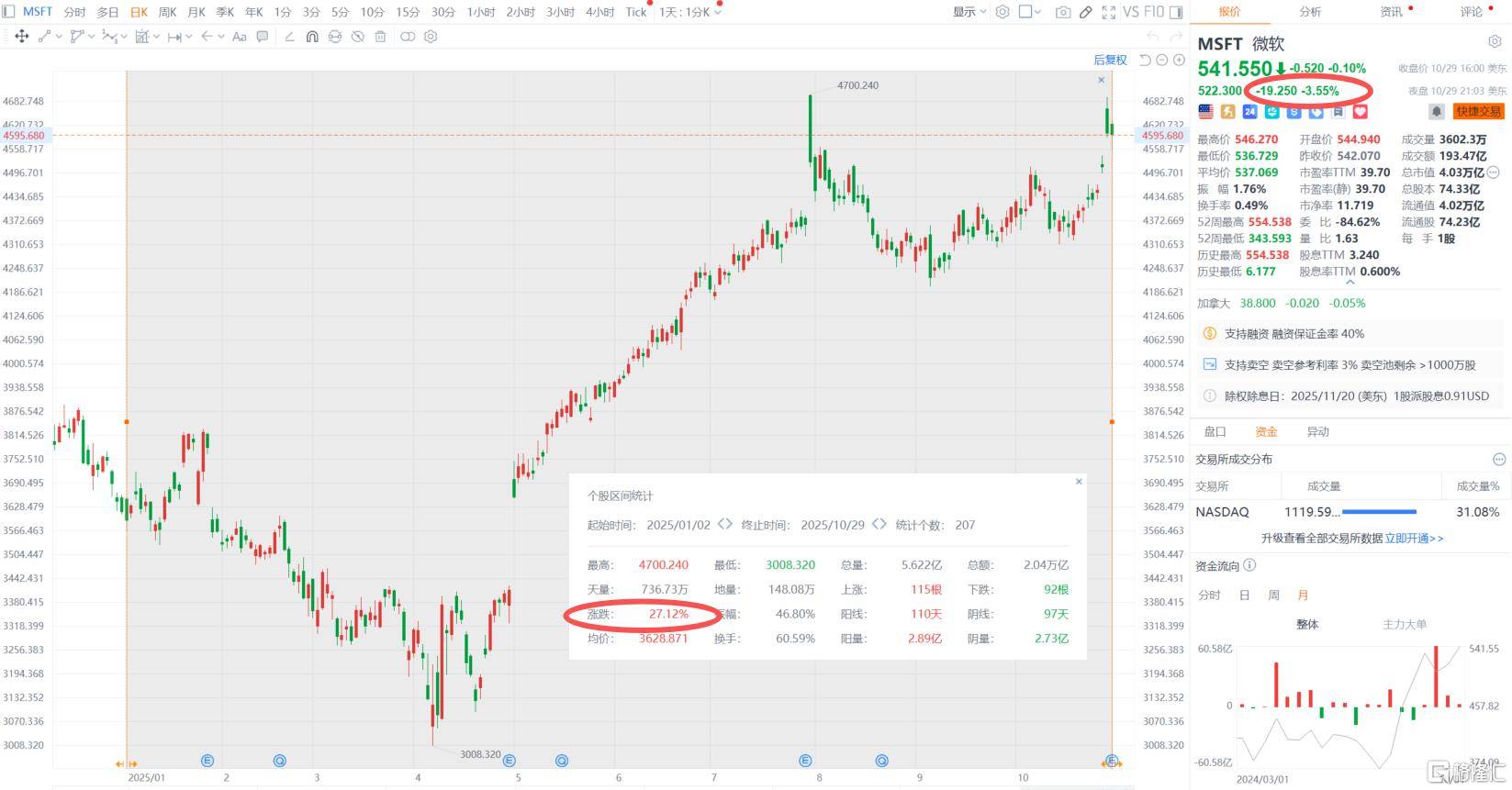
Core Insights - Microsoft reported a significant increase in revenue and net profit for Q1 of FY2026, with revenue reaching $77.7 billion, an 18% year-over-year growth, and net profit at $27.7 billion, a 12% increase [1][1][1] - Despite the positive financial results, Microsoft's stock price fell nearly 4% in after-hours trading [1] - The company's capital expenditures hit a record $34.9 billion, exceeding the previously anticipated $30 billion for the quarter [1][1][1] - Microsoft disclosed a $3.1 billion reduction in net profit due to losses from its investment in OpenAI [1][1][1] - A new partnership agreement with OpenAI was announced, which includes a commitment from OpenAI to purchase $250 billion worth of Azure services [1][1][1] - Microsoft's investment in OpenAI has reportedly yielded approximately 10 times the return [1][1][1]
微软CEO纳德拉:收购动视暴雪后,微软成了全球营收最高游戏发行商
Huan Qiu Wang· 2025-10-30 03:10
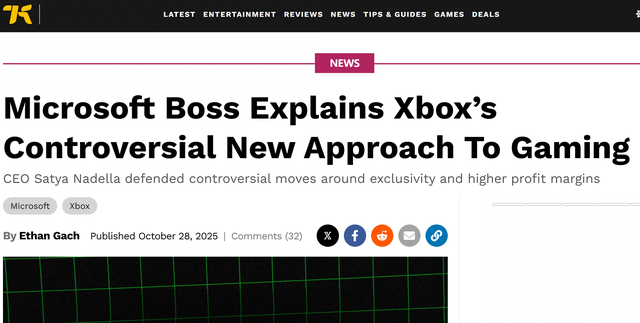
Core Insights - Microsoft CEO Satya Nadella stated that after acquiring Activision Blizzard, the company has become one of the highest-grossing game publishers globally, aiming to make gaming ubiquitous across various platforms [1][3] - The core foundation of Microsoft's gaming business is based on the Windows platform, which has enabled the success of other platforms like Steam, and the company plans to break down platform barriers to allow gaming across consoles, PCs, mobile devices, and cloud gaming [1] Industry Competition - Nadella highlighted that Microsoft's main competitors in the entertainment sector are not traditional gaming companies but platforms like TikTok, emphasizing that the essence of competition in the entertainment industry is the battle for user attention [3] - The company must continuously innovate its business model and explore new interactive media forms to seize industry development opportunities [3] Profitability and Innovation - Nadella stressed the importance of maintaining good profit margins to drive innovation in the gaming industry, stating that without continuous innovation, the industry could face significant challenges [3] - This perspective has sparked discussions among players, particularly regarding the contrast between the company's layoffs in the gaming division and Nadella's 22% salary increase to $96.5 million [3]
微软2026财年第1财季游戏业务亮红灯,Xbox硬件销售收入暴跌 29%
Sou Hu Cai Jing· 2025-10-30 03:09
Core Insights - The content and services segment, centered around Game Pass, showed resilience with a 1% year-over-year revenue growth, indicating that despite poor hardware sales, Microsoft maintained some revenue growth through subscription services and digital content sales [1] - Overall, the gaming division's revenue declined by 2% due to the struggling Xbox hardware business, resulting in a loss of $113 million (approximately 803 million RMB) [1] - Microsoft is actively adjusting its gaming business model by reducing reliance on first-party hardware and supporting OEM manufacturers like ASUS with handheld devices, while promoting a cross-platform publishing strategy to reach a broader player base [1] - This shift from a closed hardware ecosystem to an open content service model is a core initiative for Microsoft to respond to current market changes, with long-term effects yet to be observed [1]
AI烧钱太猛!“AI基建霸主”疯狂加码,微软投资OpenAI已赚10倍
Sou Hu Cai Jing· 2025-10-30 03:00
Core Viewpoint - The earnings season for major U.S. tech companies, including Microsoft, Meta, and Google, has reached its peak, with Microsoft reporting strong revenue and net profit growth, but facing concerns over Azure's growth and high AI-related expenses [1][2][3]. Financial Performance - Microsoft reported Q1 revenue of $77.7 billion, an 18% increase year-over-year, exceeding market expectations of $75.6 billion [8]. - Diluted earnings per share (EPS) were $3.72, up approximately 13% year-over-year, also surpassing the expected $3.68 [8]. - The company's total capital expenditures surged to nearly $35 billion, a 74.5% increase year-over-year, significantly exceeding Wall Street's forecast of $30.06 billion [16]. Business Segments - Microsoft's commercial cloud revenue, which includes Office and Azure, reached $49.1 billion, a year-over-year increase of about 26%, above the expected $48.6 billion [11]. - The intelligent cloud segment, including Azure, generated $30.9 billion, growing approximately 28% year-over-year, surpassing the anticipated $30.2 billion [12]. - Azure's revenue grew by 39%, matching the growth rate of the previous quarter and exceeding the general market expectation of 37% [13]. - The productivity and business processes segment, which includes Microsoft 365 Copilot AI tools, reported $33.02 billion in revenue, a 17% year-over-year increase, above the expected $32.29 billion [14]. AI Investments - Microsoft is heavily investing in AI, with significant capital expenditures directed towards AI infrastructure, including GPU and CPU procurement to support Azure's growing demand [17]. - The company has committed a total of $13 billion to OpenAI, with $11.6 billion already funded, and the investment is currently valued at approximately $135 billion [19][20]. - Recent agreements with OpenAI, including a $250 billion commitment for Azure services, are expected to enhance Azure's growth prospects significantly [21].
微软投资OpenAI已获10倍回报
Di Yi Cai Jing· 2025-10-30 02:54
Core Insights - Microsoft reported a market capitalization of $4 trillion and released its Q1 FY2026 earnings, showing revenue growth of 18% to $77.7 billion and net profit growth of 12% to $27.7 billion, yet the stock price fell nearly 4% in after-hours trading [2][3] Financial Performance - Q1 FY2026 revenue was $77.7 billion, a year-over-year increase of 18% [2] - Net profit for the quarter reached $27.7 billion, up 12% from the previous year [2] - The gross margin for the quarter was 69%, reflecting a decline attributed to investments in artificial intelligence [3] Capital Expenditure - Capital expenditures hit a record $34.9 billion, exceeding the previous forecast of over $30 billion [2] - Approximately half of the capital expenditure was allocated to short-term assets, primarily for GPU and CPU procurement to support Azure platform demand and AI solutions [2] - The remaining expenditure focused on long-term assets, including $11.1 billion in financing leases for large data centers [2] Business Segments - The Intelligent Cloud segment generated $30.9 billion in revenue, a 28% increase year-over-year, with Azure and other cloud services revenue growing by 40% [3] - The More Personal Computing segment reported $13.8 billion in revenue, a 4% increase, with Windows OEM and device revenue rising by 6% [3] - The Productivity and Business Processes segment achieved $33 billion in revenue, up 17%, with LinkedIn revenue increasing by 10% [4] Investments and Partnerships - Microsoft disclosed a $3.1 billion loss in net profit due to investments in OpenAI during Q1 FY2026 [4] - A new partnership agreement with OpenAI was announced, including a $250 billion purchase of Azure services, with Microsoft claiming a return of approximately 10 times on its investment in OpenAI [4] Workforce Changes - Microsoft has implemented multiple rounds of layoffs this year, including 6,000 employees in May and 9,000 in July, totaling nearly 4% of its workforce [4] Legal Issues - Microsoft is facing a lawsuit from the Australian Competition and Consumer Commission (ACCC) for allegedly misleading 2.7 million customers regarding the bundling of Microsoft 365 software with AI tool Copilot, which the ACCC claims violates Australian consumer law [5]

微软电话会:订单激增,Azure供不应求,数据中心紧张预计持续到2026年
Hua Er Jie Jian Wen· 2025-10-30 02:35
Core Insights - Microsoft achieved double-digit revenue and profit growth in Q1 FY2026, but Azure's capacity constraints are becoming a key growth limitation [1][2] - Azure and other cloud services revenue grew by 39%, matching the highest growth rate in two and a half years, but still fell short of some optimistic buyer expectations [1][2] - The company plans to double its data center footprint in the next two years to alleviate capacity pressure [2][3] Financial Performance - Q1 revenue reached $77.7 billion, with an 18% year-over-year growth [21] - Gross margin was 69%, slightly down year-over-year due to increased AI infrastructure investments [21] - Operating income grew by 24% year-over-year, with an operating margin of 49% [21] Capital Expenditure - Capital expenditures reached $34.9 billion, a 74% increase year-over-year, with about half allocated for short-term assets like GPUs and CPUs [4][22] - The company is investing heavily to meet unprecedented demand, particularly in AI and cloud services [4][22] Azure and Cloud Services - Azure's revenue exceeded $49 billion, growing 26% year-over-year, with a significant increase in remaining performance obligations (RPO) by over 50% to nearly $400 billion [3][24] - Azure AI customer count reached 80,000, including 80% of Fortune 500 companies [3][11] - Despite strong demand, Azure's capacity constraints are impacting revenue, particularly for high-priority services like Microsoft 365 Copilot [5][24] Strategic Partnerships - Microsoft signed a new agreement with OpenAI, valued at $250 billion, enhancing its strategic position in AI [3][7] - The partnership is expected to provide more certainty regarding intellectual property rights and further solidify Microsoft's market position [7][9] Market Dynamics and Risks - Concerns about an "AI bubble" and investment risks have emerged among investors, but Microsoft emphasizes the strong demand reflected in its RPO [6][34] - The company is focused on sustainable, balanced long-term growth rather than short-term expansion [6][34] Future Outlook - Microsoft anticipates that data center constraints will persist until 2026, but is actively working to expand capacity and optimize existing data centers [2][3] - The company expects continued strong growth in cloud and AI products, with Azure revenue projected to grow approximately 37% [27]
微软将继续增加在人工智能方面投资,科创板人工智能ETF(588930)昨日“吸金”近千万元
2 1 Shi Ji Jing Ji Bao Dao· 2025-10-30 01:58
Core Viewpoint - The article highlights the performance of the AI-focused ETF on the STAR Market, emphasizing its potential growth driven by increasing investments in artificial intelligence and supportive policies in China [1]. Group 1: ETF Performance - The STAR Market AI ETF (588930) opened lower on October 30, with a decline of 0.73% and a premium trading rate of 0.07, while experiencing a net inflow of over 9.8 million yuan the previous day [1]. - Among the ETF's constituent stocks, Foxit Software rose over 6%, with notable gains from Daotong Technology, Lanke Technology, and Optics Valley [1]. Group 2: Market Trends and Insights - The STAR Market AI ETF closely tracks the Shanghai Stock Exchange STAR Market AI Index (950180.CSI), which selects 30 large-cap companies involved in providing foundational resources, technology, and application support for AI [1]. - Microsoft’s CEO announced plans to continue increasing investments in AI, both in capital and talent, to seize significant opportunities ahead [1]. - Haitong International noted that AI is a crucial driver of the new technological revolution and industrial transformation, benefiting from ongoing technological advancements and policy support [1]. - Huaxi Securities pointed out that with the increasing domestic AI policies and global macroeconomic fluctuations, AI has become one of the most certain investment directions, with leading tech companies continuously enhancing their computing power investments [1].
全文|微软Q1业绩会实录:对与OpenAI的合作充满信心
Xin Lang Ke Ji· 2025-10-30 01:28
Core Insights - Microsoft reported Q1 FY2026 revenue of $77.673 billion, an 18% increase year-over-year, and net profit of $27.747 billion, a 12% increase year-over-year [1] - The company has seen a significant growth in commercial bookings, with a 111% increase, indicating strong demand for its services [2] - Despite strong financial performance, Microsoft's stock has underperformed compared to the market, raising concerns about potential risks related to artificial general intelligence (AGI) and competition [2][3] Financial Performance - Q1 FY2026 revenue reached $77.673 billion, up from $65.585 billion in the same quarter last year, reflecting an 18% growth [1] - Net profit for the quarter was $27.747 billion, compared to $24.667 billion a year earlier, marking a 12% increase [1] - The remaining performance obligations (RPO) balance is nearing $400 billion, with a weighted average duration of 2 years, indicating a robust pipeline of future revenue [5][6] AI and Technology Strategy - Microsoft emphasizes the need for a comprehensive system to address the uneven performance of AI models, highlighting products like GitHub Agent HQ and Microsoft 365 Copilot [3][4] - The company is optimistic about the long-term potential of AI, despite acknowledging that AGI is not achievable in the short term [4] - Microsoft is focusing on building a flexible and scalable computing infrastructure to support various AI applications and services [10][11] Market Position and Competitive Landscape - Microsoft is strategically balancing its third-party and first-party business models to mitigate risks associated with customer concentration [13][14] - The company is committed to investing in high-value AI systems and ensuring that its infrastructure can support diverse customer needs [11][15] - Microsoft is cautious about taking on contracts that do not align with its long-term strategic goals, ensuring that it maintains a balanced portfolio [17][18] Operational Challenges - Azure's revenue has been impacted by a shortage of computing power, which has prioritized resource allocation to core business areas like M365 Copilot and security features [16] - The company is actively expanding its infrastructure to meet the growing demand for computing resources, particularly in AI and cloud services [8][9] - Microsoft is focused on modernizing its computing clusters and ensuring that its investments align with customer contract timelines [10][12]