
CITIC Securities Co., Ltd.(06030)

Search documents
中信证券(06030) - 董事会会议通知
2026-03-11 09:18
中信証券股份有限公司(「本公司」)董事會(「董事會」)謹此公佈,董事會會議將於2026年 3月26日(星期四)舉行,藉以(其中包括)考慮及批准本公司及其附屬公司截至2025年12 月31日止年度之經審計業績及派發末期股息之建議。 承董事會命 中信証券股份有限公司 董事長 張佑君 中國北京 2026年3月11日 於本公告刊發日期,本公司執行董事為張佑君先生、鄒迎光先生及張長義先生;本公司非執行董事為李艺女士、 梁丹先生、張學軍先生、付臨芳女士及趙先信先生;本公司獨立非執行董事為李青先生、史青春先生、張健華先 生、劉俏先生及李蘭冰女士;及本公司職工董事為施亮先生。 香港交易及結算所有限公司及香港聯合交易所有限公司對本公告的內容概不負責,對其準確性或完整性亦不發表 任何聲明,並明確表示,概不對因本公告全部或任何部份內容而產生或因倚賴該等內容而引致的任何損失承擔任 何責任。 6030 董事會會議通知 ...
康希诺跌2.34% 2020年上市募52亿元中信证券保荐
Zhong Guo Jing Ji Wang· 2026-03-11 08:15
Group 1 - The stock price of CanSino (688185.SH) has dropped to 70.85 yuan, reflecting a decline of 2.34% and currently in a state of underperformance [1] - CanSino was listed on the Shanghai Stock Exchange's STAR Market on August 13, 2020, with an issuance of 24.8 million shares at a price of 209.71 yuan per share [1] - The total funds raised from the initial public offering (IPO) amounted to 5.201 billion yuan, with a net amount of 4.979 billion yuan after deducting issuance costs, exceeding the original plan by 3.979 billion yuan [1] Group 2 - The planned use of the raised funds includes 1 billion yuan for the construction of the second phase of the production base, vaccine development, cold chain logistics system, and working capital [1] - The issuance costs for the IPO were 221 million yuan, with underwriting and sponsorship fees accounting for 205 million yuan [2] - CITIC Securities, as the lead underwriter, received an allocation of 496,000 shares, representing 2% of the total shares issued, with an investment amount of 104 million yuan [2]

中信证券:重大项目建设和算电协同新形态并进 建议关注核心设备企业
Zhi Tong Cai Jing· 2026-03-11 03:57
Core Viewpoint - The report from CITIC Securities highlights the government's focus on accelerating green transformation and establishing a new power system, indicating a clearer long-term development outlook for major UHV projects [1][2]. Group 1: Green Transformation and Power System Development - The government work report emphasizes the acceleration of comprehensive green transformation, including the formulation of an energy powerhouse construction plan, the establishment of a new power system, and the promotion of smart grid construction [2]. - Key areas of focus include the construction of a clean and low-carbon power system, with smart grid development and green electricity applications being highlighted as priorities [2]. Group 2: Intelligent Economy and Collaborative Development - The government report outlines plans for large-scale intelligent computing clusters and collaborative development of computing and electricity, which are included in the top-level design [3]. - This collaborative approach emphasizes the integration of network and source planning, direct green electricity applications, and the digitalization of the power grid [3]. Group 3: UHV Projects and Development Expectations - A series of major UHV projects are expected to be included in national planning, with recent proposals for projects in various regions such as Shanxi, Xinjiang, and Tibet [4]. - The report suggests that significant project progress is often catalyzed during major policy windows like the Two Sessions, indicating that UHV projects will remain a core aspect of energy and power construction during the 14th Five-Year Plan [4]. Group 4: Investment Strategy - The Two Sessions provide a critical window for the power equipment sector, outlining long-term planning and development trends for the next five years [5]. - The dual carbon goals and the construction of a new power system are expected to be central themes, with a focus on major UHV projects and the exploration of new business models related to computing and electricity [5].
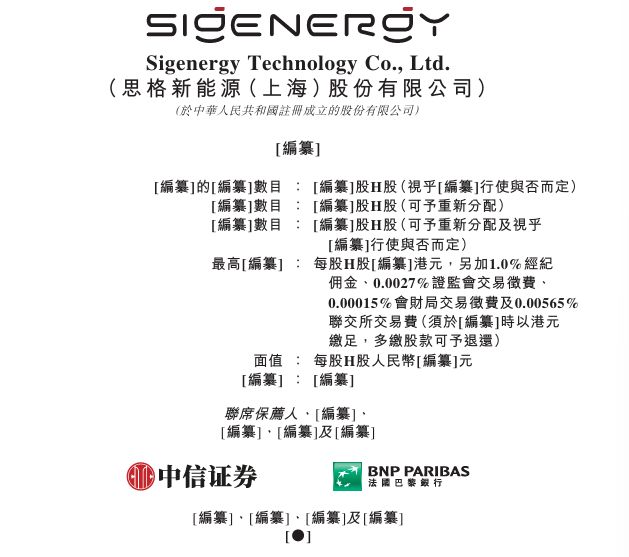
思格新能源,递交IPO招股书,拟赴香港上市,中信证券、法巴联席保荐
Xin Lang Cai Jing· 2026-03-11 03:27
Core Viewpoint - Sigenergy Technology Co., Ltd. (Sigenergy), a leading provider of distributed energy storage solutions, has submitted its prospectus for an IPO on the Hong Kong Stock Exchange after two previous applications were invalidated. The company aims to leverage its innovative products and extensive distribution network to capture market share in the renewable energy sector [4][5]. Company Overview - Sigenergy was founded in May 2022 by Xu Yingtong, the former president of Huawei's smart photovoltaic business, and has quickly established itself as a global leader in the distributed energy storage system (DESS) market [6]. - The company offers integrated energy solutions that combine AI and advanced software technologies for solar power generation, energy storage, and charging [6]. Market Position - According to a Frost & Sullivan report, Sigenergy became the world's largest provider of stackable distributed solar-storage integrated solutions by product shipment volume within two years of its establishment, achieving a market share of 28.6% in 2024 [6]. - The flagship product, SigenStor, is the first five-in-one solar-storage-charging integrated machine in the industry, contributing over 90% of the company's total revenue during the reporting period [6][7]. Product and Sales Performance - As of September 30, 2025, Sigenergy had established a broad distribution network with 161 distributors across over 80 countries and regions, becoming a preferred partner for leading distributors in major markets [7]. - The total energy capacity sales of SigenStor reached 2,355 MWh in the first nine months of 2025 [7]. Financial Performance - The company's revenue for the years 2022, 2023, 2024, and the first nine months of 2025 were RMB 0, 0.58 billion, 1.33 billion, and 5.64 billion, respectively, with corresponding net profits of RMB -0.76 billion, -3.73 billion, 0.84 billion, and 1.89 billion [16][17]. Shareholder Structure - Xu Yingtong holds a 10.18% stake in Sigenergy, with various entities controlled by him collectively holding approximately 49.28% of the voting rights [9][11]. Management Team - The board of directors consists of 8 members, including Xu Yingtong as Chairman and CEO, and Zhang Xianmiao as President, both of whom have extensive experience in the renewable energy sector [13][14].

中信证券研究:电新|高层密集发声,绿色燃料量价迎利好
Xin Lang Cai Jing· 2026-03-11 01:55
Core Viewpoint - The Chinese government is intensifying its efforts to develop green fuels and hydrogen energy, establishing a national low-carbon transition fund to support these sectors as new economic growth points, while also enhancing the certainty of scale expansion in the green fuel industry through policy and financial support [1][3][9]. Group 1: Government Initiatives - The Ministry of Industry and Information Technology (MIIT) and the National Energy Administration (NEA) are actively promoting breakthroughs in hydrogen energy and green fuel sectors, emphasizing their strategic importance for national energy security and independence [2][8]. - The establishment of the national low-carbon transition fund aims to support the development of the green fuel industry, facilitating a comprehensive green energy transition [3][9]. Group 2: Financial Support and Market Dynamics - The low-carbon transition fund will provide industry-specific financial support and cost subsidies, addressing bottlenecks in development and aiding in key technology breakthroughs [3][9]. - The fund is expected to play a crucial role in accelerating the commercialization of green fuels by lowering the barriers to industrialization and enhancing acceptance in downstream applications [3][9]. Group 3: Market Trends and Comparisons - The development of green fuels can be compared to the trends in electrochemical energy storage, as both serve similar functions and are expected to experience growth driven by external demand followed by domestic policy support [4][10]. - The initial market demand for green fuels is anticipated to be driven by international decarbonization policies, with domestic demand expected to grow significantly as relevant policies are implemented [4][10]. Group 4: Investment Strategies - The cost of green electricity is a critical variable in the economic viability of green hydrogen and ammonia production, with wind power being identified as the most cost-effective source [6][11]. - Companies with strong wind power capabilities and favorable wind resource endowments are likely to benefit significantly from the industry's growth, as the transition of wind power companies to green fuel operators is seen as a high-certainty trend [6][11].

中信证券研究:海外宏观|HALO会是持续主线吗?
Xin Lang Cai Jing· 2026-03-11 01:49
Core Viewpoint - The narrative around AI has shifted from "AI Bubble" to "AI Disruption" and "HALO," indicating a transition from systemic bubble pricing to structural differentiation pricing in the market [1][2]. Group 1: Market Transition - The core logic of the initial phase of AI narrative was driven by computing power expansion and AI capital expenditure, characterized by a highly concentrated structure dominated by Mega Cap companies in the US [3][8]. - As of 2026, the market is reassessing which entities will benefit from resource bottlenecks, which will face substitution risks, and which possess survival certainty, leading to a differentiation into Winners, Survivors, and Losers [3][8]. Group 2: Winners, Survivors, and Losers - Within the US market, before the outbreak of the US-Iran conflict in 2026, sectors such as AI infrastructure, energy, and semiconductor equipment are expected to strengthen, becoming Winners; while software assets with high substitution risks are under pressure, becoming Losers [3][8]. - On a country level, driven by a surge in demand for storage chips, the South Korean stock market is expected to outperform other major markets, becoming a Winner; the European market is viewed as a phase Survivor (HALO) due to its industry structure; while the Indian market, characterized by labor-intensive services and outsourcing, has recently lagged, becoming a phase Loser [3][8]. Group 3: HALO Concept - HALO represents a one-time survival premium revaluation for low substitution risk assets, emerging after Losers have been priced in; it is not equivalent to structural winners [4][9]. - The HALO trade is seen as a reflection of phase-style rotation rather than a new long-term growth paradigm; true assets with sustained excess return potential should be closely tied to key nodes in the AI expansion path and resource bottlenecks or technological upgrades [4][9].

中信证券:关注霍尔木兹海峡通行的边际变化
Sou Hu Cai Jing· 2026-03-11 00:58
Core Viewpoint - The blockage of the Strait of Hormuz is reshaping the energy supply chain, leading to increased shipping distances and potential high freight rates due to geopolitical tensions [1][2][5]. Group 1: Energy Supply Chain Impact - The Strait of Hormuz accounts for approximately 35.9% of global crude oil maritime transport, with Saudi Arabia, Iraq, and the UAE being the top three exporters [2]. - The shipping distance from Yanbu Port to Qingdao Port has increased by about 18%, and when considering the output capacity of Yanbu and Fujairah ports, the demand gap is expected to widen shipping distances by over 30% [2][3]. - The anticipated arrival of around 10 oil tankers at Yanbu Port is expected to alleviate concerns of "price without market," potentially benefiting from risk premiums associated with geopolitical conflicts [1][2]. Group 2: Freight Rate Dynamics - Short-term strategies include releasing strategic reserves and adjusting supply chains to mitigate the geopolitical impacts of the US-Iran conflict, while partial restoration of the Strait's passage capacity remains crucial [2][3]. - If the Strait of Hormuz is reopened, Asian countries are likely to engage in compensatory crude oil procurement, which could lead to increased freight rates if vessel utilization is limited [3][5]. - The concentration of VLCC (Very Large Crude Carrier) capacity is historically high, and the pricing mechanism for freight rates is being restructured, enhancing shipowners' bargaining power [3][4]. Group 3: Industry Outlook - Sinokor has expanded its VLCC capacity significantly, controlling nearly a quarter of the global VLCC fleet, which has led to a more consolidated market structure and improved pricing power [4]. - The oil shipping cycle is expected to benefit from the ongoing geopolitical tensions, with projections indicating that leading oil shipping companies may achieve record profits by 2026 [5]. - The changing freight rate formation mechanism is expected to diminish seasonal characteristics, with companies like China Merchants Energy and COSCO Shipping Energy projected to exceed profits in Q1 2026 compared to Q4 2025 [5].
中信证券:高层密集发声,绿色燃料量价迎利好
Sou Hu Cai Jing· 2026-03-11 00:58
Core Viewpoint - The Chinese government is intensifying its efforts to develop green fuels and hydrogen energy, establishing a national low-carbon transition fund to support these industries as new economic growth points, while also implementing dual control over carbon emissions to facilitate funding for low-carbon transitions [1][3]. Group 1: Government Initiatives - The Ministry of Industry and Information Technology (MIIT) and the National Energy Administration (NEA) are actively promoting breakthroughs in hydrogen energy and green fuel sectors, emphasizing their strategic importance for national energy security and independence [2]. - The establishment of the national low-carbon transition fund aims to provide financial support and cost subsidies for the green fuel industry, addressing key bottlenecks in development and facilitating technological advancements [3]. Group 2: Market Dynamics - The green fuel market is expected to follow a similar trajectory to the electrochemical energy storage sector, initially driven by external demand and later supported by domestic policies and market conditions [4]. - The transition to green fuels is anticipated to reduce China's dependence on foreign oil and mitigate risks associated with international energy supply chains, enhancing the share of green electricity in energy consumption [2]. Group 3: Investment Opportunities - Companies with strong wind energy capabilities and high-quality wind resources are likely to benefit significantly from the green fuel industry's growth, as the cost of green electricity is a critical factor in determining the economic viability of green fuels [5]. - The transformation of wind energy companies into green fuel operators is seen as a high-certainty trend, potentially increasing profit margins and opening new valuation opportunities in the market [5].
中国铝业(02600.HK)遭中信证券资产管理有限公司减持1801.4万股
Ge Long Hui· 2026-03-10 13:29
格隆汇3月10日丨根据联交所最新权益披露资料显示,2026年3月6日,中国铝业(02600.HK)遭中信证券资产管理有限公司在场内以每股均价13.6635港元减持 1801.4万股,涉资约2.46亿港元。 减持后,中信证券资产管理有限公司最新持股数目为419,468,000股,持股比例由11.09%下降至10.64%。 | 股份代號: | 02600 | | --- | --- | | 上市法國名稱: | 中國鋁業股份有限公司 - H股 | | 日期 (日 / 月 / 年): | 10/02/2026 - 10/03/2026 | | 表格序號 | 大股東/董事/最高行政人員名 作出披露的 買入 / 賣出或涉及的 每股的平均價 | | | | 持有權益的股份數目 佔已發行的有關事件的日 相關法 | | --- | --- | --- | --- | --- | --- | | | 股份數目 | 原因 | | | 請參閱上述*註 有投票權股期(日/月/ 份權益 | | | | | | | 份自分比 细 | | CS20260310E00067 | 中信证券资产管理有限公司 | 1201(L) | 18.014. ...

中信证券资产管理有限公司减持中国铝业1801.4万股 每股作价约13.66港元

Zhi Tong Cai Jing· 2026-03-10 11:09
Group 1 - CITIC Securities Asset Management Company reduced its stake in China Aluminum (601600) (02600) by 18.014 million shares at a price of HKD 13.6635 per share, totaling approximately HKD 246 million [1] - After the reduction, CITIC Securities holds approximately 419 million shares, representing a holding percentage of 10.64% [1]